Cold Injury Residuals Claims Guide
This guide explains how to file a cold injury claim and how the VA evaluates it: how service connection works, how cold injury residuals get connected to your service (directly, through a diagnosis that surfaces years later, or secondary to another condition), what evidence you need, why these claims get denied, a checklist before you file, what the claims process looks like step by step, how to read your decision letter, and what to do whether you win or you're denied. Cold injury, frostbite and the lasting damage from severe cold exposure, is one of the most under-claimed conditions among veterans who served in Korea, Alaska, mountain units, and cold-weather guard duty. The rating has one rule that changes everything: each affected body part is rated on its own. You will also learn how cold injury residuals are rated under 38 CFR § 4.104, Diagnostic Code 7122, including the criteria for the 10, 20, and 30 percent levels per affected part.
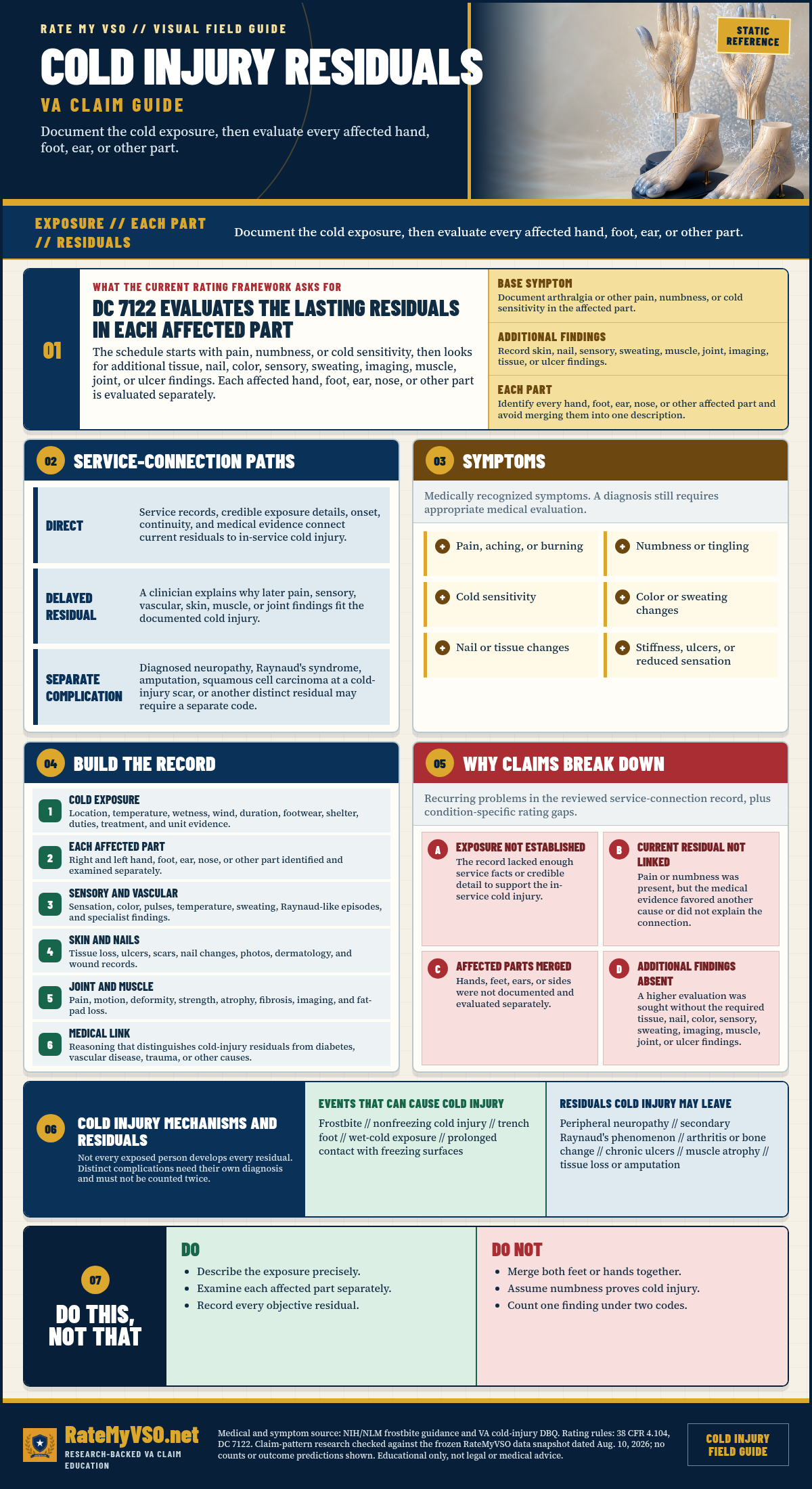 One-page guide: Cold Injury Residuals Claims in One Page
Cold-injury guide covering DC 7122, exposure evidence, separate evaluation of each affected part, symptoms and objective residuals, distinct complications, and common claim gaps. Opens the full-size chart, free to save or print.
One-page guide: Cold Injury Residuals Claims in One Page
Cold-injury guide covering DC 7122, exposure evidence, separate evaluation of each affected part, symptoms and objective residuals, distinct complications, and common claim gaps. Opens the full-size chart, free to save or print.
Start with the essentials
- 01Service Connection
The ways service connection can be established for this condition.
- 02Diagnosis and Evidence
Common symptoms and the evidence cited in published Board appeals.
- 03Your History
What you experienced, what others observed, and what treatment changed.
Understand the claim
Types of Cold Injury
Frostbite is actual tissue freezing, ice crystals forming in skin and deeper tissue after prolonged exposure to freezing temperatures. It is the most severe acute cold injury and the one most likely to leave permanent nerve and circulation damage.
Immersion foot / trench foot results from prolonged exposure to wet cold above freezing, commonly from standing in cold water or wet boots for extended periods. It damages the same small blood vessels and nerves as frostbite without the tissue actually freezing.
Chilblains (pernio) are a milder, repeated cold-exposure injury, itching, red or purple patches on the skin, usually on the hands, feet, ears, or nose, from repeated exposure to cold, damp air without freezing.
All three are evaluated under the same diagnostic code, DC 7122, once residual symptoms are present. A diagnosis identifying which type of cold injury occurred is useful context, but the rating turns on the residual symptoms and findings present today, not on which label was used in service.
ICD-10 Diagnosis Codes
The ICD-10 diagnosis codes most commonly used for DC 7122, Cold injury residuals (the kind on your medical records, decision letter, or C&P exam report). VA rates the disability and its residuals, not the diagnosis itself, so coding can vary.
How Service Connection Works, At a High Level
Before getting into the specific pathways below, it helps to understand the three things every cold injury claim ultimately has to show. This is the same basic test that applies to any VA disability claim, just applied to this condition.
- A current diagnosis. A doctor must identify a current cold injury or frostbite residual, or lasting symptoms such as numbness, cold sensitivity, pain, or discolored skin. This is the single most important element, and the most common reason these claims are denied.
- An in-service cold exposure or injury. Proof you were exposed to cold, or were treated for frostbite, during service. VA often concedes this on its own by making a favorable finding, for example based on winter service in Korea, Alaska, or Germany.
- A medical link (nexus). Evidence connecting your current problem to the in-service cold exposure. For observable frostbite residuals like numbness, your own credible account of symptoms since service can be enough; for more complex conditions, a doctor's opinion is usually needed.
How It Gets Service Connected
Cold injury is not a VA presumptive condition. Service connection must be established through one of the following pathways.
Direct, from cold-weather service
Service in a cold climate or mission, Korea, Alaska, Europe in winter, mountain and airborne training, extended guard or field duty in the cold, with current cold-injury symptoms and a medical link back to that exposure. VA often concedes the cold exposure itself on its own, by making a favorable finding based on documented winter service, which the Board is then bound by. See our Service Connection Guide.
Latent residuals, even without an in-service diagnosis
Even without an in-service "frostbite" diagnosis, the residuals can still be service-connected if the cold exposure is established, through unit history, duty location, or buddy statements, and a doctor connects the current symptoms to it. Missing service records do not doom the claim; when records were lost, the Board owes the veteran a heightened duty to consider the benefit of the doubt. If the helpful and harmful evidence are roughly equal, the veteran wins.
For observable frostbite residuals you can describe yourself, like numbness, tingling, and cold sensitivity, your own credible account of symptoms starting in service and continuing since can serve as the medical link on its own. Consistent statements about when symptoms began, and that they have continued, matter here.
Secondary (38 CFR § 3.310)
Conditions that grow out of the cold injury, such as arthritis, peripheral nerve damage, or skin changes in the affected part, can themselves be service-connected as secondary to the cold injury. See our Secondary Conditions Guide.
Across published DC 7122 decisions, here is how often the Board granted by the legal theory the claim was argued on:
What VA Looks For: Tests, Records, and Diagnostic Codes
Records to gather for a direct or secondary claim:
- A current diagnosis in your medical records: a doctor naming a cold injury or frostbite residual, or the specific symptoms (numbness, cold sensitivity, pain, discolored skin).
- Proof of the in-service cold exposure: duty location and dates, unit and mission history, winter field or guard duty, and buddy statements, especially useful when there is no in-service frostbite diagnosis on record.
- X-rays and exam findings: imaging showing arthritis or bone abnormalities in the affected part, along with exam notes on nail changes, color changes, or impaired sensation, all of which move the rating above the baseline level.
- The diagnostic codes involved: DC 7122 for the cold injury residual itself, plus whatever code applies to a related complication you're separately claiming, for example peripheral neuropathy, Raynaud's phenomenon, arthritis, skin changes, or an amputation code.
- The actual form the examiner fills out: the Cold Injury Residuals Disability Benefits Questionnaire (DBQ), discussed in more detail later in this guide.
What Cold Injury Residuals Are
Cold injury residuals are the long-term effects of frostbite or serious cold exposure: pain, numbness, tingling, extreme cold sensitivity, color changes, nail and skin changes, and sometimes tissue loss in the hands, feet, ears, or nose. The VA rates them under diagnostic code 7122, in the cardiovascular schedule because cold injury damages circulation and nerves (see 38 CFR § 4.104).
Reviewing how the Board of Veterans' Appeals has actually decided these claims shows a consistent pattern: a current diagnosis is the single most common reason these claims are denied, exposure to cold in service is frequently conceded by VA on its own, and veterans are allowed to describe observable symptoms like numbness and cold sensitivity themselves without needing a doctor to translate every detail.
Symptoms and rating
Symptoms Recorded in Granted Cold injury residuals Decisions
We analyzed 530 granted Board decisions involving cold injury residuals for symptoms named in sentences about the condition (rating-criteria recitations excluded). Descriptive of the published record, what the Board wrote down, not a checklist of what to report.
Bar length shows decisions. Percentages remain context.
Detected by phrase-reading the decision text with condition-specific vocabularies. Source: Board of Veterans' Appeals decisions, RateMyVSO analysis.
How the VA Rates Cold Injury (DC 7122)
Cold injury residuals are rated under DC 7122, 38 CFR § 4.104.
So the first job in a cold-injury claim is to list every part that was affected, each foot, each hand, the ears, the nose, and to have each one examined and rated on its own.
Evidence and Board research
Evidence That Wins
We analyzed the Board's published DC 7122 decisions: a private nexus opinion in the file goes with a much higher grant rate, shown below.
- A current diagnosis in your records. See a doctor and get the cold injury, or its specific residual symptoms, clearly named in your medical records before you file.
- Proof of the cold exposure: duty location and dates, unit and mission history, winter field or guard duty, and buddy statements, especially when there is no in-service frostbite diagnosis.
- An exam of every affected part, listing each foot, hand, ear, or nose separately with its findings, so each gets its own rating.
- X-rays of the affected extremities, which can show the arthritis or bone changes that reach the 20 and 30 percent levels.
- A private nexus opinion that reviews your history and explains its reasoning. An opinion is most persuasive when it discusses your specific facts and gives reasons for the link to service, not just a bare conclusion. See Nexus Letters Guide.
- Photos and buddy statements. Photographs of skin discoloration or lesions, and statements from people who witnessed the cold-weather event or noticed the symptoms afterward, contribute visible, corroborating evidence. See our Buddy & Lay Statements Guide.
- Your own consistent account of symptoms. For observable residuals like numbness and cold sensitivity, a clear and consistent description of when they began and that they have continued since service can itself serve as the medical link.
- The Cold Injury Residuals DBQ, which records the findings, per part, that the rating depends on. See the DBQ Guide.
Evidence Cited in Published Cold injury residuals Decisions
We analyzed 6,659 published Board decisions involving cold injury residuals for condition-specific evidence, counting only case-specific mentions (boilerplate recitations excluded). "Favorable" is the share of decisions citing that evidence where every issue was granted or the outcome was mixed; the baseline across all these decisions is 49.7%. Evidence appearing in a decision does not mean it decided the case. Descriptive of the published record, not a prediction.
Bar length shows decisions citing the evidence.
Detected by phrase-reading the decision text with condition-specific vocabularies. Source: Board of Veterans' Appeals decisions, RateMyVSO analysis.
Board Grants, Dissected
The decisions below show that direct service connection claims for cold injury residuals under DC 7122 often turn on two things: whether the Veteran gave a credible, detailed account of the cold exposure in service, and whether the VA exam report properly considered that account instead of just pointing to a lack of paperwork. Board decisions are not binding precedent, and each case is decided on its own record, but these grants show a consistent pattern in how the Board weighed the evidence.
Frostbite of both feet granted despite VA exam that leaned on missing complaints Citation A26033104 (April 9, 2026), Hearing docket
The record: The Veteran testified at a Board hearing that during a cold-weather training exercise at Fort Dix his fingers and toes turned blue, and that he never made an official complaint because "when you're in basic training, you do what you're told to do." The January 2025 VA examiner diagnosed cold injuries to both feet but gave a negative nexus opinion based on the absence of complaints of frostbite in the record.
Why it won: The Board found the VA opinion had little probative value because it relied on an absence of complaints in the record, citing Fountain v. McDonald. The Board found the Veteran's lay statements about his symptoms and their onset competent and credible because they were corroborated by his service record showing he was stationed at Fort Dix. It resolved doubt in his favor.
Great toe cold injury granted after Board rejected exam based only on missing records Citation A26028932 (March 31, 2026), Evidence Submission docket
The record: The Veteran reported that his feet were submerged in water after rappelling during Army Ranger School and he later suffered frostbite. His military personnel file confirmed he attended Ranger School in 1969. The December 2024 VA examiner gave a negative nexus opinion, stating in capital letters that there were no identifiable STRs so the diagnosis was "less likely related to active duty."
Why it won: The Board found this examination inadequate for rating purposes because it was based entirely on the lack of contemporaneous service records, citing Dalton v. Nicholson and Buchanan v. Nicholson. The Board took notice that Ranger School is conducted in remote areas where medical care is hard to get, found the Veteran's account credible, and found his lay reports of ongoing numbness sufficient to establish nexus.
Right foot frostbite granted using later VA-generated records after inadequate exam Citation A26024857 (March 19, 2026), Direct Review docket
The record: The Veteran's service treatment records confirmed he was treated for frostbite in Germany, but his overseas treatment notes were never located. A February 2025 VA exam found no diagnosed disability, performed limited testing, and did not address the Veteran's reported ongoing pain and swelling. A later November 2025 VA rating decision, generated after a separate claim, positively diagnosed frostbite residuals of both feet and granted service connection for the left foot.
Why it won: The Board found the February 2025 exam inadequate and unreliable, noting missing service records triggered a heightened duty to consider the benefit of the doubt under Cromer v. Nicholson. Rather than remand and delay resolution under Scott v. McDonald, the Board applied the later VA-generated diagnosis and nexus evidence directly to grant the claim.
Frostbite residuals of the forehead, ears, cheeks, nose, lips, torso, arm, and legs granted on private opinion Citation A26023514 (March 16, 2026), Hearing docket
The record: The Veteran, a World War II artilleryman, was already service connected for frostbite of the hands and feet and sought an extension to other body parts. A January 2025 VA exam found "no diagnosis warranted" for the other areas because the examiner said the Veteran denied pain in those areas "at this time." A December 2025 private physician, a former deputy chief of an army emergency department with frostbite treatment experience, examined the Veteran and found "compelling evidence" linking pain, cold sensitivity, and discoloration in these areas to his in-service cold weather injury, supported by submitted photographs of skin lesions.
Why it won: The Board found the VA exam inconclusive because it only reflected symptoms at that specific moment and did not address the photographed lesions. The Board gave the private opinion greater probative weight because it described the Veteran's history and current symptoms and connected them to service.
Right big toe frostbite granted at equipoise despite a same-examiner reversal Citation A26004667 (January 20, 2026), Direct Review docket
The record: STRs documented treatment for frostbite of the right ear lobe (for which service connection was already granted) and separately for right toe pain attributed at the time to a basketball injury. A March 2024 VA examiner initially opined the right big toe frostbite was at least as likely as not due to service, then reversed that opinion on an addendum request, stating the pain was "secondary to basketball injury." A later, different examiner also gave a negative opinion, citing no objective evidence of frostbite during service.
Why it won: The Board found the overall evidence, including the Veteran's competent report of being told in service he had frostbite and his established service connection for frostbite of the same ear during the same cold exposure, placed the record in balance. It applied the benefit of the doubt doctrine and granted the claim.
Why These Claims Get Denied
Beyond the general "no diagnosis" and "no nexus" reasons covered above, a few specific denial patterns show up often enough to call out on their own.
- No current diagnosis, even where cold exposure was conceded. The most common reason these claims are denied. Even when VA conceded the in-service cold exposure, claims still failed without a current diagnosed cold injury disability. Exposure is only one of the three required elements.
- The veteran's own opinion about the cause of a complex condition, without a doctor's opinion behind it. You can describe symptoms yourself, but you are usually not qualified to diagnose the condition or give the medical cause of a complex one. Back up the medical link with a doctor.
- Another likely cause left unaddressed. When another cause fits the facts, such as diabetes, age, or footwear that doesn't match the body part actually frostbitten in service, claims were denied. Address these head on, ideally with an opinion explaining why the cold injury still played a role.
- A long, unexplained gap between service and treatment. Decades of silence in the records hurt these claims, for example where symptoms did not surface in the record until roughly four decades after service. When a veteran explained the gap and a buddy statement confirmed the in-service event, it helped move the claim forward.
- The veteran's own treating doctor's negative opinion, left unaddressed. A negative opinion from your own long-time doctor, stating no connection to service, can be highly persuasive to the Board if it goes unanswered. Make sure the providers who know you best understand and support the in-service link.
- Skipping the hearing or building no record at all. Claims with no diagnosis and no in-service or post-service records for any cold injury, and no appearance at a scheduled hearing, were denied quickly. Show up, and put diagnosis and symptom evidence in the file.
Pitfalls and Common Mistakes
Patterns the published DC 7122 decisions flag most often. Among the Board's classified service-connection denials for cold injury, here is what claims most often fell short on.
- Filing "frostbite" instead of each part. DC 7122 is rated per affected part. List every foot, hand, ear, and nose so each is examined and rated separately.
- Stopping at pain and numbness. Those alone are 10 percent per part. X-rays and exam findings (nail, color, sensation, bone changes) reach 20 and 30 percent.
- Assuming no frostbite diagnosis in service kills the claim. Residuals can be service-connected if the cold exposure is established and a doctor links the current symptoms to it. Some claims for a specific frostbite diagnosis were denied in the same decision that granted the underlying nerve or circulation condition under a different name, because the record supported the residual symptom even though it did not support the frostbite label.
- Not claiming the add-on conditions. Arthritis, peripheral neuropathy, and skin changes in the same part are separate service-connected claims, not folded into the cold-injury rating.
- No X-rays. The bone and joint findings that raise the rating are on imaging. Ask that the affected extremities be X-rayed.
- Insisting on the word "frostbite" instead of describing the symptoms. If your records do not show a frostbite diagnosis but you have lasting nerve or circulation problems, describe the symptoms rather than insisting on the label; the underlying residual can sometimes be recharacterized to fit the evidence in the file.
Do's and Don'ts
A condensed version of everything above, in the order it actually matters when you sit down to build your file.
- Get a current cold injury or frostbite residual diagnosis on record before you file.
- Gather proof of the in-service cold exposure, locations, seasons, and duties, and check whether VA has already conceded it.
- Write down your symptoms, when they started, and that they've continued since service, and keep that account consistent.
- Get a private nexus opinion that reviews your history and explains its reasoning, not a bare conclusion.
- Collect photos of discoloration or lesions and buddy statements from those who witnessed the cold event.
- If a VA exam denied you based only on missing or silent service records, point that out directly in your appeal.
- Ask for every affected part, each foot, hand, ear, or nose, to be examined and rated separately.
- Ask that the affected extremities be X-rayed, since bone and joint findings are what raise the rating.
- Claim the add-on conditions (arthritis, neuropathy, skin changes) separately once the primary cold injury is service-connected.
- File an Intent to File before you're fully ready, to help lock in an earlier effective date.
- Don't assume that a conceded cold exposure alone will win the claim, you still need a current diagnosis.
- Don't rely only on your own opinion about the cause of a complex condition, causation is treated as a medical question a doctor needs to answer.
- Don't ignore other likely causes like diabetes, age, or footwear that doesn't match the frostbitten part, address them head on.
- Don't leave a long gap between service and treatment unexplained, explain the delay and back it up if you can.
- Don't let your own treating doctor's negative opinion go unaddressed.
- Don't skip a scheduled hearing or file with no diagnosis and no records in support.
- Don't file "frostbite" as one claim when multiple parts were affected, each part needs its own rating.
- Don't stop at describing pain and numbness alone if you can get X-rays and an exam documenting more.
Secondary relationships
Common Secondary Conditions
Cold injury keeps damaging the affected part over time, so the same limb can carry separate, service-connected add-on claims as the tissue and nerves worsen. The same foot can carry the cold-injury rating and, separately, service-connected arthritis, peripheral neuropathy, Raynaud's phenomenon, or skin changes that grew out of it. Rare skin cancers can also arise at old cold-injury sites. Each is its own claim on the same part. DC 7122's corpus of published decisions is smaller than higher-volume codes, so the data below is thinner than on some other guides; treat the patterns as a starting point, not a complete picture.
Conditions that can cause cold injury residuals (cold injury as the secondary)
Claims where cold injury residuals were argued as secondary to an already service-connected condition, for example a foot injury that changed how the foot handled cold, or a psychiatric condition. This is the "ways to connect via another condition" list:
Conditions cold injury residuals can cause (cold injury as the primary)
Conditions veterans have claimed as caused or aggravated by service-connected cold injury residuals, in other words, conditions secondary to the cold injury once it is already service-connected:
Prepare and take the next step
Prepare: your own working pages
Optional. These are your own notes, in your own words. They are not a VA form, they are not sent to the VA, and nothing here is a medical finding or a prediction about your claim.
Three reminders while you prepare
- Build the exposure timeline
Record where and when the cold exposure occurred, the conditions you remember, immediate symptoms, and any treatment. Use approximate dates when exact dates are unavailable. Go to this part
- Describe each affected body part separately
Cold injury residuals can differ by hand, foot, ear, nose, or other area. Note the symptoms, objective findings, and daily effects for each one. Go to this part
- Connect current residuals to the available record
Organize the records you have, mark what is missing or unverified, and take focused questions to an examiner, clinician, or representative. Go to this part
Sign in or create an account to save your answers and come back to them later. You can fill these in and print them without an account.
Cold exposure and early symptoms
Affected body parts and current findings
Function, flares, and treatment
Records and unanswered questions
Decision-letter reading sheet
Quick Checklist Before You File
Bring these together before you submit anything.
- See a doctor and get a current cold injury or frostbite residual clearly diagnosed in your medical records.
- Gather proof of cold exposure in service (locations, seasons, duties), and check whether VA has already conceded it.
- Write down your symptoms, when they started, and that they have continued since service.
- Get a private medical opinion that reviews your history and explains the link to service.
- Collect photos of discoloration or lesions and buddy statements from those who witnessed the cold event.
- If a VA exam denied you based only on missing service records, point that out in your appeal.
- List every affected body part, each foot, hand, ear, and nose, so each can be examined and rated separately.
- If already service connected, count your residuals per body part to check whether you qualify for a higher rating under DC 7122.
- If you were denied before, file a Supplemental Claim with new and relevant evidence rather than starting over.
For the mechanics of actually submitting the claim, see the Standard Claim Guide and the Fully Developed Claim Guide (filing with all your evidence up front can speed up the decision).
The Claims Process, Step by Step
Once you file, your claim moves through a series of hand-offs. Understanding who does what helps you know who to contact, and what to expect, at each stage.
- You file the claim. Directly with VA, through VA.gov, or with the help of an accredited representative. Filing an Intent to File first can lock in an earlier effective date.
- VA acknowledges the claim and assigns it for development. A Veteran Service Representative (VSR) is assigned to gather your service treatment records, VA and private medical records, and any other evidence needed.
- The VSR orders a Compensation & Pension (C&P) exam if one is needed. Most cold injury claims require one, especially where the affected parts and current findings haven't already been documented.
- The C&P exam is conducted. By a VA clinician or a contracted examiner, who completes a Cold Injury Residuals Disability Benefits Questionnaire (DBQ) documenting the findings for each affected part and, where relevant, a nexus opinion.
- The file goes to a Rating Veteran Service Representative (RVSR), the "rater." The rater reviews the complete file, including the exam results, and decides whether service connection is warranted for each affected part and at what percentage.
- A senior reviewer may review the decision before it's finalized, depending on the complexity of the claim.
- VA issues the decision letter. This states whether the claim is granted or denied for each part, the rating percentage if granted, and the reasons behind the decision.
- If you disagree, you choose an appeal lane. Higher-Level Review, Supplemental Claim, or a Board appeal, covered later in this guide.
Who's who: VSO vs. VSR vs. Rater vs. C&P Examiner
Your VSO
An accredited representative from a veterans service organization, or an accredited attorney or claims agent. Not a VA employee. Helps you prepare, gather evidence, and file, and can represent you through an appeal. Has no authority to decide your claim.
VSR (Veteran Service Representative)
VA staff who "develops" your claim: requests records, schedules the C&P exam, and assembles the file. Does not decide the rating.
Rater (RVSR)
VA staff who reviews the completed file and makes the actual decision, service connection or denial, and the percentage, per affected part. This is the person whose judgment the decision letter reflects.
C&P Examiner
A VA clinician or a contracted medical examiner who conducts the exam and completes the DBQ. Documents findings and, where asked, a nexus opinion. Does not decide the claim.
For the full walkthrough of every stage with more detail, see Inside Your Claim and Claim Stages.
DBQs and Your C&P Exam
The Cold Injury Residuals Disability Benefits Questionnaire (DBQ) is the standardized form an examiner completes for your condition. It structures the exam findings into the specific data points VA's rating schedule requires, per affected part: pain, numbness, or cold sensitivity, plus whether nail abnormalities, color changes, impaired sensation, tissue loss, hyperhidrosis, or X-ray findings are present. See the DBQ Guide for how these forms work, including whether a private DBQ completed by your own doctor can be submitted instead of relying solely on a VA exam.
Before your C&P exam, list every affected part so each one is actually examined, and be specific about symptoms in each: which fingers, which toes, whether the ears or nose are involved. Ask that the affected extremities be X-rayed if that hasn't already happened. Be consistent with what's already in your medical records and prior statements. For a full walkthrough of what to expect and how to prepare, see the C&P Exam Prep Guide.
Reading Your Decision Letter, and What to Do If Denied
Your decision letter has two parts: a narrative section explaining the reasoning (often called "reasons and bases"), and a codesheet showing the actual rating percentage for each affected part, the effective date, and the diagnostic code used. See the Reading Your Decision Letter Guide for how to find and interpret each part, or use the Letter Interpreter tool to upload your own letter and get a plain-English breakdown.
If your claim is denied, or the rating is lower than you expected, you have three main lanes:
- Supplemental Claim: refile with new and relevant evidence, such as a new nexus opinion, a fresh diagnosis, or new X-rays. See Supplemental Claim Guide.
- Higher-Level Review (HLR): a senior reviewer looks at the same evidence again for a difference of opinion, no new evidence is added. See HLR Guide.
- Board Appeal: your case goes to a Veterans Law Judge at the Board of Veterans' Appeals, with options for a direct review, an evidence docket, or a hearing. See Board Appeal Guide.
Not sure which lane fits your situation? See the Appeals decision guide for a side-by-side comparison of all three.
After You Win: Maintaining Your Rating
A grant is not always the end of the story. Keeping up with treatment and documenting your symptoms at follow-up visits protects you if VA schedules a future reexamination. Not every rating gets reexamined; understand when a rating becomes protected from future review (including Permanent and Total status) and what to do if VA proposes to reduce it. See Protect Your Rating and Future Reexaminations for the specifics.
If a new residual or complication develops later, such as arthritis or nerve damage showing up in an affected part, or if an existing rated part worsens, you can file for that condition separately or for an increased rating. See the Rating Increase Guide. For effective dates, filing an Intent to File first and continuously pursuing your claim protects the earliest possible start date for your compensation.
References and related resources
Quick Reference Tables
Rating Levels (Per Affected Part)
| Rating | Findings in the affected part |
|---|---|
| 30% | Pain, numbness, or cold sensitivity plus two or more of: tissue loss, nail abnormalities, color changes, locally impaired sensation, hyperhidrosis, or X-ray abnormalities (osteoporosis, punched-out lesions, or osteoarthritis). Ceiling for a single part. |
| 20% | Pain, numbness, or cold sensitivity plus one of the findings above |
| 10% | Pain, numbness, or cold sensitivity alone |
Service Connection Pathways
| Pathway | What it requires | Evidence needed |
|---|---|---|
| Direct (cold-weather service) | Winter/cold-climate duty documented or conceded, current diagnosis, nexus | Unit history, duty location and dates, diagnosis, nexus opinion |
| Latent residuals | No in-service frostbite diagnosis required if exposure is established | Buddy statements, unit history, consistent symptom account, doctor's link |
| Secondary (38 CFR § 3.310) | Cold injury residual caused or aggravated by an already service-connected condition | Nexus opinion tying the primary condition to the cold-injury residual |
Complications Rated Separately (Note 1 to DC 7122)
| Complication | Rated under |
|---|---|
| Peripheral neuropathy | Separate neurological diagnostic code |
| Amputation of an affected digit or limb | Separate amputation diagnostic code |
| Raynaud's phenomenon | Separate vascular diagnostic code |
| Arthritis in the affected part | Separate musculoskeletal diagnostic code, supported by X-ray |
| Skin changes or skin cancer at the injury site | Separate skin diagnostic code |
From Filing to Decision: Who Does What
| Role | Does | Decides your rating? |
|---|---|---|
| VSO / accredited representative | Helps prepare, gather evidence, and file; represents you on appeal | No |
| VSR | Develops the claim: orders records and the C&P exam | No |
| C&P Examiner | Conducts the exam, completes the DBQ, may give a nexus opinion | No / but has a strong impact |
| Rater (RVSR) | Reviews the full file and decides service connection and percentage, per part | Yes |
Frequently Asked Questions
Can I get a rating for both feet?
I was never diagnosed with frostbite in service. Can I still claim it?
What raises the rating above 10 percent?
Does cold injury cause other conditions I can claim?
What service usually leads to cold injury claims?
My frostbite claim was denied but the VA granted a different diagnosis. What happened?
Can I get a higher rating once I'm already at 30 percent for a part?
Related Tools and Guides
Sources
- 38 CFR § 4.104, DC 7122, Schedule of Ratings, Cardiovascular System (Cold Injury Residuals)
- 38 CFR § 3.303, direct service connection and continuity of symptoms, including § 3.303(d), disease diagnosed after service
- 38 CFR § 3.304, service connection generally
- 38 CFR §§ 3.307 and 3.309, presumptive chronic diseases
- 38 CFR § 3.310, Secondary Service Connection
- 38 CFR § 3.102, benefit of the doubt
- 38 CFR § 3.159, competent lay evidence and the duty to assist
- 38 CFR § 3.400, effective dates; 38 CFR § 3.155, intent to file
- 38 CFR § 3.317, Gulf War undiagnosed illness
- 38 USC §§ 1110 and 1131, basic service connection
- 38 USC § 5107(b), benefit of the doubt
- 38 USC § 1154(a), consideration of the circumstances of service
- CCK Law, "Cold Injury Residuals VA Disability"
- Hill & Ponton, "Cold-Weather Injuries VA Disability"