RateMyVSO / Mental health
VA Mental Health Claims
Everything you need in one place to file a successful VA mental health claim. Mental health conditions are among the most-claimed VA disabilities, and almost all of them, PTSD, depression, anxiety, and bipolar disorder, are rated on one shared scale (38 CFR 4.130) that depends on how the condition affects your work and daily life, not on the label your doctor uses. This hub covers how the rating formula works, the condition guides, how to prove a stressor or military sexual trauma, traumatic brain injury, and the diagnostic codes behind each claim.
Start with your question
A guide for what you’re dealing with.
Choose a condition to explore its rating, evidence and claim guidance.

PTSD Claims Guide
Diagnostic code 9411: stressors, evidence, and what wins at the Board.Open guide
Depression Claims Guide
Codes 9434 / 9435: major depressive disorder, evidence, and secondaries.Open guide
Anxiety Claims Guide
Generalized anxiety and panic disorder under code 9400.Open guide
Insomnia Claims Guide
When sleeplessness is rated on its own and when it folds into another condition.Open guideIllustrative portraits and scenes, not diagnostic depictions.
01 / Understand the rating
Make sense of the rating.

VA Mental Health Rating Formula
The 0/10/30/50/70/100% ladder under 38 CFR 4.130, in plain English.Open guide
VA Math Calculator
See how a mental health rating combines with your other ratings and 2026 pay.Open guideProposed Mental Health Rating Changes
VA's proposed new formula for rating PTSD, depression, and other mental health conditions, and who could gain or lose.Open guide02 / Build your evidence
Bring the right pieces together.

Confirming a PTSD Stressor
How VA verifies the in-service event behind a PTSD claim.Open guideMilitary Sexual Trauma (MST)
The relaxed evidence rules and markers VA accepts for MST claims.Open guide
Buddy Statements
How lay statements document symptoms and in-service events.Open guide
Nexus Letters
The medical opinion that links your condition to service.Open guide03 / TBI & additional support
Keep the overlapping questions clear.
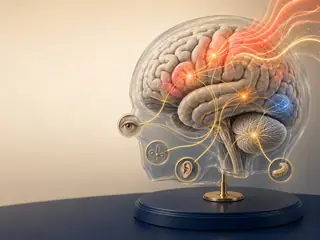
TBI Claims Guide
Traumatic brain injury, residuals, and overlap with mental health.Open guideHow VA Rates TBI
The 10 facets of cognitive impairment under diagnostic code 8045.Open guide
SMC-T (TBI Aid & Attendance)
Special Monthly Compensation for severe TBI needing in-home care.Open guideSave for later
Your printable reference shelf.
The existing one-page guides, grouped together so they are easy to find and save.
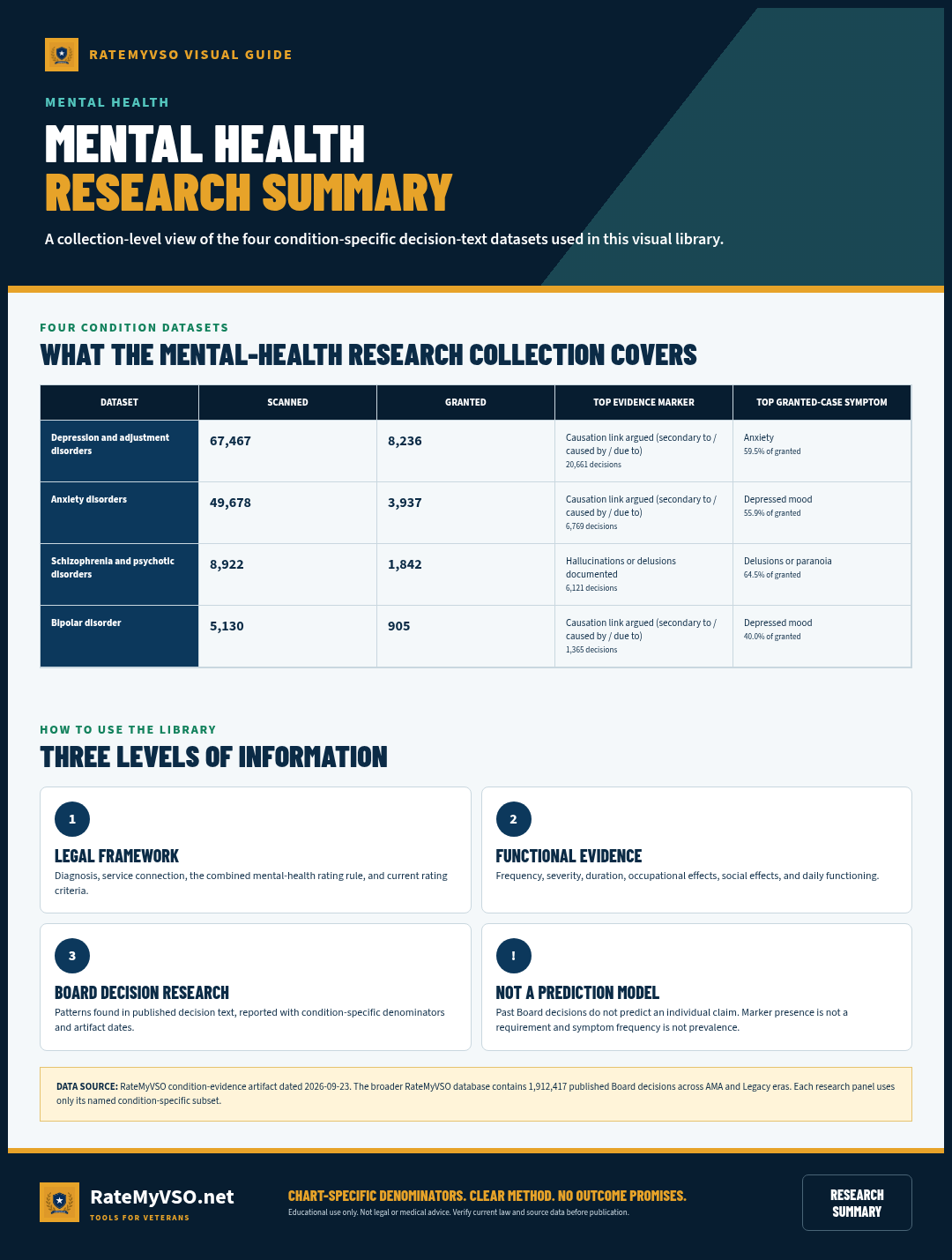 One-page guide: Mental Health Research Summary
Summary of the RateMyVSO mental-health research datasets: 67,467 depression, 49,678 anxiety, 8,922 schizophrenia and 5,130 bipolar Board decisions, each counted separately. Opens the full-size chart, free to save or print.
One-page guide: Mental Health Research Summary
Summary of the RateMyVSO mental-health research datasets: 67,467 depression, 49,678 anxiety, 8,922 schizophrenia and 5,130 bipolar Board decisions, each counted separately. Opens the full-size chart, free to save or print.
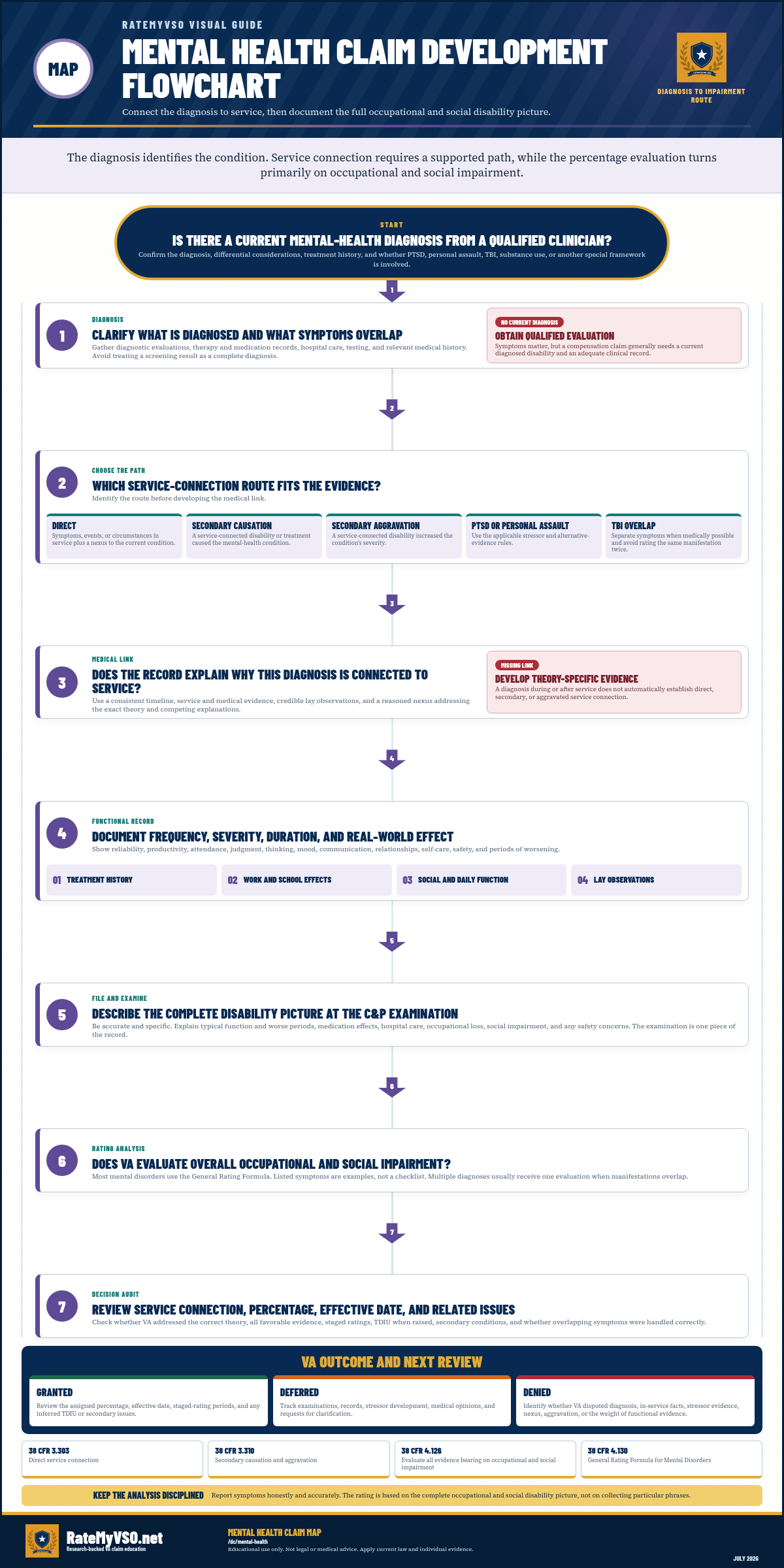
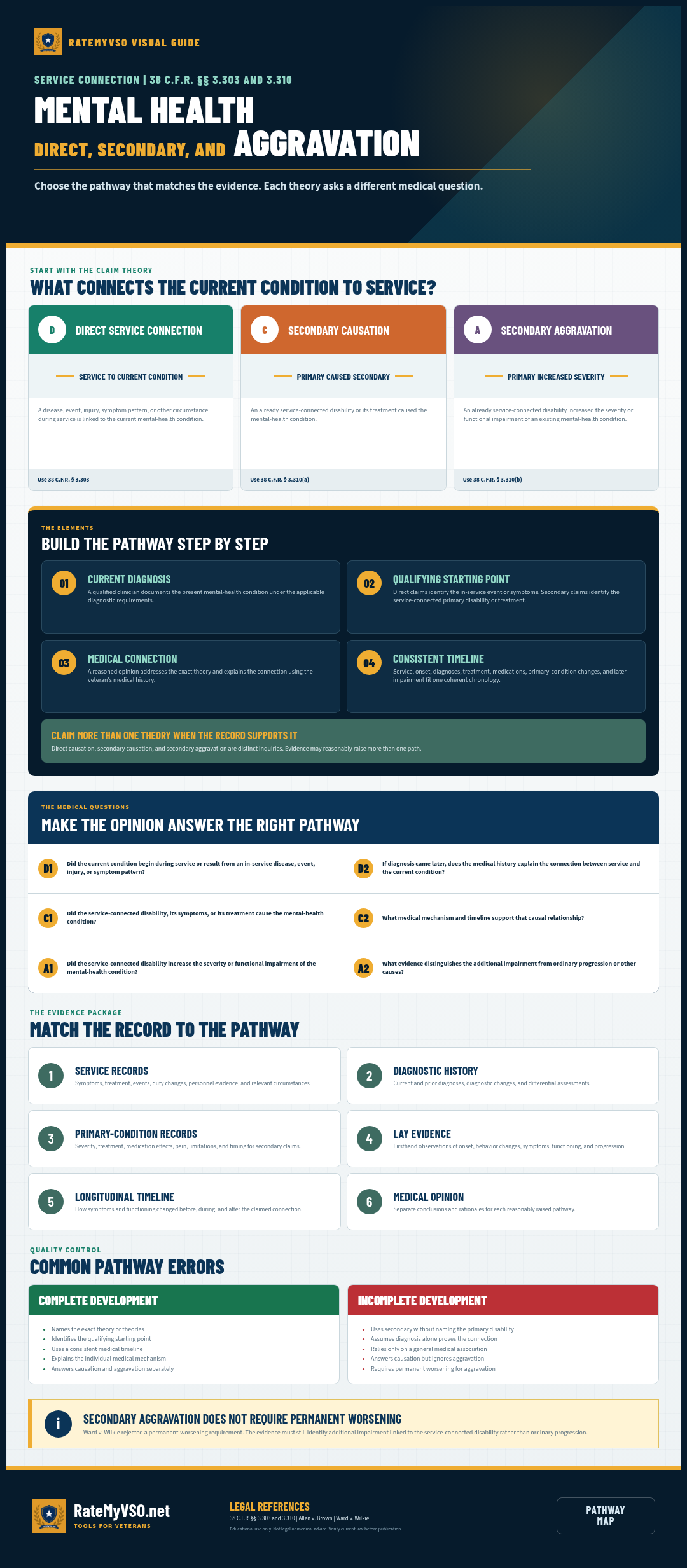
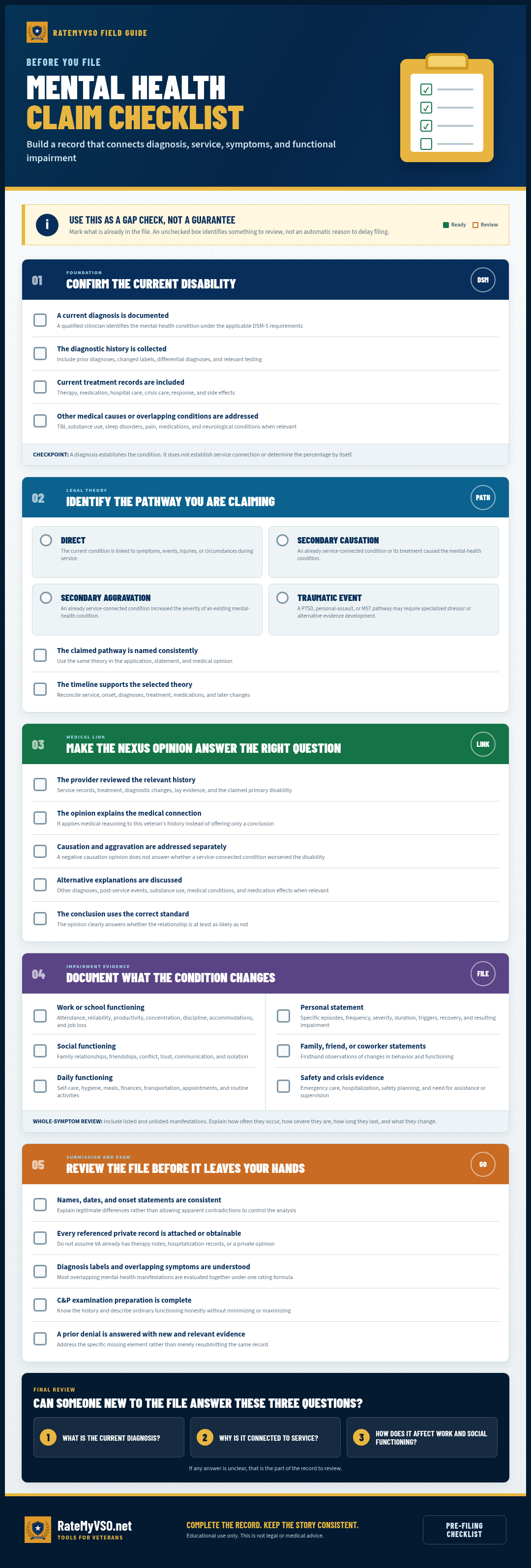
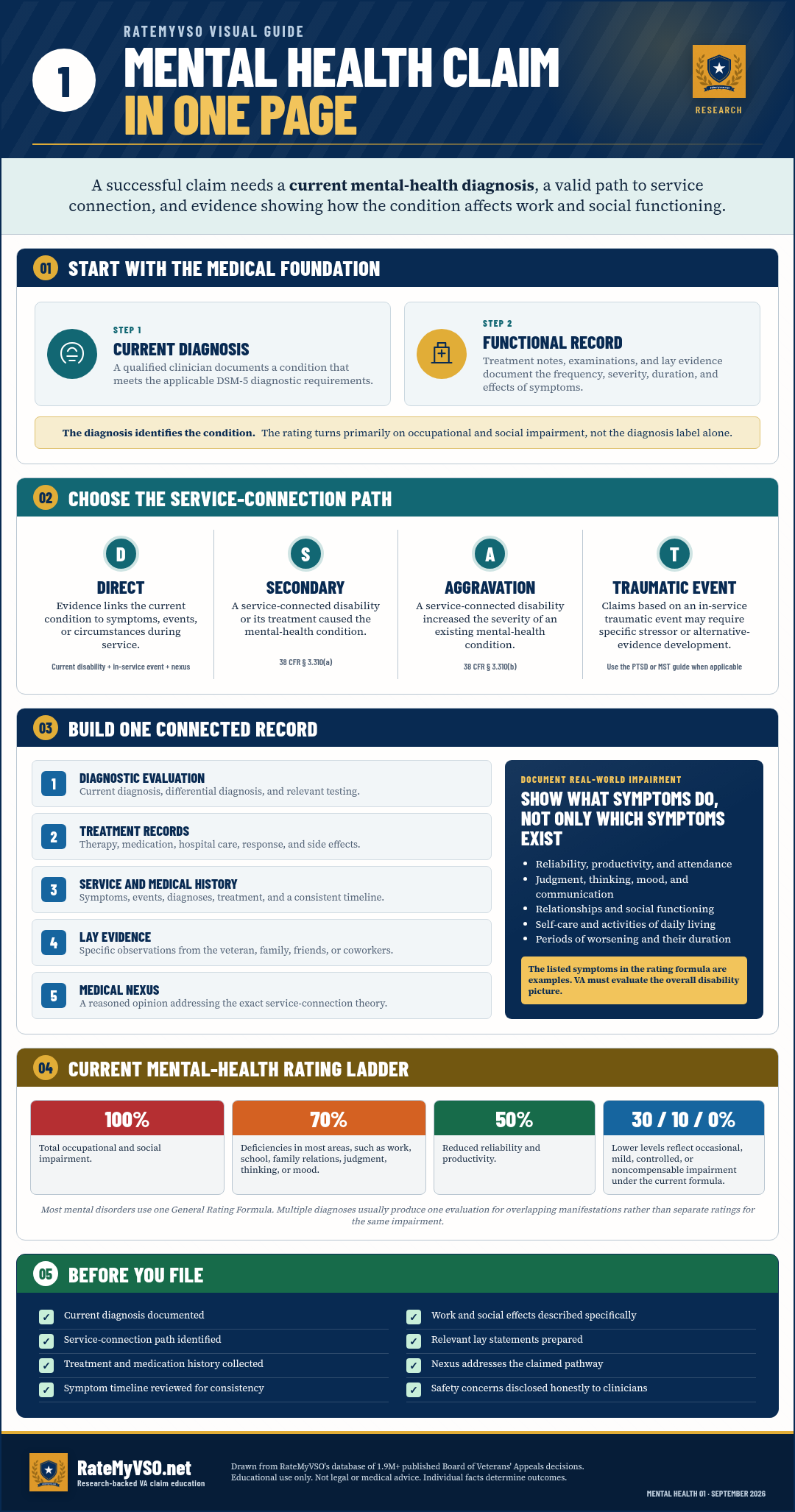 One-page guide: Mental Health Claim in One Page
One-page mental-health VA claim overview covering diagnosis, service connection, medical nexus, functional impairment, evidence, and claim preparation. Opens the full-size chart, free to save or print.
One-page guide: Mental Health Claim in One Page
One-page mental-health VA claim overview covering diagnosis, service connection, medical nexus, functional impairment, evidence, and claim preparation. Opens the full-size chart, free to save or print.
How the VA Rates Mental Health
With a few exceptions, every service-connected mental health condition is rated under the same scale: the General Rating Formula for Mental Disorders at 38 CFR 4.130. The rating turns on occupational and social impairment, how much the condition interferes with holding a job and maintaining relationships, not on which diagnosis you carry.
| Rating | What it reflects |
|---|---|
| 0% | Diagnosed, but symptoms are mild or controlled and do not impair work or social function. |
| 10% | Mild symptoms with occasional decrease in work efficiency during periods of stress. |
| 30% | Occasional impairment, depressed mood, anxiety, mild memory loss, but generally functioning. |
| 50% | Reduced reliability and productivity, panic attacks, impaired judgment, difficulty with relationships. |
| 70% | Deficiencies in most areas, work, school, family, mood, with serious symptoms. |
| 100% | Total occupational and social impairment. |
If your mental health condition alone keeps you from holding steady work but you are rated below 100%, you may qualify for Total Disability based on Individual Unemployability (TDIU), which pays at the 100% rate.
Browse the Diagnostic Codes
Each code page shows the rating criteria, C&P exam tips, secondary conditions, and Board appeal data for that condition.
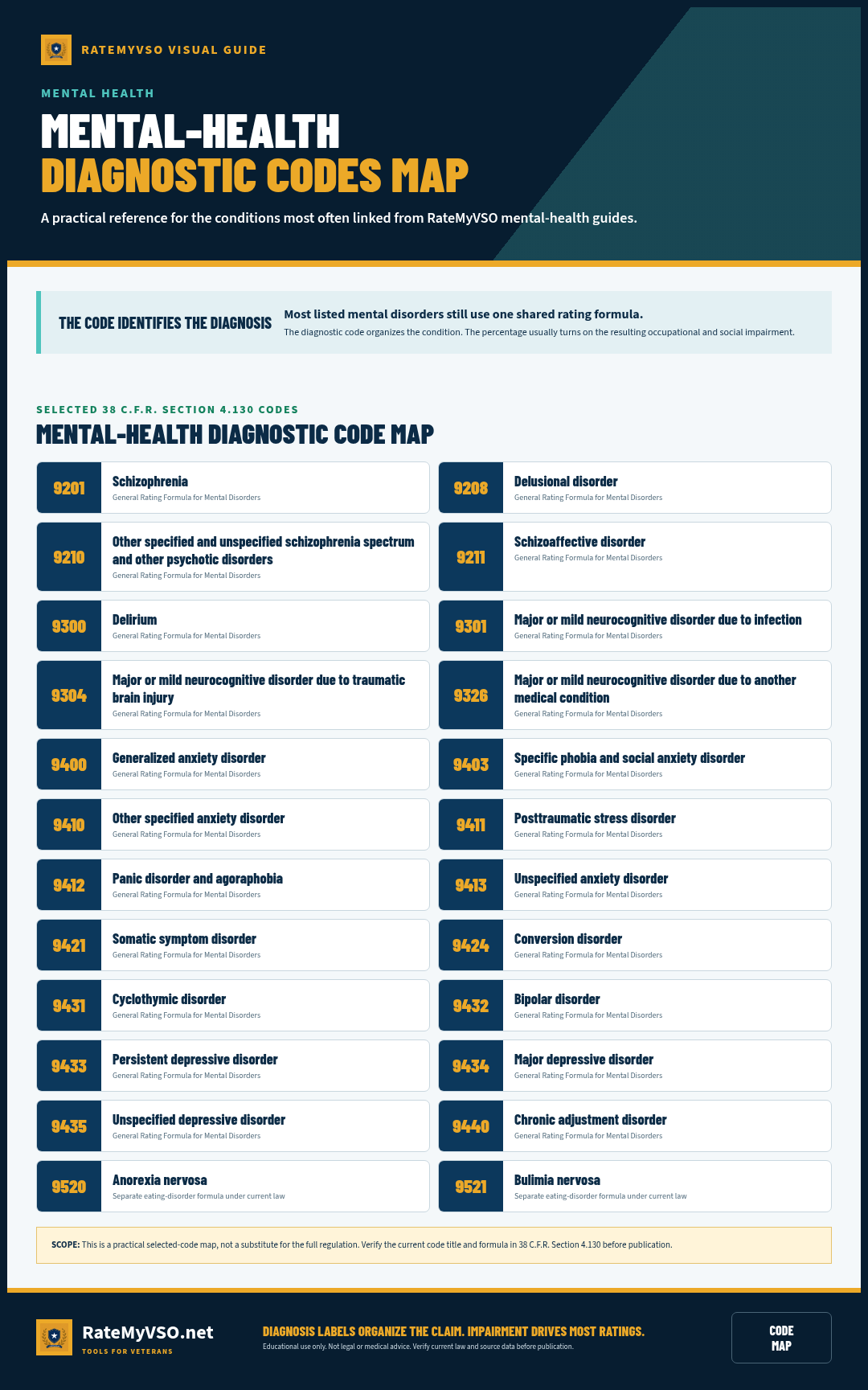 One-page guide: Mental-Health Diagnostic Codes Map
Reference map of selected mental-health diagnostic codes under 38 C.F.R. Section 4.130. Opens the full-size chart, free to save or print.
One-page guide: Mental-Health Diagnostic Codes Map
Reference map of selected mental-health diagnostic codes under 38 C.F.R. Section 4.130. Opens the full-size chart, free to save or print.
This hub is for educational purposes only and is not medical or legal advice. Rating criteria come from 38 CFR 4.130. For help with your claim, find a VSO representative near you.