VA PTSD Ratings and Claims Guide
This guide explains how to file a PTSD claim and how the VA evaluates it: how service connection works, the stressor categories and their different evidence standards, what VA looks for, the automatic 50% rule, how PTSD is rated from 0 to 100 percent, secondary conditions, evidence, why these claims get denied, a checklist before you file, what the claims process looks like step by step, how to read your decision letter, and what to do whether you win or you're denied. You will also learn the three requirements for service connection (a verified in-service stressor, a current DSM-5 diagnosis, and a medical nexus), and how symptom severity maps to a rating under the General Rating Formula for Mental Disorders at 38 CFR § 4.130.

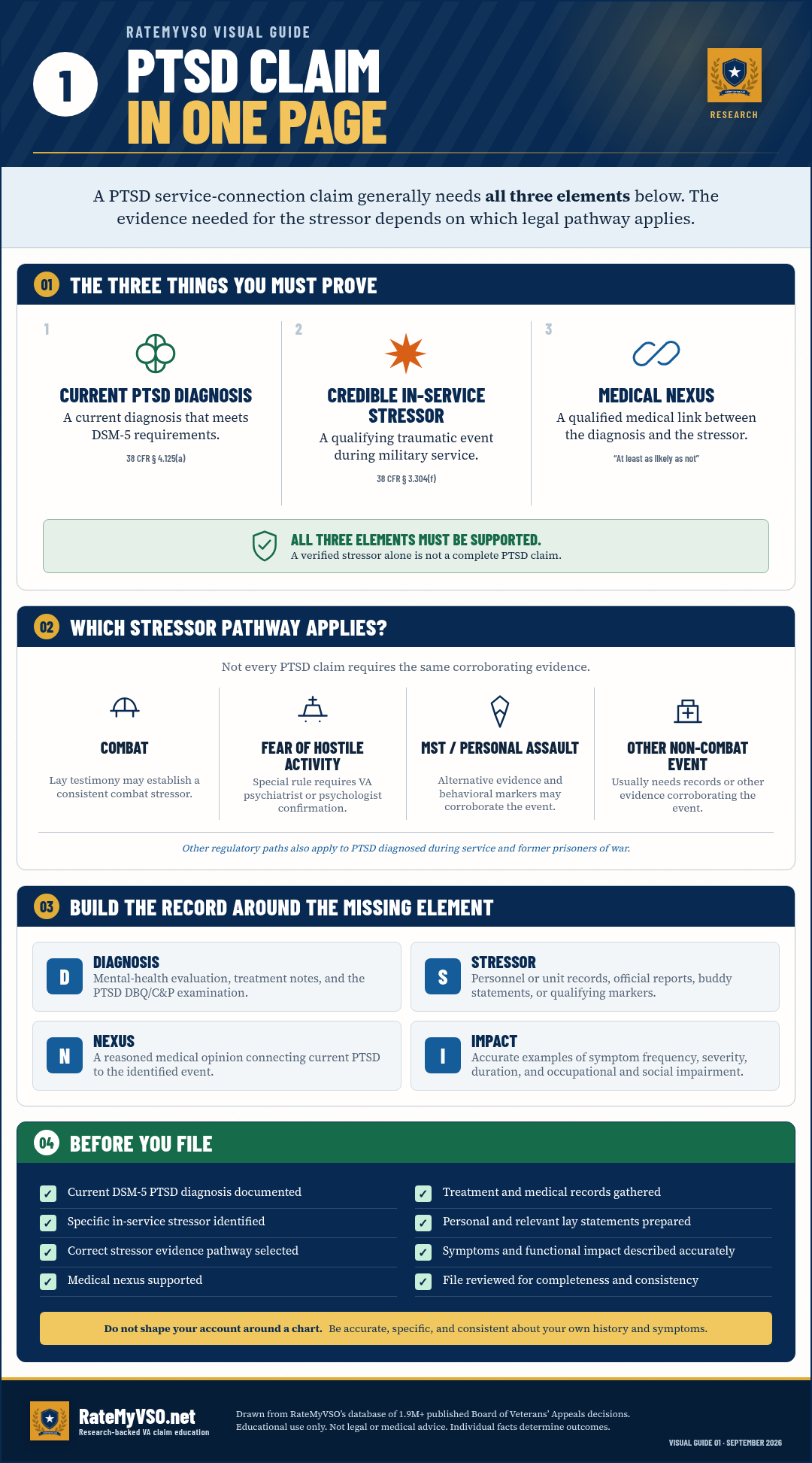 One-page guide: PTSD Claim in One Page
PTSD claim overview showing the current diagnosis, in-service stressor, and medical nexus elements, followed by stressor evidence pathways and a filing checklist. Opens the full-size chart, free to save or print.
One-page guide: PTSD Claim in One Page
PTSD claim overview showing the current diagnosis, in-service stressor, and medical nexus elements, followed by stressor evidence pathways and a filing checklist. Opens the full-size chart, free to save or print.
Start with the essentials
- 01Service Connection
The ways service connection can be established for this condition.
- 02Diagnosis and Evidence
Common symptoms and the evidence cited in published Board appeals.
- 03Your History
What you experienced, what others observed, and what treatment changed.
Understand the claim and stressor paths
Overview
Post-Traumatic Stress Disorder is one of the most commonly claimed mental health conditions in the VA disability system. It is rated under DC 9411, which cross-references the General Rating Formula for Mental Disorders found at 38 CFR § 4.130. Unlike most physical conditions, PTSD is evaluated on occupational and social impairment rather than on measurable clinical findings such as lab values or range of motion.
This guide covers the three elements required for service connection, how stressor categories affect evidence requirements, what VA actually looks for in the record, the direct and secondary/aggravation pathways to service connection, how the rating formula works, the evidence that has moved published Board decisions, why these claims get denied, a checklist before you file, the claims process step by step, and what conditions are commonly linked to PTSD.
We analyzed published Board of Veterans' Appeals decisions on PTSD for patterns in what evidence tends to be present in claims that get granted, and what tends to be missing in claims that get denied. These are patterns, not promises. Board decisions bind only the case they decide and are not VA policy; your own facts and evidence determine your outcome.
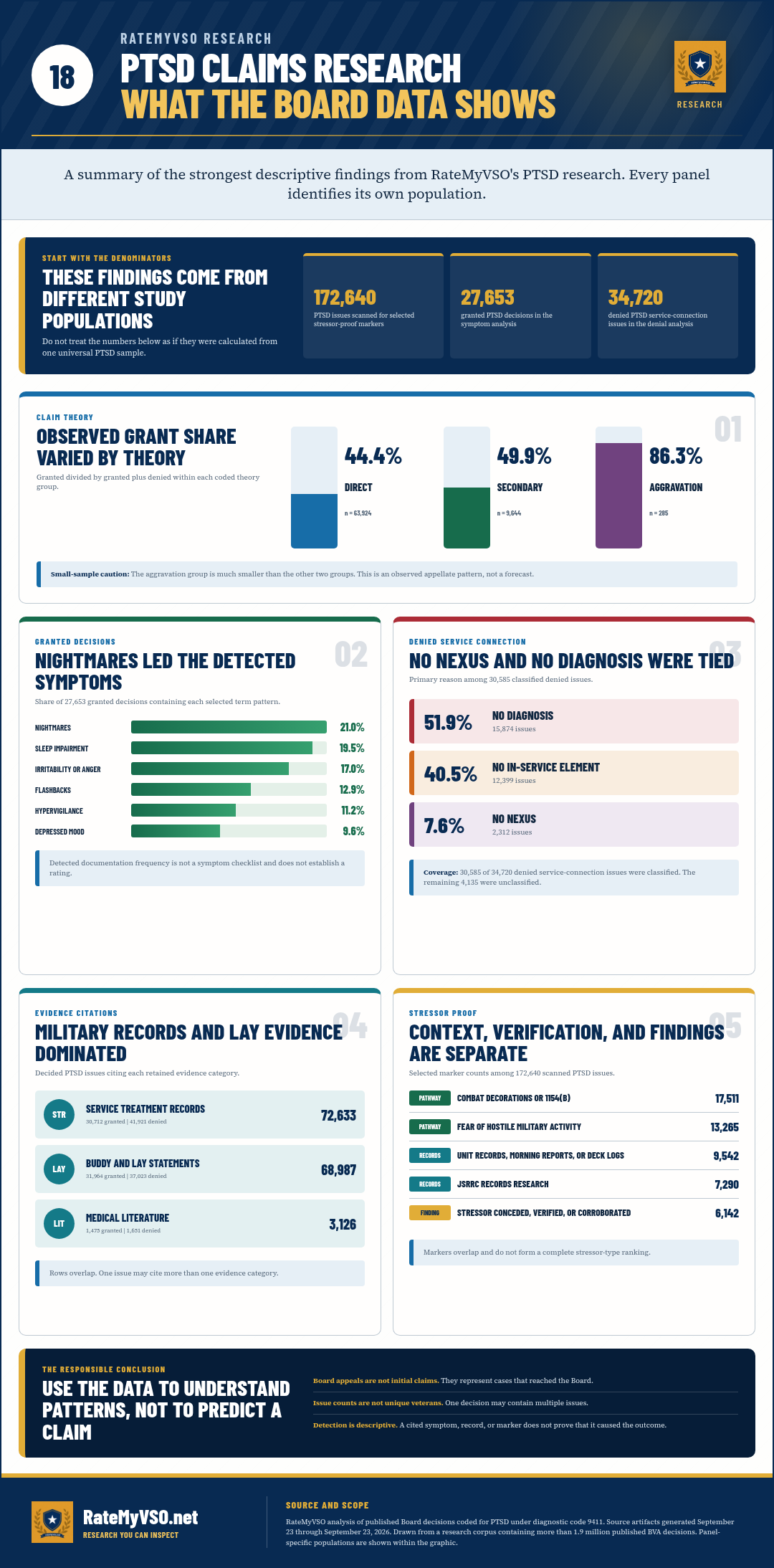 One-page guide: PTSD Research Summary
Summary of PTSD Board research with separate study populations: 172,640 scanned issues, 27,653 granted decisions read for symptoms, and 34,720 denied service-connection issues. Opens the full-size chart, free to save or print.
One-page guide: PTSD Research Summary
Summary of PTSD Board research with separate study populations: 172,640 scanned issues, 27,653 granted decisions read for symptoms, and 34,720 denied service-connection issues. Opens the full-size chart, free to save or print.
ICD-10 Diagnosis Codes
The ICD-10 diagnosis codes most commonly used for DC 9411, Posttraumatic stress disorder (the kind on your medical records, decision letter, or C&P exam report). VA rates the disability and its residuals, not the diagnosis itself, so coding can vary.
How Service Connection Works, At a High Level
VA service connection for PTSD requires all three of the following (see 38 CFR § 3.304(f)):
- A current diagnosis. The diagnosis must be made by a licensed mental health professional using the criteria in the Diagnostic and Statistical Manual of Mental Disorders, Fifth Edition (DSM-5), as required by 38 CFR § 4.125(a). A self-reported belief that one has PTSD does not satisfy this element on its own, and a record that only mentions PTSD in passing, without a documented DSM-5 evaluation behind it, is often not enough either.
- A credible in-service stressor. A stressor is a traumatic event that occurred during military service. Under DSM-5 Criterion A, qualifying events involve actual or threatened death, serious injury, or sexual violence experienced directly, witnessed, or learned about in a specific context. The evidence required to establish that the stressor occurred depends on the category of stressor involved (see Stressor Categories below).
- A medical nexus linking the diagnosis to the in-service stressor. A medical opinion from a qualified provider must state that the current PTSD is connected to the identified in-service stressor. The standard phrase used in VA practice is "at least as likely as not," meaning a probability of 50% or greater. (See our Nexus Letters Guide for what makes a strong opinion.) (38 CFR § 3.304(f))
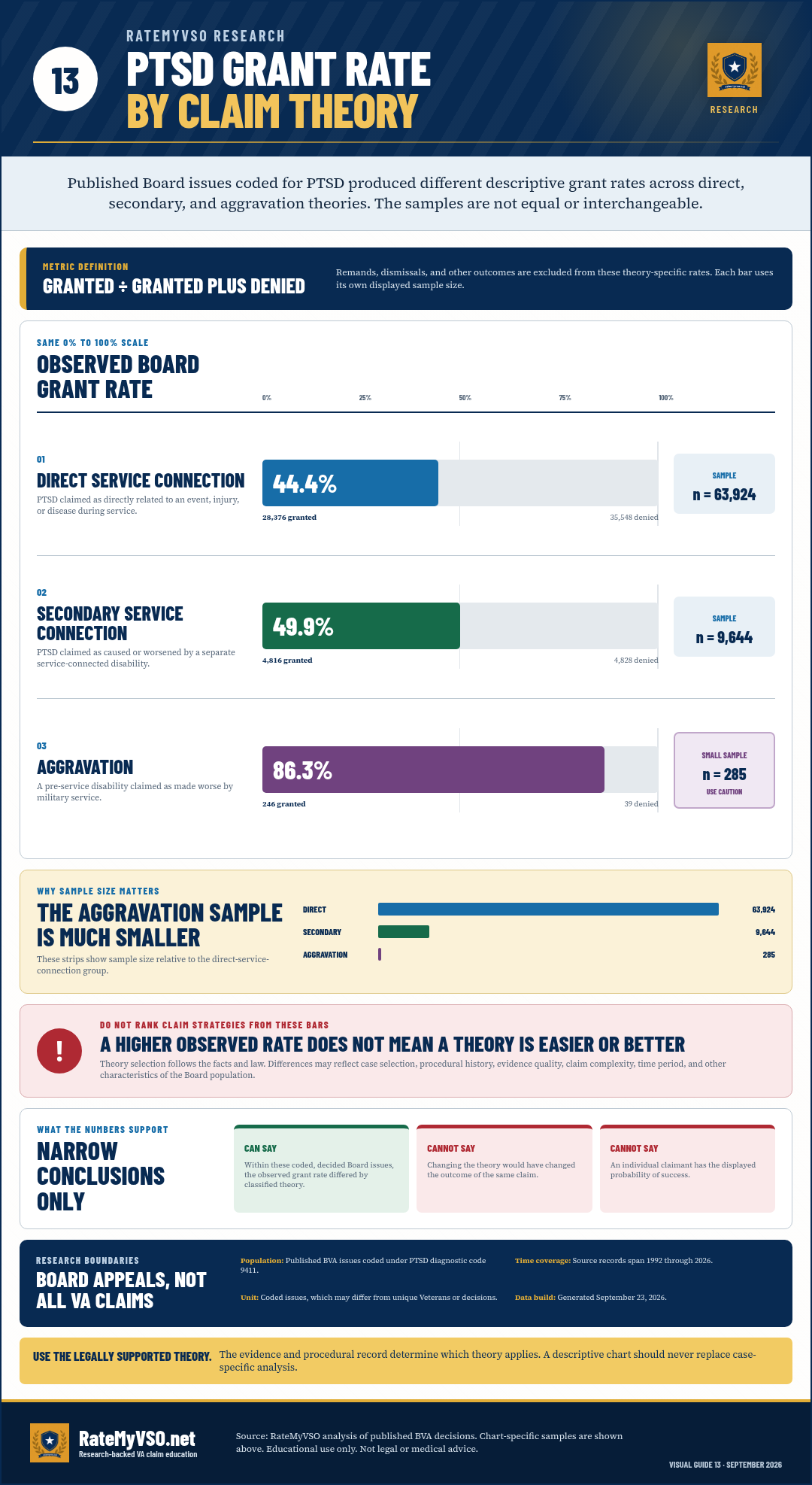 One-page guide: PTSD Grant Rate by Claim Theory
Observed Board grant shares for PTSD claim-theory groups with separate sample sizes: 63,924 direct, 9,644 secondary and 285 aggravation issues. Opens the full-size chart, free to save or print.
One-page guide: PTSD Grant Rate by Claim Theory
Observed Board grant shares for PTSD claim-theory groups with separate sample sizes: 63,924 direct, 9,644 secondary and 285 aggravation issues. Opens the full-size chart, free to save or print.
Service Connection Pathways: Direct and Secondary
The great majority of PTSD claims are established directly, through the three-element test above: a current diagnosis, a verified stressor, and a medical nexus tying the two together. Two other pathways exist and are worth knowing about, even though they come up far less often for PTSD than direct connection does.
Direct Service Connection
A veteran demonstrates that PTSD arose from a specific in-service traumatic stressor, established under one of the five stressor categories described above, with a current DSM-5 diagnosis and a medical nexus connecting the two. This is the pathway behind the overwhelming majority of granted PTSD claims.
Service Connection by Aggravation (38 CFR § 3.306)
When a veteran had a documented pre-service PTSD diagnosis or trauma-related mental health condition that was chronically worsened, beyond its natural progression, by military service, aggravation-based service connection is available. This is distinct from a straightforward direct claim: the question is not whether service caused the condition, but whether service made an existing condition measurably worse. A medical opinion addressing aggravation should establish the baseline severity before service and compare it to the severity afterward.
Secondary Service Connection (38 CFR § 3.310)
PTSD can also be recognized as secondary to, meaning caused or aggravated by, an already service-connected disability, though this is a narrower and less common route than direct connection. This theory fits situations where an existing service-connected condition itself precipitates or worsens PTSD symptoms, for example chronic, disfiguring, or life-threatening complications of a service-connected physical condition that become their own source of ongoing psychological trauma. As with any secondary claim, a medical opinion should address the causal or aggravating mechanism specifically, not simply note that the veteran has both conditions. See our Secondary Service Connection Guide for how this pathway works generally.
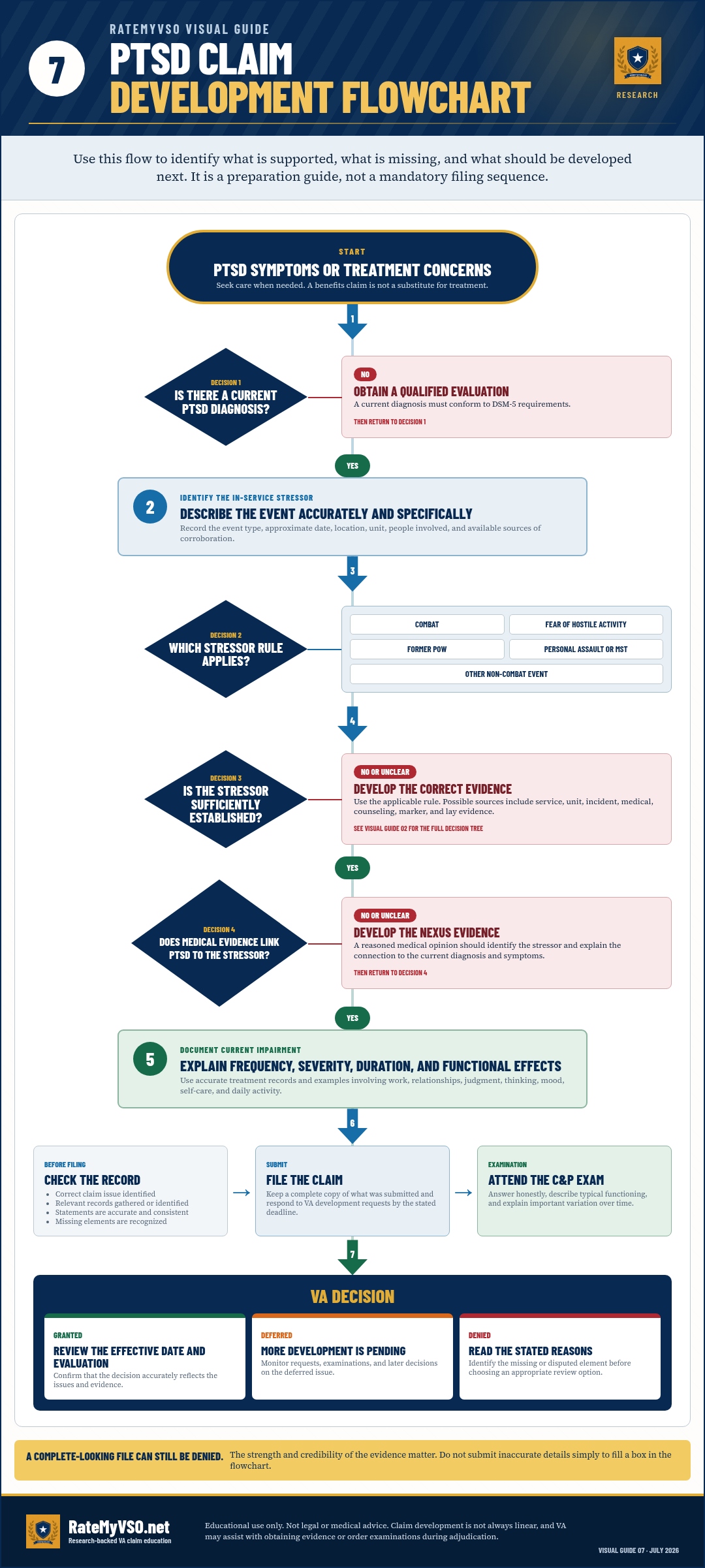
Stressor Categories and Evidence Standards
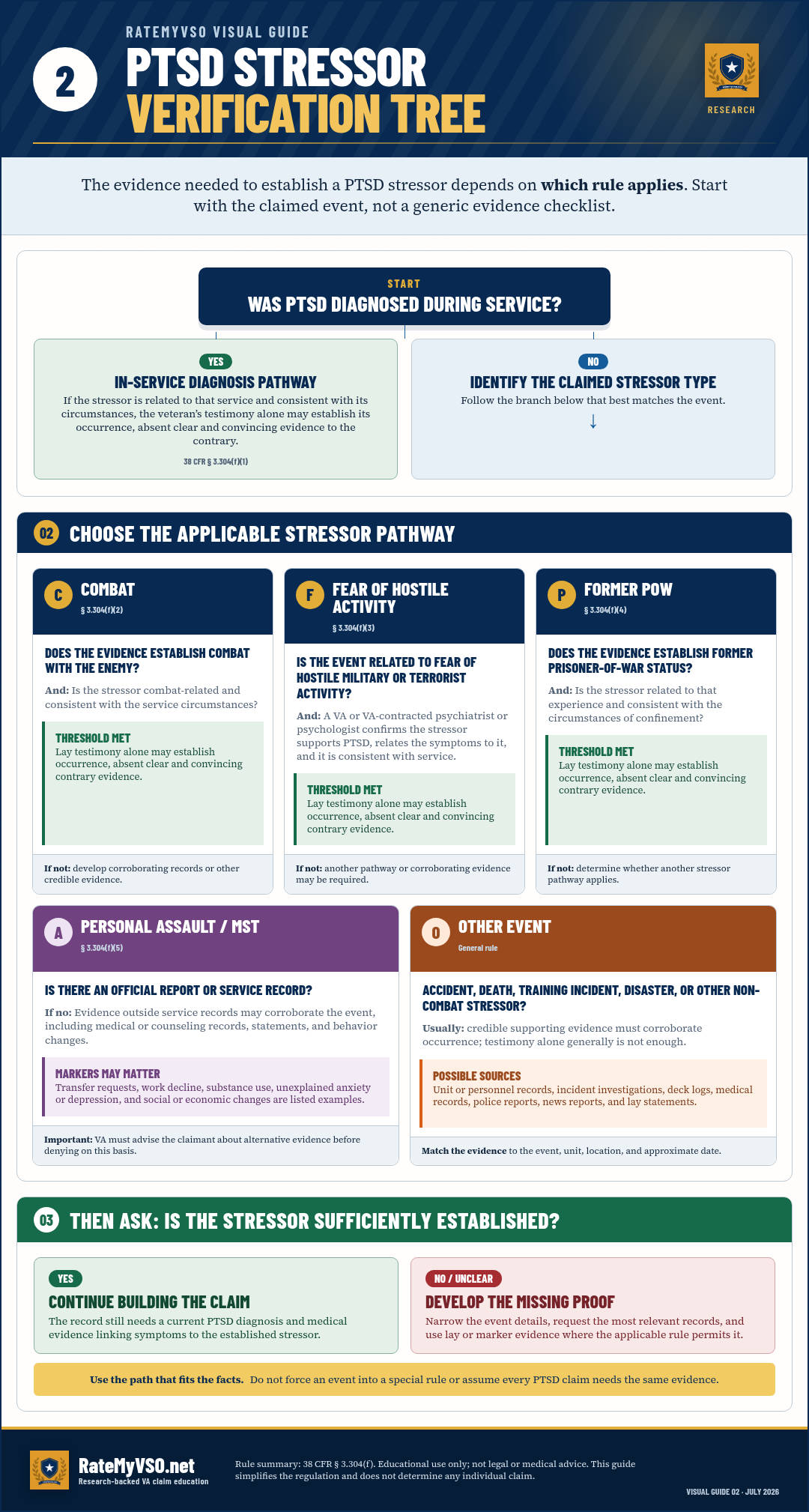
The evidence required for the in-service stressor element varies significantly based on how the stressor is classified. 38 CFR § 3.304(f) defines five stressor categories, each with its own evidence standard, some of them considerably easier to satisfy than a full record search. For a deeper walkthrough of the verification process itself, including JSRRC searches, the 60-day window rule, the VSR/RVSR workflow, and BVA outcome data, see the VA PTSD Stressor Verification guide.
Category 1: PTSD Diagnosed During Service
When PTSD was formally diagnosed during active military service and the claimed stressor relates to that service, a veteran's lay testimony alone is sufficient to establish the occurrence of the stressor. The only rebuttal available to VA is clear and convincing evidence to the contrary. (38 CFR § 3.304(f)(1))
Category 2: Combat Stressors
When a veteran engaged in combat with the enemy and claims a stressor related to that combat, lay testimony alone can establish the stressor, provided it is consistent with the circumstances, conditions, and hardships of the veteran's service. Service records showing combat service, combat medals (Combat Infantryman Badge, Combat Action Badge, Purple Heart), or assignment records confirming deployment to a combat zone satisfy the threshold. (38 CFR § 3.304(f)(2), 38 U.S.C. § 1154(b))
A well-documented combat stressor still is not, by itself, a complete claim. VA has still denied claims where the combat stressor was fully conceded but the current-diagnosis element was missing at the time the claim was decided. Establishing the stressor removes one hurdle; the current diagnosis and medical nexus still have to be there too.
Category 3: Fear of Hostile Military or Terrorist Activity
Veterans who served in proximity to hostile military or terrorist activity but did not directly engage in combat may also establish a stressor without detailed corroborating documentation. A VA psychiatrist or psychologist (or contractor equivalent) must confirm that the claimed stressor is adequate to support a PTSD diagnosis and that the veteran's symptoms are related to it. The stressor also must be consistent with the places, types, and circumstances of the veteran's service. (38 CFR § 3.304(f)(3), added July 13, 2010, 75 FR 39843)
Category 4: Prisoner of War Experience
Veterans who were prisoners of war under 38 CFR § 3.1(y) may establish a PTSD stressor through lay testimony alone when the stressor is related to the POW experience and is consistent with the circumstances of captivity. PTSD is also a presumptive condition under 38 CFR § 3.309(c) for former POWs when manifested to a compensable degree at any time after discharge. (38 CFR § 3.304(f)(4))
Category 5: Military Sexual Trauma (MST) and Personal Assault
When the claimed stressor involves in-service personal or sexual assault, VA may not deny the claim without first advising the claimant that evidence from sources other than service records may corroborate the stressor. Acceptable corroborating evidence includes records from law enforcement, rape crisis centers, mental health counseling centers, hospitals, or physicians; statements from family members, roommates, or fellow service members; and evidence of behavioral changes following the assault. (38 CFR § 3.304(f)(5))
Behavioral markers recognized by VA include:
- A request for transfer to a different duty assignment following the assault
- Deterioration in work performance
- Onset of substance abuse
- Episodes of depression, panic attacks, or anxiety without an otherwise identifiable cause
- Unexplained changes in economic or social behavior
The M21-1 adjudication manual at Part III, Subpart iv, Section 4.H directs adjudicators to apply a benefit-of-the-doubt standard when evaluating MST-related stressors. Claims that fail on this stressor category are commonly denied because the only corroboration offered comes from family members who did not personally witness the in-service events; using the wider range of alternative evidence the rule allows (behavior-change records, counseling notes, statements from people who knew the veteran at the time) is the stronger path. See our MST Claims Guide for additional context.
 One-page guide: PTSD Stressor-Proof Patterns
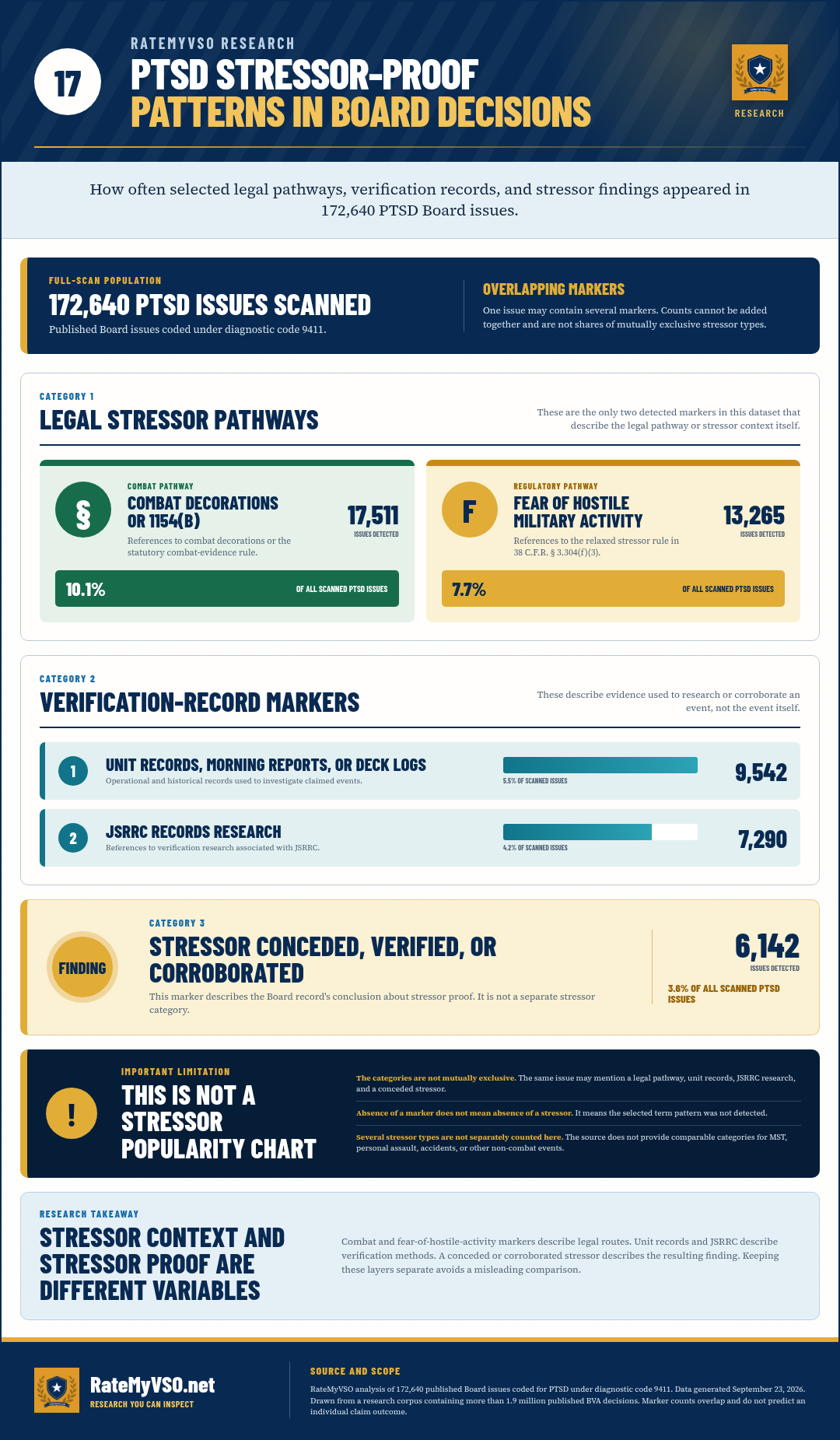
Selected legal pathways, verification-record markers and stressor findings detected across 172,640 PTSD Board issues. Opens the full-size chart, free to save or print.
One-page guide: PTSD Stressor-Proof Patterns
Selected legal pathways, verification-record markers and stressor findings detected across 172,640 PTSD Board issues. Opens the full-size chart, free to save or print.
Sympathetic Reading and the Scope of a Mental-Health Claim
A claim filed under a specific label, "PTSD," "depression," "anxiety," is not limited to that label. Under M21-1, Part V, Subpart iii, Chapter 13, Section 1.a, VA must read a mental-disorders claim as covering any mental disability that may reasonably be defined by:
- the description of the claim,
- the symptoms the claimant describes,
- the information and evidence the claimant submits, and
- any other information and evidence VA has obtained.
This is the "sympathetic reading" rule. It is grounded in Robinson v. Shinseki, 557 F.3d 1355 (Fed. Cir. 2009), which held that VA must construe pro se veteran filings sympathetically. The M21-1 explicitly states: "A sympathetic reading of pleadings cannot be based on a standard that requires legal sophistication and must consider whether all submissions taken together have articulated a claim."
Why this matters for veterans
Veterans regularly file under a single mental-health label and end up with a C&P examiner who diagnoses a different mental disorder. Common patterns:
- Veteran files for PTSD, examiner diagnoses Major Depressive Disorder (MDD) instead.
- Veteran files for PTSD, examiner diagnoses adjustment disorder, anxiety disorder unspecified, or persistent depressive disorder.
- Veteran files for "anxiety," examiner finds the more accurate diagnosis is PTSD or panic disorder.
- MST-based filings often shift between PTSD, depression, and anxiety diagnoses across examiners.
Under Robinson and the M21-1, none of these should produce a denial that says "you claimed PTSD but you have MDD." VA is required to evaluate whatever mental disability the evidence reasonably supports. The rating schedule itself, at 38 CFR § 4.130, uses the same General Rating Formula for nearly all mental disorders, so the rating outcome is usually the same regardless of which mental-health diagnosis prevails.
The duty-to-assist anchor
The same M21-1 section reminds raters that under 38 CFR § 3.159, the duty to assist is triggered by a substantially complete application, which requires the benefit claimed plus any medical condition on which it is based, including a description of symptoms of a body part or system. A veteran does not need a precise DSM-5 diagnosis to start the process. Symptoms are enough.
What to do if VA denied your claim on the "wrong label" theory
- Read the denial carefully. If VA said something like "the veteran claimed X but the diagnosis is Y, so the claim is denied," that is a Robinson / M21-1 V.iii.13.1.a violation.
- File a Higher-Level Review (HLR) arguing the rater misapplied the sympathetic-reading duty. Cite Robinson v. Shinseki and the M21-1 section in the HLR request. See HLR Guide.
- Or file a Supplemental Claim with the diagnostic-broadening evidence and an explicit statement that the claim should be read as covering all mental disorders supported by the record. See Supplemental Claim Guide.
- Do not assume you must refile from scratch. Doing so resets your effective date. The sympathetic-reading rule is supposed to preserve the original date.
Cross-references
See also Mental Health Rating Formula (same General Rating Formula across most mental disorders), MST Guide (alternative evidence path), Letter Interpreter (to decode a denial that may have missed this rule), and How VA Raters Weigh Medical Opinions (when an examiner's diagnostic conclusion is challengeable).
Source: M21-1, Part V, Subpart iii, Chapter 13, Section 1.a (effective 2026-05-27); cross-reference M21-1, Part V, Subpart ii, Chapter 3, Section A; controlling caselaw Robinson v. Shinseki, 557 F.3d 1355 (Fed. Cir. 2009).
Symptoms, daily functioning, and rating
Symptoms Recorded in Granted PTSD (stressor proof) Decisions
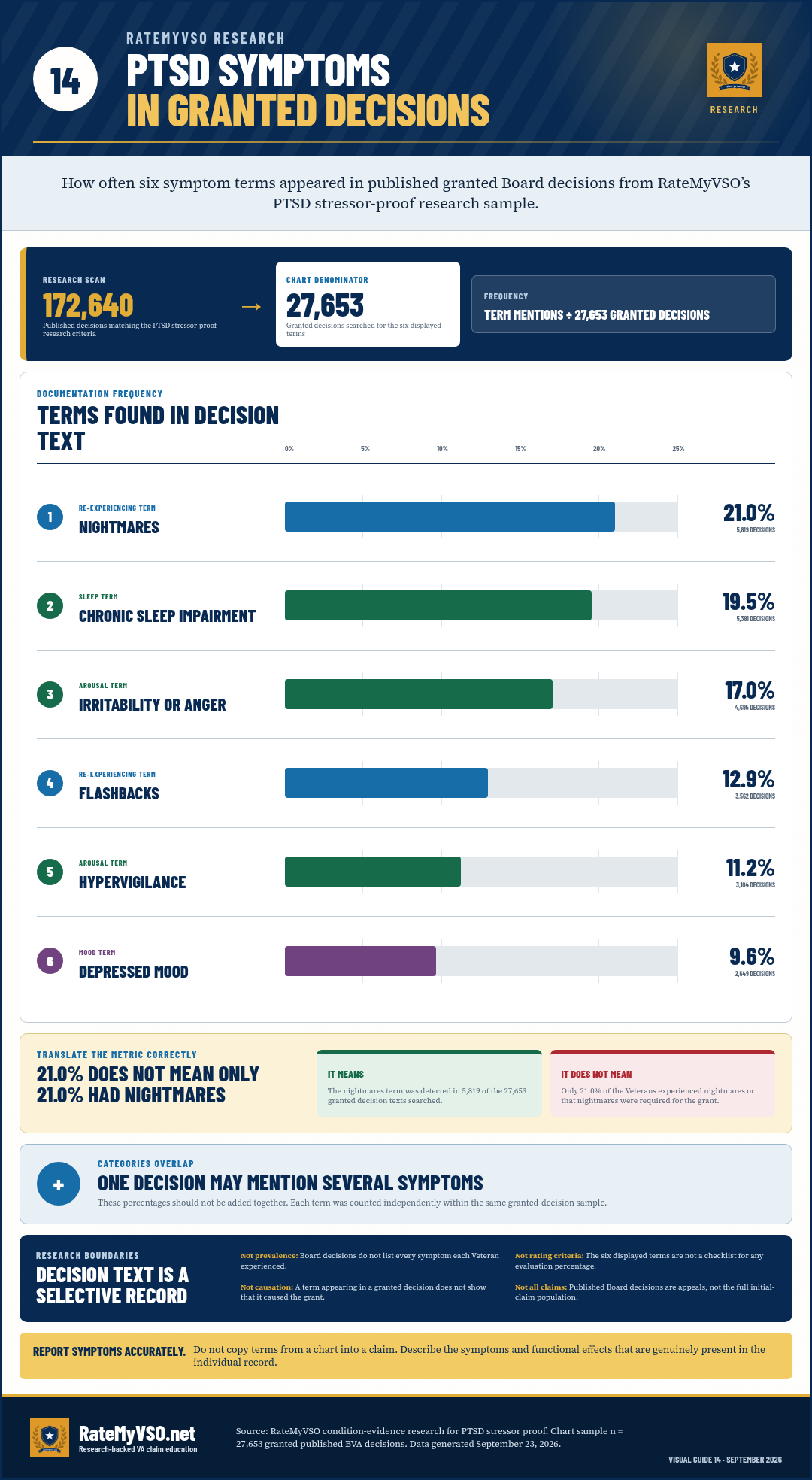
We analyzed 27,653 granted Board decisions involving ptsd (stressor proof) for symptoms named in sentences about the condition (rating-criteria recitations excluded). Descriptive of the published record, what the Board wrote down, not a checklist of what to report.
Bar length shows decisions. Percentages remain context.
Detected by phrase-reading the decision text with condition-specific vocabularies. Source: Board of Veterans' Appeals decisions, RateMyVSO analysis.
The Pyramiding Rule for Mental Health
VA may not evaluate the same disability, or the same manifestation of disability, under multiple diagnostic codes. For mental health conditions, this means a veteran generally receives one combined mental health rating even when multiple diagnoses exist (PTSD, major depressive disorder, anxiety disorder). (see 38 CFR § 4.14)
Symptoms that overlap completely between two mental health diagnoses produce only one rating. However, when two mental health diagnoses produce distinct, non-overlapping symptoms, separate ratings may be possible. This determination requires careful review of the clinical evidence.
The pyramiding rule does not apply between mental health conditions and physical secondary conditions. Sleep apnea, migraines, and gastrointestinal conditions secondary to PTSD are rated separately under their own diagnostic codes. See our Pyramiding Guide for more. Do not file a physical secondary condition, such as sleep apnea or migraines, as though it were part of the PTSD claim itself; file it as its own secondary claim so it gets its own rating.
The Automatic 50% Rule
A special rule applies when a mental disorder is diagnosed in service connection with a claim involving a traumatic event. When it applies, VA assigns a minimum 50% rating and schedules a mandatory re-evaluation between six months and one year after the rating is assigned. At re-evaluation, the rating is adjusted up or down based on current symptoms. (see 38 CFR § 4.129)
This provision is frequently misunderstood. It does not apply to every PTSD claim. It applies when VA establishes service connection for a mental disorder related to a traumatic event AND the evidence shows the veteran experienced an acute situational reaction or mental disorder in connection with that event during service. The key practical consequence is that the 50% rating floor prevents an initial service connection decision from coming back at 0% or 10% without a subsequent re-evaluation. (38 CFR § 4.129)
How VA Rates PTSD
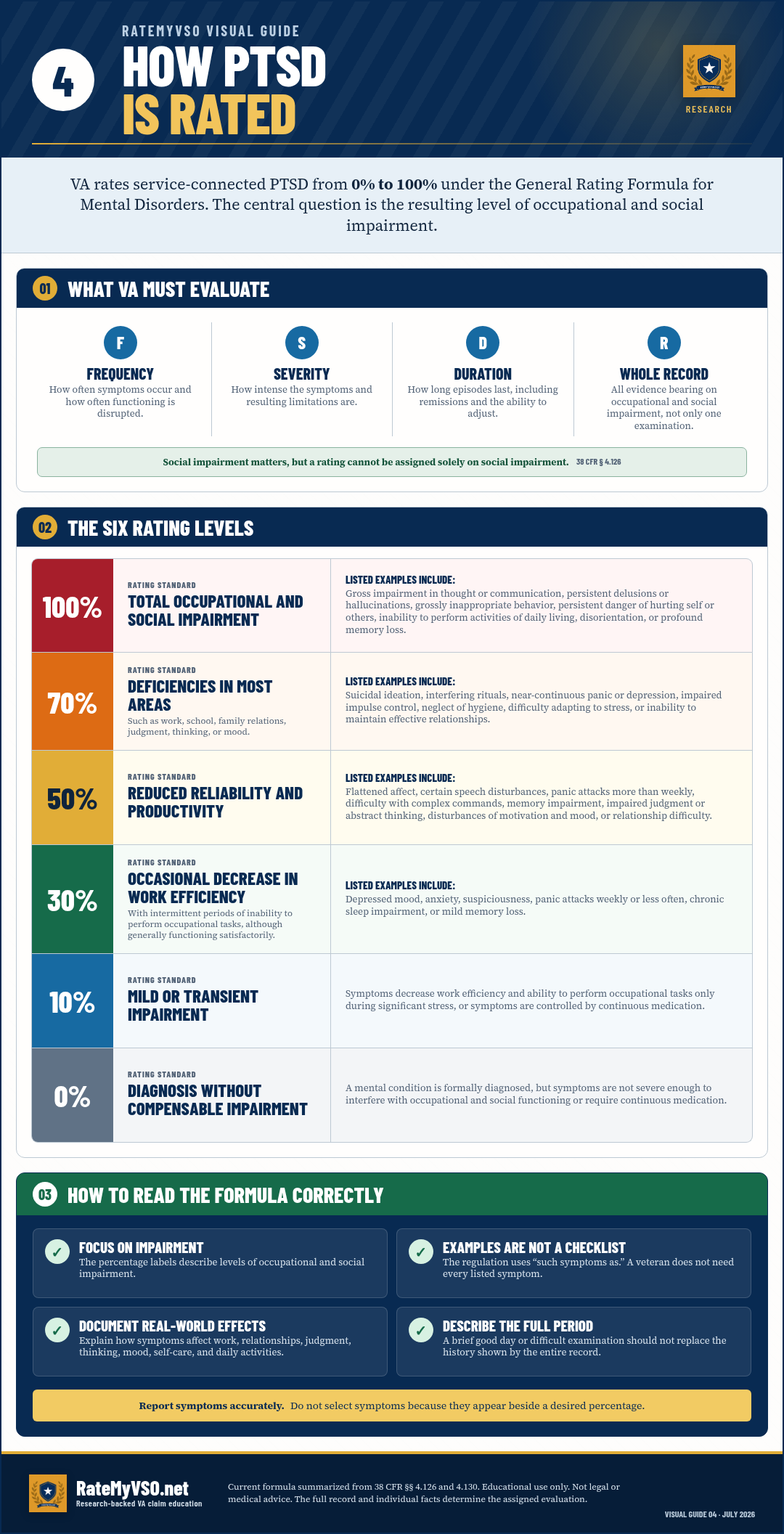
PTSD is rated under DC 9411 using the General Rating Formula for Mental Disorders at 38 CFR § 4.130. The formula uses six rating levels. Mental health ratings are not a continuous scale. The available percentages are 0%, 10%, 30%, 50%, 70%, and 100% only. There are no 20%, 40%, 60%, 80%, or 90% ratings under this formula.
The rating reflects occupational and social impairment, meaning the combined impact on employment and on personal and community relationships.
The Whole-Symptom Evaluation Standard
Rating agencies evaluate mental disorders based on all symptoms present, not only on those specifically listed in the rating criteria. A symptom not explicitly named in the formula can still support a higher rating if it contributes to occupational or social impairment consistent with that level. (see 38 CFR § 4.126)
The evaluation captures the overall level of impairment in ordinary conditions of daily life including work, school, and social activities. The C&P examiner is directed to describe the severity, frequency, and duration of symptoms and to assess the degree of social and occupational impairment they cause.
TDIU for PTSD
Total Disability Individual Unemployability (TDIU) pays compensation at the 100% rate when a veteran cannot maintain substantially gainful employment due to service-connected disabilities. Under 38 CFR § 4.16(a), a veteran with a single service-connected mental disorder rated at 70% or higher may qualify for TDIU if that condition prevents employment. A veteran with a PTSD rating of 60% combined with other service-connected conditions totaling 70% or higher may also qualify. Unemployability due solely to PTSD is among the most common TDIU claims adjudicated.
Evidence and Board research
What VA Looks For: Tests, Records, and Diagnostic Codes
Whether your claim turns on the stressor, the diagnosis, or the nexus, the record VA actually reviews centers on a small set of documents and data points.
- The DSM-5 diagnosis itself: a mental health evaluation, ideally by a psychiatrist or psychologist, that documents the specific DSM-5 Criterion A through H findings, not just a chart note that mentions "PTSD" in passing or "by history."
- Stressor evidence matched to the applicable category: service personnel records, unit histories, deployment orders, and combat decorations for combat and in-service categories; law enforcement, medical, or counseling records and behavioral-change evidence for MST and personal-assault claims; buddy statements corroborating the event for any category.
- Treatment records: ongoing mental health treatment, therapy notes, medication history, and any crisis-line or emergency contact close in time to service, all of which help establish that symptoms began around service and have continued.
- The diagnostic codes involved: DC 9411 for PTSD itself, plus whatever code applies to a condition you're connecting to it as a secondary claim, for example DC 6847 (sleep apnea), DC 8100 (migraines), DC 7522 (erectile dysfunction), or DC 7101 (hypertension), each discussed further in Common Secondary Conditions below.
- The actual form the examiner fills out: a Disability Benefits Questionnaire (DBQ) for mental disorders, discussed in more detail later in this guide.
- The medical nexus opinion: a statement, with reasoning, that connects the current PTSD diagnosis to the identified stressor at "at least as likely as not" or higher.
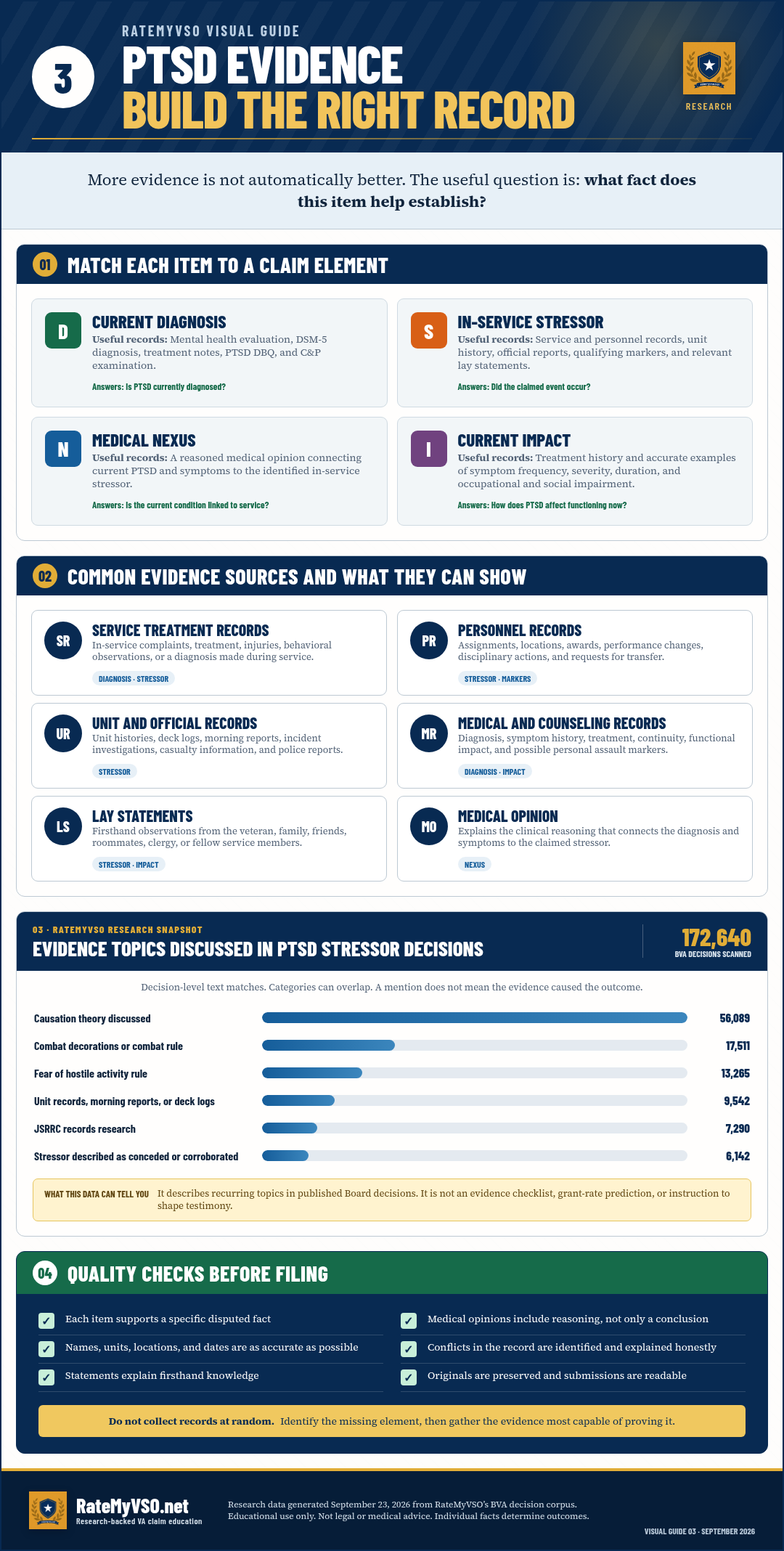 One-page guide: PTSD Evidence Guide
PTSD evidence guide organized around diagnosis, stressor, nexus, symptom severity and supporting records, drawn from 172,640 scanned Board decisions. Opens the full-size chart, free to save or print.
One-page guide: PTSD Evidence Guide
PTSD evidence guide organized around diagnosis, stressor, nexus, symptom severity and supporting records, drawn from 172,640 scanned Board decisions. Opens the full-size chart, free to save or print.
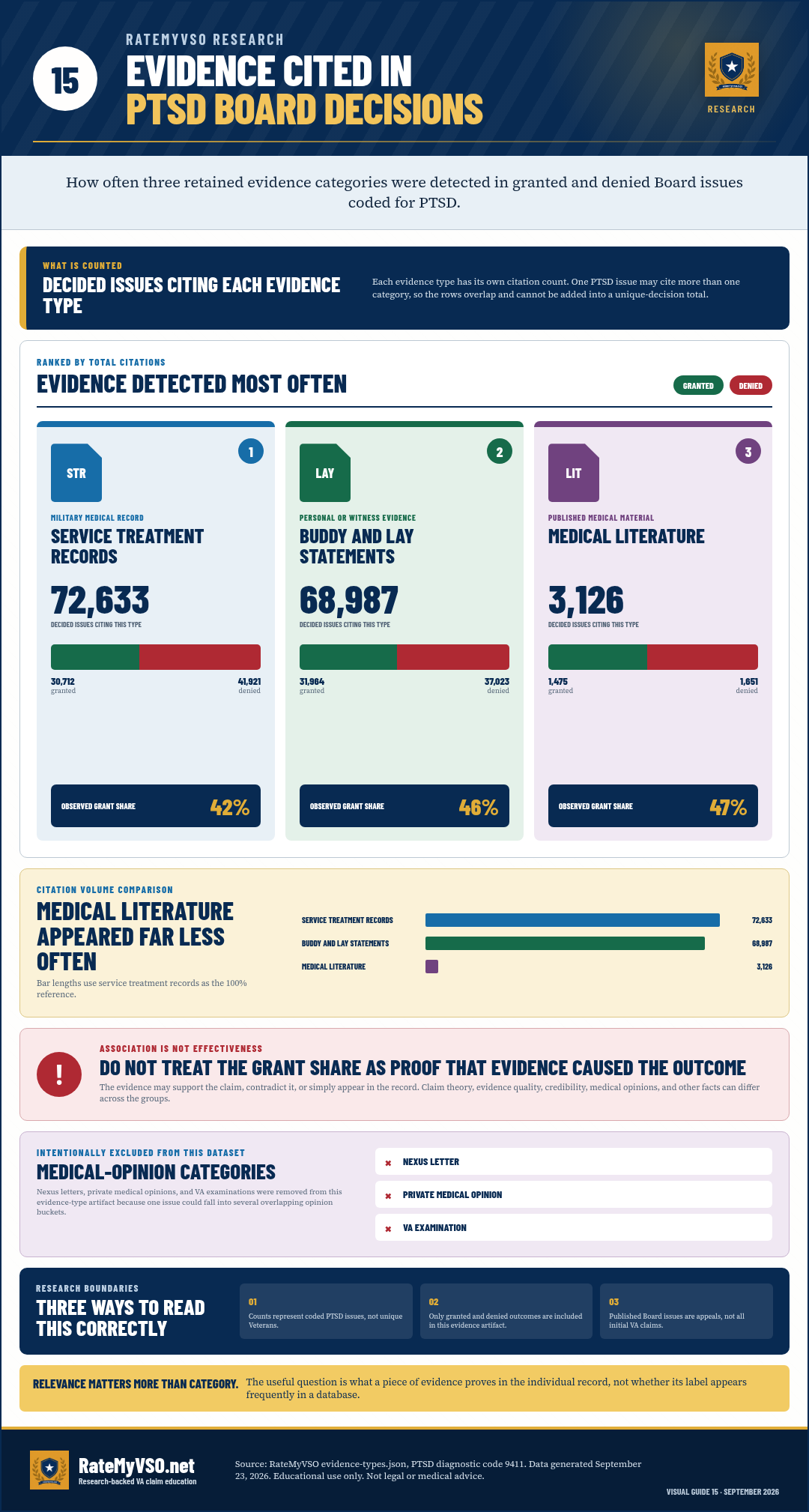
Evidence Cited in Published PTSD (stressor proof) Decisions
We analyzed 172,640 published Board decisions involving ptsd (stressor proof) for condition-specific evidence, counting only case-specific mentions (boilerplate recitations excluded). "Favorable" is the share of decisions citing that evidence where every issue was granted or the outcome was mixed; the baseline across all these decisions is 60.3%. Evidence appearing in a decision does not mean it decided the case. Descriptive of the published record, not a prediction.
Bar length shows decisions citing the evidence.
Detected by phrase-reading the decision text with condition-specific vocabularies. Source: Board of Veterans' Appeals decisions, RateMyVSO analysis.
Board Grants, Dissected
The set of published Board decisions below shows PTSD granted on a direct basis under a handful of recurring fact patterns. Boards granted service connection when a corroborated in-service stressor lined up with a credible current diagnosis, even where a VA examiner's own opinion, or a diagnostic label mismatch, initially cut against the veteran. Board decisions are not binding on future cases, and each veteran's facts are different, but these cases show what kinds of evidence tipped the balance.
Stressor corroborated by a VA-employed researcher's own search Citation A26039296 (April 28, 2026), Hearing docket
The record: The veteran said he feared every port call after his ship, the USS Enterprise, was at sea while the USS Cole was bombed in Yemen in October 2000. A May 2021 VA examiner found his symptoms did not meet full PTSD criteria but still concluded the in-service stressors were "at least as likely as not" the cause of another diagnosed disorder with PTSD-like symptoms. His private treating therapist separately linked his fear of travel and avoidance of talking about his Navy service to the Cole bombing. The veteran's own PTSD diagnosis from a private examiner and a private nexus letter were in the file, but the Board found they didn't satisfy every regulatory requirement for a PTSD label specifically.
Why it won: The Board found his military personnel records placed him on the USS Enterprise during the correct dates, and a submitted news article verified the Cole attack. Because the AOJ had already conceded a current diagnosis and a nexus, the only real dispute was the in-service event, and the record corroborated it. The Board denied the PTSD label itself but granted service connection for the closely related diagnosed condition instead.
Herbicide-era Vietnam veteran wins after Board finds VA exam incomplete Citation A26039104 (April 27, 2026), Direct Review docket
The record: The veteran served in Vietnam from 1968 to 1972. A December 2024 VA examiner found no PTSD diagnosis and said his symptoms did not meet full criteria. But the veteran had a long history of PTSD diagnoses from VA and private counselors, and a prior VA exam had also diagnosed PTSD. The December 2024 examiner never addressed those earlier diagnoses.
Why it won: The Board applied the rule that a PTSD diagnosis by a mental health professional is presumed to follow proper diagnostic criteria unless there is compelling evidence otherwise. Because the 2024 examiner ignored the earlier diagnoses and didn't explain why they were wrong, the Board found there was a current diagnosis. The stressor met the fear-of-hostile-activity standard and matched his Vietnam service, so the Board resolved doubt in the veteran's favor on the nexus question too.
National Guard live-fire training accident, newspaper article confirms the stressor Citation A26039058 (April 27, 2026), Hearing docket
The record: The veteran, a Texas Army National Guard member, said he administered first aid to fellow servicemembers killed in a 1993 live-fire training accident at Fort Hood. A 2019 VA mental health note documented this stressor as the basis for his PTSD diagnosis. He later submitted a newspaper article about the incident within the post-hearing evidence window.
Why it won: The Board found the newspaper article and his military personnel records (showing ACDUTRA status around that period) corroborated the stressor. Because the veteran was a National Guard member rather than full-time active duty, the Board also had to find the evidence at least in approximate balance on whether he was in a covered duty status (ACDUTRA) at the time. It resolved that question in his favor too.
Fear-of-hostile-activity stressor outweighs a negative VA opinion that ignored the record Citation A26038794 (April 27, 2026), Evidence Submission docket
The record: The veteran said he witnessed four fellow airmen struck by lightning during a training exercise at Hurlburt Field, one of whom died. A VA examiner found he did not meet DSM-5 criteria for any mental disorder and gave no reasoning for that conclusion, and did not address the veteran's reported symptoms of memory loss, mood changes, and difficulty with relationships. A private licensed psychologist diagnosed PTSD and linked it to the lightning-strike stressor, noting the veteran's first wife said he "completely changed" after service.
Why it won: The Board found the VA examiner's opinion inadequate because it failed to address the veteran's lay statements and gave no rationale, so it carried no probative weight. A VA records researcher independently found an Air Force website article confirming the lightning-strike incident, and the AOJ had already conceded the stressor. With no persuasive evidence against the claim left standing, the Board found the private psychologist's opinion sufficient to grant.
PTSD granted secondary to a newly service-connected TBI-related headache condition Citation A26038689 (April 24, 2026), Hearing docket
The record: The veteran said a simulated grenade explosion during training caused a head laceration, TBI, and chronic headaches. A fellow servicemember's 2013 affidavit corroborated the incident and the veteran's headache complaints afterward. A private physician who reviewed his records concluded his headaches were "at least as likely as not" residuals of the in-service TBI. A separate private psychologist found his diagnosed persistent depressive disorder was "at least as likely as not" caused by the headache condition. Two earlier VA opinions against the claim had relied on the absence of contemporaneous service records.
Why it won: The Board found the negative VA opinions of minimal value because they leaned on missing records and did not grapple with the veteran's credible, consistent testimony. The buddy statement and the detailed private opinions were given substantial weight. Because TBI and headaches were granted first, the psychiatric condition (including PTSD-type symptoms) was then granted as secondary to the now service-connected headache disability.
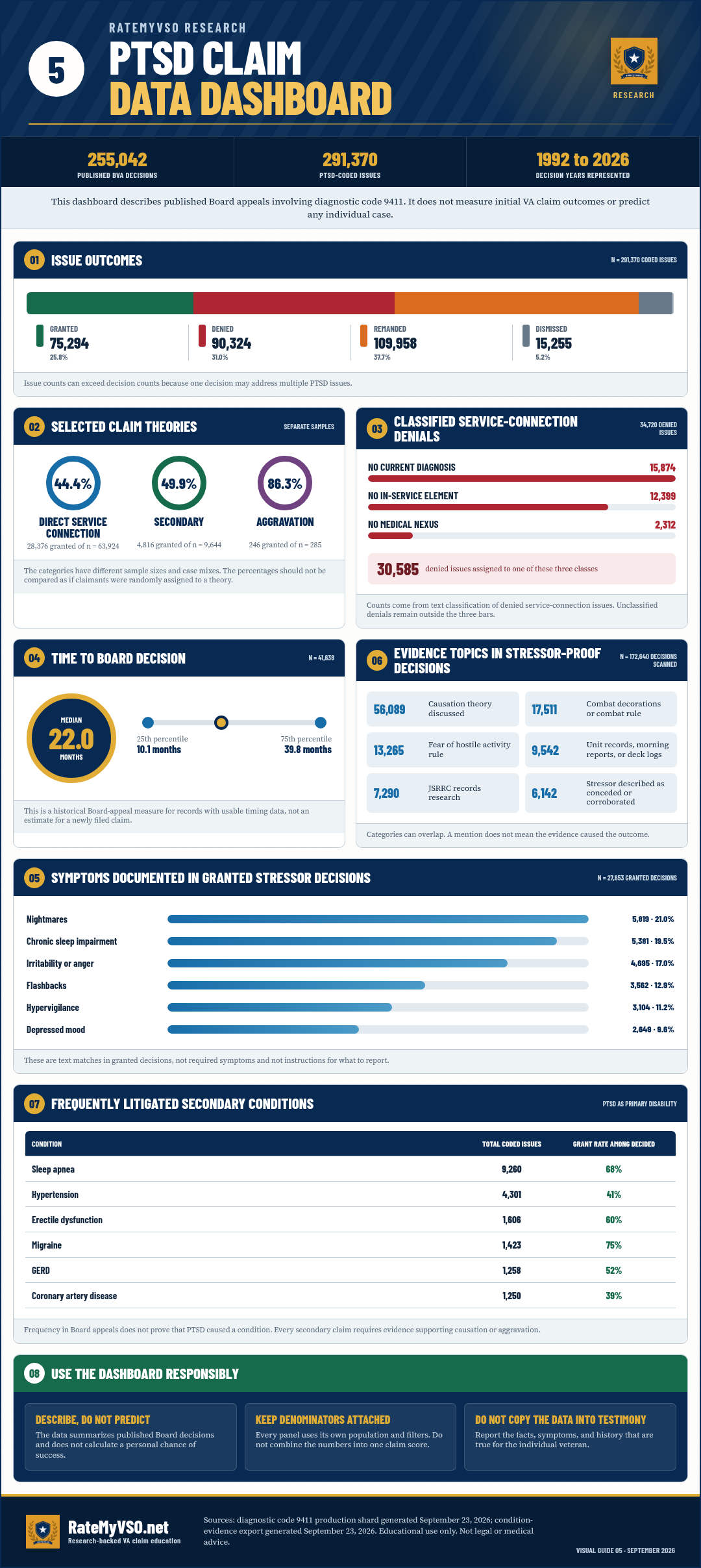
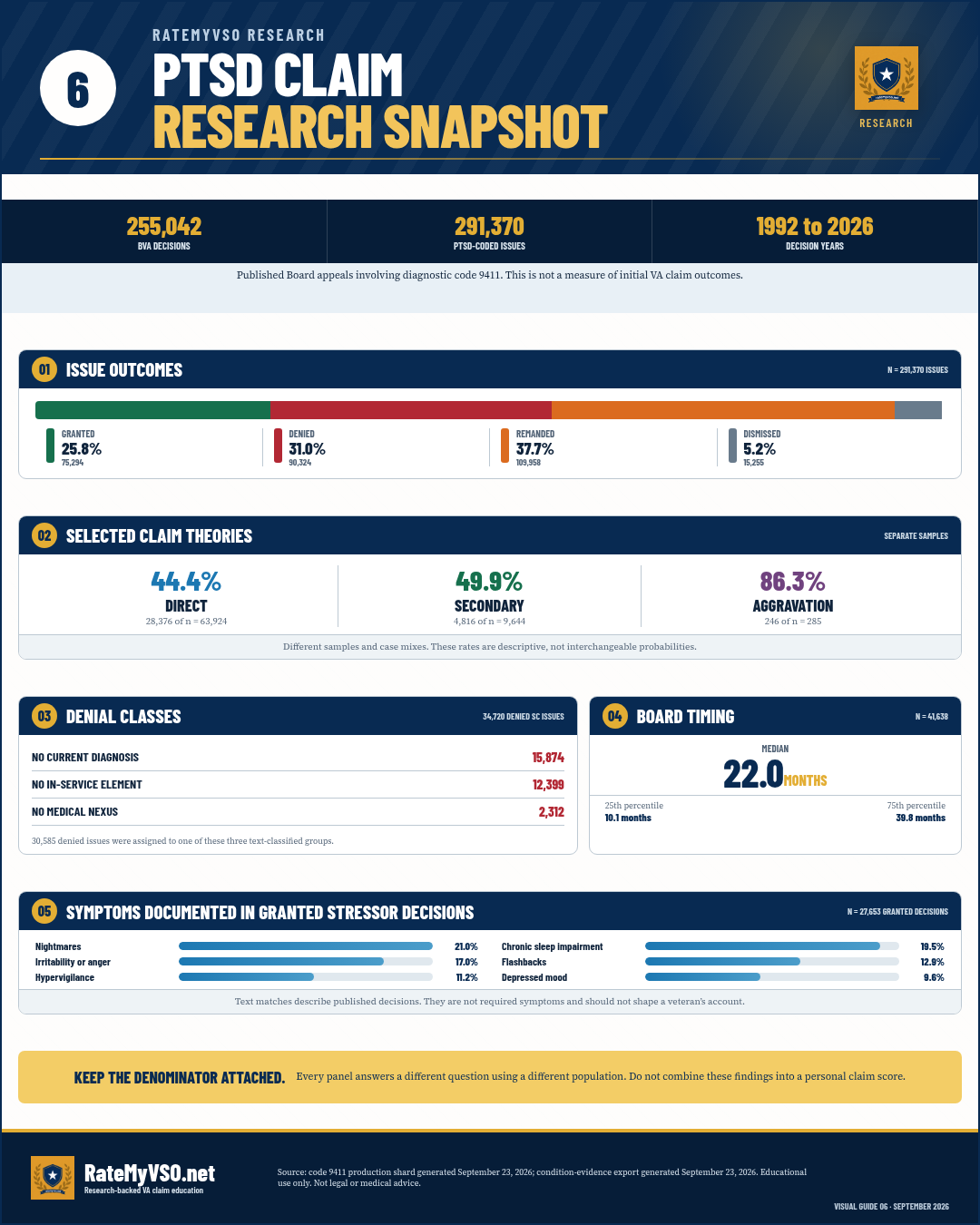
Printable companions to these numbers live in the PTSD Visual Guide Library: the Claim Data Dashboard and the compact Research Snapshot.
Why These Claims Get Denied
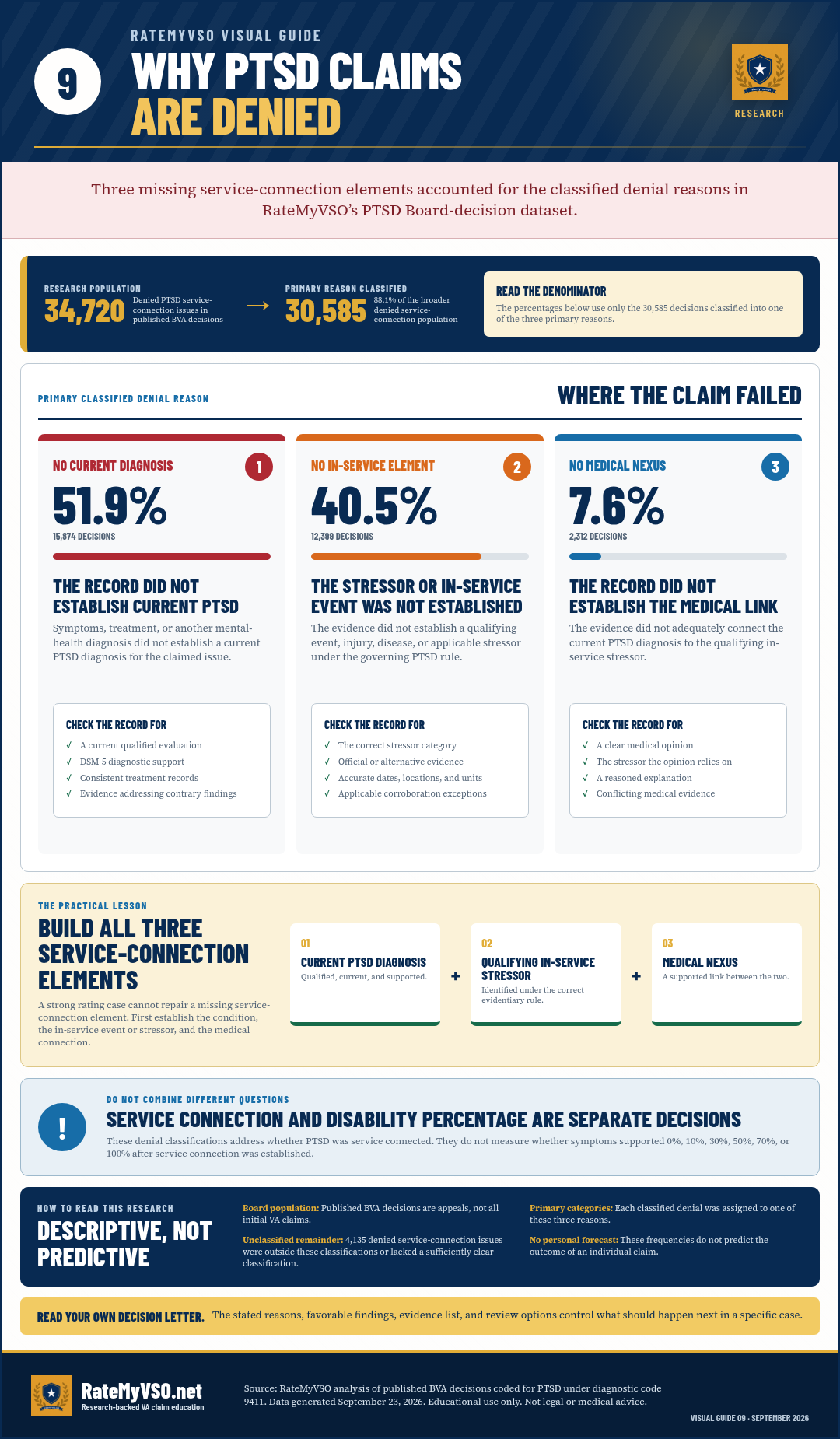
Beyond the general "no current diagnosis," "unverified stressor," and "no nexus" reasons covered above, a few specific denial patterns show up often enough in published decisions to call out on their own.
- A verified stressor with no current diagnosis. A fully documented, even conceded, in-service stressor is not enough by itself. Claims have been denied where VA agreed a combat or other stressor qualified, but at the time of the claim there was no current PTSD diagnosis in the record.
- A passing or "by history" mention of PTSD, without a real DSM-5 evaluation behind it. Where repeated exams find the DSM-5 criteria are not met, and the only supporting notes are unexplained "by history" entries, those notes are typically given little weight because nothing shows they followed the DSM-5 standard.
- An uncorroborated personal-assault stressor. When a personal-assault or MST stressor cannot be corroborated, and the only supporting statements come from family members who did not personally witness the in-service event, the stressor element can fail. Using the wider range of alternative evidence available under 38 CFR § 3.304(f)(5), behavioral-change records, counseling notes, contemporaneous statements from people who knew the veteran at the time, is the stronger path.
- A medical opinion built on facts that are not in the actual record. A nexus opinion that assumes a fact not supported by the file, for example assuming the veteran was already service connected for a condition that had never been established, can be given no weight regardless of its conclusion. Make sure any doctor writing your opinion is working from your correct, real facts.
- An onset story that shifts, or points in different directions. When the record contains conflicting accounts of when symptoms began, for example pointing to childhood in one place and to years after service in another, that inconsistency lets VA find the condition started outside of service.
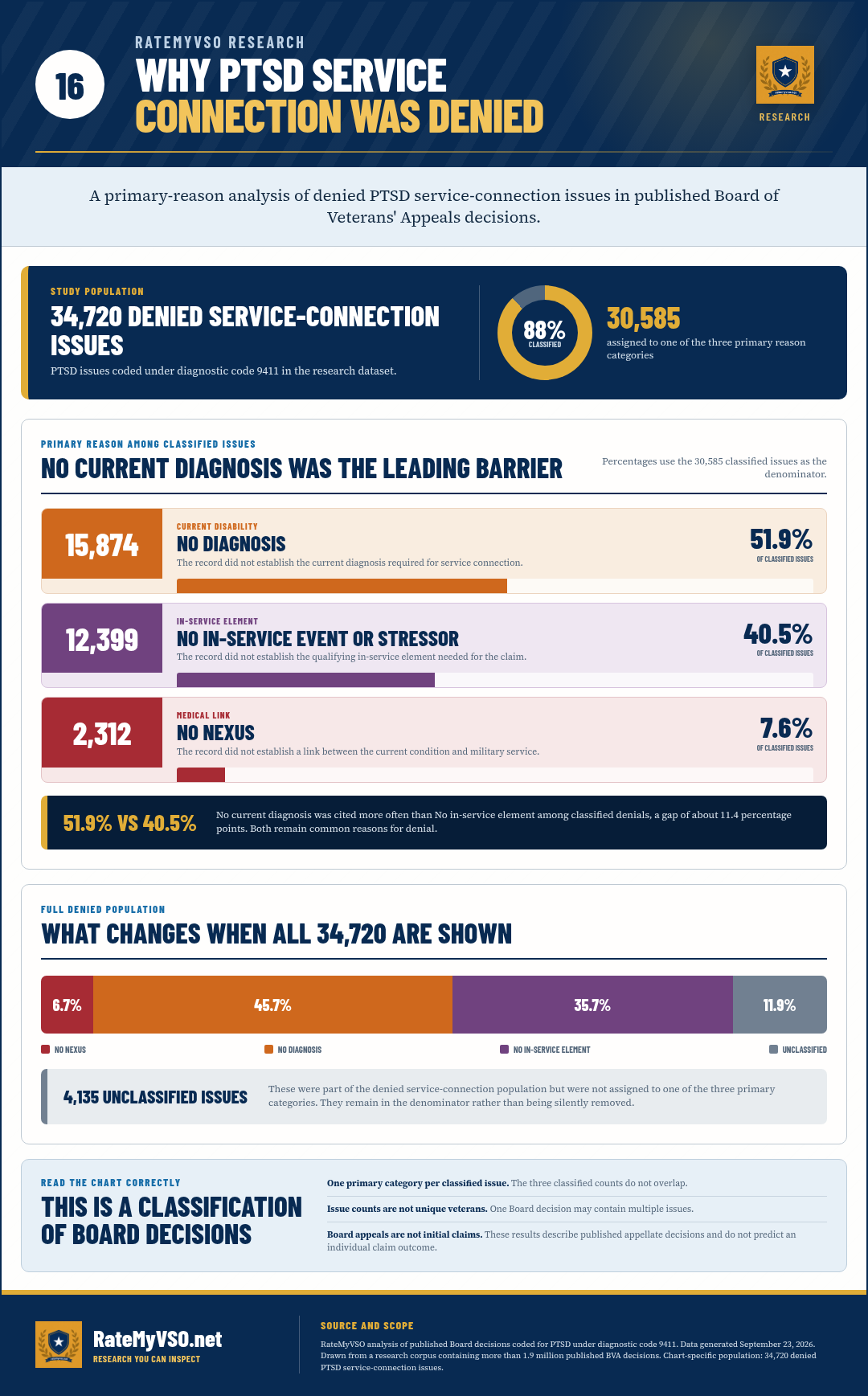 One-page guide: PTSD Denial Reasons Research
Primary denial-reason distribution across 30,585 classified PTSD service-connection issues, out of 34,720 denied, with the 4,135 unclassified issues shown separately. Opens the full-size chart, free to save or print.
One-page guide: PTSD Denial Reasons Research
Primary denial-reason distribution across 30,585 classified PTSD service-connection issues, out of 34,720 denied, with the 4,135 unclassified issues shown separately. Opens the full-size chart, free to save or print.
Pitfalls and Common Mistakes
Patterns the published DC 9411 decisions and the rating rules flag most often. Among the Board's classified service-connection denials for PTSD, the most common reasons are no current diagnosis, no verified in-service stressor, and a missing medical nexus. The pitfalls below are more about how a claim or appeal is handled procedurally.
- Treating a different mental-health diagnosis as a loss. When a C&P examiner diagnoses MDD or anxiety instead of PTSD, the claim is not automatically denied. The sympathetic-reading rule requires VA to evaluate whatever mental disability the evidence reasonably supports. See Sympathetic Reading.
- Filing separately for overlapping mental-health diagnoses. Under 38 CFR 4.14, overlapping symptoms across mental-health diagnoses produce one combined rating, not stacked ratings. Physical secondaries such as sleep apnea or migraines are rated separately, and should be filed as their own secondary claims.
- Missing an appeal deadline, or using a vague appeal form. A Board appeal filed after the one-year deadline can be dismissed with no ruling on the merits, and a blanket appeal form that does not name the specific decision being appealed can be found invalid. File on time, and name the exact decision and issues you are appealing.
- Letting your account of the stressor or symptom onset drift between statements. Consistency across every form, exam, and hearing is one of the most repeated factors in the Board's reasoning, in both directions.
A printable one-page version of these pitfalls, Common Reasons PTSD Claims Are Denied, is in the PTSD Visual Guide Library.
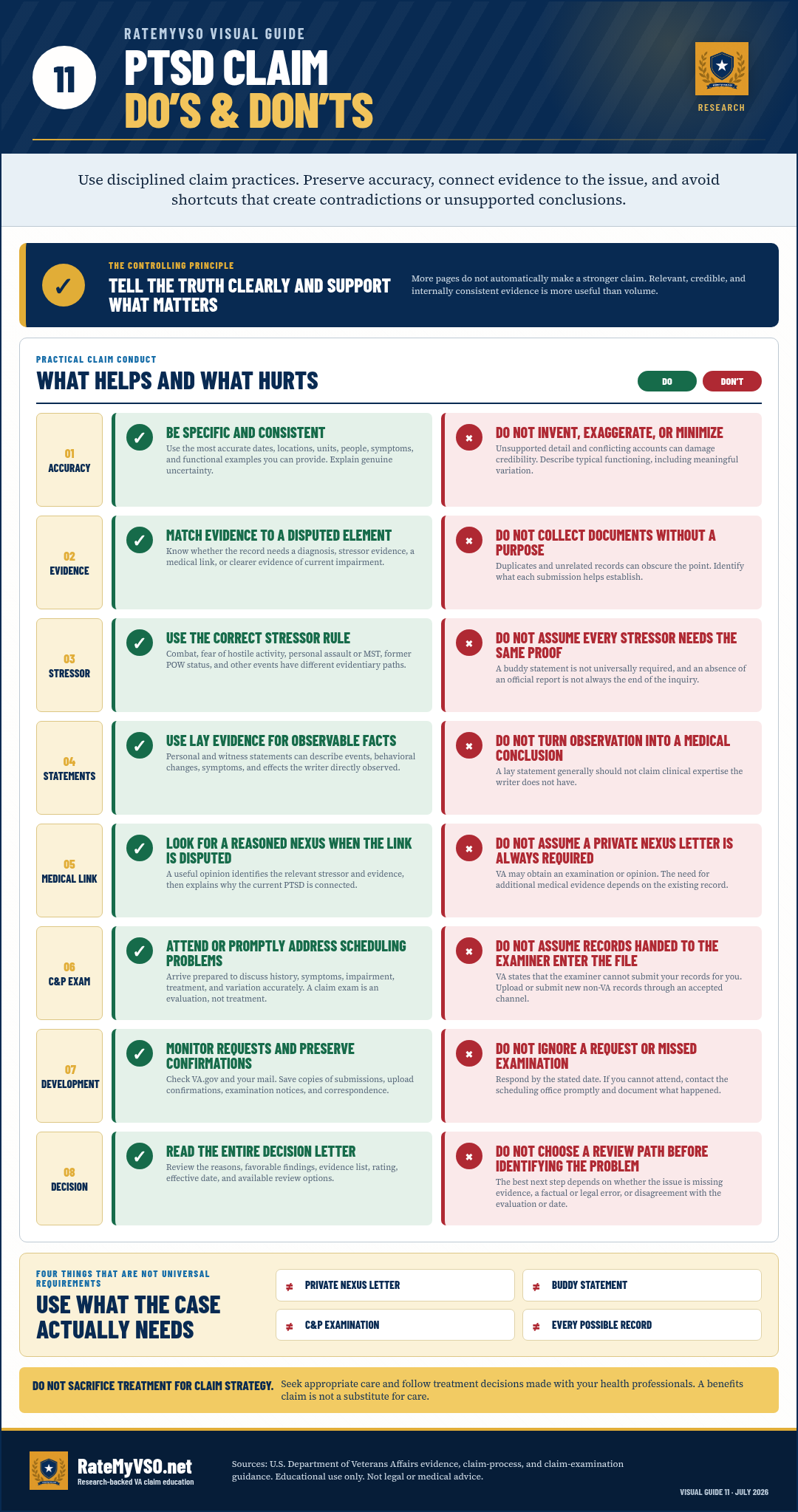
Do's and Don'ts
A condensed version of everything above, in the order it actually matters when you sit down to build your file.
- Get a real DSM-5 evaluation from a qualified mental health professional, not just a chart note that mentions PTSD in passing.
- Identify which stressor category applies to you (in-service diagnosis, combat, fear of hostile activity, POW, or MST/personal assault) and use the evidence standard that category allows.
- Get a medical nexus opinion that explains its reasoning and addresses your specific stressor and history, not a bare conclusion.
- Corroborate your stressor with something objective where you can: a buddy statement, personnel or exposure records, or unit records.
- Keep your account of the stressor and your symptom onset consistent across every form, exam, and hearing.
- Seek treatment early and keep going, contemporary treatment records help prove your symptoms started around service and continued.
- Add lay statements from family or fellow service members describing symptoms they've witnessed.
- Be honest about your worst days when describing your symptoms, not just your good ones.
- Match your description of symptoms to the language the rating formula actually uses where it's true to your experience.
- File on time and name the exact decision and issues on every appeal form.
- If you were denied before, file a Supplemental Claim with new and relevant evidence rather than starting over.
- Don't assume a strong, even fully verified, stressor wins the claim by itself, you still need a current diagnosis and a nexus.
- Don't rely on a passing or "by history" PTSD mention as your diagnosis, get a real DSM-5 evaluation.
- Don't rely only on family statements to corroborate a personal-assault stressor if they didn't witness the in-service events, use the wider range of alternative evidence the rule allows.
- Don't let a nexus opinion rest on facts that aren't actually in your record, make sure the provider has your correct history.
- Don't let your account of when symptoms began shift between statements and exams.
- Don't assume a different mental-health diagnosis (MDD, GAD, anxiety) ends your claim, the sympathetic-reading rule covers you.
- Don't file overlapping mental-health diagnoses as separate claims, but do file physical secondary conditions on their own.
- Don't minimize your symptoms when describing your worst days to an examiner.
- Don't miss the one-year Board appeal deadline, and don't file a vague appeal form that fails to name the specific decision.
A printable side-by-side version, PTSD Claim Do's and Don'ts, is in the PTSD Visual Guide Library.
Evidence for a PTSD Claim
We analyzed the Board's published DC 9411 decisions: a private nexus opinion in the file goes with a much higher grant rate, shown below.
A DSM-5 diagnosis, documented as such. For PTSD ratings, the C&P examination carries the most weight in determining the rating level. The examiner uses a Disability Benefits Questionnaire (DBQ) for mental disorders and assesses the current level of occupational and social impairment. See our DBQ Library for the form itself. The examiner is not required to document symptoms the veteran does not report during the exam.
A nexus opinion that explains its reasoning. Across published decisions, an opinion that walks through the "why," addressing the specific stressor, the veteran's history, and the mechanism connecting the two, has been given far more weight than one that simply states a conclusion. This has held true regardless of whether the opinion came from a private provider or a VA examiner; what matters is the reasoning, not just who wrote it.
Stressor corroboration. A fellow service member's statement describing the same event, personnel or exposure records placing the veteran at the right place and time, or unit records documenting the incident. See our PTSD Stressor Verification Guide.
A consistent account, told the same way every time. The Board has repeatedly leaned on whether a veteran's account of the stressor and the onset of symptoms stayed the same across statements, exams, and hearings over the years. Tell the same honest account to every doctor, on every form, and at any hearing.
Contemporary treatment records. Ongoing treatment helps prove your symptoms started around service and continued. A documented crisis-line call, an emergency visit, or the start of regular therapy close in time to separation can matter as much as anything else in the file. Getting help also protects your health, which matters most.
Lay statements: First-person descriptions of symptoms, and statements from a spouse, family members, or people who served alongside you who directly observed nightmares, anger, hypervigilance, or avoidance, contribute to the evidence record. See our Buddy & Lay Statements Guide. Lay statements are admissible for describing symptoms a person can directly observe. (Buchanan v. Nicholson, 451 F.3d 1331 (Fed. Cir. 2006).)
Secondary relationships
Common Secondary Conditions
We found these are the conditions most often linked with PTSD in the Board's published decisions. Each bar is the BVA grant rate for DC 9411, with the number of decisions below it. They describe what the Board's record shows across many veterans, not a prediction about any one claim.
Conditions PTSD can cause (PTSD as the primary)
Conditions veterans have claimed as caused or aggravated by a service-connected PTSD:
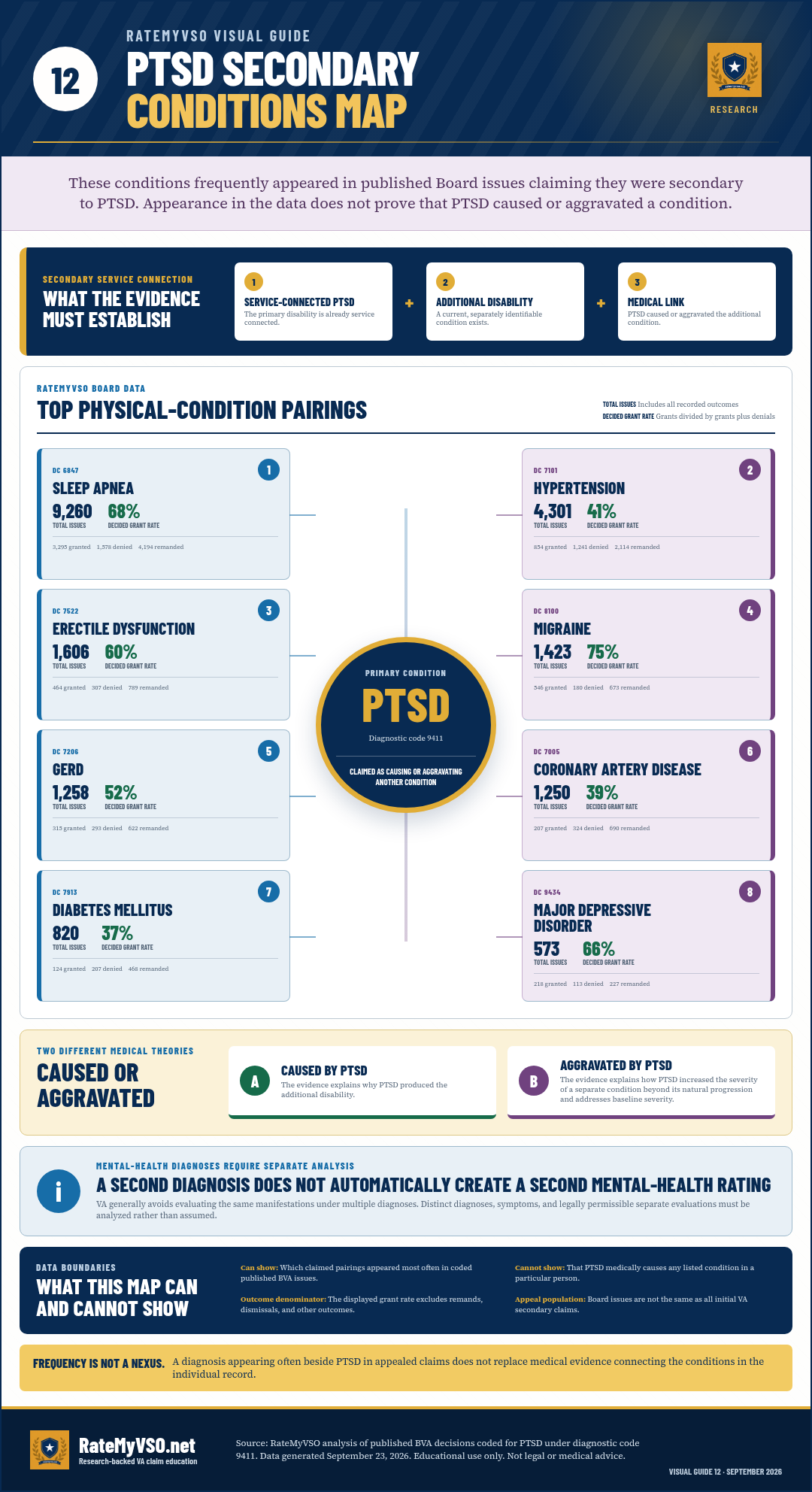 One-page guide: PTSD Secondary Conditions Map
Board-data map of conditions claimed secondary to PTSD with issue counts and decided grant shares, led by 9,260 sleep apnea appeals. Opens the full-size chart, free to save or print.
One-page guide: PTSD Secondary Conditions Map
Board-data map of conditions claimed secondary to PTSD with issue counts and decided grant shares, led by 9,260 sleep apnea appeals. Opens the full-size chart, free to save or print.
Prepare and take the next step
Prepare: your own working pages
Optional. These are your own notes, in your own words. They are not a VA form, they are not sent to the VA, and nothing here is a medical finding or a prediction about your claim.
Three reminders while you prepare
- Which stressor path applies changes what is needed
Combat, fear of hostile activity, personal assault and a few others are proved differently, and one of them may need no outside corroboration at all. Find yours before gathering anything. Go to this part
- The rating is about functioning, not a symptom list
Note what the symptoms stop you doing at work and at home, in your own words. The guide sets out the criteria and what the Board has treated as meeting them. Go to this part
- Bring the diagnosis, the stressor and the link together
Note what records exist for each of the three, and mark honestly what you do not have. The figures on this page describe published Board decisions, not your odds. Go to this part
Sign in or create an account to save your answers and come back to them later. You can fill these in and print them without an account.
Stressor-path and record questions
Daily-functioning notes
Treatment and exam questions
Records and unanswered questions
Decision-letter reading sheet
Quick Checklist Before You File
Bring these together before you submit anything.
- A current PTSD diagnosis made under the DSM-5 by a qualified professional, documented as such, not just a passing mention.
- A written description of your in-service stressor, told the same way every time, and matched to the correct stressor category.
- Proof the stressor happened: service or personnel records, an exposure record, or a buddy statement. For combat, fear of hostile activity, POW, or personal assault, use the easier proof rules in Stressor Categories.
- A medical nexus opinion that connects your PTSD to the stressor and explains its reasoning.
- Treatment records and lay statements from family or fellow service members describing your symptoms.
- A calendar note for every VA deadline, and specific decision details named on every appeal form.
For the mechanics of actually submitting the claim, see the Standard Claim Guide and the Fully Developed Claim Guide (filing with all your evidence up front can speed up the decision).
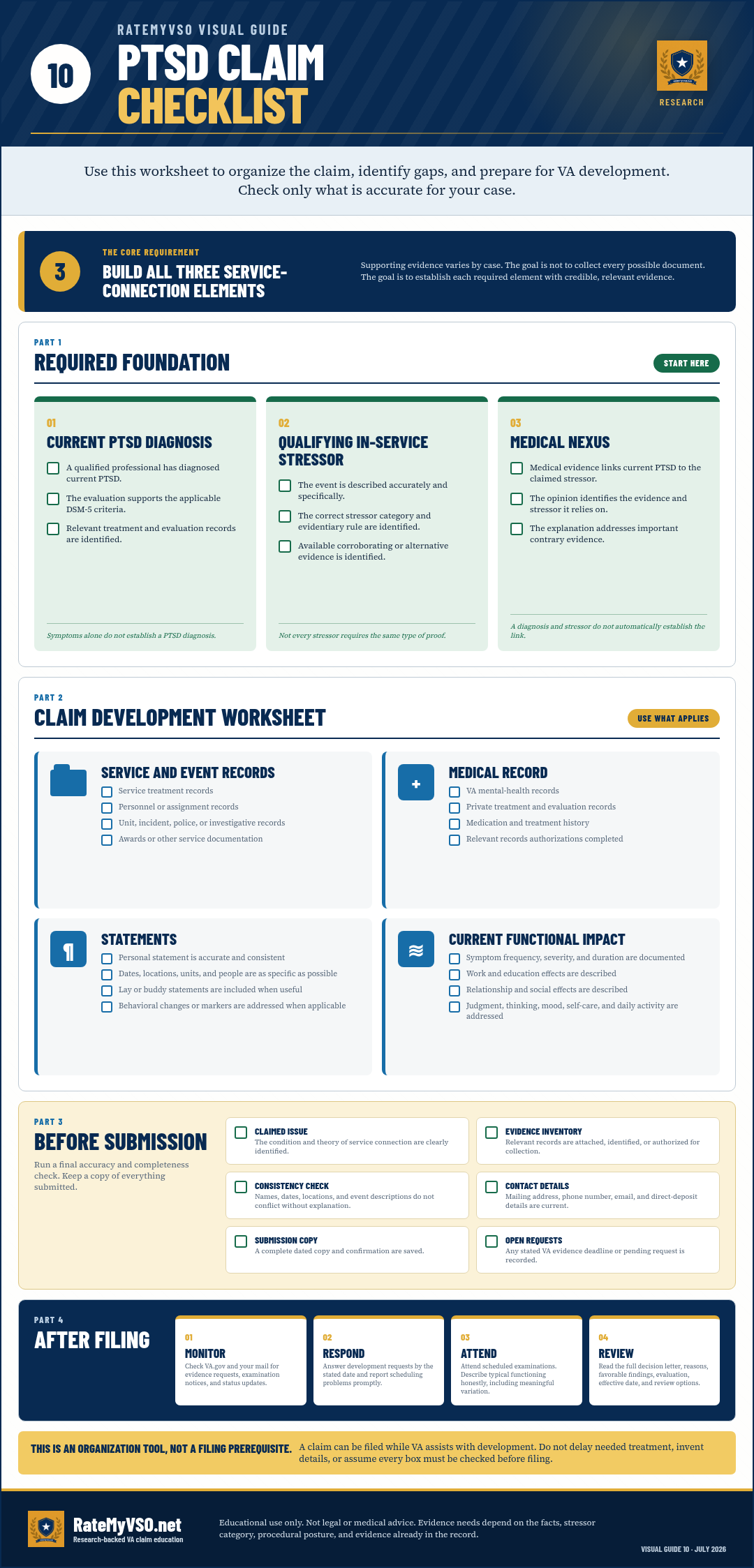 One-page guide: PTSD Claim Checklist
PTSD claim preparation checklist covering diagnosis, stressor, nexus, records, statements, filing, and examination preparation. Opens the full-size chart, free to save or print.
One-page guide: PTSD Claim Checklist
PTSD claim preparation checklist covering diagnosis, stressor, nexus, records, statements, filing, and examination preparation. Opens the full-size chart, free to save or print.
The Claims Process, Step by Step
Once you file, your claim moves through a series of hand-offs. Understanding who does what helps you know who to contact, and what to expect, at each stage.
- You file the claim. Directly with VA, through VA.gov, or with the help of an accredited representative.
- VA acknowledges the claim and assigns it for development. A Veteran Service Representative (VSR) is assigned to gather your service treatment records, VA and private medical records, and any other evidence needed.
- The VSR orders a Compensation & Pension (C&P) exam. Nearly all PTSD claims require one, since the exam produces the DSM-5 diagnosis and the assessment of occupational and social impairment the rating depends on.
- The C&P exam is conducted. By a VA clinician or a contracted examiner, who completes a Disability Benefits Questionnaire (DBQ) for mental disorders, documenting the diagnosis, symptom severity, and, where relevant, a nexus opinion.
- The file goes to a Rating Veteran Service Representative (RVSR), the "rater." The rater reviews the complete file, including the exam results, and decides whether service connection is warranted and at what percentage.
- A senior reviewer may review the decision before it's finalized, depending on the complexity of the claim.
- VA issues the decision letter. This states whether the claim is granted or denied, the rating percentage if granted, and the reasons behind the decision.
- If you disagree, you choose an appeal lane. Higher-Level Review, Supplemental Claim, or a Board appeal, covered later in this guide.
Who's who: VSO vs. VSR vs. Rater vs. C&P Examiner
Your VSO
An accredited representative from a veterans service organization, or an accredited attorney or claims agent. Not a VA employee. Helps you prepare, gather evidence, and file, and can represent you through an appeal. Has no authority to decide your claim.
VSR (Veteran Service Representative)
VA staff who "develops" your claim: requests records, schedules the C&P exam, and assembles the file. Does not decide the rating.
Rater (RVSR)
VA staff who reviews the completed file and makes the actual decision, service connection or denial, and the percentage. This is the person whose judgment the decision letter reflects.
C&P Examiner
A VA clinician or a contracted medical examiner who conducts the exam and completes the DBQ. Documents findings and, where asked, a nexus opinion. Does not decide the claim.
For the full walkthrough of every stage with more detail, see Inside Your Claim and Claim Stages.
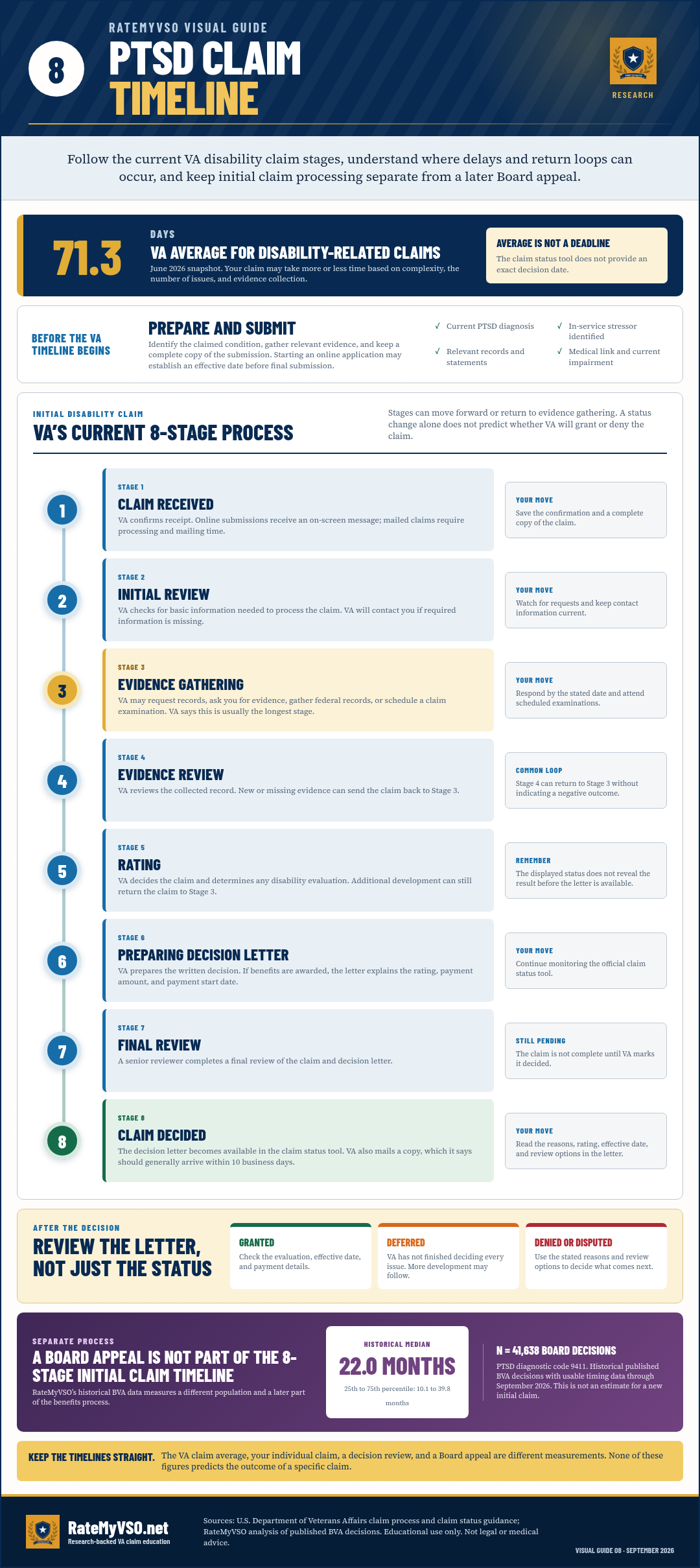 One-page guide: PTSD Claim Timeline
PTSD claim timeline showing filing, initial review, evidence gathering, examination, decision and possible review paths, with a Board median of 22.0 months across 41,638 appeals. Opens the full-size chart, free to save or print.
One-page guide: PTSD Claim Timeline
PTSD claim timeline showing filing, initial review, evidence gathering, examination, decision and possible review paths, with a Board median of 22.0 months across 41,638 appeals. Opens the full-size chart, free to save or print.
DBQs and Your C&P Exam
A Disability Benefits Questionnaire (DBQ) is the standardized form an examiner completes for your condition. For PTSD, it structures the exam findings into the specific occupational and social impairment criteria the rating schedule requires, along with a nexus opinion where one is requested. See the DBQ Guide for how these forms work, including whether a private DBQ completed by your own doctor can be submitted instead of relying solely on a VA exam.
Before your C&P exam, bring a clear, specific, and honest account of your symptoms, focus on your worst days and how the condition affects daily function, not just how you feel on an average day. Be consistent with what's already in your medical records and prior statements. The examiner is not required to document symptoms you do not report, so do not minimize what you're actually experiencing. For a full walkthrough of what to expect and how to prepare, see the C&P Exam Prep Guide and the C&P Exam Reference.
Reading Your Decision Letter, and What to Do If Denied
Your decision letter has two parts: a narrative section explaining the reasoning (often called "reasons and bases"), and a codesheet showing the actual rating percentage, the effective date, and the diagnostic code used. See the Reading Your Decision Letter Guide for how to find and interpret each part, or use the Letter Interpreter tool to upload your own letter and get a plain-English breakdown.
If your claim is denied, or the rating is lower than you expected, you have three main lanes:
- Supplemental Claim: refile with new and relevant evidence, such as a new nexus opinion, a corroborating buddy statement, or updated treatment records. See Supplemental Claim Guide.
- Higher-Level Review (HLR): a senior reviewer looks at the same evidence again for a difference of opinion, no new evidence is added. See HLR Guide.
- Board Appeal: your case goes to a Veterans Law Judge at the Board of Veterans' Appeals, with options for a direct review, an evidence docket, or a hearing. File on time and name the exact decision and issues you are appealing. See Board Appeal Guide.
Not sure which lane fits your situation? See the Appeals decision guide for a side-by-side comparison of all three. If your denial turned on VA treating a different mental-health diagnosis as fatal to your PTSD claim, see Sympathetic Reading for the specific argument and where to raise it.
After You Win: Rating, Effective Date, and Maintaining Your Rating
Winning service connection is step one. VA then assigns a rating percentage and an effective date, which set your monthly payment and any back pay.
- Match your symptoms to the exact words of the rating criteria. Published decisions have secured a higher rating and an earlier start date where an exam used language listed directly in the rating rules, for example "difficulty adapting to stressful circumstances."
- Lean on treatment records when an exam seems to downplay you. Where treatment records document something more severe than a single exam captured, for example an actual suicide attempt where an exam recorded only ideation, the Board has given the treatment records more weight.
- Do not minimize your symptoms. The Board has recognized that some veterans tend to underreport, and has still granted a higher rating where the record supported it. Be honest about your worst days, not just your good ones.
- Keep appealing on time to protect your earliest effective date. Continuously pursuing a claim rather than letting a decision go final, and then refiling later, can preserve an earlier effective date.
Keep your treatment consistent. Continued follow-up with a mental health provider, and honest documentation of your symptoms over time, protects you if VA schedules a future reexamination (including the mandatory reexamination tied to the automatic 50% rule). Not every rating gets reexamined; understand when a rating becomes protected from future review (including Permanent and Total status) and what to do if VA proposes to reduce it. See Protect Your Rating and Future Reexaminations for the specifics.
If your PTSD worsens after the initial grant, you can file for an increased rating. See the Rating Increase Guide.
References and related resources
Quick Reference Tables
Stressor Categories at a Glance
| Stressor Type | Evidence Standard | Key Regulation |
|---|---|---|
| PTSD diagnosed in service | Lay testimony alone (no clear/convincing rebuttal) | 38 CFR § 3.304(f)(1) |
| Combat with enemy | Lay testimony if consistent with service circumstances | 38 CFR § 3.304(f)(2); 38 U.S.C. § 1154(b) |
| Fear of hostile/terrorist activity | Lay testimony plus VA psychiatric/psych confirmation | 38 CFR § 3.304(f)(3) |
| POW experience | Lay testimony alone; also presumptive | 38 CFR § 3.304(f)(4); 38 CFR § 3.309(c) |
| MST / Personal assault | Alternative evidence and behavioral markers accepted | 38 CFR § 3.304(f)(5) |
Service Connection Pathways
| Pathway | What It Requires | Key Regulation |
|---|---|---|
| Direct | Verified stressor (matched to category) + current DSM-5 diagnosis + medical nexus | 38 CFR § 3.304(f) |
| Aggravation | Pre-service PTSD or trauma-related condition, chronically worsened beyond natural progression by service | 38 CFR § 3.306 |
| Secondary | PTSD caused or aggravated by an already service-connected disability (uncommon for PTSD; used far more often in reverse, PTSD as the primary condition) | 38 CFR § 3.310 |
From Filing to Decision: Who Does What
| Role | Does | Decides your rating? |
|---|---|---|
| VSO / accredited representative | Helps prepare, gather evidence, and file; represents you on appeal | No |
| VSR | Develops the claim: orders records and the C&P exam | No |
| C&P Examiner | Conducts the exam, completes the DBQ, may give a nexus opinion | No / but has a strong impact |
| Rater (RVSR) | Reviews the full file and decides service connection and percentage | Yes |
Related Tools and Guides
Sources
- 38 CFR § 3.304(f), Direct Service Connection, PTSD Stressor Requirements
- 38 CFR § 4.125, Diagnosis of Mental Disorders (DSM-5 requirement)
- 38 CFR § 4.126, Evaluation of Disability from Mental Disorders
- 38 CFR § 4.129, Mental Disorders Due to Traumatic Stress
- 38 CFR § 4.130, Schedule of Ratings, Mental Disorders
- 38 CFR § 4.14, Avoidance of Pyramiding
- 38 CFR § 3.306, Aggravation of Pre-Service Disability
- 38 CFR § 3.310, Disabilities Proximately Due to a Service-Connected Disease or Injury
- 38 CFR § 4.16, Total Disability Ratings for Compensation Based on Unemployability
- 38 CFR § 3.309(c), Diseases Subject to Presumptive Service Connection (POW)
- 38 U.S.C. § 1154(b), Combat Veteran Presumption
- 38 U.S.C. § 5107(b) and 38 CFR § 3.102, benefit of the doubt when the evidence is in balance
- 75 FR 39843 (July 13, 2010), Final Rule Adding Fear of Hostile Military/Terrorist Activity Stressor Category
- Buchanan v. Nicholson, 451 F.3d 1331 (Fed. Cir. 2006), lay testimony evidentiary standard
- Allen v. Principi, 237 F.3d 1368 (Fed. Cir. 2001), Secondary service connection for substance use disorder
- Robinson v. Shinseki, 557 F.3d 1355 (Fed. Cir. 2009), Sympathetic reading of pro se filings
- M21-1 Part III, Subpart iv, Section 4.H, MST Adjudication Guidance
- M21-1, Part V, Subpart iii, Chapter 13, Section 1.a (effective 2026-05-27), Sympathetic Reading of Mental-Disorders Claims