GERD Secondary to PTSD
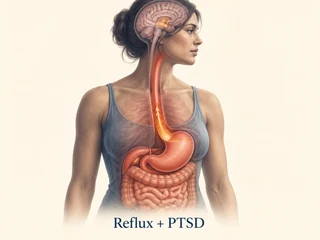
Acid reflux claimed as secondary to PTSD is one of the most common digestive pairings at the Board of Veterans' Appeals, and one of the closest: when the Board decides it on the merits, veterans win just over half the time. That makes the evidence pattern matter more here than in the easier pairings. This guide covers the gut-brain mechanism, the three causal chains that appear in the grants (stress, medication, and alcohol), the legal standard under 38 CFR § 3.310 including how Spicer's but-for standard has been used as a shield, five recent Board grants dissected, and the evidence that separates the wins from the losses.
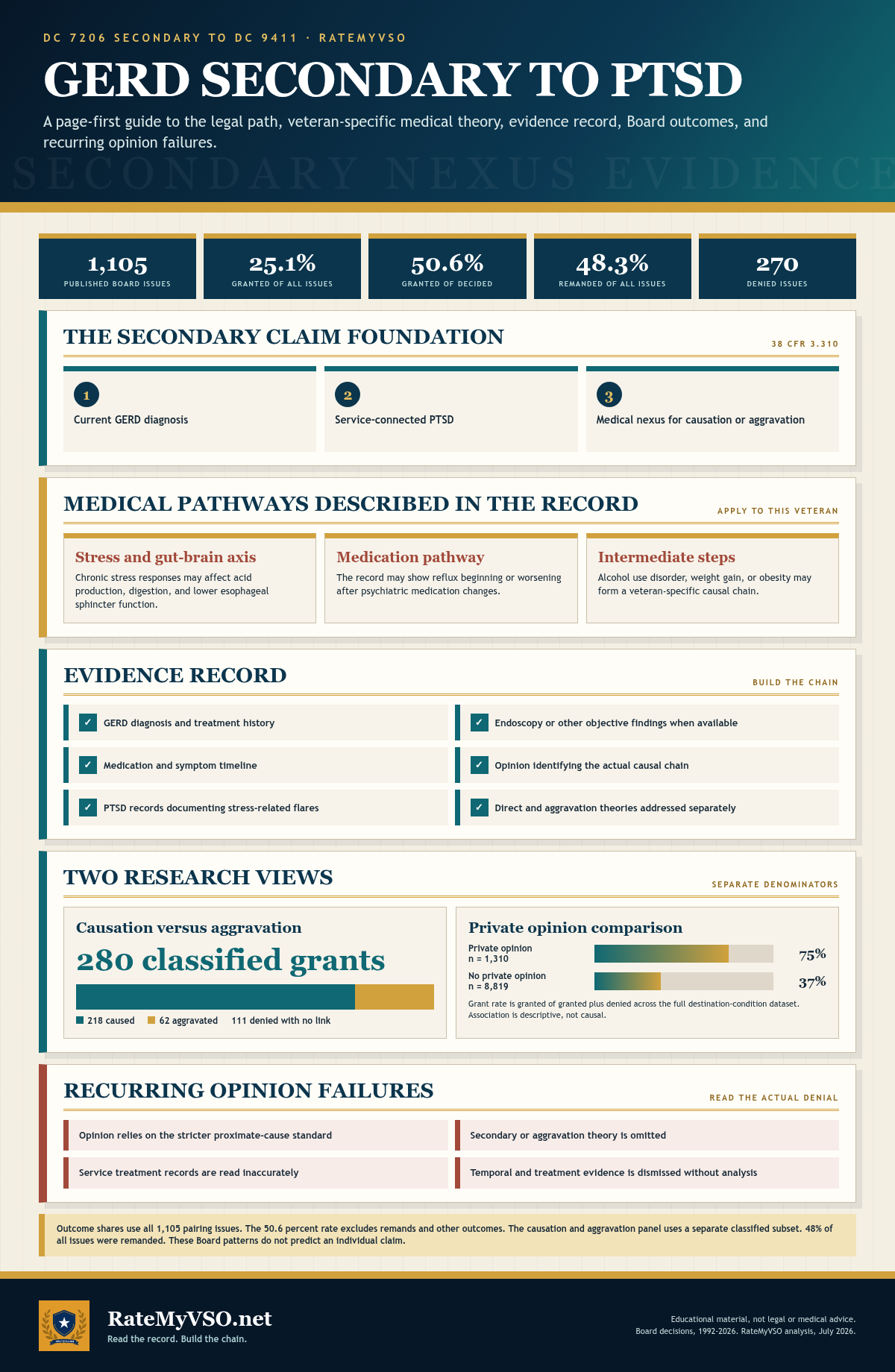 Visual guide: GERD Secondary to PTSD
Board outcomes for this pairing, the three secondary service-connection elements, the medical theories, the evidence record, and the causation versus aggravation split. Opens the full-size chart, free to save or print.
Visual guide: GERD Secondary to PTSD
Board outcomes for this pairing, the three secondary service-connection elements, the medical theories, the evidence record, and the causation versus aggravation split. Opens the full-size chart, free to save or print.
Start with the essentials
- 01Service Connection
The ways a secondary connection can be established for this pairing.
- 02Diagnosis and Evidence
Common symptoms and the evidence that supports this kind of claim.
- 03Your History
What you experienced, what others observed, and what treatment changed.
Understand the claim
ICD-10 Diagnosis Codes
The ICD-10 diagnosis codes most commonly used for DC 7206, Gastroesophageal reflux disease (the kind on your medical records, decision letter, or C&P exam report). VA rates the disability and its residuals, not the diagnosis itself, so coding can vary.
The Legal Path: 38 CFR § 3.310, and Spicer as a Shield
A secondary service connection claim needs three things (Wallin v. West, 11 Vet. App. 509 (1998)):
- A current disability: a diagnosed GERD, which for DC 7206 means a documented GERD diagnosis in the treatment records, ideally with endoscopy or medication-response evidence.
- A service-connected primary: the PTSD rating itself.
- A nexus: medical evidence connecting the two.
The shared doctrine (multi-step chains, the equipoise standard, the baseline trap on aggravation) is covered in depth in the companion guide: Sleep Apnea Secondary to PTSD. Two points are specific to how the GERD cases have played out:
Symptoms and rating
If Granted: The Rating
Since May 2024, GERD has its own diagnostic code, DC 7206 (38 CFR § 4.114), rated on esophageal stricture severity and swallowing impairment: 0, 10, 30, 50, and 80 percent tiers, with the 10 percent level reachable on daily medication for dysphagia and higher tiers requiring documented recurrent or refractory strictures. Claims rated before May 2024 sit under the old hiatal hernia analogy (DC 7346: 10/30/60). The secondary rating combines with your PTSD rating under VA math rather than adding, run it in the VA Math Calculator. Full rating detail, the C&P exam, and the code-change transition rules are in the general GERD Claims Guide.
Evidence and Board research
The Numbers, from 1.9M Appeals
In the Board's published decisions, GERD (DC 7206) claimed as secondary to PTSD (DC 9411) is the sixth most-filed PTSD secondary by volume, and the closest call: grants and denials run nearly even.
How those 1,105 issues came out
Compare the companion pairings: sleep apnea secondary to PTSD wins 67 percent of decided issues, migraines 74 percent. GERD's 51 percent grant rate and its high remand share point to the same cause: the medical-opinion record in these files is often thin, and the outcome here depends on the quality of the nexus evidence more than in any other top PTSD pairing. The five grants below show what the winning records had.
Five Recent Board Grants, Dissected
All five decisions below granted service connection for GERD secondary to PTSD, decided August 2025 through April 2026 before five different Veterans Law Judges. Published Board decisions are not precedent, but the patterns repeat.
Treating psychologist's letter plus two undeveloped theories · Citation A26030400 (Apr. 2, 2026), Hearing docket
The record: the veteran's treating clinical psychologist wrote that his "extreme stomach distress that has bordered on incapacitation... often seems to be associated with PTSD/stress flare-ups." The VA examiner credibly disagreed: the literature "does not support that PTSD causes GERD." The Board weighed both at moderate weight.
Why it won: the tie, plus VA's own errors. The agency had never obtained an aggravation opinion or an obesity-intermediate-step opinion (the veteran had a documented BMI of 30), theories it was obliged to develop. Equipoise plus benefit of the doubt granted the claim outright. A treating provider's plain clinical impression, not a purchased letter, was enough to reach the tie.
VA's own examiner wins it on the alcohol chain · Citation A26005396 (Jan. 21, 2026), Direct Review docket, decided one year after the rating decision
The record: the veteran's psychiatric rating was for PTSD with alcohol use disorder. The January 2025 VA examiner gave a positive opinion: alcohol consumption raises GERD risk with volume and frequency, about one serving a day tracks a 16 percent risk increase, so the GERD was at least as likely as not due to the service-connected condition.
Why it won: no negative opinion existed against the secondary theory, and the Board took the examiner's reasoning at face value. Where substance use is rated as part of the psychiatric disability, the chain from it to the stomach is part of the service-connected picture, and here VA's own exam made the case.
The proximate-cause error: negative VA opinion voided, GERD and OSA granted together · Citation A25097245 (Nov. 7, 2025), Direct Review docket
The record: one private opinion (a licensed physician assistant who interviewed the veteran and reviewed the records) covering two conditions: GERD aggravated by PTSD, and OSA aggravated by PTSD directly and through weight gain. VA opinions went the other way on both.
Why it won: the Board assigned the negative OSA opinion "no probative value" because it applied the proximate-cause standard, stricter than Spicer's but-for standard and therefore legally wrong, and found the negative GERD rationales inadequate. With the negatives gone or discounted, the single private opinion reached equipoise on both issues. One well-built opinion, two grants.
The VA exam that misread the service records · Citation A25089227 (Oct. 16, 2025), Hearing docket, Vietnam-era veteran
The record: the VA examiner denied on the ground that service records were "silent" for GERD-related symptoms. They were not: the May 1972 separation records documented midepigastric pain with shortness of breath, an irritable duodenal bulb, and antacid use. A private physician opined the veteran's PTSD and anxiety exacerbated his reflux and esophagitis.
Why it won: an opinion built on an inaccurate factual premise loses its weight (Reonal v. Brown, 5 Vet. App. 458 (1993)). The Board said the private opinion "may not be the strongest," and granted anyway, because the only opinion against it had disqualified itself. Read your own service records before the examiner does.
The medication timeline as the nexus · Citation A25072818 (Aug. 28, 2025), Evidence docket, after an HLR
The record: clean service records, no stomach complaints for two decades after service, psychotropic medication for PTSD started March 2019, stomach complaints documented from April 2019. A consulting clinician tied it together with the gut-brain-axis literature and the observation that the veteran's GERD flares tracked his PTSD flares. The VA opinion addressed only direct service connection and never engaged the secondary theory.
Why it won: the dates did the arguing. The Board walked through the pharmacy and treatment records itself and found the sequence credible and consistent. With no negative opinion on the secondary theory at all, equipoise was easy. The evidence that won was already in the veteran's VA treatment file; the opinion just organized it.
The pattern across all five
- Every grant had a reasoned opinion supporting the link, and the sources were unusually varied: a treating psychologist, VA's own examiner, a private physician assistant, a private physician, and a consulting clinician. None of the five turned on an expensive specialist.
- Three of five turned on a defect in the VA opinion: the wrong legal standard (proximate cause post-Spicer), an inaccurate factual premise, or silence on the secondary theory entirely.
- The specific chain matters: stress, medication timeline, alcohol, or obesity. The winning opinions named one and matched it to the record, rather than asserting a generic link.
- Equipoise carried at least two of the five. In this pairing, a tie is a win, and the tie is reachable with modest but well-grounded evidence.
What the Board Said in Recent Grants
These are the Board's own words, quoted from the findings in 5 recent granted decisions on this pairing. Each sentence is the finding the grant rested on, not a summary of it. Click a citation to read the full decision.
“The Veteran's GERD is at least as likely as not related to his service-connected PTSD”
“Resolving all reasonable doubt in the Veteran's favor, the Veteran has a current and valid diagnosis of gastroesophageal reflux disease (GERD), and it is at least as likely as not either secondary to service-connected PTSD, either with or without obesity as an intermediate step.”
“Resolving all reasonable doubt in the Veteran's favor, his GERD is caused by his service-connected PTSD”
“Affording the Veteran the benefit of the doubt, his gastroesophageal reflux disease (GERD) is caused by increased stomach acid due to service-connected post-traumatic stress disorder (PTSD)”
“The Veteran's GERD is caused by his service-connected posttraumatic stress disorder (PTSD), with major depressive disorder (MDD).”
Quoted from published Board decisions on this pairing, most recent first. Descriptive of the published record, not a prediction about any individual claim. Search the full decisions in BVA Decision Search.
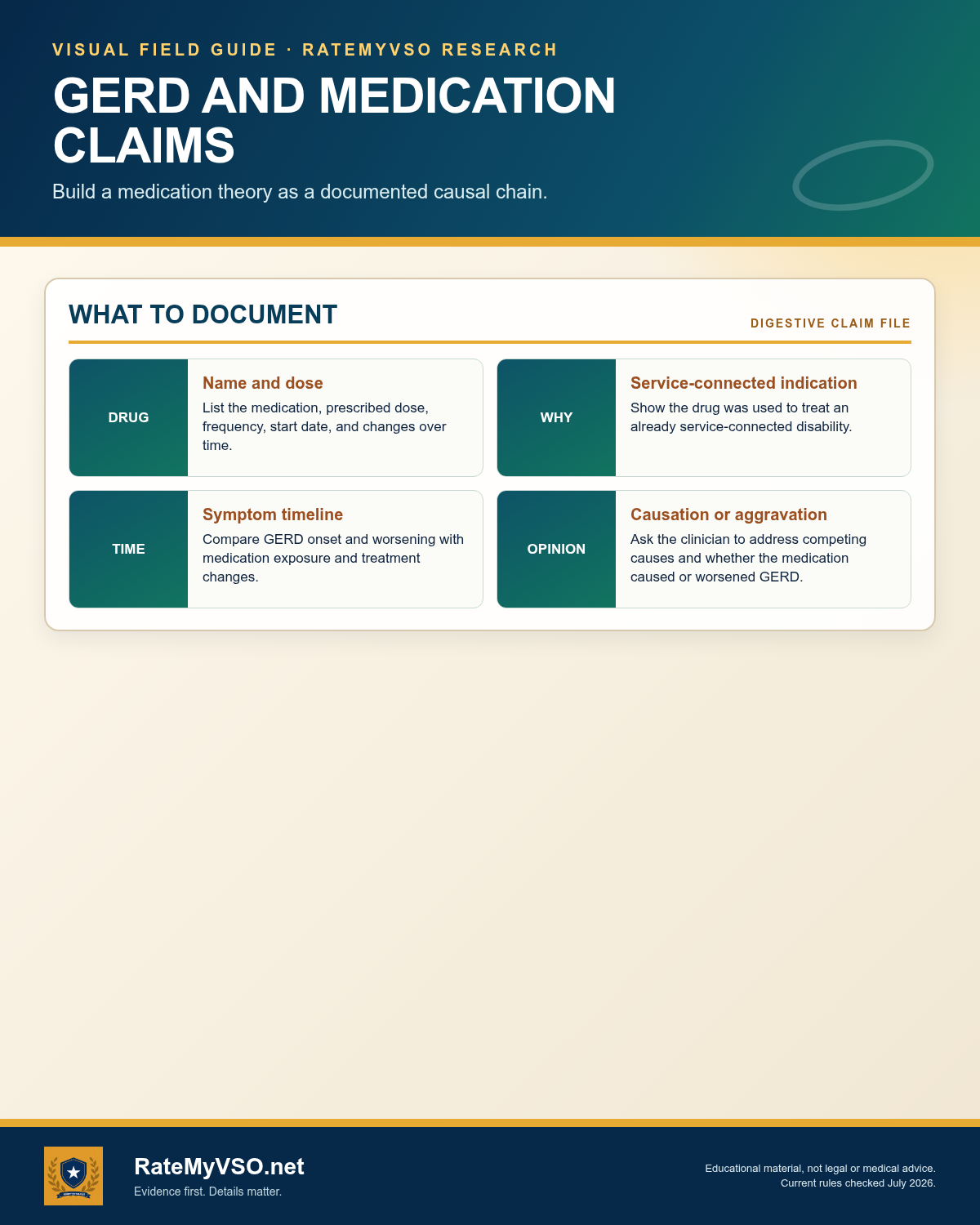
The Evidence Checklist
What the winning files contained, item by item.
- A documented diagnosis: GERD in your treatment records, ideally with objective support (endoscopy findings, a Barrett's esophagus note, or documented response to acid-suppressing medication). The rating decision's "favorable findings" section often concedes the diagnosis early; from there the whole case is the nexus.
- The chain, matched to your record: the winning opinions each picked the causal route the file actually supported:
- Stress: treatment notes showing stomach distress flaring with PTSD symptoms (the treating psychologist's observation in A26030400).
- Medication: the prescription timeline, what was started, when, and when the reflux complaints began (A25072818).
- Alcohol: where alcohol use disorder is rated with the PTSD, the consumption history connects it (A26005396).
- Obesity: BMI history plus evidence the weight gain traces to the PTSD or its medications (the intermediate-step analysis in A26030400).
- A reasoned nexus opinion: "at least as likely as not caused by, or aggravated by," the service-connected PTSD; the gut-brain mechanism in plain terms; the specific chain named; the literature cited (the 2x GI-disorder findings in veterans with mental health diagnoses, the alcohol dose-risk data). Written to the but-for standard, not "proximate cause."
- Your service records, read closely: in-service stomach complaints, antacid use, or epigastric treatment notes matter twice: they can anchor a parallel direct theory, and they preempt the "records are silent" denial that failed in A25089227.
- Your own statement: symptom onset and flare timing relative to PTSD symptoms and medication changes is competent lay evidence (Layno), and it steered the Board's own record-reading in A25072818.
Across all published DC 7206 decisions, files with a private medical opinion track a much higher grant rate, shown live below.
Why VA Denies These Claims, and What the Board Said Back
Each rationale below is quoted or paraphrased from the actual VA examinations in the five cases, alongside how the Board answered it.
| VA examiner's rationale | How the Board answered it |
|---|---|
| "The medical literature does not support that PTSD causes GERD." | Weighed as credible, but only to moderate weight, and the claim still granted at equipoise where a treating provider's opinion sat on the other side and VA had failed to develop the aggravation and obesity theories (A26030400). |
| Opinion written against "proximately due to or the result of," the pre-Spicer standard. | "No probative value." Proximate cause is stricter than the but-for standard 38 U.S.C. § 1110 requires, so the opinion answered the wrong legal question (A25097245). |
| "Service treatment records are silent" for GERD symptoms. | Factually wrong on the record (separation exam documented epigastric pain and antacid use), and an opinion on an inaccurate factual premise loses its weight (Reonal; A25089227). |
| Negative opinion addresses direct service connection only, never the secondary theory. | Not evidence against the secondary claim at all; the positive secondary opinion stood unopposed (A25072818, and the same gap fed the grant in A26005396). |
| The temporal link and the psychologist's impression are "compelling" but "do not imply causation." | The demand for proven causation overshoots the standard. Approximate balance plus benefit of the doubt is the test, and the Board granted on exactly that posture (A26030400). |
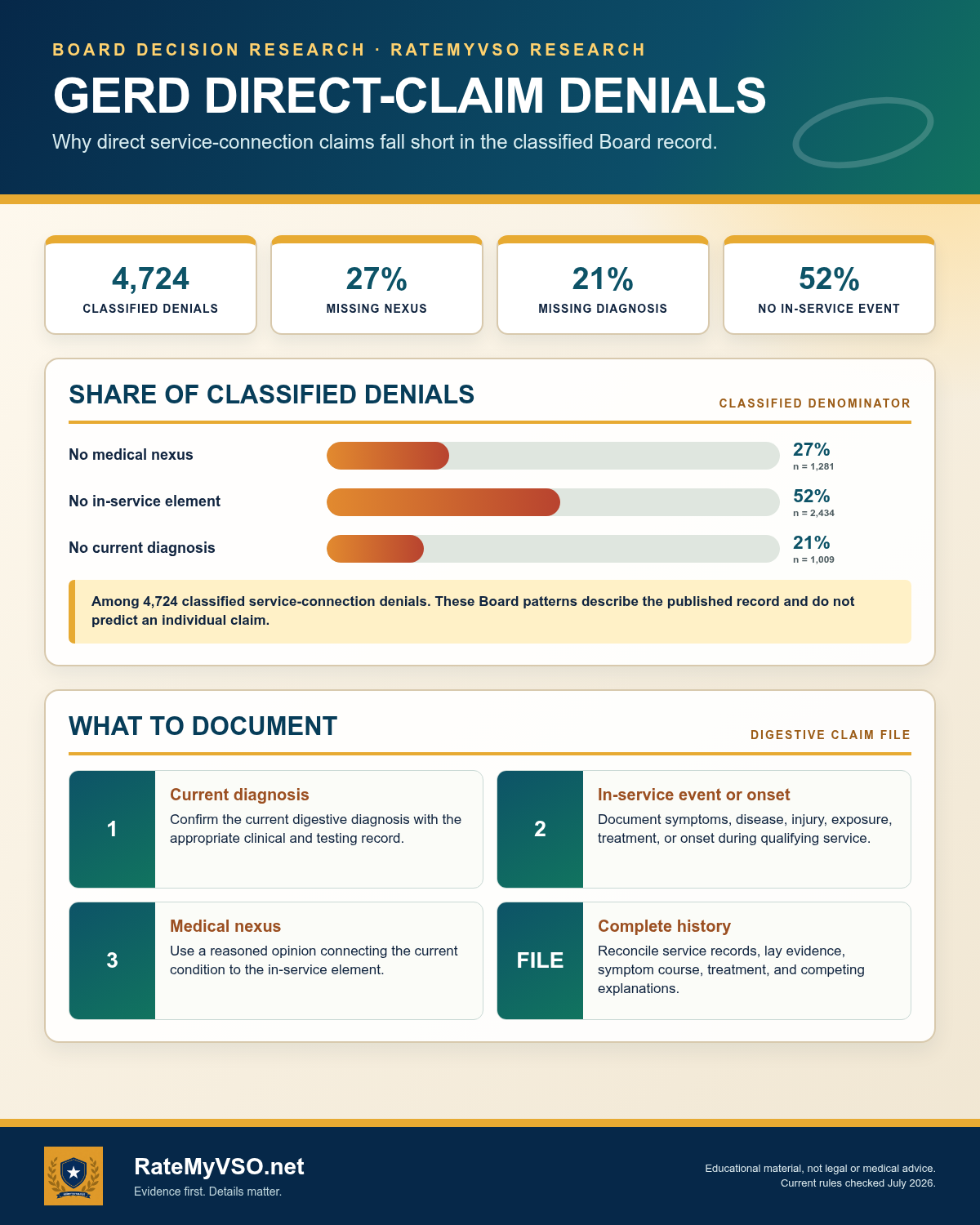
Across the Board's full record for GERD, the most common denial reason is a missing in-service event, shown live below.
Secondary relationships
The Mechanism: How PTSD Causes GERD
The credited opinions in recent grants describe three distinct causal chains from PTSD to reflux disease. A strong nexus opinion picks the chain that matches the veteran's actual record.
1. The stress chain: fight-or-flight and the gut-brain axis
The nerves connecting the digestive system to the brain release chemicals that regulate the contraction and relaxation of the gastrointestinal tract. Chronic activation of the fight-or-flight response disrupts that regulation: acid production rises, digestion slows, and sustained stress weakens the lower esophageal sphincter, the muscle that keeps stomach acid out of the esophagus. A credited clinician put it directly: medical research shows stress affects illness "via the brain-gut axis, particularly with gastrointestinal conditions, with a higher rate of gastrointestinal disorders demonstrated among patients with PTSD" (Bd. Vet. App. A25072818). Research on post-9/11 veterans has found those with mental health diagnoses were roughly twice as likely to develop gastrointestinal disorders as those without.
2. The medication chain
Common psychiatric medications can relax the lower esophageal sphincter and delay stomach emptying. In one grant, the timeline itself became the evidence: the veteran had no GERD symptoms before, during, or at separation from service, started psychotropic medication for his service-connected PTSD in March 2019, and his stomach complaints began in April 2019. The Board matched the treatment records to the pharmacy dates and granted (Bd. Vet. App. A25072818). If your reflux began after a prescription change, that sequence is documentary evidence sitting in your own records.
3. The alcohol chain
Where alcohol use disorder is part of the service-connected psychiatric rating, the chain runs through it. In one grant the VA examiner's own opinion carried the claim: alcohol consumption is associated with increased GERD risk that rises with volume and frequency, and roughly one serving per day is associated with a 16 percent increase in the risk of developing GERD (VA examiner's opinion, credited in Bd. Vet. App. A26005396). Obesity works the same way: where PTSD drives weight gain, obesity can be the "intermediate step" between the psychiatric condition and the reflux (VAOPGCPREC 1-2017, expressly analyzed in Bd. Vet. App. A26030400).
Spicer cuts both ways, and recently it cut for the veteran
Spicer v. McDonough, 61 F.4th 1360 (Fed. Cir. 2023) held that secondary service connection requires "but-for" causation, which is broader than the old "proximate cause" language, it reaches multi-step chains and even situations where the service-connected condition blocks treatment of the other one. In practice VA examiners often still write opinions against the old, stricter proximate-cause standard. In one November 2025 double grant (GERD and sleep apnea together), the Board threw out the negative VA opinion entirely, assigning it "no probative value," because it applied proximate cause, "which is stricter than but-for causation," and granted both claims on the private opinion that remained (Bd. Vet. App. A25097245). If your denial rests on an opinion phrased around "proximately due to," the standard itself may be the reviewable error.
When VA Never Checked a Theory It Should Have
VA's duty to assist includes developing every theory reasonably raised: causation, aggravation, and where the record shows weight gain, the obesity-intermediate-step question. In one April 2026 grant the Board found the agency committed pre-decisional error twice over, by never obtaining an aggravation opinion and never obtaining an obesity-intermediate-step opinion, and resolved the resulting equipoise for the veteran rather than remanding (Bd. Vet. App. A26030400). The near-50-percent remand rate in this pairing is largely this: files sent back because a theory was never medically addressed.
The Wider Data
Where GERD sits among the conditions veterans claim as secondary to PTSD. Live from the Board's published decisions, refreshed weekly:
Bars are BVA grant rates among decided issues for each condition claimed as secondary to PTSD, with issue counts. Descriptive of the published record, not a prediction about any one claim. Explore the underlying decisions in BVA Decision Search.
Prepare and take the next step
Prepare: your own working pages
Optional. These are your own notes, in your own words. They are not a VA form, they are not sent to the VA, and nothing here is a medical finding or a prediction about your claim.
Three reminders while you prepare
- Keep the two conditions separate
Record the history, diagnosis, symptoms, and treatment for PTSD and GERD separately before describing the possible relationship. Go to this part
- Ask about causing and worsening separately
A clinician may need to address whether PTSD caused GERD, whether it worsened it, and what other explanations the record shows. Go to this part
- Build the timeline from records you have
Mark missing or unverified records honestly. Research from published Board decisions describes the record reviewed; it does not predict an individual claim. Go to this part
Sign in or create an account to save your answers and come back to them later. You can fill these in and print them without an account.
Two-condition timeline
GERD: symptoms and daily function
Provider questions about the relationship
Records and unanswered questions
Decision-letter reading sheet
Quick Checklist Before You File
- Documented GERD diagnosis, ideally with endoscopy or medication-response evidence.
- One clearly identified causal chain (stress, medication, alcohol, or obesity) that matches your actual record.
- A nexus opinion written to the but-for standard, naming the chain and citing the underlying mechanism.
- Your own service treatment records reviewed for any stomach, epigastric, or antacid-use entries.
- Pharmacy and treatment dates pulled and lined up if you're arguing the medication-timeline chain.
- If your psychiatric rating includes alcohol use disorder, note that connection explicitly.
- If you have a documented weight-gain history tied to PTSD or its medications, raise the obesity-intermediate-step theory rather than leaving it for VA to (not) develop.
For the mechanics of filing itself, see the Standard Claim Guide and the Fully Developed Claim Guide.
Do's and Don'ts
A condensed version of the pattern across the five grants and the denial rationales above.
- Get a documented GERD diagnosis in your file, ideally with objective support (endoscopy, a Barrett's note, or a recorded response to acid-suppressing medication).
- Pick the chain your record actually supports, stress, medication timeline, alcohol, or obesity, and get a nexus opinion built around that one, not a generic link.
- Pull your own pharmacy and treatment dates before the exam does; a clean timeline from medication start to symptom onset was the deciding evidence in more than one grant.
- Check whether a negative opinion was written to "proximately due to" instead of "at least as likely as not" or "but for", that's a legal defect, not just a disagreement.
- Read your own service treatment records for any epigastric, antacid, or stomach-complaint entries VA might have missed or mischaracterized as silent.
- Don't assume a purchased specialist letter beats a treating provider's plain clinical impression, several grants ran on exactly the latter.
- Don't let a "compelling but not proof of causation" framing stand unchallenged, that overshoots the actual benefit-of-the-doubt standard.
- Don't skip the aggravation or obesity-intermediate-step theory if your record supports it, VA has a duty to develop every reasonably raised theory and remands often trace back to exactly this gap.
- Don't assume alcohol use helps or hurts by default, it only strengthens the chain where the alcohol use disorder itself is part of your service-connected psychiatric rating.
- Don't take a VA exam's "records are silent" statement at face value without checking the actual separation and service treatment records yourself.
The Claims Process, Step by Step
A secondary claim moves through the same pipeline as any other. Understanding who does what helps you know who to contact and what to expect.
- You file the claim, naming PTSD as the service-connected primary and GERD as secondary. Directly with VA, through VA.gov, or with an accredited representative's help.
- VA assigns a Veteran Service Representative (VSR) to develop the claim: gather your service treatment records, VA and private medical records, and order a C&P exam if needed.
- The C&P exam is conducted, usually with the examiner asked to address the specific secondary theory (causation and aggravation both).
- The file goes to a Rating Veteran Service Representative (RVSR), the "rater," who weighs the medical evidence and decides service connection and, if granted, the rating percentage.
- VA issues the decision letter stating the outcome and the reasoning.
- If denied or under-rated, you choose an appeal lane, Supplemental Claim, Higher-Level Review, or a Board appeal, covered below.
Who's who: VSO vs. VSR vs. Rater vs. C&P Examiner
Your VSO
An accredited representative, agent, or attorney. Not a VA employee. Helps prepare and file, and can represent you on appeal. Has no authority to decide your claim.
VSR
VA staff who develops the claim: gathers records and schedules the exam. Does not decide the rating.
Rater (RVSR)
VA staff who reviews the complete file and makes the actual decision on service connection and percentage.
C&P Examiner
Conducts the exam and, where asked, gives a nexus opinion. Does not decide the claim, but as the case dissections above show, the opinion's reasoning and legal framing carry real weight.
For the full walkthrough, see Inside Your Claim and Claim Stages.
DBQs and Your C&P Exam
A Disability Benefits Questionnaire (DBQ) is the standardized form the examiner completes for your condition. See the DBQ Guide for how these forms work and whether a private DBQ from your own doctor can be submitted instead of relying solely on a VA exam. For what to expect and how to prepare, see the C&P Exam Prep Guide, and be specific about how your reflux symptoms track your PTSD symptoms or your medication timeline; several of the grants above turned on exactly that kind of detail being in the record.
Reading Your Decision Letter, and What to Do If Denied
Your decision letter has a narrative "reasons and bases" section and a codesheet with the rating and effective date. See the Reading Your Decision Letter Guide or use the Letter Interpreter tool to decode your own letter. If denied, or if the reasoning cites the wrong legal standard (see the proximate-cause discussion above), you have three main lanes:
- Supplemental Claim: refile with new and relevant evidence, such as a nexus opinion addressing the specific chain or an aggravation/obesity theory VA never developed. See Supplemental Claim Guide.
- Higher-Level Review (HLR): a senior reviewer looks at the same evidence again, useful if the denial rested on a legal error like the proximate-cause framing. See HLR Guide.
- Board Appeal: your case goes to a Veterans Law Judge, with a direct review, evidence, or hearing docket. See Board Appeal Guide.
Not sure which lane fits? See the Appeals decision guide for a side-by-side comparison.
After You Win: Maintaining Your Rating
Keep your GERD treatment consistent, ongoing prescriptions, follow-up visits, and any endoscopy results, protects you if VA schedules a future reexamination. See Protect Your Rating for when a rating becomes protected and Future Reexaminations for what triggers one. If your reflux worsens, you can file for an increased rating, see the Rating Increase Guide.
References and related resources
Frequently Asked Questions
Why is this pairing so much harder to win than sleep apnea or migraines secondary to PTSD?
The published record puts GERD at 51 percent of decided issues granted, versus 67 percent for sleep apnea and 74 percent for migraines. The visible difference in the files is the opinion record: GERD claims reach the Board with thinner nexus evidence, and nearly half of all issues get remanded for exactly that gap. The grants above show the flip side: with a chain-specific opinion in the file, the claim wins on the same equipoise standard as everything else.
My denial says my GERD is not "proximately due to" my PTSD. Does that wording matter?
Possibly a great deal. Spicer v. McDonough (Fed. Cir. 2023) held the statute requires but-for causation, which is broader than proximate cause, and the Board has assigned "no probative value" to a VA opinion that applied the stricter proximate-cause framing (A25097245). An opinion answering the wrong legal question is a reviewable defect, not a fact you have to out-argue.
My reflux started after I began psychiatric medication. Is that useful evidence?
It was the winning evidence in A25072818. The pharmacy dates and the first stomach-complaint entries in your VA treatment records form a documentary timeline that a clinician can anchor a nexus opinion to, and that the Board can verify itself. Pull the records and line up the dates before the C&P exam does it for you.
Does drinking connected to my PTSD help or hurt the claim?
Where alcohol use disorder is rated as part of your service-connected psychiatric condition, the alcohol-to-GERD chain is part of the service-connected picture, and a VA examiner's own dose-risk reasoning carried a grant on exactly that basis (A26005396). Where it is not rated, the analysis is more contested; the chain-of-causation doctrine (Spicer, VAOPGCPREC 1-2017 for the obesity parallel) is the framework a nexus opinion works within.
Do I need an expensive specialist opinion?
Not on this record. The five grants ran on a treating psychologist's letter, VA's own examiner, a private physician assistant, a private physician the Board itself called "may not be the strongest," and a consulting clinician organizing the veteran's existing records. What each had was a specific chain, matched to the file, stated to the right standard. Across all published DC 7206 decisions a private opinion does track a higher grant rate, but reasoning beats credentials.
What changed with the GERD rating code in 2024?
Before May 2024 GERD had no code of its own and was rated by analogy to hiatal hernia (DC 7346, tiers 10/30/60). The 2024 digestive-system revision gave it DC 7206, rated on esophageal stricture and dysphagia with tiers up to 80 percent. Which criteria apply can depend on when you filed; the general GERD guide covers the transition rules.
Sources
- Bd. Vet. App. A26030400 (Apr. 2, 2026); A26005396 (Jan. 21, 2026); A25097245 (Nov. 7, 2025); A25089227 (Oct. 16, 2025); A25072818 (Aug. 28, 2025) (published, non-precedential).
- 38 U.S.C. §§ 1110, 5107; 38 CFR §§ 3.102, 3.303, 3.310, 4.114 (DC 7206, DC 7346), 4.130 (DC 9411).
- Wallin v. West, 11 Vet. App. 509 (1998); Allen v. Brown, 7 Vet. App. 439 (1995) (en banc); Spicer v. McDonough, 61 F.4th 1360 (Fed. Cir. 2023); Lynch v. McDonough, 21 F.4th 776 (Fed. Cir. 2021) (en banc); Gilbert v. Derwinski, 1 Vet. App. 49 (1990); Reonal v. Brown, 5 Vet. App. 458 (1993); Layno v. Brown, 6 Vet. App. 465 (1994); Nieves-Rodriguez v. Peake, 22 Vet. App. 295 (2008); Robinson v. Peake, 21 Vet. App. 545 (2008).
- VAOPGCPREC 1-2017 (obesity as an intermediate step).
- Medical literature as cited within the decisions above, including gut-brain-axis research, gastrointestinal-disorder rates in veterans with mental health diagnoses, and alcohol dose-risk data for GERD.
- Aggregate outcome counts: RateMyVSO index of published BVA decisions (as of July 2026 for the static chart; live widgets refresh weekly).