VA Anxiety Claims Guide
Anxiety disorders are among the most commonly service-connected mental health conditions after PTSD. The VA groups generalized anxiety disorder, panic disorder, specific phobias, social anxiety, and other anxiety-spectrum diagnoses under a shared rating formula. This guide explains the diagnostic codes, how service connection actually gets established (direct and secondary), how the rating formula works, the single-rating rule when anxiety coexists with other mental health conditions, the evidence that wins, why these claims get denied, a checklist before you file, what the claims process looks like step by step, how to read your decision letter, and what to do whether you win or you're denied.

Start with the essentials
- 01Service Connection
The ways service connection can be established for this condition.
- 02Diagnosis and Evidence
Common symptoms and the evidence cited in published Board appeals.
- 03Your History
What you experienced, what others observed, and what treatment changed.
Understand the claim
Overview
Anxiety disorders are rated under the General Rating Formula for Mental Disorders at 38 CFR 4.130, using whichever diagnostic code best matches the diagnosis, most commonly DC 9400 (generalized anxiety disorder), DC 9412 (panic disorder and/or agoraphobia), or DC 9403 (specific phobia or social anxiety disorder). One important thing up front: VA generally reads an anxiety claim broadly to cover any mental health condition your symptoms and records point to, whether that turns out to be generalized anxiety disorder, depression, adjustment disorder, or PTSD. So the service-connection lessons in this guide apply to acquired psychiatric disorders generally, not just to claims that use the word anxiety.
ICD-10 Diagnosis Codes
The ICD-10 diagnosis codes most commonly used for DC 9400, Generalized anxiety disorder (the kind on your medical records, decision letter, or C&P exam report). VA rates the disability and its residuals, not the diagnosis itself, so coding can vary.
How Service Connection Works, At a High Level
Before getting into the specific paths below, it helps to understand the three things every anxiety claim ultimately has to show on a direct basis. This is the same basic test that applies to any VA disability claim, just applied to this condition.
- A current diagnosis. A doctor must diagnose a real mental health condition now, such as generalized anxiety disorder, under DSM-5 criteria. Where there is no diagnosis at all, only a veteran's belief that something is wrong, the claim fails at this first step.
- An in-service cause or event. Something documented during service, such as a traumatic event, an assault, harassment, operational stress, or documented nervousness or worry. A vague statement that the military lifestyle in general was stressful, without pointing to a specific event, is not enough.
- A medical link (nexus). A qualified clinician must connect the current anxiety to that in-service event, or to an already service-connected condition, and explain the reasoning rather than just stating a conclusion.
- What the VA measures at your C&P exam
- Evidence that has won at the Board
- Inside the rater's playbook: grant, denial, and remand rates
- Secondary condition map
What VA Looks For: Tests, Records, and Diagnostic Codes
Records to gather for a direct or secondary claim:
- A DSM-5 diagnosis: from a psychiatrist, psychologist, or licensed clinical social worker, specifying the category that maps to the correct code, DC 9400, 9403, 9410, 9412, or 9413.
- Service records documenting the in-service event or stressor: personnel records, service treatment records (STRs), separation exam notes flagging nervous trouble or excessive worry, disciplinary records tied to a documented cause, or, for military sexual trauma, the markers discussed below.
- The Mental Disorders DBQ: the Disability Benefits Questionnaire an examiner completes, capturing the diagnosis, current symptoms, and the occupational and social impairment language the rating formula uses.
- A nexus opinion: connecting the diagnosis to the in-service event or to a service-connected primary condition, discussed in the evidence section below.
- Treatment history: therapy notes, prescription records, and any hospitalizations for mental health crises since service, showing continuity of the condition over time.
Anxiety Disorders the VA Recognizes
The VA's rating schedule lists several diagnostic codes for anxiety-spectrum conditions. All of them are rated under the same General Rating Formula for Mental Disorders at 38 CFR 4.130. The diagnosis determines which code applies. The code does not change how the rating level is calculated.
DC 9400: Generalized Anxiety Disorder
GAD involves persistent, excessive worry about multiple areas of daily life (work, health, finances) for at least six months, with physical symptoms such as muscle tension, fatigue, poor concentration, and sleep disruption. Diagnosed under DSM-5 criteria.
DC 9412: Panic Disorder and/or Agoraphobia
Recurrent unexpected panic attacks with persistent concern about future attacks or their consequences. Agoraphobia (avoidance of situations where escape seems difficult) can accompany or stand alone. Rated under the same formula.
DC 9403: Specific Phobia and Social Anxiety Disorder
Marked fear or anxiety about a specific object or situation (specific phobia) or social or performance situations (social anxiety disorder), leading to avoidance or significant impairment.
DC 9410 / 9413: Other and Unspecified Anxiety
DC 9410 (other specified anxiety disorder) covers clinically significant anxiety that does not meet full criteria for a named category. DC 9413 (unspecified anxiety disorder) is used when a diagnosis is deferred or more information is needed.
Service-Connection Paths
Direct service connection
To establish anxiety disorder directly, a veteran needs: (1) a current DSM-5 diagnosis, (2) an in-service event, injury, or stressor, and (3) a medical nexus linking the two. The in-service stressor does not have to be a traumatic event. It can be any documented stressor during service (operational stress, harassment, injury, combat support duties) that a medical professional ties to the onset or worsening of the anxiety condition. Symptoms written down at the time help: a separation exam checking nervous trouble or excessive worry, or disciplinary action explained by documented worry and anxiety, are the kind of contemporaneous notes that support a direct grant.
Secondary service connection (38 CFR 3.310)
Secondary service connection under 38 CFR 3.310 is one of the most common routes for anxiety disorders. A veteran does not need the anxiety to have started in service; it only needs to be caused or aggravated by a service-connected condition. Documented secondary pathways include:
Secondary to Chronic Pain
Ongoing pain from a service-connected musculoskeletal condition (back, knee, shoulder) is one of the most frequently cited causes of secondary anxiety. The nexus opinion should describe how living with the pain, and its effect on activity, sleep, and mood, contributed to or worsened the anxiety.
Secondary to Tinnitus (DC 6260)
The constant noise of service-connected tinnitus drives hypervigilance and anxiety in a well-documented pathway. A nexus opinion should explain how the tinnitus itself, not just having a hearing condition generally, produces or aggravates the anxious symptoms.
Secondary to Traumatic Brain Injury (TBI)
TBI-related changes in neurological function and emotional regulation commonly cause or worsen anxiety. A neurological or psychiatric nexus opinion should tie the anxiety to the specific TBI-related changes documented in the record.
Secondary to Sleep Apnea and Other Sleep Disorders
Poor sleep quality from a service-connected sleep disorder such as sleep apnea (DC 6847) can produce or worsen anxiety symptoms. See the Sleep Apnea Claims Guide for the sleep-apnea side of this same pathway.
Secondary to Other Service-Connected Mental Health Conditions
Anxiety disorders frequently co-occur with PTSD or depression. When they do, the secondary nexus is the interaction between the conditions. The rating, however, is a single combined evaluation, not a second rating stacked on top, as explained in the single-rating section below.
For a nexus letter establishing secondary connection, the physician must state that it is "at least as likely as not" that the anxiety was caused or aggravated by the named service-connected condition. See the nexus letters guide.
Aggravation
Which rules apply depends on one thing: whether the condition was written down when you entered service.
- Noted at entrance. If an anxiety disorder was recorded on the entrance examination, the claim runs on the aggravation path (38 USC 1153, 38 CFR 3.306). An increase in the condition during service is presumed to be aggravation, and VA needs clear and unmistakable evidence that the increase was only the natural progress of the disease to rebut that.
- Not noted at entrance. If nothing was recorded, you are presumed to have entered in sound condition (38 USC 1111, 38 CFR 3.304(b)). To rebut that presumption the government must show, by clear and unmistakable evidence, both that the condition existed before service and that it was not aggravated by service, as the court explained in Wagner v. Principi, 370 F.3d 1089 (Fed. Cir. 2004). If it cannot show both, the claim is treated as one for service connection, not aggravation.
This is general information about how the two paths differ, not advice about any one claim.
Symptoms and rating
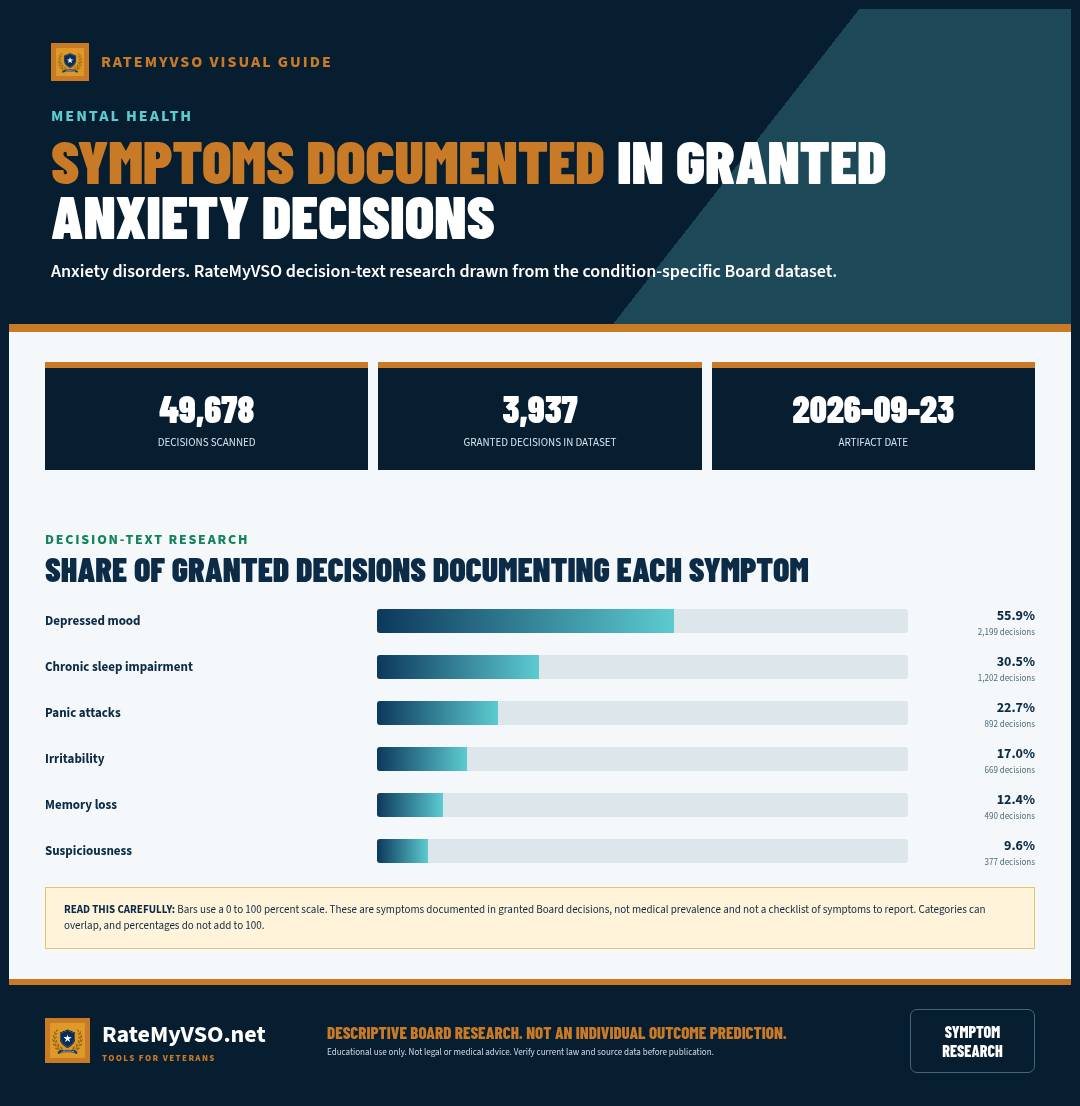
Symptoms Recorded in Granted Anxiety disorders Decisions
We analyzed 3,937 granted Board decisions involving anxiety disorders for symptoms named in sentences about the condition (rating-criteria recitations excluded). Descriptive of the published record, what the Board wrote down, not a checklist of what to report.
Bar length shows decisions. Percentages remain context.
Detected by phrase-reading the decision text with condition-specific vocabularies. Source: Board of Veterans' Appeals decisions, RateMyVSO analysis.
How the Rating Formula Works
All anxiety disorder diagnostic codes are evaluated under the General Rating Formula for Mental Disorders at 38 CFR 4.130. The formula sets six possible ratings: 0, 10, 30, 50, 70, and 100 percent. The key driver at every level is the degree of occupational and social impairment. The rating levels:
For the full verbatim criteria at each level, including the listed example symptoms, see the dedicated page: VA Mental Health Rating Formula Guide.
Listed Symptoms Are Examples, Not a Checklist
Under the rating formula, the listed symptoms at each level (such as "panic attacks more than once a week" at 50%) are examples of the kind of impairment that warrants that rating. They are not a mandatory checklist that a veteran must match item-by-item.
The Court of Appeals for Veterans Claims confirmed this in Mauerhan v. Principi, 16 Vet. App. 436 (2002): the list of symptoms in 38 CFR 4.130 is "non-exhaustive." A veteran does not need to exhibit the exact symptoms enumerated at a given level. Symptoms not on the list can still support a rating at that level if they reflect the corresponding degree of occupational and social impairment.
The Single-Rating Rule When Multiple Mental Health Conditions Coexist
Where co-existing mental health conditions produce overlapping symptoms that cannot be separated, the VA generally assigns one evaluation covering all of them. This is not a punishment. It is the application of the anti-pyramiding rule at 38 CFR 4.14, which bars paying twice for the same impairment, together with 38 CFR 4.130. There is a narrow exception: where two mental health diagnoses cause distinct, non-overlapping impairment, that has to be analyzed separately rather than assumed away (Amberman v. Shinseki, 570 F.3d 1377 (Fed. Cir. 2009)). Whether a separate evaluation is actually assigned depends on the individual record.
In practical terms: if a veteran has both service-connected generalized anxiety disorder (DC 9400) and service-connected PTSD (DC 9411), the VA will assign a single mental health rating that accounts for the combined picture. It will not pay separately for each condition on top of the other.
The single-rating rule applies to the symptom overlap. If you believe your combined impairment from anxiety plus another mental health condition is worse than your current rating reflects, a rating increase claim is the path to raise the combined evaluation.
Proposed 2022 Revision to 38 CFR 4.130
In the Federal Register dated February 15, 2022, VA published a proposed rule that would revise the General Rating Formula for Mental Disorders at 38 CFR 4.130. The proposal would reorganize the rating criteria and modify how symptom clusters and impairment are described at each level.
Evidence and Board research
Evidence That Wins These Claims
We analyzed the Board's published DC 9400 decisions: a private nexus opinion in the file goes with a much higher grant rate, shown below.
- A DSM-5 diagnosis. Required under 38 CFR 4.125. A diagnosis from a licensed mental health provider (psychiatrist, psychologist, licensed clinical social worker) using DSM-5 criteria qualifies. The label on the diagnosis matters: make sure the provider specifies the DSM-5 category that maps to DC 9400, 9403, 9410, 9412, or 9413.
- The Mental Disorders DBQ. The Disability Benefits Questionnaire for mental disorders captures the exact occupational and social impairment language the rating formula uses. A private provider who fills out this DBQ, or a similar narrative that addresses the same criteria, significantly strengthens the claim. See the DBQ guide.
- Documentation of occupational and social impairment. Performance reviews, supervisor statements, records of missed work, school records, or documentation of social withdrawal are concrete evidence of function-level impairment at the relevant rating tier.
- Lay statements on continuity and daily impact. The veteran's own written statement describing how anxiety affects work, relationships, and daily activities is admissible evidence. Buddy statements from family members or coworkers who observed the impairment add independent corroboration. See buddy statements.
- A nexus letter for secondary claims. For secondary service connection, the key document is a medical nexus letter in which the provider ties the anxiety to a specific service-connected condition and uses the "at least as likely as not" standard. See nexus letters.
- Treatment records showing continuity. Records from mental health treatment since service (therapy notes, prescription records, hospitalizations for mental health crises) demonstrate that the condition was present and treated over time.
- Service records for direct claims. Personnel records, medical records from service, STRs showing in-service treatment for anxiety or related complaints, and any documentation of the in-service stressor all strengthen a direct claim.
- A nexus opinion that shows its work. The opinions that win are the ones that review the record, state a clear conclusion, and give a full rationale, not a bare conclusion with no explanation. An opinion naming a specific in-service event and tying it to service records (a documented incident, a separation exam entry, a service record confirming the event happened) carries far more weight than a general statement that service caused the condition.
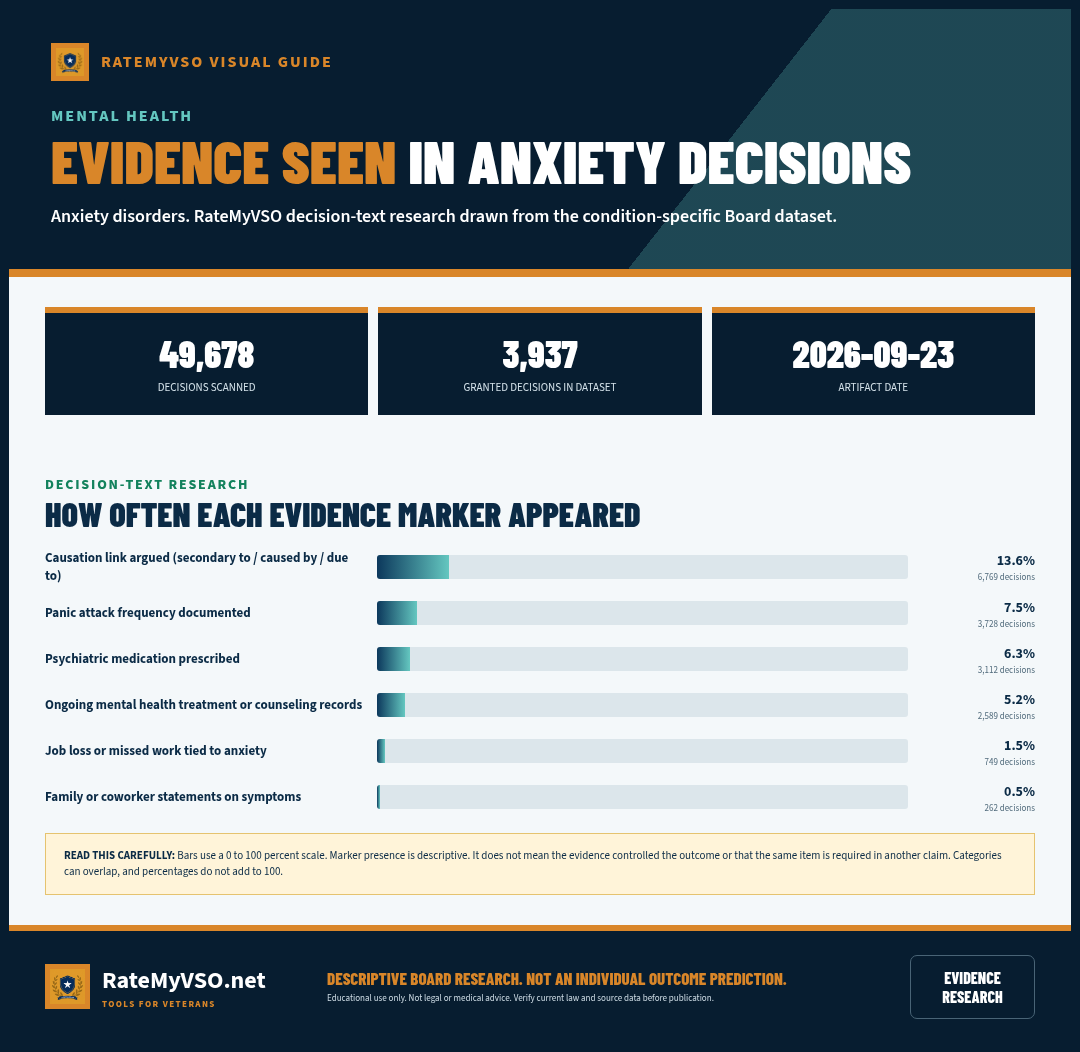
Evidence Cited in Published Anxiety disorders Decisions
We analyzed 49,678 published Board decisions involving anxiety disorders for condition-specific evidence, counting only case-specific mentions (boilerplate recitations excluded). "Favorable" is the share of decisions citing that evidence where every issue was granted or the outcome was mixed; the baseline across all these decisions is 42.3%, combining every diagnostic code below. Evidence appearing in a decision does not mean it decided the case. Descriptive of the published record, not a prediction.
Bar length shows decisions citing the evidence.
By diagnostic code
These codes are grouped together above. They do not perform the same, so find your own code here rather than reading the combined figure. A code retired in the schedule rewrites appears without a link, because its decisions were judged under criteria that no longer apply.
Bar length shows published decisions reviewed.
Detected by phrase-reading the decision text with condition-specific vocabularies. Source: Board of Veterans' Appeals decisions, RateMyVSO analysis.
Board Grants, Dissected
The decisions below show that the Board has granted direct service connection for generalized anxiety disorder in a range of factual settings, from combat deployments to childhood grief reactions to boot camp stressors. In each case, the Board weighed competing medical opinions and resolved the tie, or found one opinion clearly more thorough, in the veteran's favor. Keep in mind that Board decisions are not binding precedent and each case turned on its own facts and evidence.
Grief after a parent's death counted as an in-service stressor Citation A26039309 (April 2026), direct review docket
The record: The veteran learned of his father's sudden death while stationed aboard a Navy ship. A July 2021 VA exam diagnosed other specified trauma and stressor related disorder but gave a negative nexus opinion. A September 2021 addendum VA opinion focused on whether the event met PTSD stressor criteria, not on whether it caused the veteran's actual diagnosis. Dr. C.M., a private psychologist, examined the veteran, reviewed his file, and explained that his symptoms had persisted and intensified since 2017 in a way that was medically distinct from normal grief.
Why it won: The Board rejected both VA opinions as non-responsive to the real question, since they analyzed PTSD stressor criteria rather than the veteran's actual diagnoses of persistent depressive disorder and generalized anxiety disorder. The Board found Dr. C.M.'s opinion persuasive because she reconciled her rationale with the veteran's lay statements and distinguished ordinary grief from a diagnosable psychiatric disorder.
Decades of conflicting opinions ended in a tie, and the veteran won Citation A26037556 (April 2026), direct review docket, decided for substitution purposes
The record: The veteran, who died during the appeal, reported that his psychiatric symptoms began after a military motorcycle accident that seriously injured his friend. A December 2018 VA exam found no relation to service and did not address 1970s and 1980s treatment records. A June 2020 private opinion by psychologist J.S. linked the anxiety and depression to the in-service accident. A January 2021 VA exam blamed the veteran's alcohol use, citing a research article on alcohol and depression. J.S. rebutted this in a February 2021 addendum. A December 2021 VA opinion again found no service connection but again failed to address the 1970s treatment records.
Why it won: The Board found the VA opinions repeatedly ignored relevant post-service treatment records from the 1970s and 1980s showing early depression treatment. With the private and VA opinions in genuine equipoise, and the VA side weakened by this gap, the Board resolved reasonable doubt in the appellant's favor.
Combat deployment anxiety diagnosed by a physician assistant outweighed a flawed VA exam Citation A26037552 (April 2026), direct review docket
The record: The veteran had combat service in Afghanistan and in-service treatment records documenting anxiety, sleep trouble, and alcohol use following deployment. A March 2025 VA exam found no mental health diagnosis, but the Board found it inconsistent with other records and not based on a full file review. T.C., a private physician assistant, diagnosed major depressive disorder, generalized anxiety disorder, and insomnia and linked them to the veteran's deployment.
Why it won: The Board gave the March 2025 VA exam no probative weight because it conflicted with the medical record and did not appear to reflect review of the full claims file. T.C.'s opinion was found consistent with service treatment records and post-service VA treatment records, and there was no probative evidence against it.
A same-day VA finding of onset in service supported the grant Citation A26037278 (April 2026), hearing docket
The record: A VA examination in April 2021 diagnosed insomnia disorder and generalized anxiety disorder and found both were related to the veteran's active duty service.
Why it won: Since the VA's own examiner had already tied the current diagnosis to service, and there was no opinion to the contrary, the Board found the criteria for service connection met without further analysis needed.
Boot camp mistreatment as a stressor, even without a documented in-service diagnosis Citation A26036304 (April 2026), evidence submission docket
The record: The veteran described psychological abuse during a basic training bivouac exercise, including exposure to cold, rain, and simulated combat conditions with flashbangs and live ammunition. Service treatment records did not document this. A March 2020 opinion from a VA clinical psychologist and an October 2024 opinion from a licensed clinical social worker both supported a connection to this bootcamp event. VA opinions from October 2023 and October 2024 were mixed, and a July 2025 VA opinion, while written to rule out a secondary theory, described the veteran's anxiety as tracing back to the bootcamp trauma rather than to a service-connected condition.
Why it won: The Board found the veteran's stressor statements credible and unrebutted. Weighing the conflicting medical opinions, the Board found the July 2025 VA opinion's own language supported a direct link to service, even though it had been framed as a secondary opinion. The Board held that a medical opinion can be flawed in one respect yet still probative in another, and resolved the resulting approximate balance of evidence in the veteran's favor.
Why These Claims Get Denied
Beyond the general "no nexus" and "no diagnosis" reasons covered elsewhere in this guide, a few specific denial patterns show up often enough to call out on their own.
- A confirmed diagnosis with no connection to service. Having a real mental health diagnosis on record, even a clearly documented one, is not enough by itself. Claims are denied where the disorder plainly exists but nothing in the record ties it to an in-service event or to a service-connected condition.
- A vague "the military lifestyle was stressful" stressor. General statements about the ordinary stress or lifestyle of military service, without pointing to a specific event, are not enough to establish an in-service stressor. Where nothing specific is identified, VA can find no exam is even warranted because there is no in-service event to evaluate.
- A stressor account that shifts. When a veteran's description of what happened changes materially between statements, that inconsistency itself becomes a reason the claim is not found credible, particularly in personal-assault or military sexual trauma claims where the stressor itself is rarely documented in the record.
- A long, unexplained gap with no documented symptoms. When there are no psychiatric symptoms in the record for many years after service, and no explanation is offered for the delay, especially where the veteran had earlier denied any psychiatric history, the gap weighs against a direct connection.
- A nexus opinion that only repeats an already-questioned account. A medical opinion built entirely on the veteran's own report of what happened in service is weak where that account has already been found not credible elsewhere in the record. The opinion needs support beyond the veteran's own restated history, and a general lay assertion with no medical support behind it carries no real weight on its own.
- A diagnosis that is actually a personality disorder. A personality disorder is not a disability VA can compensate under 38 CFR 3.303(c). Where examiners conclude the correct diagnosis was a personality disorder rooted in a period before service, rather than an acquired anxiety disorder, the claim fails, and it can also support VA later taking back a rating that was already granted.
Common Mistakes
Patterns the published DC 9400 decisions and the rating rule flag most often. In the Board's service-connection denials for anxiety, no in-service event is the single largest reason.
- No nexus opinion in the file. In the published decisions, a private nexus opinion goes with a much higher grant rate. A useful opinion names the in-service stressor or the service-connected primary and states that the anxiety is at least as likely as not caused or aggravated by it.
- No DSM-5 diagnosis on record. A missing current diagnosis is another leading denial reason. The VA evaluates mental disorders under DSM-5 criteria (38 CFR 4.125), so a diagnosis from a licensed provider mapping to DC 9400 is the foundation of the claim.
- No documented in-service event. Some denials turn on the lack of an in-service event, injury, or stressor. For a direct claim, personnel records, STRs, or buddy statements that fix the stressor in service close that gap.
- Expecting a second rating for anxiety alongside PTSD or depression. Under 38 CFR 4.14 and 4.130, all co-existing mental health conditions share one combined evaluation. Anxiety folds into that single rating rather than adding a separate percentage, so the path to more compensation is a rating increase on the combined evaluation.
- Treating the listed symptoms as a checklist. Per Mauerhan v. Principi, the symptoms named at each level of 38 CFR 4.130 are non-exhaustive examples. A claim framed only around matching listed symptoms can understate the occupational and social impairment that actually drives the rating.
Do's and Don'ts
A condensed version of everything above, in the order it actually matters when you sit down to build your file.
- Get a nexus opinion that reviews your record, states a clear conclusion, and explains its reasoning, not a bare conclusion.
- Name a specific in-service event or stressor and tie it to whatever service records confirm it.
- Let VA read your claim broadly. Don't narrow yourself to the word anxiety; symptoms can support any psychiatric diagnosis the record shows.
- Point to symptoms written down at the time, separation-exam notes, sick-call records, or discipline explained by documented worry or anxiety.
- Use the benefit of the doubt when the evidence is evenly balanced. You do not have to prove your case beyond doubt.
- Add buddy, spouse, and family statements describing your symptoms and when they started.
- Keep your account of the stressor and its onset consistent across every statement, form, and exam.
- If you already have service connection, decide whether your real fight is the rating, the effective date, or a proposed severance, and gather evidence for that specific fight.
- Don't assume a diagnosis alone wins the claim. You still need the in-service event and the nexus.
- Don't rely on a vague "military lifestyle was stressful" description as your stressor.
- Don't let your account of what happened shift between statements and exams. Inconsistency undermines credibility more than almost anything else.
- Don't wait years with no documented symptoms and no explanation for the gap.
- Don't lean on a nexus opinion that just repeats your own account with nothing else behind it, especially if that account has been questioned elsewhere.
- Don't expect a personality disorder to be service-connected. It isn't a compensable disability under VA's own rule.
- Don't expect a second, stacked rating for anxiety on top of an existing PTSD or depression rating. They share one combined mental-health evaluation.
Secondary relationships
Common Secondary Conditions
We found these are the conditions most often linked with anxiety in the Board's published decisions. Each bar is the BVA grant rate for DC 9400, with the number of decisions below it. They describe what the Board's record shows across many veterans, not a prediction about any one claim.
Conditions that can cause anxiety (anxiety as the secondary)
Claims where anxiety was argued as secondary to an already service-connected condition. This is the "ways to connect via another condition" list, and it's usually the easier route into a grant:
Conditions anxiety can cause (anxiety as the primary)
Conditions veterans have claimed as caused or aggravated by a service-connected anxiety:
Prepare and take the next step
Prepare: your own working pages
Optional. These are your own notes, in your own words. They are not a VA form, they are not sent to the VA, and nothing here is a medical finding or a prediction about your claim.
Three reminders while you prepare
- Describe functioning in your own words
Focus on work, relationships, routines, concentration, judgment, sleep, and ordinary tasks rather than trying to match a rating phrase. Go to this part
- Record frequency, duration, and change over time
Note how often difficulties occur, how long they last, treatment, and periods when functioning improves or worsens. Go to this part
- Use only the history you choose to record
These worksheets do not require a detailed trauma narrative. Mark records or questions you do not have rather than guessing. Go to this part
Sign in or create an account to save your answers and come back to them later. You can fill these in and print them without an account.
Daily functioning notes
Treatment and symptom history
Connection and examination questions
Records and unanswered questions
Decision-letter reading sheet
Quick Checklist Before You File
Bring these together before you submit anything.
- A current mental health diagnosis from a qualified clinician, using DSM-5 criteria.
- A specific in-service event, stressor, or documented symptom, and any records that confirm it.
- A nexus opinion that reviews your record and fully explains why your anxiety is linked to service, or to a specific service-connected condition.
- Buddy, spouse, and family statements describing your symptoms and when they started.
- Your account of what happened, kept consistent everywhere you tell it.
- A note to let VA consider every psychiatric diagnosis your symptoms support, not just the word anxiety.
- If you already have service connection: a clear sense of whether your real issue is the rating, the effective date, or a proposed severance, with evidence gathered for that specific fight.
For the mechanics of actually submitting the claim, see the Standard Claim Guide and the Fully Developed Claim Guide (filing with all your evidence up front can speed up the decision).
The Claims Process, Step by Step
Once you file, your claim moves through a series of hand-offs. Understanding who does what helps you know who to contact, and what to expect, at each stage.
- You file the claim. Directly with VA, through VA.gov, or with the help of an accredited representative.
- VA acknowledges the claim and assigns it for development. A Veteran Service Representative (VSR) is assigned to gather your service treatment records, VA and private mental health records, and any other evidence needed.
- The VSR orders a Compensation & Pension (C&P) exam if one is needed. Most direct anxiety claims require a mental health exam, and secondary claims especially need a nexus opinion.
- The C&P exam is conducted. By a VA clinician or a contracted examiner, who completes the Mental Disorders Disability Benefits Questionnaire (DBQ) documenting the diagnosis, current symptoms, and, where relevant, a nexus opinion.
- The file goes to a Rating Veteran Service Representative (RVSR), the "rater." The rater reviews the complete file, including the exam results, and decides whether service connection is warranted and at what percentage.
- A senior reviewer may review the decision before it's finalized, depending on the complexity of the claim.
- VA issues the decision letter. This states whether the claim is granted or denied, the rating percentage if granted, and the reasons behind the decision.
- If you disagree, you choose an appeal lane. Higher-Level Review, Supplemental Claim, or a Board appeal, covered later in this guide.
Who's who: VSO vs. VSR vs. Rater vs. C&P Examiner
Your VSO
An accredited representative from a veterans service organization, or an accredited attorney or claims agent. Not a VA employee. Helps you prepare, gather evidence, and file, and can represent you through an appeal. Has no authority to decide your claim.
VSR (Veteran Service Representative)
VA staff who "develops" your claim: requests records, schedules the C&P exam, and assembles the file. Does not decide the rating.
Rater (RVSR)
VA staff who reviews the completed file and makes the actual decision, service connection or denial, and the percentage. This is the person whose judgment the decision letter reflects.
C&P Examiner
A VA clinician or a contracted medical examiner who conducts the exam and completes the DBQ. Documents findings and, where asked, a nexus opinion. Does not decide the claim.
For the full walkthrough of every stage with more detail, see Inside Your Claim and Claim Stages.
DBQs and Your C&P Exam
A Disability Benefits Questionnaire (DBQ) is the standardized form an examiner completes for your condition. For mental disorders it structures the exam findings into the exact occupational and social impairment language the rating schedule uses. See the DBQ Guide for how these forms work, including whether a private DBQ completed by your own provider can be submitted instead of relying solely on a VA exam.
Before your C&P exam, bring a clear, specific account of your symptoms, focus on your worst days and how the condition affects work and relationships, not just how you feel on an average day. Be consistent with what's already in your medical records and prior statements. For a full walkthrough of what to expect and how to prepare, see the C&P Exam Prep Guide.
Reading Your Decision Letter, and What to Do If Denied
Your decision letter has two parts: a narrative section explaining the reasoning (often called "reasons and bases"), and a codesheet showing the actual rating percentage, the effective date, and the diagnostic code used. See the Reading Your Decision Letter Guide for how to find and interpret each part, or use the Letter Interpreter tool to upload your own letter and get a plain-English breakdown.
If your claim is denied, or the rating is lower than you expected, you have three main lanes:
- Supplemental Claim: refile with new and relevant evidence, such as a new nexus opinion or updated treatment records. See Supplemental Claim Guide.
- Higher-Level Review (HLR): a senior reviewer looks at the same evidence again for a difference of opinion, no new evidence is added. See HLR Guide.
- Board Appeal: your case goes to a Veterans Law Judge at the Board of Veterans' Appeals, with options for a direct review, an evidence docket, or a hearing. See Board Appeal Guide.
Not sure which lane fits your situation? See the Appeals decision guide for a side-by-side comparison of all three.
After You Win: Ratings, Effective Dates, and Maintaining Your Rating
Once you're already service-connected for anxiety, your next fight, if there is one, is usually about the rating (how much), the effective date (how far back), or occasionally a proposal to sever a past grant. These are different fights from the service-connection fight covered earlier in this guide, and they turn on different evidence.
- The 100 percent rating requires total impairment in both areas. A 100 percent rating under 38 CFR 4.130 requires total occupational and social impairment. Veterans who kept a job or kept meaningful relationships have been held to less than total impairment, even with severe symptoms, so a higher-rating claim resting only on isolated severe episodes can fall short of the top tier.
- Occasional or inconsistent severe symptoms may not reach the top rating on their own, particularly where they are inconsistent with other exam findings in the file. The top rating is reserved for impairment that is genuinely total, not for periodic severe episodes against an otherwise more functional baseline.
- Effective dates generally run from your claim or intent to file, not from when your symptoms actually began. An earlier effective date generally requires an earlier claim already in the record; for unemployability specifically, the effective date can instead run from the date the record makes clear you could no longer work.
- VA can take away (sever) a past grant for clear and unmistakable error, such as a corrected diagnosis, under 38 CFR 3.105. The burden is on VA to prove the error, but VA can succeed, which is one more reason an accurate diagnosis at the outset matters.
Keep your treatment consistent. Continued follow-up with a mental health provider, and records showing ongoing treatment, protects you if VA schedules a future reexamination. Not every rating gets reexamined; understand when a rating becomes protected from future review (including Permanent and Total status) and what to do if VA proposes to reduce it. See Protect Your Rating and Future Reexaminations for the specifics.
If your anxiety worsens after the initial grant, you can file for an increased rating on the combined mental-health evaluation. See the Rating Increase Guide.
References and related resources
Quick Reference Tables
Secondary Connection Pathways
| Primary Condition | Mechanism | Evidence Needed |
|---|---|---|
| Chronic pain (musculoskeletal) | Ongoing pain affects mood, sleep, and daily function | Nexus opinion tying the pain condition to the anxious symptoms |
| Tinnitus (DC 6260) | Constant noise drives hypervigilance and anxiety | Nexus opinion specific to the tinnitus, not hearing loss generally |
| TBI | Neurological changes affecting emotional regulation | Neurological or psychiatric nexus opinion |
| Sleep apnea (DC 6847) and other sleep disorders | Poor sleep quality worsens anxious symptoms | Nexus opinion linking the sleep disorder to the anxiety |
| Other service-connected mental health conditions (PTSD, depression) | Overlapping and interacting psychiatric symptoms | DSM-5 diagnosis + nexus; rated as one combined evaluation, not stacked |
From Filing to Decision: Who Does What
| Role | Does | Decides your rating? |
|---|---|---|
| VSO / accredited representative | Helps prepare, gather evidence, and file; represents you on appeal | No |
| VSR | Develops the claim: orders records and the C&P exam | No |
| C&P Examiner | Conducts the exam, completes the DBQ, may give a nexus opinion | No / but has a strong impact |
| Rater (RVSR) | Reviews the full file and decides service connection and percentage | Yes |
Frequently Asked Questions
Can I get a VA rating for anxiety if I already have a PTSD rating?
My anxiety was diagnosed after I left the military. Can I still get service connection?
How do I claim anxiety secondary to tinnitus or chronic pain?
What does "occupational and social impairment" mean at the 50% level?
Do I need the exact symptoms listed in the regulation to get a certain rating?
Can VA take away my anxiety rating after I've already won?
Related Tools and Guides
Sources
- 38 CFR 4.130, Diagnostic Codes 9400, 9403, 9410, 9411, 9412, 9413, 9435, 9440, General Rating Formula for Mental Disorders
- 38 CFR 4.125, DSM-5 diagnosis requirement
- 38 CFR 3.303, 3.303(b), and 3.303(d), basic rules for direct service connection and disease diagnosed after discharge
- 38 CFR 3.303(c), personality disorders are not compensable disabilities
- 38 CFR 3.310, secondary service connection
- 38 CFR 3.306, aggravation of a pre-existing condition
- 38 CFR 3.304(b), presumption of soundness at entry; 38 CFR 3.304(f) and 3.304(f)(5), PTSD stressors and personal-assault proof markers
- 38 CFR 3.102 and 38 USC 5107(b), benefit of the doubt
- 38 CFR 3.104(c), Board bound by VA's own favorable findings
- 38 CFR 3.105, severance of service connection for clear and unmistakable error
- 38 CFR 3.156 and 3.2501, new and relevant evidence and supplemental claims
- 38 CFR 3.159, VA's duty to assist, including when a medical exam is required
- Mauerhan v. Principi, 16 Vet. App. 436 (2002), symptoms listed in 38 CFR 4.130 are non-exhaustive examples
- Clemons v. Shinseki, 23 Vet. App. 1 (2009), a claim for one psychiatric diagnosis is read to reach any diagnosis the record supports
- Shedden v. Principi, 381 F.3d 1163 (Fed. Cir. 2004), the three elements of direct service connection
- Nieves-Rodriguez v. Peake, 22 Vet. App. 295 (2008), what makes a medical opinion persuasive
- McLendon v. Nicholson, 20 Vet. App. 79 (2006), the low threshold for when VA must provide a medical exam
- Caluza v. Brown, 7 Vet. App. 498 (1995), weighing the credibility of lay and medical statements
- Lynch v. McDonough, 21 F.4th 776 (Fed. Cir. 2021), the benefit-of-the-doubt standard
- VA.gov, mental health disability eligibility
This guide is educational, not legal or medical advice, and not a prediction of any individual claim outcome. Rating criteria change; confirm current details at eCFR 38 CFR 4.130. For help with your own claim, talk to a VA-accredited representative.