COPD Claims Guide
Chronic obstructive pulmonary disease covers emphysema and chronic bronchitis, the long-term lung damage that makes it hard to move air. The VA rates COPD under diagnostic code 6604, and unlike most conditions the rating comes almost entirely from numbers on a breathing test, not from how short of breath you feel. This guide explains how the pulmonary function test sets the rating, why COPD is now a burn-pit presumptive under the PACT Act, the in-service smoking rule that trips people up, the evidence that wins, why claims get denied, the claims process from filing to decision letter, and what to do whether you're denied or you win.
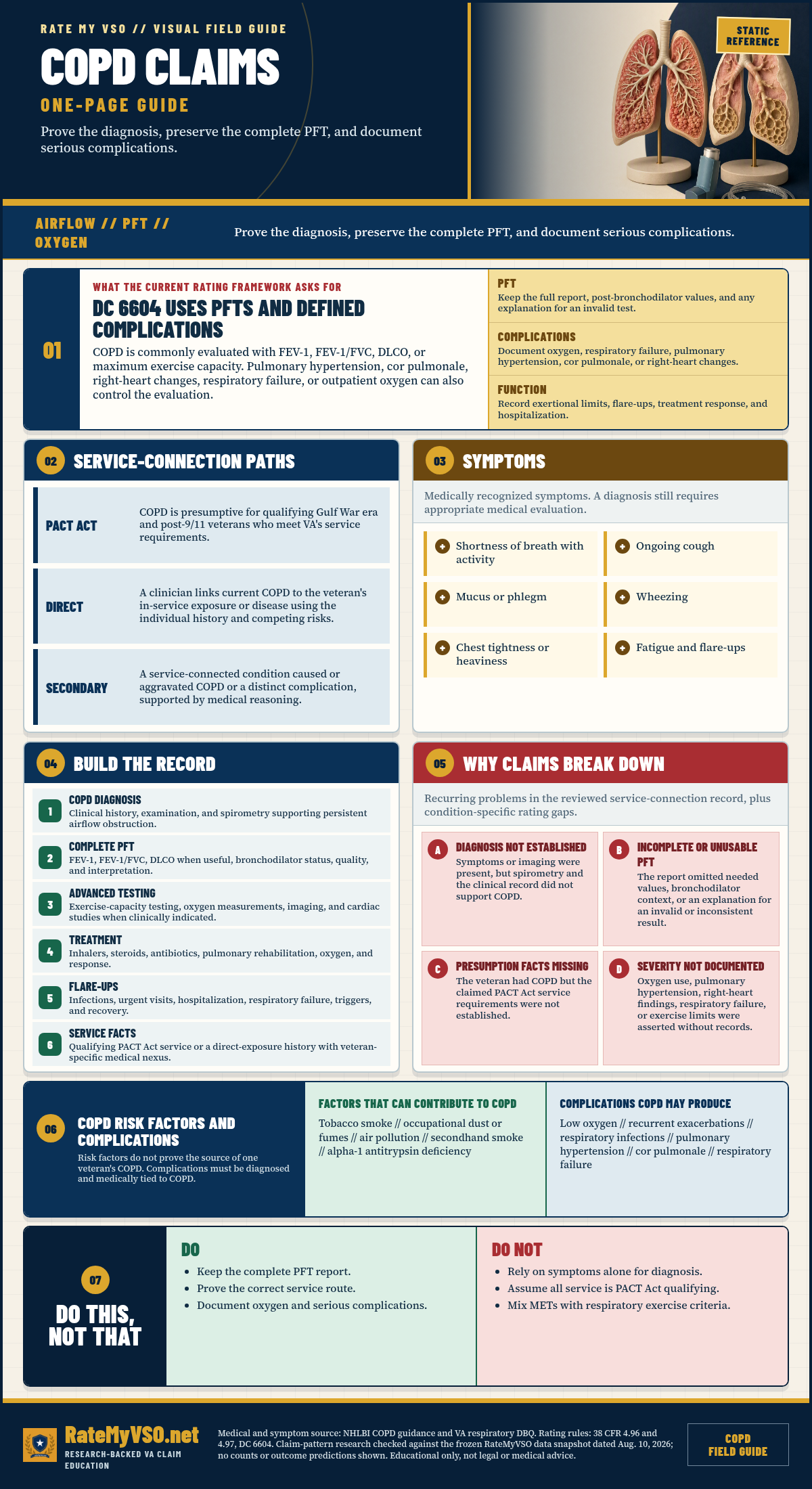 One-page guide: COPD Claims in One Page
COPD guide covering DC 6604, complete pulmonary-function testing, PACT Act and other service paths, symptoms, oxygen and serious complications, evidence, and common claim gaps. Opens the full-size chart, free to save or print.
One-page guide: COPD Claims in One Page
COPD guide covering DC 6604, complete pulmonary-function testing, PACT Act and other service paths, symptoms, oxygen and serious complications, evidence, and common claim gaps. Opens the full-size chart, free to save or print.
Start with the essentials
- 01Service Connection
The ways service connection can be established for this condition.
- 02Diagnosis and Evidence
Common symptoms and the evidence cited in published Board appeals.
- 03Your History
What you experienced, what others observed, and what treatment changed.
Understand the claim
ICD-10 Diagnosis Codes
The ICD-10 diagnosis codes most commonly used for DC 6604, Chronic obstructive pulmonary disease (the kind on your medical records, decision letter, or C&P exam report). VA rates the disability and its residuals, not the diagnosis itself, so coding can vary.
How Service Connection Works, At a High Level
Before getting into the specific pathways below, it helps to understand the three things every direct COPD claim ultimately has to show. This is the same basic test that applies to any VA disability claim, just applied to this condition.
- A current diagnosis. A present diagnosis of COPD (emphysema or chronic bronchitis) in the medical record. In published decisions VA frequently concedes the diagnosis, so this part is rarely where a claim is won or lost.
- An in-service cause or event. Something that happened or was documented in service that could plausibly have caused the lung disease, for example a conceded toxic exposure, an in-service respiratory illness, or combat conditions, or a service-connected condition already on the books that caused or worsened the COPD.
- A medical nexus. A qualified medical opinion connecting the COPD to that in-service cause or to the service-connected condition, and explaining the reasoning, not just stating a conclusion. This is where most COPD claims are actually won or lost.
How It Gets Service Connected
Unlike some conditions, COPD is not presumed to be caused by Agent Orange or by burn pits under the PACT Act automatically for every claim type, so a claim that leans only on a presumption without meeting its own terms, or on toxic exposure argued alone, is a weak claim. Established pathways include:
Burn Pits and Airborne Hazards (PACT Act Presumptive)
COPD is one of the respiratory conditions presumptively linked to burn-pit and airborne-hazard exposure for covered Gulf War and post-9/11 veterans. If you have a qualifying exposure and service, you generally do not have to prove the medical link. See the PACT Act and burn-pit presumptives.
Direct Service Connection, Including a Conceded Toxic Exposure (TERA)
COPD shown to have started in or been caused by service through another route, for example asbestos, fuel, solvent, or other occupational exposure, with a current diagnosis and a nexus. VA can concede a Toxic Exposure Risk Activity (TERA) even without a presumption applying, and a supporting medical opinion can then tie the COPD to that conceded exposure. When the evidence for and against is roughly balanced, the benefit-of-the-doubt rule (38 USC § 5107(b); 38 CFR § 3.102) resolves the tie in the veteran's favor. See our Service Connection Guide.
Secondary Service Connection (38 CFR § 3.310)
COPD caused or chronically aggravated by an already service-connected condition. Published decisions show this pathway working even where a later VA opinion disagreed, for example COPD aggravated by a service-connected metabolic condition such as diabetes. The aggravation prong matters here too: a service-connected condition that made an existing COPD worse, not just one that caused it outright, can support a grant. See our Secondary Conditions Guide.
Combat and Continuity of Symptoms
Combat veterans get the benefit of a relaxed evidence rule under 38 USC § 1154(b): credible testimony that breathing trouble began in service and continued since can support a grant even without contemporaneous treatment records, once the underlying diagnosis and nexus are otherwise in place. Consistent, credible lay testimony about onset and continuity matters for non-combat claims too (38 CFR § 3.303(b)).
Across published DC 6604 decisions, here is how often the Board granted by the legal theory the claim was argued on:
Grant rate by exposure flag
How often the Board granted DC 6604 issues that carried each exposure signal, next to the overall baseline:
What VA Looks For: Tests, Records, and Diagnostic Codes
Whether you are filing directly, through the burn-pit presumptive path, or secondary to another condition, the record VA actually reviews centers on a small set of documents and data points.
- The pulmonary function test itself: post-bronchodilator FEV-1, FEV-1/FVC, and DLCO, the three values the rating is built from (see above).
- Exposure records: deployment records, unit history, or the burn-pit registry placing you where airborne hazards were, if you're using the presumptive or TERA (Toxic Exposure Risk Activity) path.
- Treatment records: documentation of oxygen use, hospitalizations, or heart-related findings such as cor pulmonale, all relevant to both service connection and the rating level.
- The diagnostic codes involved: DC 6604 for COPD itself, DC 6600 for chronic bronchitis, DC 6603 for emphysema, plus whatever code applies to a condition you're connecting it to secondarily, for example DC 7913 (diabetes mellitus).
- The actual form the examiner fills out: the Respiratory Conditions Disability Benefits Questionnaire (DBQ), discussed in more detail later in this guide.
What COPD Is
COPD is a group of lung diseases, mainly emphysema and chronic bronchitis, that block airflow and make breathing progressively harder. Symptoms include shortness of breath, a chronic cough, wheezing, and frequent chest infections. The VA rates it under diagnostic code 6604, part of the respiratory schedule (see 38 CFR § 4.97).
Across published DC 6604 decisions, a clear pattern shows up: before the PACT Act, COPD was hard to win on toxic-exposure theories alone, because it was not on any presumptive exposure list. That changed in August 2022: COPD is now a burn-pit and airborne-hazard presumptive for covered Gulf War and post-9/11 veterans, and newer Board decisions grant on that basis when the qualifying service is shown. Outside that presumption, the claims that succeed usually rest on a strong medical opinion, a secondary link to another service-connected condition, or credible, consistent testimony that breathing problems began in service and never went away. See the Service Connection Guide for how that test works generally.
Symptoms and rating
Symptoms Recorded in Granted COPD and chronic lung disease Decisions
We analyzed 2,069 granted Board decisions involving copd and chronic lung disease for symptoms named in sentences about the condition (rating-criteria recitations excluded). Descriptive of the published record, what the Board wrote down, not a checklist of what to report.
Bar length shows decisions. Percentages remain context.
Detected by phrase-reading the decision text with condition-specific vocabularies. Source: Board of Veterans' Appeals decisions, RateMyVSO analysis.
How the VA Rates COPD (DC 6604)
The level is set by the breathing-test values, taking whichever result rates highest.
| Rating | FEV-1 (% predicted) | FEV-1/FVC | DLCO |
|---|---|---|---|
| 10% | 71 to 80% | 71 to 80% | 66 to 80% |
| 30% | 56 to 70% | 56 to 70% | 56 to 65% |
| 60% | 40 to 55% | 40 to 55% | 40 to 55% |
| 100% | Less than 40% | Less than 40% | Less than 40% |
The 100 percent level is also reached by other severe findings: cor pulmonale (right-sided heart failure), pulmonary hypertension, episodes of acute respiratory failure, or the need for outpatient oxygen therapy. A maximum exercise capacity below 15 ml/kg/min of oxygen consumption also reaches 100 percent.
Rated by Breathing Tests (This Is the Whole Game)
COPD is scored from a pulmonary function test (PFT), the spirometry that measures how much and how fast you can move air. Three numbers drive the rating:
- FEV-1: how much air you can force out in the first second, as a percent of what is predicted for your age and size.
- FEV-1/FVC: that first-second volume as a share of your total forced breath.
- DLCO: how well oxygen passes from your lungs into your blood.
Evidence and Board research
Evidence That Wins
- A complete, current pulmonary function test, reporting post-bronchodilator FEV-1, FEV-1/FVC, and DLCO. This is what the rating is built from, an old or incomplete PFT is a leading reason ratings come in low.
- Proof of a qualifying exposure for the presumptive path: deployment records or the burn-pit registry placing you where the airborne hazards were.
- A diagnosis of COPD (emphysema or chronic bronchitis) in the medical record, distinct from asthma, which is rated differently.
- Records of oxygen use, hospitalizations, or heart involvement if you are seeking the 100 percent level.
- A private nexus opinion that explains its reasoning. The strongest wins come from a doctor who reviewed the whole record, engaged the contrary evidence, and gave detailed reasons, not a bare conclusion. An opinion that just checks a box, without stating which test values apply or why, can be found not probative. See our Nexus Letters Guide.
- An exam that actually addresses your service records and lay statements, rather than one that leans only on the absence of records. VA opinions that ignore documented in-service respiratory problems or a veteran's own reports are given little weight, which can open the door to a grant on appeal.
- The benefit-of-the-doubt rule. You do not need to prove your case beyond doubt. When the positive and negative evidence is roughly equal, the law requires VA to decide in your favor (38 USC § 5107(b); 38 CFR § 3.102).
- The Respiratory Conditions DBQ, which captures the PFT values and findings the rating turns on. See the DBQ guide.
Evidence Cited in Published COPD and chronic lung disease Decisions
We analyzed 36,233 published Board decisions involving copd and chronic lung disease for condition-specific evidence, counting only case-specific mentions (boilerplate recitations excluded). "Favorable" is the share of decisions citing that evidence where every issue was granted or the outcome was mixed; the baseline across all these decisions is 43.9%, combining every diagnostic code below. Evidence appearing in a decision does not mean it decided the case. Descriptive of the published record, not a prediction.
Bar length shows decisions citing the evidence.
By diagnostic code
These codes are grouped together above. They do not perform the same, so find your own code here rather than reading the combined figure. A code retired in the schedule rewrites appears without a link, because its decisions were judged under criteria that no longer apply.
Bar length shows published decisions reviewed.
Detected by phrase-reading the decision text with condition-specific vocabularies. Source: Board of Veterans' Appeals decisions, RateMyVSO analysis.
Board Grants, Dissected
The Board has granted direct service connection for COPD in a range of situations. Some grants rest on the PACT Act's toxic exposure presumptions, some on Agent Orange exposure, some on secondary theories tied to another service-connected condition, and some on straightforward direct-nexus findings from a private or VA doctor. Board decisions are not binding precedent on future claims, but the cases below show the kinds of evidence and reasoning that succeeded.
Treating pulmonary doctor's opinion outweighs a later VA opinion on herbicide exposure Citation A26032050 (April 8, 2026), Hearing docket
The record: The veteran's treating pulmonary medical doctor, who had frequent direct contact with him, submitted a June 2025 opinion linking COPD to herbicide exposure in Vietnam, citing pulmonary function test findings that could not be explained by smoking alone. A later July 2025 VA opinion found COPD less likely related to toxic exposure, citing the veteran's decades of smoking, but the examiner did not reconcile that finding with the June 2025 positive opinion or address other theories of entitlement.
Why it won: The Board gave the treating doctor's opinion high probative value because of the length of the treatment relationship and the specific clinical findings cited. It found the VA opinion incomplete because it failed to address the contrary opinion. Resolving reasonable doubt in the veteran's favor, the Board granted direct service connection due to herbicide exposure.
Eight years as primary care physician gives private opinion the edge on tobacco causation Citation A26038207 (April 23, 2026), Hearing docket
The record: The veteran's private primary care physician of eight years, Dr. E.W., opined it was more likely than not that his COPD was caused by active-duty exposure to inorganic dust and unprotected smoke from shipboard firefighting training, even though the veteran also smoked cigarettes. There was no VA opinion contradicting this.
Why it won: The Board found the private opinion definitive and well supported, noting the examiner directly addressed both the dust exposure and the smoking history rather than ignoring one. With no contrary medical opinion in the file, the Board resolved reasonable doubt in the veteran's favor.
PACT Act presumption applies even though direct service connection did not Citation A26037126 (April 21, 2026), Hearing docket
The record: The veteran served during the Persian Gulf War and was diagnosed with both bullous emphysema and COPD. His service treatment records were unavailable, and the Board found no evidence that symptoms began in service, so direct service connection was not supported.
Why it won: The Board explained that emphysema and COPD are on the list of diseases presumptively associated with Persian Gulf War service under the PACT Act. Because the veteran's Southwest Asia deployment was conceded, the Board granted service connection on this presumptive basis without needing a direct nexus opinion.
VA examiner's own positive opinion wins out over a later speculative VA opinion Citation A26033436 (April 10, 2026), Hearing docket
The record: A March 2025 VA examiner reviewed the veteran's toxic exposure risk activity from his rocket crewman duties and opined it was at least as likely as not that COPD was caused by that exposure, citing medical literature on burn pits and occupational fume exposure. A later June 2025 VA examiner found a nexus to toxic exposure would be speculative given the veteran's 30-year smoking history, but that examiner also acknowledged non-smokers can develop COPD and that the disease was likely multifactorial.
Why it won: The Board found the second examiner's own acknowledgment of multiple causes undercut the negative conclusion. Citing Alemany v. Brown, the Board noted that an exact or "obvious" etiology is not required to grant service connection, and resolved doubt in the veteran's favor.
PTSD-driven tobacco use chain, supported by a detailed private doctor's rationale Citation A26038307 (April 23, 2026), Evidence Submission docket
The record: The veteran argued that his service-connected PTSD caused him to use tobacco after service, and that tobacco use caused his COPD. A December 2025 private medical doctor opined that the veteran's service-connected PTSD led to chronic tobacco use, citing medical literature on the association between PTSD and heavier, more persistent smoking. Department of Corrections medical records, private treatment records, and lay statements from the veteran and his brother supported the history of breathing problems and tobacco use.
Why it won: The Board applied the framework from VAOPGCPREC 6-2003, which allows secondary service connection where a service-connected disability caused tobacco use after service, that tobacco use was a substantial factor in the secondary disability, and the secondary disability would not have occurred but for that tobacco use. The Board found the private opinion, medical literature, and lay evidence all pointed the same direction and granted the claim.
Why These Claims Get Denied
Beyond a missing nexus or an incomplete PFT, a few specific denial patterns show up often enough in published decisions to call out on their own.
- Assuming a presumption automatically covers it. COPD is not on the presumptive list for herbicide (Agent Orange) exposure, and outside the covered burn-pit categories it is not a PACT Act presumptive either. Veterans who counted on a presumption applying without meeting its actual terms lost, because direct proof was still required.
- Relying only on the veteran's own belief about the cause. VA treats the cause of COPD as a medical question a layperson is not competent to resolve alone. A veteran's personal opinion that service caused the condition, without a supporting doctor, does not carry the claim.
- Building the claim on in-service smoking. By law, service connection cannot be granted just because a veteran started or continued smoking in service. Claims that rest on tobacco use as the cause are denied regardless of how clearly the smoking connects to the diagnosis.
- A long gap with no continuity of breathing problems. Where COPD first appears many years after service with no record of symptoms in between, the claimed in-service onset is found not credible.
- A supportive private opinion built on inaccurate facts. An opinion is only as good as the record it relies on. If the underlying facts are wrong, for example the timeline of when smoking actually started, the opinion carries no weight even if the reasoning otherwise looks sound.
Pitfalls and Common Mistakes
The same handful of missteps account for most lost or under-rated COPD claims. Among the Board's classified service-connection denials for COPD, here is what claims most often fell short on:
- Arguing in-service smoking as the cause. By law the VA cannot grant service connection based on the veteran's own tobacco use in service. Argue a qualifying exposure like burn pits, or a secondary link, instead.
- Relying on an old or incomplete PFT. The rating is built from current post-bronchodilator FEV-1, FEV-1/FVC, and DLCO. A stale or partial test undercounts the severity.
- Not claiming the presumptive path. COPD is a PACT Act burn-pit presumptive. Veterans with qualifying exposure sometimes try to prove a direct link when the presumption already does the work.
- Letting COPD and asthma get confused. They are rated on different scales. Make sure the diagnosis and the rating code match your condition.
- Missing the heart connection. Long-standing COPD can strain the right side of the heart. Cor pulmonale and related findings can reach the 100 percent level and should be documented.
- A checkbox form with no explanation. A doctor's form that just marks boxes, without explaining the reasoning or which test values apply, can be found not probative.
- An exam that leans only on silence in old records. An exam that dismisses a claim solely because service records are quiet on the issue, without engaging the veteran's own statements or later evidence, can be challenged as inadequate.
Do's and Don'ts
A condensed version of everything above, in the order it actually matters when you sit down to build your file.
- Get a private nexus opinion that explains its reasoning and engages the record, not a bare conclusion or a checkbox form.
- Check whether you qualify for the burn-pit presumptive path before trying to prove a direct link the hard way.
- Identify any conceded toxic exposure (TERA), such as asbestos or fuel and solvent exposure, and connect it to your COPD.
- Ask whether an already service-connected condition caused or worsened your COPD, and raise it as a secondary theory.
- Gather lay and buddy statements about breathing problems that started in service and continued.
- Make sure a current, complete pulmonary function test (FEV-1, FEV-1/FVC, DLCO) is in the file before you file for a rating.
- Ask VA to apply the benefit of the doubt when the evidence for and against is roughly equal.
- If a VA exam ignored your lay statements or leaned only on silence in old records, say so directly in your response or appeal.
- Don't assume Agent Orange or burn-pit rules automatically cover you without checking the actual terms.
- Don't rely only on your own belief about what caused it, causation for COPD is treated as a medical question.
- Don't build your claim on in-service smoking, the law bars service connection on that basis alone.
- Don't let decades pass without documenting breathing problems if you're claiming a continuous in-service onset.
- Don't submit a private opinion built on facts the record doesn't support, it can be rejected outright.
- Don't count on a checkbox form with no explanation, it can be found not probative.
- Don't let COPD and asthma get confused on the claim, they're rated on different scales.
Secondary relationships
Common Secondary Conditions
Lung disease strains the heart and the rest of the body, so COPD sits in a chain with other conditions in both directions. Each bar below is the Board's grant rate for DC 6604 in that pairing, with the number of decisions under it. They describe the published record across many veterans, not a prediction about any one claim.
Conditions that can cause COPD (COPD as the secondary)
Claims where COPD was argued as secondary to an already service-connected condition. This is the "ways to connect via another condition" list:
Conditions COPD can cause (COPD as the primary)
Conditions veterans have claimed as caused or aggravated by service-connected COPD, in other words conditions secondary to COPD once COPD itself is already service-connected, as chronic lung disease burdens the heart and reduces oxygen:
Prepare and take the next step
Prepare: your own working pages
Optional. These are your own notes, in your own words. They are not a VA form, they are not sent to the VA, and nothing here is a medical finding or a prediction about your claim.
Three reminders while you prepare
- Start with the diagnosis and objective testing
Record the diagnosed condition, testing, imaging, and treatment. Keep different respiratory or nasal diagnoses separate. Go to this part
- Track episodes and treatment requirements
Note flare frequency, infections or attacks, medicines, procedures, and urgent or routine care as the record describes them. Go to this part
- Describe breathing and daily effects
Record what exertion, sleep, work, or ordinary activities are limited, without estimating test results or assigning yourself a rating. Go to this part
Sign in or create an account to save your answers and come back to them later. You can fill these in and print them without an account.
Respiratory symptom and episode log
Testing and treatment record
Connection and examination questions
Records and unanswered questions
Decision-letter reading sheet
Quick Checklist Before You File
Bring these together before you submit anything.
- Confirm you have a current, documented COPD diagnosis.
- Ask a doctor for a written nexus opinion that gives reasons and reviews your records.
- Identify any conceded toxic exposure (TERA), such as asbestos, fuel, or solvent exposure, and connect it to your COPD.
- Consider a secondary theory: did an already service-connected condition cause or worsen your COPD?
- Gather lay and buddy statements about breathing problems in service and since.
- Make sure recent, complete pulmonary function tests (PFTs) are in the file for the rating.
- File promptly, and confirm VA received your complete claim within one year of any intent to file, the rule is strict.
For the mechanics of actually submitting the claim, see the Standard Claim Guide and the Fully Developed Claim Guide (filing with all your evidence up front can speed up the decision).
The Claims Process, Step by Step
Once you file, your claim moves through a series of hand-offs. Understanding who does what helps you know who to contact, and what to expect, at each stage.
- You file the claim. Directly with VA, through VA.gov, or with the help of an accredited representative.
- VA acknowledges the claim and assigns it for development. A Veteran Service Representative (VSR) is assigned to gather your service treatment records, VA and private medical records, exposure records, and any other evidence needed.
- The VSR orders a Compensation & Pension (C&P) exam if one is needed. Not every claim requires one, but most COPD claims do, especially where the pulmonary function values or a nexus opinion are still needed.
- The C&P exam is conducted. By a VA clinician or a contracted examiner, who completes a Disability Benefits Questionnaire (DBQ) documenting the diagnosis, the pulmonary function test results, and, where relevant, a nexus opinion.
- The file goes to a Rating Veteran Service Representative (RVSR), the "rater." The rater reviews the complete file, including the exam results, and decides whether service connection is warranted and at what percentage.
- A senior reviewer may review the decision before it's finalized, depending on the complexity of the claim.
- VA issues the decision letter. This states whether the claim is granted or denied, the rating percentage if granted, and the reasons behind the decision.
- If you disagree, you choose an appeal lane. Higher-Level Review, Supplemental Claim, or a Board appeal, covered next in this guide.
Who's who: VSO vs. VSR vs. Rater vs. C&P Examiner
Your VSO
An accredited representative from a veterans service organization, or an accredited attorney or claims agent. Not a VA employee. Helps you prepare, gather evidence, and file, and can represent you through an appeal. Has no authority to decide your claim.
VSR (Veteran Service Representative)
VA staff who "develops" your claim: requests records, schedules the C&P exam, and assembles the file. Does not decide the rating.
Rater (RVSR)
VA staff who reviews the completed file and makes the actual decision, service connection or denial, and the percentage. This is the person whose judgment the decision letter reflects.
C&P Examiner
A VA clinician or a contracted medical examiner who conducts the exam, runs or reviews the pulmonary function test, and completes the DBQ. Documents findings and, where asked, a nexus opinion. Does not decide the claim.
For the full walkthrough of every stage with more detail, see Inside Your Claim and Claim Stages.
DBQs and Your C&P Exam
The Respiratory Conditions DBQ is the standardized form an examiner completes for COPD, it structures the exam findings into the specific data points VA's rating schedule requires, chiefly the pulmonary function test values. See the DBQ Guide for how these forms work, including whether a private DBQ completed by your own doctor can be submitted instead of relying solely on a VA exam.
Before your C&P exam, bring your most recent pulmonary function test results if you have them, a clear account of your oxygen use and any hospitalizations, and be consistent with what's already in your medical records and prior statements. For a full walkthrough of what to expect and how to prepare, see the C&P Exam Prep Guide.
Reading Your Decision Letter, and What to Do If Denied
Your decision letter has two parts: a narrative section explaining the reasoning (often called "reasons and bases"), and a codesheet showing the actual rating percentage, the effective date, and the diagnostic code used. See the Reading Your Decision Letter Guide for how to find and interpret each part, or use the Letter Interpreter tool to upload your own letter and get a plain-English breakdown.
If your claim is denied, or the rating is lower than you expected, you have three main lanes:
- Supplemental Claim: refile with new and relevant evidence, such as a new nexus opinion or an updated pulmonary function test. See Supplemental Claim Guide.
- Higher-Level Review (HLR): a senior reviewer looks at the same evidence again for a difference of opinion, no new evidence is added. See HLR Guide.
- Board Appeal: your case goes to a Veterans Law Judge at the Board of Veterans' Appeals, with options for a direct review, an evidence docket, or a hearing. See Appeals decision guide.
Not sure which lane fits your situation? See the Appeals decision guide for a side-by-side comparison of all three, or the dedicated Board Appeal Guide.
After You Win: Maintaining Your Rating
A grant is not always the end of the story. Keep repeating your pulmonary function tests as your treating provider recommends, and keep records of oxygen use, hospitalizations, and any heart-related findings current. This protects you if VA schedules a future reexamination. Not every rating gets reexamined; understand when a rating becomes protected from future review (including Permanent and Total status) and what to do if VA proposes to reduce it. See Protect Your Rating and Future Reexaminations for the specifics.
If your COPD worsens after the initial grant, for example your pulmonary function test values drop or you're prescribed oxygen therapy, you can file for an increased rating. See the Rating Increase Guide.
References and related resources
Quick Reference Tables
Service Connection Pathways
| Pathway | Mechanism | Evidence Needed |
|---|---|---|
| Burn pits / airborne hazards (PACT Act) | Presumptive respiratory condition for covered Gulf War and post-9/11 exposure | Service dates and location, or burn-pit registry entry; no medical nexus required if presumption applies |
| Conceded toxic exposure (TERA) | Direct link through asbestos, fuel, solvent, or other occupational exposure | Exposure records + private nexus opinion tying COPD to the specific exposure |
| Secondary (e.g. diabetes or another service-connected illness) | Causation or aggravation under 38 CFR § 3.310 | Nexus opinion addressing both whether the condition caused COPD and whether it made it worse |
| Combat / continuity of symptoms | Credible testimony of onset in service and continuity since | Consistent lay and buddy statements; relaxed proof rule for combat veterans (38 USC § 1154(b)) |
From Filing to Decision: Who Does What
| Role | Does | Decides your rating? |
|---|---|---|
| VSO / accredited representative | Helps prepare, gather evidence, and file; represents you on appeal | No |
| VSR | Develops the claim: orders records and the C&P exam | No |
| C&P Examiner | Conducts the exam, runs or reviews the PFT, completes the DBQ, may give a nexus opinion | No / but has a strong impact |
| Rater (RVSR) | Reviews the full file and decides service connection and percentage | Yes |
Frequently Asked Questions
How does the VA decide my COPD rating?
Is COPD covered by the PACT Act?
Can I get COPD service-connected if I smoked in the military?
What is the highest COPD rating?
Is COPD rated the same as asthma?
Can COPD be service connected as secondary to another condition?
What if my COPD claim was denied and I have new evidence?
Related Tools and Guides
Sources
- 38 CFR § 4.97, DC 6604, Schedule of Ratings, Respiratory System (COPD)
- 38 CFR § 4.96, evaluation of respiratory conditions when test results disagree, and combined ratings for coexisting respiratory disabilities (§ 4.96(a))
- 38 CFR § 3.303, basic rules for service connection, and § 3.303(b), chronic disease and continuity of symptoms
- 38 CFR § 3.310, Secondary Service Connection (caused or aggravated)
- 38 CFR § 3.300, no service connection based on in-service tobacco use; 38 USC § 1103(a), the tobacco-use bar
- 38 CFR § 3.307 and 3.309, presumptive service connection (COPD is not on this list); 38 CFR § 3.317 and 3.320, Gulf War and toxic exposure provisions
- 38 CFR § 3.102, benefit of the doubt; 38 USC § 5107(b), same standard by statute
- 38 CFR § 3.400 and 3.155, effective dates and intent to file
- 38 USC § 1110 and 1131, basic service connection; 38 USC § 1154(b), relaxed proof for combat veterans
- VA, burn-pit and airborne hazards, PACT Act presumptive respiratory conditions
- Combee v. Brown, 34 F.3d 1039 (Fed. Cir. 1994), direct service connection remains available even for a condition that is not on a presumptive list
- Shedden v. Principi, 381 F.3d 1163 (Fed. Cir. 2004), the three elements of direct service connection: current disability, in-service incurrence, and a medical nexus
- Nieves-Rodriguez v. Peake, 22 Vet. App. 295 (2008), the probative value of a medical opinion comes from its reasoning, not just its conclusion
- Lynch v. McDonough, 21 F.4th 776 (Fed. Cir. 2021), clarifying the "approximate balance" benefit-of-the-doubt standard
- CCK Law, COPD and VA Disability Benefits