VA Eye Conditions Claims Guide
Eye conditions are among the most technically complex disabilities the VA rates. The rating framework splits into two tracks: visual impairment (measured by visual acuity and visual field testing) and incapacitating episodes (how often the condition forces you to seek treatment). Cataracts in particular have a history of being denied as a developmental defect; that changed, and veterans now have several recognized service-connection paths. This guide walks the whole path in the order a first-time claimant moves: how service connection works generally, the direct and secondary pathways (including diabetes), the evidence that wins, why these claims get denied, how the rating framework works, the cataract diagnostic codes (DC 6027 and DC 6029), a checklist before you file, what the claims process looks like step by step, how to read your decision letter, and what to do whether you win or you're denied.
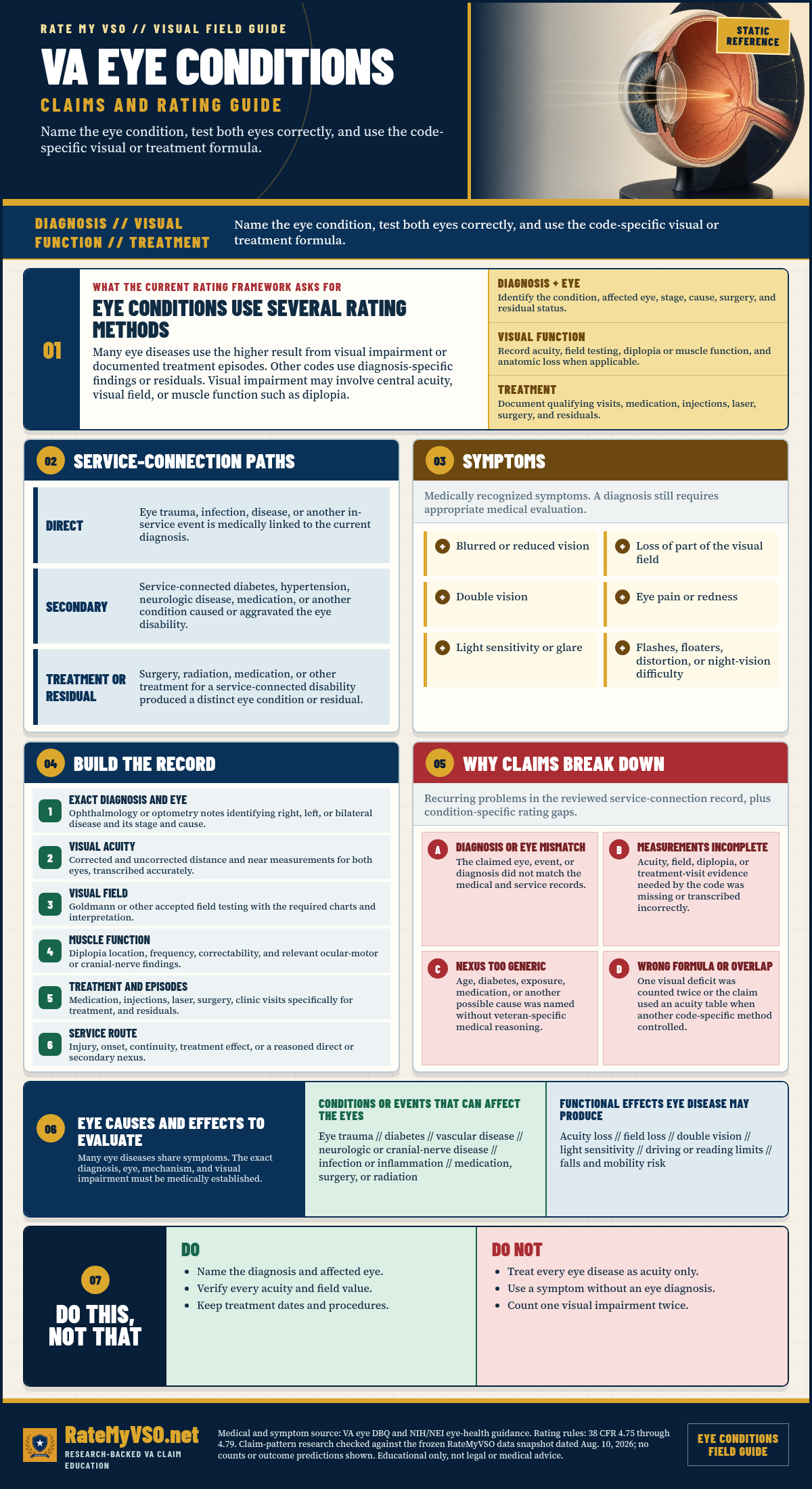 One-page guide: VA Eye Conditions Claims in One Page
Eye-conditions guide covering diagnosis-specific formulas, acuity, visual field, diplopia, treatment episodes, service paths, symptoms, examination evidence, and common claim gaps. Opens the full-size chart, free to save or print.
One-page guide: VA Eye Conditions Claims in One Page
Eye-conditions guide covering diagnosis-specific formulas, acuity, visual field, diplopia, treatment episodes, service paths, symptoms, examination evidence, and common claim gaps. Opens the full-size chart, free to save or print.
ICD-10 Diagnosis Codes
The ICD-10 diagnosis codes most commonly used for DC 6027, Cataract (the kind on your medical records, decision letter, or C&P exam report). VA rates the disability and its residuals, not the diagnosis itself, so coding can vary.
How Service Connection Works, At a High Level
Before getting into the specific pathways below, it helps to understand the three things every eye claim ultimately has to show. This is the same basic test that applies to any VA disability claim, just applied to eye conditions.
- A current diagnosis. A real, diagnosed eye condition, not just symptoms. VA often concedes this once an exam confirms the diagnosis; under 38 CFR 3.104(c), once the VA office makes that favorable finding, it binds the judge on later review.
- An in-service event, or a service-connected condition behind it. Something that happened to your eyes in service, such as an injury or a toxic or occupational exposure that is documented or conceded, or a disability VA has already service-connected that caused or worsened the eye condition.
- A medical nexus. A doctor's opinion connecting your eye condition to service, or to the service-connected condition, saying it is at least as likely as not related, and explaining the reasoning, not just stating a conclusion.
Service Connection Pathways: Direct and Secondary
Every eye condition follows the three-part test above. The practical paths that produce grants vary by condition, and which pathway fits yours changes what evidence you need to gather.
Direct Service Connection
Direct connection requires the condition to have begun during service or been caused by a specific in-service event. Documented in-service causes include:
- Physical trauma to the eye during service (blunt impact, blast exposure, fragment injury).
- Occupational exposure to ultraviolet radiation, chemical splashes, or foreign objects, for example in welding, demolition, or aviation roles where debris contact was a documented hazard.
A contemporaneous service record noting an eye injury or occupational exposure, combined with a medical nexus opinion, supports this path. Buddy statements from people who served alongside you can help establish an in-service event when the records themselves are thin. See our Service Connection Guide.
Secondary Service Connection (38 CFR § 3.310)
Secondary connection is often the stronger path for cataracts and other eye conditions, and it does not require proving the eye itself was hurt in service at all. See our Secondary Service Connection Guide.
Secondary to Diabetes (DC 7913)
Diabetes is the pathway that shows up most often in the Board's published eye decisions. Diabetic changes to the lens (diabetic cataracts) and diabetic retinopathy are well-documented complications of diabetes. Glaucoma and pseudophakia (an implanted lens after cataract surgery) have both been granted as caused by service-connected diabetes, and cataract-surgery residuals have been granted the same way, based on treatment records tying the cataracts to the diabetes. A separate rating for dry eye syndrome has also been granted after an examiner tied it to diabetes-related inflammation of the eyes. If your diabetes is service-connected, an eye condition caused or worsened by that diabetes can be service-connected as secondary to it. See secondary vs. aggravation and our Diabetic Retinopathy Secondary to Diabetes guide.
Secondary to long-term corticosteroid use
Prolonged systemic steroid use is a recognized cause of posterior subcapsular cataracts. If you take corticosteroids for a service-connected condition (for example, a service-connected autoimmune disease, asthma, or inflammatory condition), cataracts secondary to that steroid use can be service-connected. The nexus needs to document the service-connected condition, the corticosteroid treatment for it, the duration of use, and the medical link to the cataract.
Direct connection to a documented in-service blast or trauma
Cataracts and corneal scars have been granted where a documented in-service blast or impact injury to the eye is in the service record, backed by statements from fellow service members. A physician assistant's opinion that cites supporting medical literature linking eye trauma to cataracts, and applies that literature to the veteran's own facts, can be enough to create the balance of evidence needed for a grant, even where a VA examiner's opinion is negative or absent.
Toxic exposure and presumptive lists
Burn pit and airborne hazard exposures have been associated with a range of systemic conditions that can have secondary eye effects, but eye conditions themselves are not on those presumptive lists. Cataracts and other eye conditions are not on the Camp Lejeune contaminated-water list under 38 CFR 3.309(f), and are not on the PACT Act presumptive list. A claim resting only on toxic-exposure or Camp Lejeune presumption, without an actual medical link, has been denied on that basis in the Board's published decisions. Veterans with documented toxic exposures should consider whether their eye condition can be connected through a secondary nexus to another condition that is itself presumptive. See burn pit presumptive and Agent Orange presumptive for applicable conditions.
Reopening a prior denial
If your eye claim was denied before, a new and relevant nexus opinion can reopen it (38 CFR 3.156(d); 38 CFR 3.2501). In the Board's published decisions, a cataract claim denied years earlier was reopened and granted after the veteran submitted a new nexus report addressing the medical link that had been missing the first time. See the Supplemental Claim Guide.
Nexus letters for eye claims
Eye conditions that are not presumptive require a private medical opinion from a qualified provider. To serve as a nexus letter, that opinion must explicitly state the medical link to service, a plain private opinion that does not address the service connection will not. For secondary claims, the opinion should address both the service-connected primary condition and the mechanism by which it caused or worsened the eye condition. See the nexus letter guide for what a strong nexus opinion contains.
What VA Looks For: Tests, Records, and Diagnostic Codes
Records to gather for a direct or secondary claim:
- The eye exam itself: Snellen acuity values for each eye (corrected and uncorrected, distance and near), automated visual field perimetry results, and, for cataracts, whether surgery has occurred and whether a replacement lens was implanted.
- Treatment records: documented clinic visits for active treatment, such as injections, laser treatment, or surgery, which drive the incapacitating-episode track described above.
- The diagnostic codes involved: DC 6027 (cataract) or DC 6029 (aphakia) for cataract claims, DC 6066 for visual acuity loss, DC 6080 for visual field defects, and DC 6065 for the more severe vision-in-one-eye tier, plus whatever code applies to the condition you're connecting it to, most commonly DC 7913 (diabetes mellitus).
- The actual form the examiner fills out: a Disability Benefits Questionnaire (DBQ) specific to eye conditions, discussed in more detail later in this guide.
Evidence That Wins Eye Claims
We analyzed the Board's published decisions for vision loss: a private nexus opinion in the file goes with a much higher grant rate, shown below.
- A complete eye exam with Snellen acuity values. Both eyes, both corrected and uncorrected, both distance and near. The exact Snellen fraction (20/X) for each measurement feeds the rating tables. A report that says only "vision impaired" without the numerical values cannot be rated accurately.
- Visual field test results. Automated perimetry (Humphrey or Goldmann) documenting peripheral field loss in each direction. Relevant if you have glaucoma, optic nerve damage, or field defects alongside any other condition.
- The right DBQ. The eye conditions DBQ captures acuity values, field testing, the pre- vs. post-operative cataract status, presence or absence of replacement lens, incapacitating episode count, and treatment type. A complete, accurate DBQ prevents the transcription errors that commonly lower eye ratings. See DBQ guide.
- Documented treatment visits. For the incapacitating-episode track, each qualifying visit must appear in the medical record. A dated log of visits, with the treatment provided at each, makes counting straightforward for the rater.
- Treatment records that name the medication or procedure. Intravitreal injections, laser treatments, surgical interventions, and immunosuppressants all qualify as treatment events. Records that name the specific intervention and the date are stronger than a summary that says "patient managed with ongoing treatment."
- A nexus opinion that explains its reasoning, not just a conclusion. The clearest path to a grant is an opinion that spells out how the connection works, applying supporting medical literature to your own facts, rather than a bare "at least as likely as not" with no rationale. For secondary claims, the opinion should identify the service-connected primary condition, the mechanism of causation (for example, corticosteroid use or diabetic vascular changes), and the medical link to the eye condition. See nexus letters.
- Documentation that the VA office already conceded a fact. Under 38 CFR 3.104(c), once the regional office concedes your diagnosis or an in-service exposure, the Board judge is bound by that finding and cannot undo it on review. Pointing to the VA's own favorable finding can narrow the fight to the medical link.
- In-service records and buddy statements documenting exposure or injury. For direct claims, contemporaneous records of an eye injury, chemical splash, or occupational exposure duty assignment strengthen the in-service event element, and statements from people who served alongside you can fill gaps the records leave thin.
Evidence Cited in Published Eye conditions Decisions
We analyzed 20,374 published Board decisions involving eye conditions for condition-specific evidence, counting only case-specific mentions (boilerplate recitations excluded). "Favorable" is the share of decisions citing that evidence where every issue was granted or the outcome was mixed; the baseline across all these decisions is 41.2%, combining every diagnostic code below. Evidence appearing in a decision does not mean it decided the case. Descriptive of the published record, not a prediction.
Bar length shows decisions citing the evidence.
By diagnostic code
These codes are grouped together above. They do not perform the same, so find your own code here rather than reading the combined figure. A code retired in the schedule rewrites appears without a link, because its decisions were judged under criteria that no longer apply.
Bar length shows published decisions reviewed.
Detected by phrase-reading the decision text with condition-specific vocabularies. Source: Board of Veterans' Appeals decisions, RateMyVSO analysis.
Why These Claims Get Denied
Beyond the general "no nexus" reason covered above, a few specific denial patterns show up often enough in the Board's published eye decisions to call out on their own.
- A cataract diagnosis alone, treated as "just aging." Cataracts are the most commonly denied eye claim because examiners repeatedly characterize them as age-related and a natural part of aging, with no in-service cause identified. A diagnosis is only step one; without a medical link to service or to a service-connected condition, the claim does not carry.
- The veteran's own belief about the cause, without a doctor's opinion behind it. Judges have repeatedly found that a veteran is not medically qualified to say what caused a complex eye disease. A belief that dry eyes came from allergies, or that a cataract came from contaminated water, has been rejected as not a competent medical opinion. Back your belief with a doctor.
- Toxic exposure or Camp Lejeune argued alone. Eye conditions are not on the presumptive lists. A Camp Lejeune cataract claim has been denied because cataracts are not a presumed contaminated-water disease, and toxic-exposure claims for eye disease have failed for lack of any real medical link.
- A long, unexplained gap after service. Big gaps between service and diagnosis get used against you. Dry eye first diagnosed more than two decades after service, and cataracts diagnosed decades later and called age-related, have both weighed heavily toward denial in published decisions. Explain the gap with continuity of symptoms if you can.
- Claiming the wrong eye, or an event the records do not show. A right-eye claim has been denied where the service records only documented a left-eye injury and showed no right-eye trauma, even though other claims in the same case were granted. Make sure your claim matches what your records actually show.
- Confusing a rating or start-date fight with winning service connection. A large share of eye appeals at the Board are really about the rating percentage or the effective date on eyes that are already service connected, not about winning service connection itself, and several of those have still been denied. Know which battle you are in; winning a higher rating is a different task than first proving the connection.
How the VA Rates Eye Conditions
The eye-rating schedule is in 38 CFR Part 4, Subpart B, sections 4.75 through 4.79. Most eye conditions are rated on one or both of two measures.
Track 1: Visual acuity (DC 6066 and related codes)
Visual acuity ratings are based on Snellen chart results: both the distance at which you see clearly and the near-vision reading distance. The VA uses both corrected and uncorrected values, and tests both eyes separately. The tables in 38 CFR 4.75 and 4.76 convert Snellen fractions (for example, 20/200 or 20/400) into a numerical index. The numerical index for each eye is then combined to produce the schedular rating. The combination table means that acuity in both eyes matters. A severe loss in one eye combined with lesser loss in the other produces a different result than loss in only one eye.
Representative rating levels under DC 6066 are set by the combination of acuity in both eyes. The levels below are directly from the both-eye combination table in 38 CFR 4.79. Worse acuity (5/200 or below, or anatomical loss) is rated under DC 6061-6065, which carry higher ratings up to 100%.
Go deeper: open the full visual acuity breakdown (DC 6066)- What the VA measures at your C&P exam
- Evidence that has won at the Board
- Inside the rater's playbook: grant, denial, and remand rates
- Secondary condition map
Track 2: Visual field defects (DC 6080)
Visual field testing measures how wide a field you can see around a central point, including peripheral vision. Under 38 CFR 4.75, the VA uses a chart that maps loss of visual field in the nasal, temporal, superior, and inferior directions. Each direction of loss is weighted separately. DC 6080 covers visual field defects in one or both eyes. Like the acuity track, the rating depends on both the degree of loss and which eye is affected.
DC 6080 rates on two sub-frameworks: hemianopsia (loss of half or quadrant of visual field) and concentric contraction (how many degrees of field remain). The level that produces the higher rating controls.
Go deeper: open the full visual field breakdown (DC 6080)- What the VA measures at your C&P exam
- Evidence that has won at the Board
- Inside the rater's playbook: grant, denial, and remand rates
- Secondary condition map
Which track applies
For most diseases of the eye, 38 CFR 4.79 directs the rater to evaluate on whichever basis, visual impairment or incapacitating episodes, produces the higher rating. The two tracks are not added together. You get the better of the two. Eyes can also be rated on double vision (diplopia) where that is the predominant symptom.
The General Rating Formula: Incapacitating Episodes (38 CFR 4.79)
For diseases of the eye covered by the General Rating Formula for Diseases of the Eye at 38 CFR 4.79, including cataracts, the incapacitating-episode track rates based on how many documented treatment visits occurred during the past 12 months. An incapacitating episode is an eye condition severe enough to require a clinic visit to a provider specifically for treatment purposes. Routine monitoring visits do not count. The visit must be for active treatment of the condition.
Examples of qualifying treatment that the VA recognizes under 38 CFR 4.79 include systemic immunosuppressants or biologic agents, intravitreal or periocular injections, laser treatments, and surgical interventions. Each separate treatment event counts individually toward the annual total.
Cataracts: DC 6027 and DC 6029
Cataracts are rated under one of two diagnostic codes depending on whether surgery has occurred and whether a replacement lens was implanted.
DC 6027: Cataract (pre-operative or post-operative with lens replacement)
Used for cataracts that have not had surgery yet, and also for post-operative cataracts where a replacement lens (intraocular lens, or IOL) was implanted. Both situations are rated under the General Rating Formula for Diseases of the Eye at 38 CFR 4.79: either the visual impairment track (using acuity/field data) or the incapacitating-episode track, whichever produces the higher rating.
DC 6029: Aphakia (post-operative cataract, no replacement lens)
Used when a cataract has been surgically removed but no replacement lens was implanted. Without a lens, the eye cannot focus light normally, resulting in a condition called aphakia. DC 6029 rates on visual impairment (acuity and field data from the DBQ), and carries a minimum rating of 30% per the rating schedule.
Historical context: why cataracts were denied before
For many years, VA raters were instructed to classify cataracts under the refractive-error section of the rating schedule (38 CFR 4.9 addresses refractive error), which treated cataracts as a developmental or congenital defect rather than a ratable disability. Under that framework, claims were routinely denied unless very specific circumstances were met. That classification has since changed. Cataracts are now categorized with other eye diseases, the same category as glaucoma, dry eye syndrome, and similar conditions. A veteran with an old denial based on the refractive-error or congenital-defect rationale may have grounds to reopen or challenge the prior decision, because the basis for that denial no longer reflects VA policy.
- What the VA measures at your C&P exam
- Evidence that has won at the Board
- Inside the rater's playbook: grant, denial, and remand rates
- Secondary condition map
- What the VA measures at your C&P exam
- Evidence that has won at the Board
- Inside the rater's playbook: grant, denial, and remand rates
- Secondary condition map
Pitfalls and Common Mistakes
Patterns the eye-rating rules and the published decisions flag most often. In the Board's classified service-connection denials for visual acuity loss, no in-service event is the single largest reason.
- No nexus opinion in the file. For an eye condition that is not presumptive, a qualified provider's opinion connecting the condition to service, or to a service-connected primary, is the piece that is most often absent.
- An exam report without the Snellen numbers. Visual acuity ratings run on the exact corrected and uncorrected distance and near values for each eye. A report that says only "vision impaired" without the numerical Snellen fractions cannot be rated accurately and can produce a rating that is too low.
- Transcription errors going unchecked. The eye conditions DBQ captures four acuity values per eye that then have to be entered into the rating system, where the fields appear in a different order. An error at that step lowers the rating. The decision needs to be reviewed against the actual acuity values in the exam report.
- Missing the visual field track. Most eye diseases are rated on whichever basis, visual acuity or visual field loss, produces the higher rating. When automated perimetry results are absent from the file, a ratable field defect under DC 6080 can go uncounted.
- Treatment visits not logged as treatment. The incapacitating-episode track counts documented treatment visits, not routine monitoring. Visits that are not clearly labeled as treatment of the eye condition in the record may not be counted toward the annual total.
- A nexus opinion that only states a conclusion. An opinion that says a condition is "at least as likely as not" related to service without explaining why is given little weight. The opinion needs to give reasons, not just a bottom line.
Do's and Don'ts
A condensed version of everything above, in the order it actually matters when you sit down to build your file.
- Get a complete eye exam with Snellen acuity values and, if relevant, visual field testing, before you file.
- Get a private nexus opinion that explains its reasoning and cites your specific medical history, not a bare conclusion.
- Ask whether your eye condition could be secondary to a service-connected disease, especially diabetes.
- Document any in-service eye injury or occupational exposure, and gather buddy statements if the service records are thin.
- Point to any favorable finding the VA regional office already made, on the diagnosis or the in-service event.
- If you were denied before, submit new and relevant evidence to reopen the claim rather than starting over.
- Get current vision and visual-field testing before fighting a rating that is already service connected.
- Confirm your treatment visits are clearly labeled as treatment in the medical record, not just monitoring.
- Don't assume a cataract or other eye diagnosis alone wins the claim, you still need the connection to service.
- Don't rely only on your own opinion about what caused it, causation for a complex eye disease is treated as a medical question.
- Don't count on toxic-exposure or Camp Lejeune presumptions, eye conditions aren't on those lists.
- Don't leave a long gap between service and diagnosis unexplained, address it with continuity of symptoms if you can.
- Don't claim the wrong eye or an event your service records don't actually show.
- Don't confuse a fight over your rating percentage or effective date with proving service connection in the first place, they're different tasks.
- Don't submit a nexus opinion that states a conclusion without reasoning.
Quick Checklist Before You File
Bring these together before you submit anything.
- Confirm you have a current, diagnosed eye condition in your records.
- Ask whether the eye problem could be secondary to a service-connected disease, especially diabetes.
- Get a private eye doctor's nexus opinion that gives reasons and says "at least as likely as not," not just a conclusion.
- Gather service records and buddy statements for any in-service eye injury or exposure.
- Don't rely on toxic-exposure or Camp Lejeune presumptions; eye conditions are not on those lists.
- If denied before, submit new and relevant evidence to reopen (38 CFR 3.156(d)).
- If already service connected, get current vision and visual-field testing before fighting the rating.
- Keep a dated log of treatment visits (injections, laser, surgery) if you're pursuing the incapacitating-episode track.
For the mechanics of actually submitting the claim, see the Standard Claim Guide and the Fully Developed Claim Guide (filing with all your evidence up front can speed up the decision).
The Claims Process, Step by Step
Once you file, your claim moves through a series of hand-offs. Understanding who does what helps you know who to contact, and what to expect, at each stage.
- You file the claim. Directly with VA, through VA.gov, or with the help of an accredited representative.
- VA acknowledges the claim and assigns it for development. A Veteran Service Representative (VSR) is assigned to gather your service treatment records, VA and private medical records, and any other evidence needed.
- The VSR orders a Compensation & Pension (C&P) exam if one is needed. Not every claim requires one, but most eye claims do, especially secondary claims where a nexus opinion is required.
- The C&P exam is conducted. By a VA clinician or a contracted examiner, who completes a Disability Benefits Questionnaire (DBQ) documenting the acuity values, field test results, cataract/lens status, and, where relevant, a nexus opinion.
- The file goes to a Rating Veteran Service Representative (RVSR), the "rater." The rater reviews the complete file, including the exam results, and decides whether service connection is warranted and at what percentage.
- A senior reviewer may review the decision before it's finalized, depending on the complexity of the claim.
- VA issues the decision letter. This states whether the claim is granted or denied, the rating percentage if granted, and the reasons behind the decision.
- If you disagree, you choose an appeal lane. Higher-Level Review, Supplemental Claim, or a Board appeal, covered later in this guide.
Who's who: VSO vs. VSR vs. Rater vs. C&P Examiner
Your VSO
An accredited representative from a veterans service organization, or an accredited attorney or claims agent. Not a VA employee. Helps you prepare, gather evidence, and file, and can represent you through an appeal. Has no authority to decide your claim.
VSR (Veteran Service Representative)
VA staff who "develops" your claim: requests records, schedules the C&P exam, and assembles the file. Does not decide the rating.
Rater (RVSR)
VA staff who reviews the completed file and makes the actual decision, service connection or denial, and the percentage. This is the person whose judgment the decision letter reflects.
C&P Examiner
A VA clinician or a contracted medical examiner who conducts the exam and completes the DBQ. Documents findings and, where asked, a nexus opinion. Does not decide the claim.
For the full walkthrough of every stage with more detail, see Inside Your Claim and Claim Stages.
DBQs and Your C&P Exam
A Disability Benefits Questionnaire (DBQ) is the standardized form an examiner completes for your condition, it structures the exam findings into the specific data points VA's rating schedule requires. For eye conditions, the eye conditions DBQ captures acuity values, field testing, the pre- vs. post-operative cataract status, presence or absence of replacement lens, incapacitating episode count, and treatment type. See the DBQ Guide for how these forms work, including whether a private DBQ completed by your own doctor can be submitted instead of relying solely on a VA exam.
Before your C&P exam, bring a clear, specific account of your symptoms and their functional impact, and any prior eye exam records so the examiner's Snellen values and field-test results can be checked for consistency. Be consistent with what's already in your medical records and prior statements. For a full walkthrough of what to expect and how to prepare, see the C&P Exam Prep Guide.
Reading Your Decision Letter, and What to Do If Denied
Your decision letter has two parts: a narrative section explaining the reasoning (often called "reasons and bases"), and a codesheet showing the actual rating percentage, the effective date, and the diagnostic code used. See the Reading Your Decision Letter Guide for how to find and interpret each part, or use the Letter Interpreter tool to upload your own letter and get a plain-English breakdown.
If your claim is denied, or the rating is lower than you expected, you have three main lanes:
- Supplemental Claim: refile with new and relevant evidence, such as a new nexus opinion or updated eye exam. See Supplemental Claim Guide.
- Higher-Level Review (HLR): a senior reviewer looks at the same evidence again for a difference of opinion, no new evidence is added. See HLR Guide.
- Board Appeal: your case goes to a Veterans Law Judge at the Board of Veterans' Appeals, with options for a direct review, an evidence docket, or a hearing. See Board Appeal Guide.
Not sure which lane fits your situation? See the Appeals decision guide for a side-by-side comparison of all three.
After You Win: Maintaining Your Rating
A grant is not always the end of the story, especially on the rating and effective-date side. A rating reduction is not automatic: VA must show your eye actually improved, not just that a later exam was less thorough or less detailed than the one that supported the original grant. Keep your treatment consistent, continued follow-up with an eye-care provider, and a clear record of ongoing symptoms and treatment visits, protects you if VA schedules a future reexamination or proposes a reduction. Not every rating gets reexamined; understand when a rating becomes protected from future review (including Permanent and Total status) and what to do if VA proposes to reduce it. See Protect Your Rating and Future Reexaminations for the specifics.
If your eye condition worsens after the initial grant, for example progressing to more treatment visits or a lower acuity tier, you can file for an increased rating. See the Rating Increase Guide.
Common Secondary Conditions
We found these are the conditions most often linked with vision loss in the Board's published decisions. Each bar is the BVA grant rate for the pairing, with the number of decisions below it. They describe what the Board's record shows across many veterans, not a prediction about any one claim.
Ways to connect via another condition (vision loss as the secondary)
Claims where a vision loss diagnosis was argued as secondary to an already service-connected condition, most often diabetes. This is usually the easier route into a grant when direct in-service trauma is not documented:
Conditions vision loss can cause (vision loss as the primary)
Conditions veterans have claimed as caused or aggravated by an already service-connected vision loss, in other words, conditions secondary to the eye condition once it is already service-connected:
Cataracts (DC 6027) show the same secondary-pathway pattern in reverse: diabetes and open-angle glaucoma are the conditions most often paired with a cataract diagnosis in the published record. See the full DC 6027 breakdown for that data. A dedicated cond-bars widget for DC 6080 (visual field defects) is not included here because the corpus does not yet have enough classified DC 6080 pairings to meet our reliability threshold; that gap will close as more decisions are coded.
Quick Reference Tables
Secondary Connection Pathways
| Primary Condition | Mechanism | Evidence Needed |
|---|---|---|
| Diabetes mellitus (DC 7913) | Diabetic changes to the lens, diabetic retinopathy, diabetes-related inflammation | Eye exam + treatment records tying the eye condition to diabetes + nexus opinion |
| Long-term corticosteroid use for a service-connected condition | Posterior subcapsular cataract formation from prolonged systemic steroid use | Records of the steroid treatment, its duration, and a nexus opinion naming the mechanism |
| Documented in-service eye trauma or occupational exposure | Direct injury or exposure causing the eye condition | Service records or buddy statements documenting the event + nexus opinion |
Rating Tracks at a Glance
| Track | What It Measures | Governing Codes |
|---|---|---|
| Visual acuity | Corrected/uncorrected Snellen values, both eyes, combined via table | DC 6066, DC 6061-6065 |
| Visual field | Hemianopsia or concentric contraction, degrees of remaining field | DC 6080 |
| Incapacitating episodes | Documented treatment visits (injections, laser, surgery) in past 12 months | DC 6027 and other 38 CFR 4.79 diseases |
From Filing to Decision: Who Does What
| Role | Does | Decides your rating? |
|---|---|---|
| VSO / accredited representative | Helps prepare, gather evidence, and file; represents you on appeal | No |
| VSR | Develops the claim: orders records and the C&P exam | No |
| C&P Examiner | Conducts the exam, completes the DBQ, may give a nexus opinion | No / but has a strong impact |
| Rater (RVSR) | Reviews the full file and decides service connection and percentage | Yes |
Frequently Asked Questions
I was denied for cataracts years ago because it was called a congenital defect. Can I try again?
What is the difference between DC 6027 and DC 6029?
How does the incapacitating-episode count work? Does a routine checkup count?
Can cataracts be service-connected if I take steroids for another service-connected condition?
My visual acuity is poor in one eye but fine in the other. Will I get a significant rating?
Can I rely on toxic exposure or Camp Lejeune water alone to connect my eye condition?
Related Tools and Guides
Sources
- 38 CFR 4.75, general rating considerations for diseases of the eye
- 38 CFR 4.79, General Rating Formula for Diseases of the Eye (visual acuity, visual field, incapacitating episodes; Diagnostic Codes 6025, 6027, 6029, 6066, 6080, 6081)
- 38 CFR Part 4 Appendix A, DC 6027 and DC 6029
- 38 CFR 4.9, refractive error (not ratable as disability)
- 38 CFR 3.303, direct service connection; continuity of symptoms under 3.303(b); disease diagnosed after service under 3.303(d)
- 38 CFR 3.310, secondary service connection, including aggravation
- 38 CFR 3.307 and 3.309, presumptive service connection; Camp Lejeune contaminated water under 3.307(a)(7) and 3.309(f)
- 38 CFR 3.102 and 38 USC 5107(b), benefit of the doubt
- 38 CFR 3.104(c), VA office favorable findings bind the Board
- 38 CFR 3.156(d) and 3.2501, new and relevant evidence to reopen a claim
- 38 USC 1110 and 1131, basic service connection
- 38 CFR 4.13, rating reductions require actual improvement
- 38 CFR 4.119, Diagnostic Code 7913, noncompensable diabetic complications folded into the diabetes rating