VA Fibromyalgia Claims Guide
Fibromyalgia is a chronic condition involving widespread musculoskeletal pain and tender points, often accompanied by fatigue, sleep problems, and cognitive difficulties. The VA rates it under diagnostic code 5025 at three compensable levels (10, 20, and 40%). For veterans with qualifying Gulf War service, fibromyalgia is recognized as a medically unexplained chronic multisymptom illness (MUCMI) presumptively connected to service under 38 CFR 3.317, with no nexus letter required. This guide walks the whole path: the presumptive path, direct and secondary service connection for non-Gulf-War veterans, the DC 5025 rating criteria, the evidence that wins, why these claims get denied, a checklist before you file, what the claims process looks like step by step, how to read your decision letter, and what to do whether you win or you're denied.

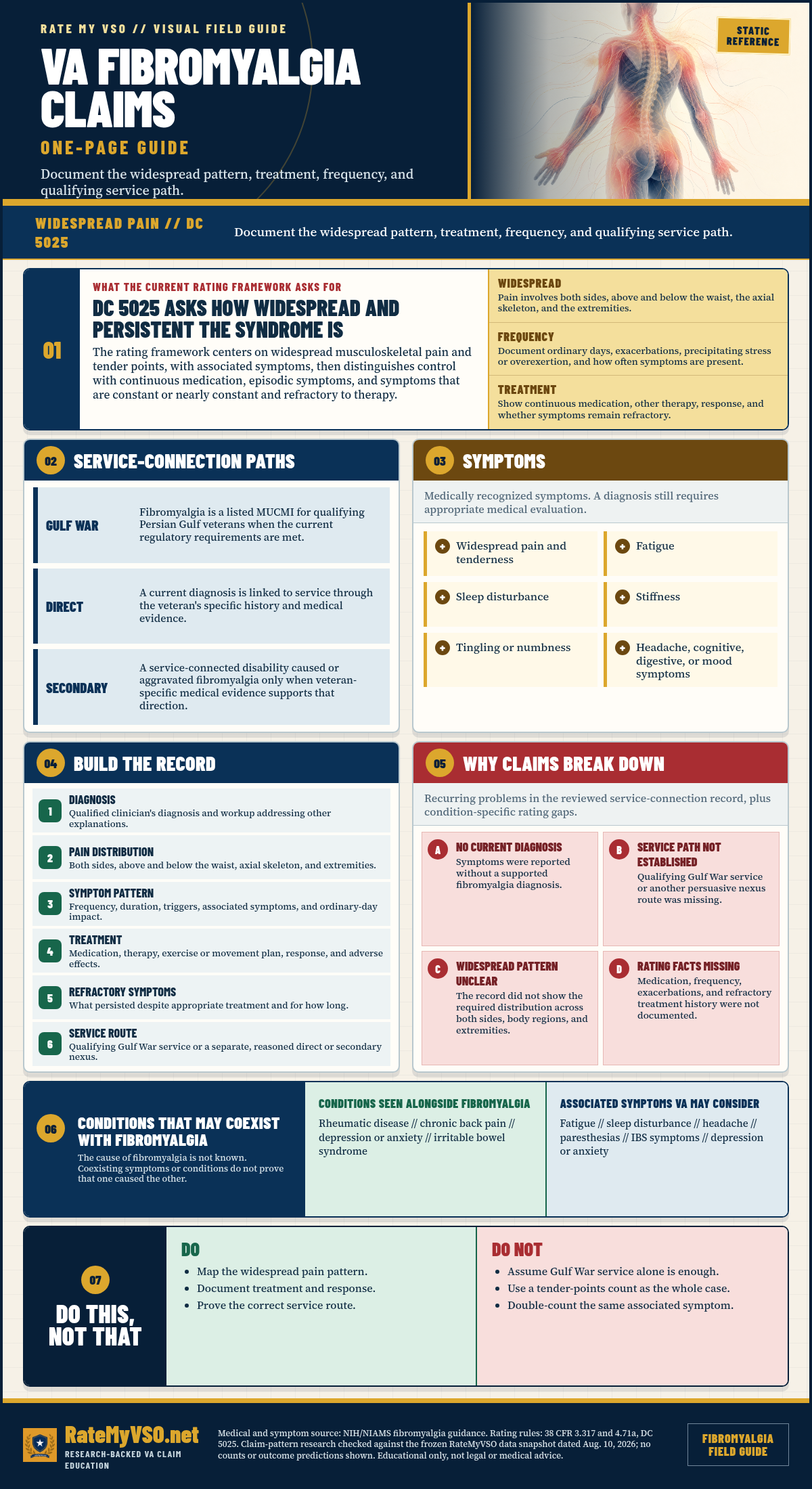 One-page guide: VA Fibromyalgia Claims in One Page
Fibromyalgia guide covering the widespread-pain definition, symptom frequency, treatment response, Gulf War and other service paths, associated symptoms, evidence, and common claim gaps. Opens the full-size chart, free to save or print.
One-page guide: VA Fibromyalgia Claims in One Page
Fibromyalgia guide covering the widespread-pain definition, symptom frequency, treatment response, Gulf War and other service paths, associated symptoms, evidence, and common claim gaps. Opens the full-size chart, free to save or print.
Start with the essentials
- 01Service Connection
The ways service connection can be established for this condition.
- 02Diagnosis and Evidence
Common symptoms and the evidence cited in published Board appeals.
- 03Your History
What you experienced, what others observed, and what treatment changed.
Understand the claim
ICD-10 Diagnosis Codes
The ICD-10 diagnosis codes most commonly used for DC 5025, Fibromyalgia (fibrositis, primary fibromyalgia syndrome) (the kind on your medical records, decision letter, or C&P exam report). VA rates the disability and its residuals, not the diagnosis itself, so coding can vary.
How Service Connection Works, At a High Level
Before getting into the specific pathways below, it helps to understand the three things every fibromyalgia claim ultimately has to show on the normal path. This is the same basic test that applies to any VA disability claim, just applied to this condition.
- A current diagnosis. A doctor has to have actually diagnosed you with fibromyalgia, and it must appear in your records during your claim. This is the single most important element for this condition, more claims fail here than anywhere else. A veteran's own belief, or being "told" by someone that they have fibromyalgia, with nothing documented in the record, does not meet this element.
- An in-service cause, or a covered shortcut. This can be an event, injury, or toxic exposure documented in service, or one of two shortcuts described below: qualifying Gulf War (Southwest Asia) service, or an already service-connected condition that caused or worsened the fibromyalgia.
- A medical nexus. On the direct or secondary path, a doctor must connect your fibromyalgia to service, or to the other condition, and explain the reasoning, not just state a conclusion. On the Gulf War presumptive path below, you do not need a nexus opinion at all.
Service Connection Pathways: Direct and Secondary (Non-Gulf-War Veterans)
Veterans without qualifying Gulf War service have additional paths, all of which require more evidence than the 3.317 presumptive.
Direct Service Connection
The standard three-element test applies: current diagnosis, an in-service event or onset, and a medical nexus linking them. If your service records document fibromyalgia symptoms in service, or if you were diagnosed while on active duty, the direct path is viable. A credible nexus opinion from a licensed physician is typically required. The evidence foundation must be clean: the examiner's narrative must align with your service records and not contradict itself (for example, attributing the cause to something outside of service).
Toxic exposure as the in-service cause. Even without Gulf War service, veterans have won direct service connection by showing exposure to jet fuel, fumes, or solvents during service, plus a doctor's opinion linking that exposure to the fibromyalgia diagnosis with a medical explanation, not just a bare conclusion.
Secondary Service Connection (38 CFR 3.310)
Fibromyalgia can be claimed as secondary to an already service-connected condition. The M21 manual does not bar it. This path requires a nexus opinion from a physician who is willing to state that the service-connected condition caused or aggravated the fibromyalgia, and the evidence supporting that link must be strong. C&P examiners may scrutinize this theory closely. A "primary fibromyalgia syndrome" entry in your medical records (meaning no identifiable cause) works against a secondary theory.
Documented winning links. Veterans have won secondary service connection by tying fibromyalgia to service-connected PTSD (where a private doctor explained that PTSD-related stress aggravates fibromyalgia), and by linking it to Crohn's disease together with a service-connected psychiatric disorder, supported by a nexus opinion that cited medical literature applied to the veteran's own facts.
The more useful direction is the reverse: using service-connected fibromyalgia as an anchor condition to claim secondaries from it. Conditions commonly associated with fibromyalgia include:
- Depression and anxiety: must be documented as separate diagnoses, not just symptoms absorbed into the fibromyalgia rating. Chronic pain causing depression is a well-supported secondary theory.
- Irritable bowel syndrome: recognized as associated with fibromyalgia. Examiners may require stronger evidence for this link. See the IBS claims guide.
- Headaches: can be secondary to fibromyalgia, but a separate diagnosis (not just a symptom of fibromyalgia itself) is needed for a separately compensable rating above 0%.
TERA (Toxic Exposure Risk Activity) Path
The PACT Act introduced the Toxic Exposure Risk Activity framework under 38 CFR 3.317 and related regulations. If you did not serve in a qualifying Gulf War location but were exposed to specific chemicals or toxic agents during service, a claim that those exposures caused fibromyalgia is legally possible. This theory depends on the specific chemicals involved and whether a medical examiner can establish a link between that exposure and fibromyalgia. Evidence demands are high. See toxic exposure appeals data.
Chronic Disability Presumptive (38 CFR 3.309(a))
If you were diagnosed with fibromyalgia within one year of separation from active duty, the condition may be presumptively service-connected as a chronic disability under 38 CFR 3.309(a) without requiring in-service documentation of symptoms. The diagnosis must fall within that one-year window.
What VA Looks For: Tests, Records, and Diagnostic Codes
Whether you are filing under the Gulf War presumptive, directly, or secondary to another condition, the record VA actually reviews centers on a small set of documents and data points.
- The diagnosis itself: a treating provider's note stating the diagnosis of fibromyalgia in plain terms, documenting the widespread pain distribution (both sides of the body, above and below the waist, axial skeleton) and tender points. Examiners often reference Mayo Clinic criteria.
- Proof of qualifying service: for the Gulf War path, service personnel records or a DD-214 showing deployment to a qualifying Southwest Asia location.
- Treatment and symptom records: documentation of continuous medication, symptom frequency, and whether treatment controls the condition, this drives the DC 5025 rating percentage.
- The diagnostic codes involved: DC 5025 for the fibromyalgia itself, plus whatever code applies to a condition you are connecting it to as secondary, for example a psychiatric disorder code for depression or anxiety, or DC 7319 for irritable bowel syndrome.
- The actual form the examiner fills out: a Disability Benefits Questionnaire (DBQ) specific to fibromyalgia, discussed in more detail later in this guide.
What Is Fibromyalgia
Fibromyalgia is a long-term condition characterized by widespread body pain, fatigue, sleep disturbance, and cognitive difficulties. Researchers believe it affects how the brain and spinal cord process pain signals. There is no inflammation or visible structural damage on imaging, which is why the VA describes it as widespread musculoskeletal pain with tender points.
For VA rating purposes, "widespread pain" has a specific definition. It must be present on both the left and right sides of the body, both above and below the waist, and must affect the axial skeleton (cervical spine, anterior chest, thoracic spine, low back) and the extremities. A diagnosis that does not meet that full distribution may not satisfy the DC 5025 criteria.
Associated symptoms listed in the rating criteria include fatigue, sleep disturbance, morning stiffness, headaches, irritable bowel syndrome, depression, anxiety, and Raynaud's-like symptoms. These are listed as "with or without" modifiers, meaning you do not need all of them, but their presence may open secondary-condition claims. See the IBS claims guide for how secondary IBS ratings work.
The Gulf War Presumptive Path: 38 CFR 3.317
For veterans who served in a qualifying location in the Southwest Asia theater, fibromyalgia is a named medically unexplained chronic multisymptom illness (MUCMI) under 38 CFR 3.317. The VA presumes service connection without requiring a nexus letter connecting the diagnosis to service. This is the strongest available path for eligible veterans, and it is one of two shortcuts (the other is the secondary route below) that let you skip the in-service-cause and nexus elements entirely.
Who qualifies
You must have served in the Southwest Asia theater of operations on or after August 2, 1990, or in other qualifying locations added under the PACT Act. Qualifying locations include the Persian Gulf, Iraq, Kuwait, Saudi Arabia, Bahrain, Qatar, the UAE, Oman, Afghanistan, and others, including the airspace above these areas. Some locations require boots on ground; the airspace provision applies differently depending on the specific region. See the Gulf War illness claims guide and the Gulf War presumptive reference page for the full location list.
Requirements under 3.317
- Qualifying service location: as above.
- A diagnosis that is at least 10 percent disabling: the fibromyalgia must be diagnosed, and the disability must be compensable (at least 10% under DC 5025), for the presumptive to apply.
- Chronicity: the condition must have persisted for six months or more. The VA considers a chronic disability one that has been present at least six months. If you file before reaching that threshold, the claim may not be grantable yet under this theory.
- No identified cause: if your fibromyalgia is clearly caused by an identifiable event unrelated to service (such as a civilian surgery), the MUCMI presumptive is harder to establish. A no-cause or idiopathic characterization in your records supports this theory.
- Diagnosis helpful but not always required: 3.317 technically covers undiagnosed illnesses as well, but for fibromyalgia, having the formal diagnosis is advantageous because the condition is recognized by name as a MUCMI.
Symptoms and rating
Symptoms Recorded in Granted Fibromyalgia Decisions
We analyzed 450 granted Board decisions involving fibromyalgia for symptoms named in sentences about the condition (rating-criteria recitations excluded). Descriptive of the published record, what the Board wrote down, not a checklist of what to report.
Bar length shows decisions. Percentages remain context.
Detected by phrase-reading the decision text with condition-specific vocabularies. Source: Board of Veterans' Appeals decisions, RateMyVSO analysis.
DC 5025 Rating Criteria: 10, 20, and 40 Percent
All three compensable levels require widespread musculoskeletal pain and tender points, with or without the associated symptoms listed above (see 38 CFR 4.71a, DC 5025). The rating then turns on how frequent and how treatable the symptoms are. Forty percent is the highest schedular rating the law allows for fibromyalgia; there is no rating above it under DC 5025.
- What the VA measures at your C&P exam
- Evidence that has won at the Board
- Inside the rater's playbook: grant, denial, and remand rates
- Secondary condition map
Anti-Pyramiding: Fibromyalgia and Other Joint or Pain Conditions
The same symptom cannot be used to support ratings under two different diagnostic codes (see 38 CFR 4.14). Because fibromyalgia produces widespread musculoskeletal pain, it can overlap symptomatically with separately rated joint conditions (such as a service-connected knee, shoulder, or back condition).
The rule operates symptom by symptom, not condition by condition. You can be rated for both fibromyalgia and a separately rated joint condition as long as the symptoms being rated are distinct. What you cannot do is use, for example, knee pain that is already being compensated under a knee rating as a basis for rating fibromyalgia pain in the same joint.
In practice, if evidence is ambiguous about which condition is causing a particular symptom, the VA rater is supposed to resolve the ambiguity in the veteran's favor by applying the most advantageous interpretation. But it is better to have records that distinguish fibromyalgia's widespread systemic pain from the localized symptoms of separately rated conditions.
Evidence and Board research
Evidence That Wins These Claims
We analyzed the Board's published decisions and found a private medical opinion is the highest-yield evidence for these claims:
- Current diagnosis from a licensed provider. The diagnosis must meet the clinical criteria for fibromyalgia. Examiners often reference Mayo Clinic criteria. Make sure your records use the term "fibromyalgia" explicitly and document the widespread pain distribution and tender points. This is the single most decisive piece of evidence in the entire claim, records with no diagnosis and "no pathology" noted are the leading reason these claims fail.
- A diagnosis from a qualified medical provider, not a chiropractor. Diagnoses and nexus opinions from chiropractors have been given little or no weight on fibromyalgia, particularly where the chiropractor's note simply echoed the veteran's own report rather than reflecting an independent exam. Get the diagnosis and any linking opinion from a physician or similarly qualified medical provider.
- Documentation of widespread pain distribution. The VA's definition requires both sides, above and below the waist, and axial skeleton involvement. Records that document the full distribution support the DC 5025 criteria.
- Symptom diary or tracking log. For 20% vs. 40%, the frequency and pattern of symptoms is decisive. A dated record of symptom severity, how often you have flares, whether rest helps, and what treatments you have tried makes the exacerbation and refractory-to-therapy criteria concrete rather than relying on memory during a C&P exam.
- Treatment records showing continuous medication. The 10% level requires continuous medication for control. Records documenting what medications you take and why establish this.
- Documentation of treatment failure (for 40%). The refractory-to-therapy standard means you have tried treatments and they have not adequately controlled the condition. Records showing trials of different medications, physical therapy, or other interventions that provided insufficient relief support a 40% rating.
- The fibromyalgia DBQ. Get a copy of the completed DBQ after any C&P exam. Verify that question 2B (continuous medication), 2D (refractory to therapy), and 3B (symptom frequency pattern) are answered accurately and consistently with your records. See the DBQ guide.
- Nexus letter (for direct or secondary paths) that explains its reasoning. On the direct or secondary path, the strongest opinions do more than state a conclusion, they review the records, describe how symptoms started, and cite medical support applied to your own facts. A letter from a physician who reviews your service records and treatment history, and who can provide a reasoned medical opinion that your fibromyalgia is related to service or to a service-connected condition, is what the Board gives weight to. See nexus letters.
- Lay statements on continuity of symptoms. Your own statement, or statements from people who know you, about how your symptoms have persisted since service and how they affect daily functioning. See buddy statements.
- NPI number verification for private DBQs. If you obtain a private DBQ, the examiner's National Provider Index number, address, phone, and fax must match what is on the NPI registry. Discrepancies give the VA grounds to question the document's authenticity.
Evidence Cited in Published Fibromyalgia Decisions
We analyzed 8,028 published Board decisions involving fibromyalgia for condition-specific evidence, counting only case-specific mentions (boilerplate recitations excluded). "Favorable" is the share of decisions citing that evidence where every issue was granted or the outcome was mixed; the baseline across all these decisions is 61%. Evidence appearing in a decision does not mean it decided the case. Descriptive of the published record, not a prediction.
Bar length shows decisions citing the evidence.
Detected by phrase-reading the decision text with condition-specific vocabularies. Source: Board of Veterans' Appeals decisions, RateMyVSO analysis.
Board Grants, Dissected
Fibromyalgia claims decided by the Board fall into two very different groups. Veterans who served in the Southwest Asia theater during the Persian Gulf War often win because fibromyalgia is treated by law as a "medically unexplained chronic multisymptom illness," which lets them skip the usual proof of an in-service injury and a medical nexus. Veterans without that Gulf War service still win, but only when they have a clear diagnosis and either a strong private medical opinion or service records that show related symptoms. The cases below show what made the difference. Board decisions are not binding on other veterans' claims, but they show how the same rules have been applied.
Persian Gulf presumption overcomes three inadequate VA exams Citation A26037374 (April 21, 2026), Direct Review docket
The record: A private physician, Dr. C.C., diagnosed fibromyalgia after reviewing medical literature against the veteran's symptoms. Three separate VA exams (2017, 2022, 2023) found no fibromyalgia diagnosis. The 2017 and 2022 exams said "most" of the veteran's symptoms were explained by other conditions but never said which symptoms. The 2023 exam claimed no diagnosis existed in the file, even though the December 2021 private diagnosis was already there.
Why it won: The Board found all three VA opinions inadequate. The word "most" left some symptoms unexplained, and the 2023 exam relied on a factually wrong premise. With the current-disability element found in the veteran's favor by benefit of the doubt, and Southwest Asia service already conceded by the RO, presumptive service connection under 38 C.F.R. § 3.317 was granted.
Treating doctor's DBQ outweighs VA opinion that ignored lay statements Citation A26036634 (April 20, 2026), Hearing docket
The record: The veteran's private doctor, who had treated him since 2007, diagnosed fibromyalgia in 2019 and later completed a December 2024 disability benefits questionnaire (DBQ) describing classic trigger-point tenderness, sleep disturbance, and worsening symptoms since Persian Gulf service. A December 2020 VA opinion said the condition was "less likely than not" related to service, reasoning that the only clinical note showing symptoms was not a "definitive diagnosis" and suggested the symptoms might be a somatic symptom disorder instead.
Why it won: The Board found the VA opinion inadequate because it did not address the veteran's lay statements or a December 2019 VA mental health DBQ that also listed fibromyalgia as a relevant diagnosis. The private physician's opinion, based on years of treatment, was given more weight under Nieves-Rodriguez because it had clear conclusions and supporting data.
Presumptive service connection granted with almost no discussion needed Citation A26036388 (April 20, 2026), Hearing docket
The record: The veteran took fibromyalgia medication during the appeal period, had confirmed presumptive service in Southwest Asia, and had no symptoms of fibromyalgia on entering service. There was no VA opinion disputing the diagnosis.
Why it won: Because fibromyalgia is a "qualifying chronic disability" for Persian Gulf veterans under 38 C.F.R. § 3.317, and there was no evidence of a supervening condition or willful misconduct, the Board found the presumption applied and granted the claim after resolving doubt in the veteran's favor.
Fibromyalgia tied to continuous pain-clinic treatment for a 10 percent rating Citation A26036047 (April 17, 2026), Hearing docket
The record: A September 2020 VA exam diagnosed fibromyalgia but found it began in 1995, after service, and did not initially meet the 10 percent rating standard requiring continuous medication to control. The exam did find a pain trigger point in the veteran's gluteal region. Treatment records showed the veteran received cortisol injections at a VA pain clinic in October 2023, January 2024, and July 2024.
Why it won: The Board found that regularly repeated pain-clinic treatment for over six months met the "continuous medication to control" standard under Diagnostic Code 5025, resolving doubt in the veteran's favor to find the condition chronic and warranting service connection tied to Persian Gulf service.
Treating physician's causal chain outweighs a VA opinion built on absence of records Citation A26029820 (April 1, 2026), Hearing docket
The record: The veteran had no Southwest Asia service, so presumptive service connection did not apply. Her service treatment records showed insomnia, dizziness, and headache complaints but no fibromyalgia diagnosis. A September 2025 private opinion from her treating physician, Z.S., MBBS, linked her in-service symptoms to her later-diagnosed fibromyalgia after reviewing her history and running lab work. An April 2021 VA opinion found fibromyalgia unrelated to service, reasoning there was no evidence of the same symptoms during or after service.
Why it won: The Board found the VA opinion inadequate because the veteran's service records did show pain, sleep disturbance, and headache complaints, the very symptoms the VA examiner said were absent. The VA opinion also failed to address the veteran's lay statements about continuous symptoms. The private opinion was found adequate and given significant weight because it was based on an in-person exam, records review, and a reasoned explanation.
Why These Claims Get Denied
Beyond the general "no nexus" reasons covered above, a few specific denial patterns show up often enough in the Board's published decisions to call out on their own.
- No current diagnosis in the record. This is by far the single most common reason fibromyalgia claims are denied. Having symptoms, or even a strong belief that you have the condition, is not enough. Claims are denied where the VA exam finds no diagnosis and the veteran has nothing better in the file, including at least one case where Gulf War service itself was conceded but the claim still failed because no doctor had actually diagnosed fibromyalgia.
- Assuming being "told" you have it is enough. Several veterans have lost because they only believed, or were told by someone, that they had fibromyalgia, with nothing documented in the record. Pain alone, without a diagnosis, symptoms, or functional impairment shown in the file, does not save the claim.
- Relying on a chiropractor for the diagnosis or the nexus. Opinions from chiropractors are repeatedly given little or no weight on fibromyalgia, especially where the diagnosis just echoes the veteran's own report rather than an independent clinical finding.
- An opinion that only repeats the veteran's own words. A private opinion that diagnoses fibromyalgia based solely on the veteran's self-report, with no listed symptoms, independent exam, or rationale, gets little to no weight.
- Claiming an in-service start your records contradict. If an opinion says the condition began in service but the service treatment records show nothing, and the provider never explains that gap, the opinion is inadequate and the claim is denied.
- An unexplained long gap after service. A long stretch between service and the first documented fibromyalgia complaint, with no explanation and no supporting nexus opinion, has been cited as a reason for denial. If there is a gap in your own history, address it directly.
Pitfalls and Common Mistakes
Patterns the published DC 5025 decisions and the rating rule flag most often. Among classified service-connection denials for fibromyalgia, a missing or insufficient diagnosis and a missing in-service event are the two largest reasons.
- No nexus opinion in the file. In the published decisions, a private nexus opinion goes with a higher grant rate. A useful opinion names the in-service event or the service-connected primary and explains the link.
- Filing direct or secondary when Gulf War service qualifies. For veterans with qualifying Southwest Asia service, fibromyalgia is a named MUCMI under 38 CFR 3.317 with no nexus required. Leading with a direct or secondary theory takes on the nexus burden the presumptive would have removed.
- Records that do not document the full widespread-pain distribution. DC 5025 requires pain on both sides, above and below the waist, and in the axial skeleton. A diagnosis that does not document that full distribution may not satisfy the criteria.
- Letting a co-occurring condition be absorbed as a symptom. Depression, IBS, or headaches documented only as fibromyalgia symptoms get rated inside the fibromyalgia evaluation. A separate formal diagnosis is what allows a separate rating.
- Filing before the six-month chronicity threshold. Under 38 CFR 3.317 the condition must have persisted six months or more. Filing earlier can leave the claim ungrantable under that theory.
- Not describing symptom frequency clearly for the rating. The gap between 20% and 40% is decided by whether symptoms are episodic (present more than one-third of the time) or constant/nearly constant and unresponsive to treatment. Vague descriptions leave the rater with less to work with.
- Filing a new standalone claim for an earlier effective date after a decision is final. Once a decision is final, you generally cannot get an earlier effective date without either appealing that original decision or alleging clear and unmistakable error (CUE). A request for an earlier date has been dismissed where the veteran never appealed and did not allege CUE.
Do's and Don'ts
A condensed version of everything above, in the order it actually matters when you sit down to build your file.
- Make sure a current diagnosis of fibromyalgia, using that exact term, is documented in your medical record before or during your claim.
- Use the Gulf War presumptive rule if you served in Southwest Asia, no nexus opinion is required on that path.
- If you have another service-connected condition, ask your doctor whether it caused or worsened your fibromyalgia.
- Get a nexus opinion that reviews your records, explains its reasoning, and cites your specific medical history, not a bare conclusion.
- Use a medical doctor or similarly qualified provider, not a chiropractor, for the diagnosis and the linking opinion.
- Keep your account of when symptoms started consistent with your service and medical records; explain any long gaps.
- For the rating, describe how often symptoms occur and whether treatment actually controls them.
- If a VA exam ignored your evidence or leaned only on an unexplained gap, say so directly in your response or appeal.
- If you were denied before, file a Supplemental Claim with new and relevant evidence rather than starting over.
- Don't assume that believing you have fibromyalgia, or being told you do, is the same as having it documented in your record.
- Don't rely on a chiropractor for the diagnosis or the nexus opinion, the Board gives these little to no weight.
- Don't submit an opinion that just repeats what you told the provider, with no independent exam or explanation behind it.
- Don't claim an in-service start that your own service treatment records contradict without explaining the discrepancy.
- Don't ignore a long unexplained gap between service and your first documented complaint.
- Don't expect a schedular rating above 40 percent, it is the maximum under DC 5025.
- Don't let a co-occurring condition (depression, IBS, headaches) sit undocumented as a separate diagnosis if you want it separately rated.
- Don't try to file a new standalone claim for an earlier effective date once the original decision is final, unless you are alleging clear and unmistakable error.
Secondary relationships
Common Secondary Conditions
We found these are the conditions most often linked with fibromyalgia in the Board's published decisions. Each bar is the BVA grant rate for DC 5025, with the number of decisions below it. They describe what the Board's record shows across many veterans, not a prediction about any one claim.
Conditions that can cause fibromyalgia (fibromyalgia as the secondary)
Claims where fibromyalgia was argued as secondary to an already service-connected condition. This is the "ways to connect via another condition" list:
Conditions fibromyalgia can cause (fibromyalgia as the primary)
Conditions veterans have claimed as caused or aggravated by a service-connected fibromyalgia:
Prepare and take the next step
Prepare: your own working pages
Optional. These are your own notes, in your own words. They are not a VA form, they are not sent to the VA, and nothing here is a medical finding or a prediction about your claim.
Three reminders while you prepare
- Describe the affected area and each side separately
Record the diagnosis, location, side, onset, and changes over time. Keep different joints, muscles, or body regions separate. Go to this part
- Document function during ordinary use and flares
Note pain, motion, weakness, endurance, stability, assistive devices, and what repeated use or a flare stops you doing. Go to this part
- Use measured findings and your own history together
Keep examination measurements and imaging distinct from your description of daily effects. Do not assign yourself a percentage. Go to this part
Sign in or create an account to save your answers and come back to them later. You can fill these in and print them without an account.
Condition and treatment timeline
Motion, flares, and daily function
Examination and objective findings
Records and unanswered questions
Decision-letter reading sheet
Quick Checklist Before You File
Bring these together before you submit anything.
- A current diagnosis of fibromyalgia documented by a qualified medical doctor, not a chiropractor, in your records, during your claim.
- If you served in the Southwest Asia (Gulf War) theater, proof of that service so you can claim fibromyalgia as a Gulf War presumptive illness under 38 CFR 3.317.
- If you have another service-connected condition, a doctor's opinion on whether it caused or worsened your fibromyalgia (a secondary claim).
- On a direct or secondary claim, a nexus opinion that reviews your records and explains its reasoning, not a bare conclusion.
- Records documenting the full widespread-pain distribution (both sides, above and below the waist, axial skeleton) and tender points.
- A symptom diary or tracking log showing frequency, flares, and whether treatment controls the condition, for the rating percentage.
- Your account of when symptoms started, consistent with your service and medical records; an explanation for any long gaps.
- If you were denied before: new and relevant evidence for a Supplemental Claim, not just a repeat of what was already considered.
For the mechanics of actually submitting the claim, see the Standard Claim Guide and the Fully Developed Claim Guide (filing with all your evidence up front can speed up the decision).
The Claims Process, Step by Step
Once you file, your claim moves through a series of hand-offs. Understanding who does what helps you know who to contact, and what to expect, at each stage.
- You file the claim. Directly with VA, through VA.gov, or with the help of an accredited representative.
- VA acknowledges the claim and assigns it for development. A Veteran Service Representative (VSR) is assigned to gather your service treatment records, VA and private medical records, and any other evidence needed.
- The VSR orders a Compensation & Pension (C&P) exam if one is needed. Not every claim requires one, but most fibromyalgia claims do, especially direct and secondary claims where a nexus opinion is required.
- The C&P exam is conducted. By a VA clinician or a contracted examiner, who completes a Disability Benefits Questionnaire (DBQ) documenting the diagnosis, tender-point and pain-distribution findings, symptom frequency, and, where relevant, a nexus opinion.
- The file goes to a Rating Veteran Service Representative (RVSR), the "rater." The rater reviews the complete file, including the exam results, and decides whether service connection is warranted and at what percentage.
- A senior reviewer may review the decision before it's finalized, depending on the complexity of the claim.
- VA issues the decision letter. This states whether the claim is granted or denied, the rating percentage if granted, and the reasons behind the decision.
- If you disagree, you choose an appeal lane. Higher-Level Review, Supplemental Claim, or a Board appeal, covered later in this guide.
Who's who: VSO vs. VSR vs. Rater vs. C&P Examiner
Your VSO
An accredited representative from a veterans service organization, or an accredited attorney or claims agent. Not a VA employee. Helps you prepare, gather evidence, and file, and can represent you through an appeal. Has no authority to decide your claim.
VSR (Veteran Service Representative)
VA staff who "develops" your claim: requests records, schedules the C&P exam, and assembles the file. Does not decide the rating.
Rater (RVSR)
VA staff who reviews the completed file and makes the actual decision, service connection or denial, and the percentage. This is the person whose judgment the decision letter reflects.
C&P Examiner
A VA clinician or a contracted medical examiner who conducts the exam and completes the DBQ. Documents findings and, where asked, a nexus opinion. Does not decide the claim.
For the full walkthrough of every stage with more detail, see Inside Your Claim and Claim Stages.
DBQs and Your C&P Exam
A Disability Benefits Questionnaire (DBQ) is the standardized form an examiner completes for your condition, it structures the exam findings into the specific data points VA's rating schedule requires. For fibromyalgia, that includes the tender-point and pain-distribution findings, whether continuous medication is required (question 2B), whether symptoms are refractory to therapy (2D), and the symptom frequency pattern (3B), the exact fields the rating tiers above turn on. See the DBQ Guide for how these forms work, including whether a private DBQ completed by your own doctor can be submitted instead of relying solely on a VA exam.
Before your C&P exam, bring a clear, specific account of your symptoms, focus on your worst days and how the condition affects daily function, not just how you feel on an average day. Be consistent with what's already in your medical records and prior statements. For a full walkthrough of what to expect and how to prepare, see the C&P Exam Prep Guide.
Reading Your Decision Letter, and What to Do If Denied
Your decision letter has two parts: a narrative section explaining the reasoning (often called "reasons and bases"), and a codesheet showing the actual rating percentage, the effective date, and the diagnostic code used. See the Reading Your Decision Letter Guide for how to find and interpret each part, or use the Letter Interpreter tool to upload your own letter and get a plain-English breakdown.
If your claim is denied, or the rating is lower than you expected, you have three main lanes:
- Supplemental Claim: refile with new and relevant evidence, such as a new diagnosis or a new nexus opinion. See Supplemental Claim Guide.
- Higher-Level Review (HLR): a senior reviewer looks at the same evidence again for a difference of opinion, no new evidence is added. See HLR Guide.
- Board Appeal: your case goes to a Veterans Law Judge at the Board of Veterans' Appeals, with options for a direct review, an evidence docket, or a hearing. See Board Appeal Guide.
Not sure which lane fits your situation? See the Appeals decision guide for a side-by-side comparison of all three.
After You Win: Ratings, Effective Dates, and Maintaining Your Rating
A grant is not always the end of the story. A number of published Board decisions for fibromyalgia are not about winning service connection at all, they are disputes over the rating percentage or the effective date after fibromyalgia was already granted. Two lessons come out of those files: first, reaching the 40 percent level requires proving both parts of the test (near-constant frequency and treatment failure), not just one; and second, once a decision becomes final, you generally cannot file a new standalone claim for an earlier effective date, you must either have appealed the original decision or be alleging clear and unmistakable error (CUE).
Keep your treatment consistent, continued follow-up with your provider documenting symptom frequency and whether medication is controlling the condition, protects your rating if VA schedules a future reexamination. Not every rating gets reexamined; understand when a rating becomes protected from future review and what to do if VA proposes to reduce it. See Protect Your Rating and Future Reexaminations for the specifics.
If your fibromyalgia worsens after the initial grant, for example symptoms becoming more frequent or unresponsive to treatment, you can file for an increased rating up to the 40 percent maximum. See the Rating Increase Guide.
References and related resources
Quick Reference Tables
Paths to Service Connection
| Path | What It Requires | Nexus Needed? |
|---|---|---|
| Gulf War presumptive (38 CFR 3.317) | Qualifying Southwest Asia service, diagnosis at least 10% disabling, six months chronicity, no identified non-service cause | No |
| Direct service connection | Current diagnosis, an in-service event or exposure (e.g. jet fuel, fumes, solvents), medical nexus | Yes |
| Secondary service connection (38 CFR 3.310) | Current diagnosis, an already service-connected condition that caused or aggravated it (e.g. PTSD, Crohn's disease, a psychiatric disorder) | Yes |
| Chronic disability presumptive (38 CFR 3.309(a)) | Diagnosis within one year of separation from active duty | No |
DC 5025 Rating Levels
| Rating | Criteria |
|---|---|
| 40% | Symptoms constant or nearly constant AND refractory to therapy |
| 20% | Episodic, precipitated by stress or overexertion, present more than one-third of the time; continuous medication required |
| 10% | Requires continuous medication for control |
| 0% | Diagnosis established, no compensable symptoms |
From Filing to Decision: Who Does What
| Role | Does | Decides your rating? |
|---|---|---|
| VSO / accredited representative | Helps prepare, gather evidence, and file; represents you on appeal | No |
| VSR | Develops the claim: orders records and the C&P exam | No |
| C&P Examiner | Conducts the exam, completes the DBQ, may give a nexus opinion | No / but has a strong impact |
| Rater (RVSR) | Reviews the full file and decides service connection and percentage | Yes |
Frequently Asked Questions
Is fibromyalgia a Gulf War presumptive?
What is the highest rating for fibromyalgia?
What does "refractory to therapy" mean for the 40% level?
Can I get secondary conditions rated from fibromyalgia?
My records say "primary fibromyalgia syndrome." Does that affect my claim?
Why was my fibromyalgia claim denied even though I clearly have symptoms?
Can I get an earlier effective date after my fibromyalgia claim was already granted?
Related Tools and Guides
Sources
- 38 CFR 4.71a, DC 5025, rating criteria for fibromyalgia
- 38 CFR 3.303, direct service connection; 3.303(b), continuity of symptoms for chronic diseases; 3.303(d), disease diagnosed after service
- 38 CFR 3.310, secondary service connection, caused or aggravated by a service-connected condition
- 38 CFR 3.317, Persian Gulf War undiagnosed illness and MUCMI such as fibromyalgia
- 38 CFR 3.307 and 3.309, presumptive chronic diseases; 3.309(a), chronic disability presumptive within one year of separation
- 38 CFR 3.102, benefit of the doubt; 38 CFR 3.104(c), favorable findings are binding on the Board
- 38 CFR 4.14, anti-pyramiding, avoiding evaluation of the same disability or manifestation under multiple diagnostic codes
- 38 USC 1110 and 1131, basic service connection; 38 USC 1117, Persian Gulf qualifying chronic disability; 38 USC 1168, toxic exposure risk activity opinions under the PACT Act; 38 USC 5107(b), benefit of the doubt
- Shedden v. Principi, 381 F.3d 1163 (Fed. Cir. 2004), the three elements of service connection
- Wallin v. West, 11 Vet. App. 509 (1998), elements of secondary service connection
- Brammer v. Derwinski, 3 Vet. App. 223 (1992), no current disability means no service connection
- McClain v. Nicholson, 21 Vet. App. 319 (2007), a current disability at any point during the claim satisfies that element
- McLendon v. Nicholson, 20 Vet. App. 79 (2006), when VA must provide a medical exam
- Saunders v. Wilkie, 886 F.3d 1356 (Fed. Cir. 2018), pain causing functional impairment can itself be a disability
- Nieves-Rodriguez v. Peake, 22 Vet. App. 295 (2008), a medical opinion's probative value comes from its reasoning, not just the examiner's credentials
- Stefl v. Nicholson, 21 Vet. App. 120 (2007), a medical opinion must rest on an accurate factual premise and explain its conclusion
- Barr v. Nicholson, 21 Vet. App. 303 (2007), VA must ensure a medical exam it relies on is adequate
- Clemons v. Shinseki, 23 Vet. App. 1 (2009), VA reads a claim by the veteran's reasonable expectations, not just the label used
- Jandreau v. Nicholson, 492 F.3d 1372 (Fed. Cir. 2007), competency of lay testimony regarding observable symptoms
- VA.gov, Gulf War illness and Southwest Asia service
- VA Public Health, medically unexplained illnesses (MUCMI)