Hernia Claims Guide
A hernia is an organ or tissue pushing through a weak spot in the muscle wall, most often in the groin. For veterans, years of heavy lifting make them common, and many are first repaired in service. The rating surprises people: a hernia that was fixed and stayed fixed rates 0 percent, while a large hernia that surgery cannot fix and that causes pain with everyday activities rates much higher. This guide walks the whole path: how service connection works, how a hernia gets connected to your service (directly, or secondary to another condition), what evidence you need, why these claims get denied, a checklist before you file, what the claims process looks like step by step, how to read your decision letter, and what to do whether you win or you're denied. It also covers the DC 7338 rating criteria, the bilateral add-on, and why hiatal hernia is rated differently.

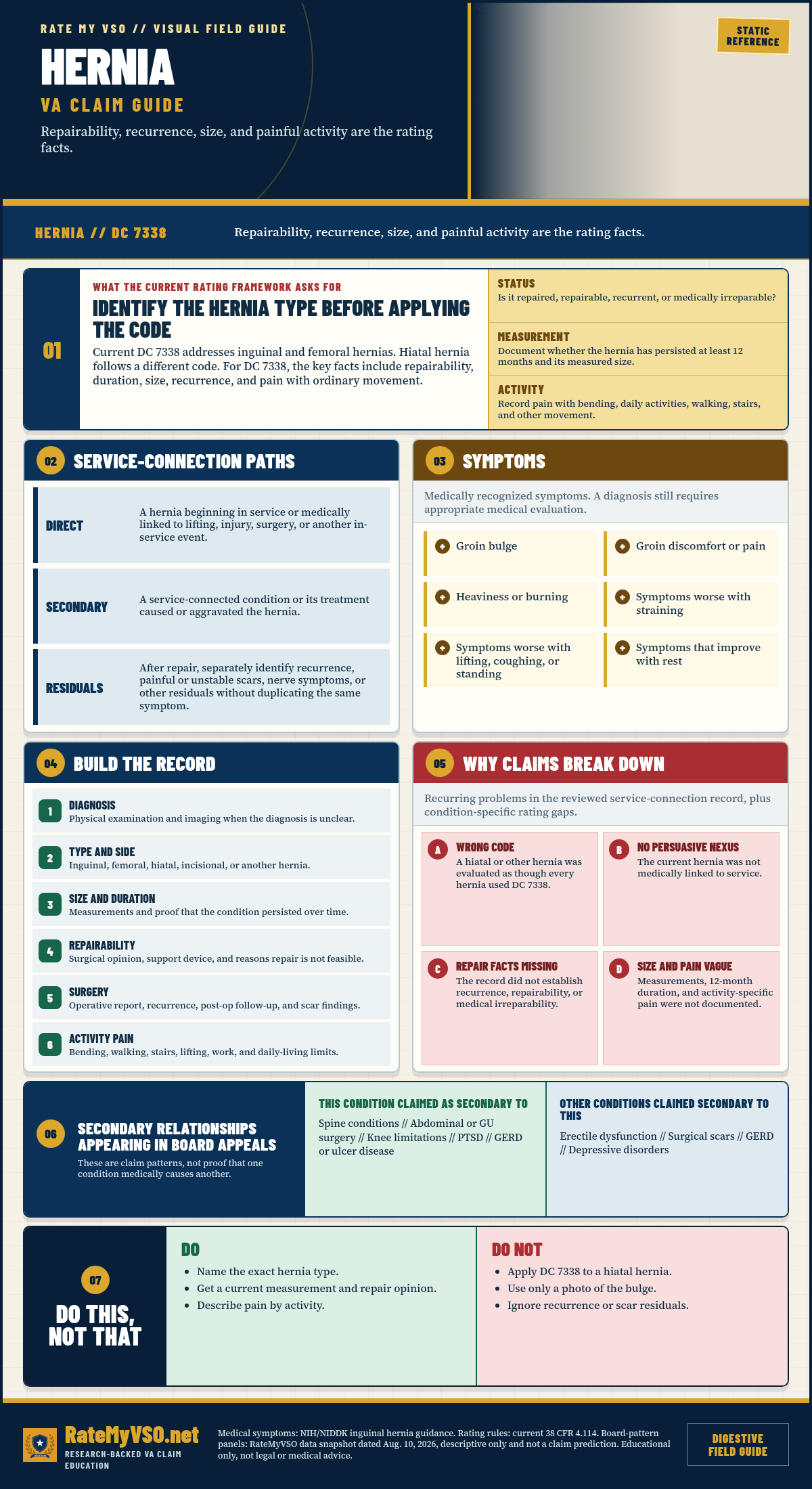 One-page guide: Hernia Claims in One Page
Hernia guide covering DC 7338, hernia type, repairability, size, recurrence, activity-related pain, records, and common claim gaps. Opens the full-size chart, free to save or print.
One-page guide: Hernia Claims in One Page
Hernia guide covering DC 7338, hernia type, repairability, size, recurrence, activity-related pain, records, and common claim gaps. Opens the full-size chart, free to save or print.
Start with the essentials
- 01Service Connection
The ways service connection can be established for this condition.
- 02Diagnosis and Evidence
Common symptoms and the evidence cited in published Board appeals.
- 03Your History
What you experienced, what others observed, and what treatment changed.
Understand the claim
What a Hernia Claim Covers
The most-claimed hernia is the inguinal (groin) hernia, diagnostic code 7338, under the digestive schedule (see 38 CFR § 4.114). Femoral, ventral, umbilical, and incisional hernias are rated under the same code, using the same irreparability, size, and pain criteria.
Types of Hernia
Inguinal hernia is the most common type claimed, where tissue pushes through the inguinal canal in the groin. It is rated under DC 7338.
Ventral (incisional) hernia develops through a weakness in the abdominal wall, often at the site of an earlier surgical incision, and is rated under the same DC 7338 criteria. (Its former code, DC 7339, was removed from the rating schedule in May 2024.)
Femoral and umbilical hernia occur at the femoral canal (upper thigh, near the groin) and the belly button, respectively. Both are rated under the same DC 7338 criteria as inguinal hernia.
A hernia is diagnosed on physical exam, sometimes confirmed with imaging, and the diagnosis generally records the type, side (or sides), whether it is reducible (can be pushed back in), and whether it is supported by a truss or belt. This guide is built from a set of real 2026 Board of Veterans' Appeals decisions involving a hernia. Most of those appeals were not actually about whether the hernia connects to service at all, they were about how much the rating should be, the effective date, painful surgical scars from the repair, or whether VA improperly took away an existing rating. Only a small share were genuine wins or losses on whether service connection itself should be granted.
ICD-10 Diagnosis Codes
The ICD-10 diagnosis codes most commonly used for DC 7338, Hernia, including femoral, inguinal, umbilical, ventral, incisional, and other (but not including hiatal) (the kind on your medical records, decision letter, or C&P exam report). VA rates the disability and its residuals, not the diagnosis itself, so coding can vary.
How Service Connection Works, At a High Level
Before getting into the specific pathways below, it helps to understand the three things every hernia claim ultimately has to show. This is the same basic test that applies to any VA disability claim, just applied to this condition.
- A current hernia. You must actually have a hernia, or its lasting effects, now. If a hernia was repaired long ago and has not come back, and there is no current diagnosis or documented residual, VA may find there is no current disability to connect.
- An in-service cause or event. Something in service must have caused the hernia, or a hernia you already had must have gotten worse in service.
- A medical link (nexus). A doctor must connect the hernia to service, or to a service-connected condition, and explain why, ideally after reviewing your records.
Service Connection Pathways: Direct and Secondary
Direct service connection is not the only path into a hernia claim. Across published DC 7338 decisions, here is how often the Board granted by the legal theory the claim was argued on:
Direct Service Connection
A hernia that appeared in service, or was repaired in service, from the heavy lifting, straining, and load-bearing of military duty, with a current diagnosis or documented residuals. See our Service Connection Guide.
Residuals of an In-Service Repair
Even if the original hernia was fixed in service, a later recurrence, or lasting pain, numbness, or weakness at the surgical site, can be service-connected as a residual. A later recurrence or residual symptoms at the repair site can be service-connected even long after discharge, with a current diagnosis and a link back to the original in-service repair.
Secondary Service Connection (38 CFR § 3.310)
A hernia caused or worsened by another service-connected condition, for example chronic straining from a bowel condition or a chronic cough, can be connected on this theory. It also runs the other direction: a new problem caused by an already service-connected hernia, such as gastrointestinal symptoms that develop in connection with the hernia or its repair, can itself be service-connected as secondary to the hernia. Secondary service connection covers disabilities proximately due to a service-connected disease or injury. See secondary conditions and our Secondary Service Connection Guide.
Aggravation of a Preexisting Hernia
Many people have a hernia, or a repair, before they enlist. If a preexisting hernia was not noted when you entered service, VA must consider whether service made it worse beyond its natural course, not just whether service caused it outright. A veteran can win service connection on this theory even when the hernia clearly predates service, where a doctor explains that specific in-service events aggravated it beyond its natural progression. Aggravation of a preexisting condition can be service-connected under 38 CFR § 3.304, and where a hernia was not noted at entry, the presumption of soundness under 38 U.S.C. § 1111 also comes into play.
Toxic Exposure, With Caution
Hernias are not automatically presumed from Agent Orange, radiation, or other toxic exposures, they are not on VA's presumptive lists. A toxic-exposure theory still needs a medical opinion specifically linking the exposure to the hernia; a claim built only on the general fact of exposure, without an examiner or doctor connecting it to this specific disability, is a weak claim on its own.
What VA Looks For: Tests, Records, and Diagnostic Codes
Records to gather for a direct or secondary claim:
- A current exam or treatment record: documenting whether the hernia is present, its type, which side (or both), its size, whether surgery can still fix it, and any pain with everyday activities such as bending over, walking, or climbing stairs.
- Surgical and treatment records: showing the original hernia, any repair, and any recurrence. This is what establishes whether the hernia is irreparable and how long it (and the pain) have been present, and hernias are often diagnosed and repaired by private doctors, so those private records matter as much as VA's own.
- The diagnostic codes involved: DC 7338 for the hernia itself (inguinal, femoral, umbilical, ventral, or incisional), plus whatever code applies to a condition you're connecting it to as secondary, for example a chronic cough or a bowel condition that causes straining.
- The actual form the examiner fills out: the Hernias Disability Benefits Questionnaire (DBQ), discussed in more detail later in this guide.
Symptoms and rating
Symptoms Recorded in Granted Hernia (inguinal, ventral) Decisions
We analyzed 503 granted Board decisions involving hernia (inguinal, ventral) for symptoms named in sentences about the condition (rating-criteria recitations excluded). Descriptive of the published record, what the Board wrote down, not a checklist of what to report.
Bar length shows decisions. Percentages remain context.
Detected by phrase-reading the decision text with condition-specific vocabularies. Source: Board of Veterans' Appeals decisions, RateMyVSO analysis.
How the VA Rates a Hernia (DC 7338)
Under the criteria that took effect May 19, 2024, the rating turns on three things: whether the hernia is irreparable, meaning surgery cannot fix it (a new or a recurrent hernia both count), how large it is, and pain during everyday activities: bending over, activities of daily living (bathing, dressing, hygiene, or transfers each count), walking, or climbing stairs. Both the hernia and the pain must have been present for 12 months or more. A hernia that is repaired, or that surgery could still fix, and that causes no symptoms rates 0 percent.
| Rating | Criteria (all hernias under DC 7338) |
|---|---|
| 100% | Irreparable hernia present 12 months or more, 15 cm or larger in one dimension, with pain during at least three of the listed activities (pain also present 12 months or more) |
| 60% | Irreparable hernia present 12 months or more, 15 cm or larger in one dimension, with pain during two of the listed activities |
| 30% | Irreparable hernia present 12 months or more, 3 cm or larger but under 15 cm, with pain during at least two of the listed activities |
| 20% | Irreparable hernia present 12 months or more, 3 cm or larger but under 15 cm, with pain during one of the listed activities |
| 10% | Irreparable hernia present 12 months or more, smaller than 3 cm |
| 0% | Asymptomatic hernia that is present and repairable, or repaired |
Evidence and Board research
Evidence That Wins
We analyzed the Board's published DC 7338 decisions: a private nexus opinion in the file goes with a much higher grant rate, shown below.
- Surgical and treatment records showing the original hernia, any repair, and any recurrence, this is what establishes whether the hernia is irreparable and how long it has been present.
- A current exam documenting whether the hernia is present, its size, whether surgery can fix it, pain with everyday activities, and whether it is one side or both.
- Records of residual symptoms after repair, pain, numbness, or weakness at the site, which can support service connection even when the hernia itself is fixed.
- A nexus opinion that explains its reasoning, tying the hernia or its residuals to service, or to another service-connected condition, and explaining why, ideally after the doctor reviews your records. A detailed opinion that walks through the specific in-service event and rules out other explanations carries far more weight than a brief, vague one; a vague opinion that ignores your records, or an opinion built on the wrong facts, is given little weight even if it sounds favorable. See nexus letters.
- Clear, consistent testimony about when it started. You are competent to describe what you felt and when, for example noticing a knot or bulge during a specific activity or deployment. Lay statements are competent evidence of symptoms you can personally observe, but keep your account consistent across every form, exam, and statement.
- The Hernias DBQ, which records the type, side, size, repairability, and activity-related pain the rating depends on. See the DBQ guide.
Evidence Cited in Published Hernia (inguinal, ventral) Decisions
We analyzed 10,510 published Board decisions involving hernia (inguinal, ventral) for condition-specific evidence, counting only case-specific mentions (boilerplate recitations excluded). "Favorable" is the share of decisions citing that evidence where every issue was granted or the outcome was mixed; the baseline across all these decisions is 55%, combining every diagnostic code below. Evidence appearing in a decision does not mean it decided the case. Descriptive of the published record, not a prediction.
Bar length shows decisions citing the evidence.
By diagnostic code
These codes are grouped together above. They do not perform the same, so find your own code here rather than reading the combined figure. A code retired in the schedule rewrites appears without a link, because its decisions were judged under criteria that no longer apply.
Bar length shows published decisions reviewed.
Detected by phrase-reading the decision text with condition-specific vocabularies. Source: Board of Veterans' Appeals decisions, RateMyVSO analysis.
Board Grants, Dissected
The decisions below show that veterans have won direct service connection for hernias (inguinal, umbilical, ventral, and repaired abdominal hernia) when the record contained credible testimony about onset, service treatment records that at least hinted at the problem, or a medical opinion linking the hernia to a preexisting condition that got worse in service. Remember that these Board decisions are not binding precedent. Each case turns on its own facts.
Repaired abdominal hernia tied to weightlifting in service Citation A26038823 (April 27, 2026), Hearing docket
The record: The veteran had surgery on an abdominal (umbilical) hernia and told the Board he did not think it was related to service. A January 2026 private opinion from R.P., D.O., found that repeated heavy weightlifting during service could cause fascial microtrauma leading to a hernia. A May 2025 VA examiner separately stated the hernia likely resulted from a combination of aging, muscle weakness, and increased abdominal pressure.
Why it won: The Board found the private opinion and the VA examiner's own explanation of the disease process were consistent with each other. It resolved doubt in the veteran's favor even though the veteran himself was not sure his hernia was connected to service.
Preexisting hernia scar found to have worsened in service Citation A26032148 (April 8, 2026), Direct Review docket
The record: The veteran had hernia surgery before his active-duty service, leaving a surgical scar. His service treatment records were largely unavailable. A March 2025 VA examination confirmed a diagnosis of left inguinal hernia status-post surgical repair, and the veteran reported left lower quadrant pain beginning after his 1976 hernia surgery.
Why it won: Because entrance records were missing, the presumption of soundness applied. The Board said there was no clear and unmistakable evidence that the condition was not aggravated in service, so the case became one of direct service connection with the evidence in relative balance.
Umbilical hernia linked by a VA examiner's own opinion Citation A26024074 (March 17, 2026), Hearing docket
The record: Private hospital records showed surgical repair of an umbilical hernia. The veteran testified he first noticed a "small knot" in his stomach while deployed in 2003, doing heavy lifting like changing semi-truck tires. A February 2021 VA medical opinion concluded the umbilical hernia was at least as likely as not caused by an in-service injury, event, or illness.
Why it won: The Board found the veteran's hearing testimony credible and consistent with the VA examiner's own favorable opinion. With the evidence at least in equipoise, the Board resolved doubt in the veteran's favor.
Left inguinal hernia proven through credible treatment-seeking statements Citation A26016971 (February 25, 2026), Hearing docket
The record: The veteran testified his left inguinal hernia pain began in 2009 while in Iraq, with surgical repair in March 2012. A March 2012 treatment record, made years before he filed for benefits, documented that he reported the pain began "several years prior" while overseas.
Why it won: The Board gave high credibility to the 2012 statement because it was made for treatment purposes, not for compensation, citing Harvey v. Brown. There was no medical evidence contradicting the link, so all three elements of service connection were met.
Ventral hernia granted where positive and negative nexus opinions were evenly matched Citation A26015781 (February 20, 2026), Direct Review docket
The record: A July 2024 VA examiner opined the ventral hernia was at least as likely as not related to service, based on the veteran's report that it began in basic training and a matching statement to his VA primary doctor. A December 2024 addendum from another VA reviewer found the rationale insufficient and instead concluded the hernia was less likely than not related to service because the first complaint came more than 22 years after service.
Why it won: The Board found both opinions probative and treated the record as being in approximate balance. Under the benefit-of-the-doubt rule, that balance favored the veteran.
Why These Claims Get Denied
Beyond the general "no current hernia" and "no nexus" reasons, a few specific denial patterns show up often enough in published hernia decisions to call out on their own.
- A hernia that was repaired long ago, with nothing current in the record. Claims are denied where the hernia had been fixed years earlier and there was no current diagnosis, or no medical records at all showing a present hernia. Without a current disability, there is no valid claim to connect.
- The veteran's own belief about what caused it, without a doctor's opinion behind it. A veteran can describe symptoms, but is generally not considered qualified to say what medically caused a hernia. A general assertion that an in-service activity caused the hernia, without a supporting medical opinion, does not carry the claim when it is weighed against a specific, reasoned opinion on the other side.
- A long gap between service and the first record of the hernia, or between discharge and when the veteran first raised it. Where the record shows decades between separation and the first documented connection to service, that gap itself becomes a reason for denial.
- Toxic or radiation exposure argued alone. Hernias are not on VA's presumptive exposure lists. A claim resting only on general exposure, without a medical opinion explaining a specific mechanism connecting that exposure to the hernia, is a weak claim on its own.
- A generic, unsupported medical opinion. An opinion that only restates the veteran's own account, ignores the record, or could describe anyone, is given little weight, even when it reaches a favorable-sounding conclusion.
Common Mistakes
The same handful of procedural missteps account for most lost or under-rated hernia claims. Among the Board's classified service-connection denials for hernia, here is what claims most often fell short on:
- Assuming a repaired hernia is worthless. A fixed hernia can rate 0 percent, but recurrence or lasting pain, numbness, and weakness at the site can still be service-connected and rated.
- Not documenting size, repairability, and pain. The rating turns on whether the hernia is irreparable, how large it is, and pain during everyday activities, each present 12 months or more. If the exam does not record these, it lands on the wrong row.
- Claiming one side when both are affected. Two compensable inguinal hernias get the more severe rating plus a 10 percent add-on (unless the more severe one is already 100 percent). Claim it as bilateral.
- Filing a hiatal hernia under DC 7338. Hiatal and paraesophageal hernias have their own code, DC 7346, which rates them under the esophageal stricture criteria (DC 7203), not under the abdominal-wall criteria on this page. Using the wrong framework loses the claim.
- Missing the residuals path. When the original repair was in service, later problems at the site are residuals that can be service-connected even years afterward.
- Waiting years to file or to raise the hernia at all. Long gaps between service and the first time a hernia is tied to it hurt credibility. File and document promptly.
Do's and Don'ts
A condensed version of everything above, in the order it actually matters when you sit down to build your file.
- Get a current diagnosis of your hernia in writing before you file.
- Point to the in-service event, injury, or symptom, or to a hernia that got worse in service.
- Get a medical nexus opinion that reviews your records and explains the why, not a bare conclusion.
- Gather your private treatment and surgery records and give them to VA, hernias are often diagnosed and repaired outside the VA system.
- If your hernia is linked to another service-connected condition, such as a chronic cough or a bowel condition that causes straining, claim it as secondary.
- If your hernia existed before service, raise aggravation, don't assume it disqualifies you.
- Give clear, consistent testimony about when your symptoms started, and keep it consistent across every form and exam.
- File promptly and keep pursuing the same claim to protect your effective date.
- Document the hernia's size, whether surgery can fix it, any recurrence, and pain with everyday activities (and how long each has lasted) for rating purposes.
- Raise a painful surgical scar from your repair as its own separate issue.
- Don't assume a diagnosis or symptoms alone will win the claim, you still need the current disability, the in-service link, and a nexus.
- Don't rely only on your own opinion about what caused it, causation for a hernia is treated as a medical question.
- Don't wait years to file or to raise the hernia, long gaps hurt credibility.
- Don't assume a hernia is presumptive from Agent Orange or radiation, it isn't, so a toxic-exposure theory still needs its own medical link.
- Don't submit a generic, unsupported medical opinion, or lean on one that ignores your actual records.
- Don't claim only one side when both are affected.
- Don't file a hiatal hernia under DC 7338, its own code (DC 7346) rates it under the esophageal stricture criteria (DC 7203).
Secondary relationships
Common Secondary Conditions
A hernia connects to other claims in both directions, through the strain that causes it and the surgery that treats it. Each bar below is the Board's grant rate for DC 7338 in that pairing, with the number of decisions under it. They describe the published record across many veterans, not a prediction about any one claim.
Conditions linked as causing a hernia (hernia as the secondary)
Claims where the hernia was argued as secondary to an already service-connected condition, most often chronic straining from a bowel condition or a chronic cough. This is the "ways to connect via another condition" list, and it's often an easier route than direct service connection:
Conditions a hernia is linked to causing (hernia as the primary)
Conditions veterans have claimed as caused or aggravated by a service-connected hernia or its repair, in other words, conditions secondary to the hernia once the hernia itself is already service-connected. Note: this page currently has enough published-decision data to chart DC 7338 in both directions; if a specific secondary code you're researching doesn't show a bar below, it means the corpus doesn't yet have enough decisions for that pairing to report a rate.
Prepare and take the next step
Prepare: your own working pages
Optional. These are your own notes, in your own words. They are not a VA form, they are not sent to the VA, and nothing here is a medical finding or a prediction about your claim.
Three reminders while you prepare
- Name the hernia and its history
Record the diagnosed type, location, onset, surgeries, and recurrences. Do not combine different hernia types or surgical residuals into one label. Go to this part
- Capture the current clinical findings
Organize what the record says about size, reducibility, support, operability, recurrence, and symptoms without assigning yourself a percentage. Go to this part
- Keep the claim and the residuals organized
Use the page's service-connection, examination, secondary-condition, and decision sections to identify the next questions and records you need. Go to this part
Sign in or create an account to save your answers and come back to them later. You can fill these in and print them without an account.
Hernia diagnosis and treatment timeline
Current findings and support
Residuals and provider questions
Records and unanswered questions
Decision-letter reading sheet
Quick Checklist Before You File
Bring these together before you submit anything.
- A current diagnosis of your hernia, in writing.
- The in-service event, injury, or symptom, or a hernia that got worse in service.
- A medical nexus opinion that reviews your records and explains the why.
- Your private treatment and surgery records, gathered and given to VA.
- If your hernia is linked to another service-connected condition, it claimed as secondary, not filed as a standalone theory.
- A plan to file promptly and keep pursuing the same claim, to protect your effective date.
- For a rating, documentation of the hernia's size, whether surgery can fix it, any recurrence, and pain with everyday activities.
For the mechanics of actually submitting the claim, see the Standard Claim Guide and the Fully Developed Claim Guide (filing with all your evidence up front can speed up the decision).
The Claims Process, Step by Step
Once you file, your claim moves through a series of hand-offs. Understanding who does what helps you know who to contact, and what to expect, at each stage.
- You file the claim. Directly with VA, through VA.gov, or with the help of an accredited representative.
- VA acknowledges the claim and assigns it for development. A Veteran Service Representative (VSR) is assigned to gather your service treatment records, VA and private medical records, and any other evidence needed.
- The VSR orders a Compensation & Pension (C&P) exam if one is needed. Most hernia claims involve one, especially where the hernia's size, repairability, or pain with everyday activities needs to be documented, or where a nexus opinion is required for a secondary or aggravation theory.
- The C&P exam is conducted. By a VA clinician or a contracted examiner, who completes a Disability Benefits Questionnaire (DBQ) documenting the type of hernia, side, size, repairability, activity-related pain, and, where relevant, a nexus opinion.
- The file goes to a Rating Veteran Service Representative (RVSR), the "rater." The rater reviews the complete file, including the exam results, and decides whether service connection is warranted and at what percentage.
- A senior reviewer may review the decision before it's finalized, depending on the complexity of the claim.
- VA issues the decision letter. This states whether the claim is granted or denied, the rating percentage if granted, and the reasons behind the decision.
- If you disagree, you choose an appeal lane. Higher-Level Review, Supplemental Claim, or a Board appeal, covered later in this guide.
Who's who: VSO vs. VSR vs. Rater vs. C&P Examiner
Your VSO
An accredited representative from a veterans service organization, or an accredited attorney or claims agent. Not a VA employee. Helps you prepare, gather evidence, and file, and can represent you through an appeal. Has no authority to decide your claim.
VSR (Veteran Service Representative)
VA staff who "develops" your claim: requests records, schedules the C&P exam, and assembles the file. Does not decide the rating.
Rater (RVSR)
VA staff who reviews the completed file and makes the actual decision, service connection or denial, and the percentage. This is the person whose judgment the decision letter reflects.
C&P Examiner
A VA clinician or a contracted medical examiner who conducts the exam and completes the DBQ. Documents findings and, where asked, a nexus opinion. Does not decide the claim.
For the full walkthrough of every stage with more detail, see Inside Your Claim and Claim Stages.
DBQs and Your C&P Exam
The Hernias Disability Benefits Questionnaire (DBQ) is the standardized form an examiner completes for your condition, it structures the exam findings into the specific data points VA's rating schedule requires (for a hernia, that includes the type, side, size, whether surgery can fix it, and pain with everyday activities). See the DBQ Guide for how these forms work, including whether a private DBQ completed by your own doctor can be submitted instead of relying solely on a VA exam.
Before your C&P exam, bring a clear, specific account of your symptoms and history, when you first noticed the hernia, whether it has recurred, and what happens during physical activity. Be consistent with what's already in your medical records and prior statements. For a full walkthrough of what to expect and how to prepare, see the C&P Exam Prep Guide.
Reading Your Decision Letter, and What to Do If Denied
Your decision letter has two parts: a narrative section explaining the reasoning (often called "reasons and bases"), and a codesheet showing the actual rating percentage, the effective date, and the diagnostic code used. See the Reading Your Decision Letter Guide for how to find and interpret each part, or use the Letter Interpreter tool to upload your own letter and get a plain-English breakdown.
If your claim is denied, or the rating is lower than you expected, you have three main lanes:
- Supplemental Claim: refile with new and relevant evidence, such as a new nexus opinion or updated treatment records. See Supplemental Claim Guide.
- Higher-Level Review (HLR): a senior reviewer looks at the same evidence again for a difference of opinion, no new evidence is added. See HLR Guide.
- Board Appeal: your case goes to a Veterans Law Judge at the Board of Veterans' Appeals, with options for a direct review, an evidence docket, or a hearing. See Board Appeal Guide.
Not sure which lane fits your situation? See the Appeals decision guide for a side-by-side comparison of all three.
After You Win: Maintaining Your Rating
Because most hernia appeals end up being about the rating or the effective date rather than whether service connection applies at all, it helps to know how VA treats a rating once it is in place. A hernia that was repaired and causes no symptoms is rated 0 percent, no monthly payment, so a grant at that level is still worth having: it establishes service connection and preserves your ability to file for an increased rating if the hernia later recurs or worsens.
Protect your effective date by filing promptly and continuously pursuing your original claim rather than letting it lapse and starting over later. Once a rating decision becomes final, a freestanding claim asking only for an earlier effective date is generally not available on its own; the recognized ways to reach back are a request for revision based on clear and unmistakable error, or a claim to reopen with new and material evidence (Rudd v. Nicholson, 20 Vet. App. 296 (2006)).
VA cannot simply take service connection away later without proving clear and unmistakable error in the original grant (38 CFR § 3.105). If VA proposes to sever or reduce an existing hernia rating, that is a formal process with its own procedural protections, not something that happens automatically.
Keep your treatment consistent, follow-up exams and records documenting recurrence, the hernia's size, and pain with everyday activities protect you if VA schedules a future reexamination. Not every rating gets reexamined; understand when a rating becomes protected from future review and what to do if VA proposes to reduce it. See Protect Your Rating and Future Reexaminations for the specifics.
If your hernia worsens after the initial grant, for example recurring, growing, or causing pain with everyday activities where it did not before, you can file for an increased rating. See the Rating Increase Guide.
References and related resources
Quick Reference
The rating table for DC 7338 (Inguinal hernia) is above in the Rating Criteria section. The tables below summarize the connection pathways and who handles each stage of the claim.
Service Connection Pathways
| Pathway | Mechanism | Evidence Needed |
|---|---|---|
| Direct | Hernia appeared or was repaired in service from heavy lifting or straining | Service treatment records + current diagnosis or residuals + nexus |
| Residuals of in-service repair | Recurrence, or lasting pain/numbness/weakness at the surgical site | Records of the in-service repair + current exam documenting the residual |
| Secondary (DC 7338) | Caused or worsened by an already service-connected condition (e.g. chronic cough, bowel condition) | Nexus opinion linking the service-connected condition to the hernia |
| Aggravation of preexisting hernia | Preexisting hernia worsened beyond its natural course by service | Baseline severity + nexus opinion addressing the worsening |
| Toxic exposure | Not presumptive; requires a specific medical mechanism | Nexus opinion explicitly linking the exposure to the hernia |
From Filing to Decision: Who Does What
| Role | Does | Decides your rating? |
|---|---|---|
| VSO / accredited representative | Helps prepare, gather evidence, and file; represents you on appeal | No |
| VSR | Develops the claim: orders records and the C&P exam | No |
| C&P Examiner | Conducts the exam, completes the DBQ, may give a nexus opinion | No / but has a strong impact |
| Rater (RVSR) | Reviews the full file and decides service connection and percentage | Yes |
Frequently Asked Questions
My hernia was fixed. Can I still get a rating?
What gets a hernia to a higher rating?
Is a hiatal hernia rated the same way?
I have hernias on both sides. How does that work?
My hernia was repaired in service years ago. Is it too late?
What if I only connected my hernia to service many years after discharge?
Can VA take away my hernia service connection later?
Related Tools and Guides
Sources
- 38 CFR § 4.114, Diagnostic Code 7338 (which also covers ventral and incisional hernias formerly rated under DC 7339), Schedule of Ratings, Digestive System (Hernia)
- 38 CFR § 3.303, basic requirements for service connection, including § 3.303(d), disease diagnosed after discharge
- 38 CFR § 3.310, Secondary Service Connection
- 38 CFR § 3.304(b) and 38 U.S.C. § 1111, presumption of soundness at entry and aggravation of a preexisting condition
- 38 CFR § 3.102, reasonable doubt, and 38 U.S.C. § 5107(b), benefit of the doubt
- 38 U.S.C. § 1110 and 38 U.S.C. § 1131, compensation for a service-connected disability
- 38 CFR § 3.105, severance of service connection and clear and unmistakable error
- 38 CFR § 3.400 and 38 U.S.C. § 5110, effective dates; 38 CFR § 3.2501, supplemental claims and new and relevant evidence
- Shedden v. Principi, 381 F.3d 1163 (Fed. Cir. 2004), the current-disability, in-service-event, and nexus elements of service connection
- Brammer v. Derwinski, 3 Vet. App. 223 (1992), no current disability means no valid claim for service connection
- McClain v. Nicholson, 21 Vet. App. 319 (2007), a disability present at the time the claim was filed or during its pendency satisfies the current-disability requirement even if it later resolves
- Lynch v. McDonough, 21 F.4th 776 (Fed. Cir. 2021), the benefit-of-the-doubt standard under 38 U.S.C. § 5107(b)
- Rudd v. Nicholson, 20 Vet. App. 296 (2006), freestanding earlier-effective-date claims are not available once a rating decision is final
- CCK Law, "VA Disability Ratings for Hernias"
- Hill & Ponton, "VA Disability Ratings for Hernias"