Lumbar Spine (Low Back) Claims Guide
Low back conditions, usually lumbosacral strain or degenerative disc disease, are among the most-filed VA claims, and they are rated under the same General Rating Formula the VA uses for the whole spine. The rating turns mostly on how far you can bend forward and your total range of motion, with a separate path for disc disease measured by flare-up bed rest, and separate add-on ratings for the sciatica that so often comes with a bad back. This guide explains the formula, the numbers, how service connection actually gets established, the evidence that wins, why these claims get denied, the claims process step by step, and what to do whether you win or you're denied.
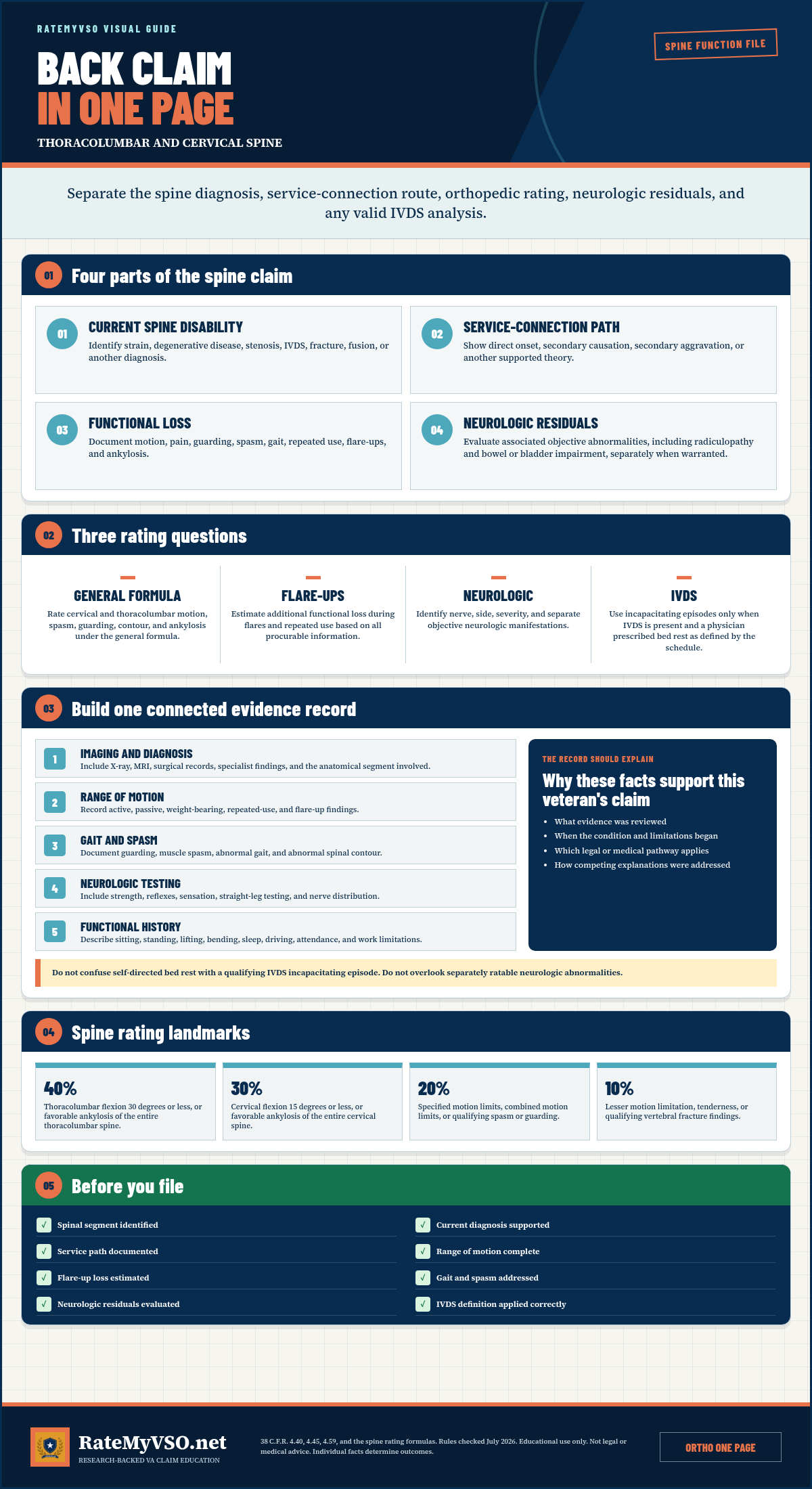 One-page guide: Back Claim in One Page
Five-part visual guide to spine claims covering diagnosis, service connection, range of motion, flare-ups, neurologic residuals, IVDS, rating landmarks, and a filing checklist. Opens the full-size chart, free to save or print.
One-page guide: Back Claim in One Page
Five-part visual guide to spine claims covering diagnosis, service connection, range of motion, flare-ups, neurologic residuals, IVDS, rating landmarks, and a filing checklist. Opens the full-size chart, free to save or print.
Overview
Lower back conditions, lumbar strain, degenerative arthritis, and degenerative disc disease, are among the most-filed VA disability claims. All three are rated under the same rule, the General Rating Formula for Diseases and Injuries of the Spine (38 CFR § 4.71a), so the exact diagnosis matters less than how far you can bend and what your record shows. This guide walks the whole path: how service connection works, the direct and secondary pathways, the rating criteria, what evidence wins, why these claims get denied, a checklist before you file, the claims process step by step, how to read your decision letter, and what to do whether you win or you're denied.
Types of Low Back Conditions
Lumbosacral strain (DC 5237) is a soft-tissue injury to the muscles and ligaments of the low back, and the most commonly diagnosed low back condition. It is rated purely on range of motion and related findings under the General Rating Formula.
Degenerative arthritis of the spine (DC 5242) is wear on the spinal joints, confirmed by imaging (X-ray or MRI). Arthritis carries an added advantage: it is on VA's list of "chronic diseases," which can open an easier path to service connection when there is no formal nexus opinion in the file, covered under Service Connection Pathways below.
Intervertebral disc syndrome, IVDS (DC 5243), is assigned only when disc herniation causes compression or irritation of the adjacent nerve root. All other disc diagnoses, including degenerative disc disease, are assigned under DC 5242. VA can rate IVDS either by the same range-of-motion table as strain and arthritis, or by a separate formula based on physician-prescribed bed rest for incapacitating episodes, whichever gives the higher rating. See the IVDS section below.
Whichever diagnosis you carry, VA requires a current diagnosis confirmed by imaging or a clinical exam before assigning any rating. A veteran's report of back pain alone, without a diagnosis, is not sufficient.
Symptoms Recorded in Granted Back and neck (spine) Decisions
We analyzed 20,010 granted Board decisions involving back and neck (spine) for symptoms named in sentences about the condition (rating-criteria recitations excluded). Descriptive of the published record, what the Board wrote down, not a checklist of what to report.
Bar length shows decisions. Percentages remain context.
Detected by phrase-reading the decision text with condition-specific vocabularies. Source: Board of Veterans' Appeals decisions, RateMyVSO analysis.
- What the VA measures at your C&P exam
- Evidence that has won at the Board
- Inside the rater's playbook: grant, denial, and remand rates
- Secondary condition map
ICD-10 Diagnosis Codes
The ICD-10 diagnosis codes most commonly used for DC 5237, Lumbosacral or cervical strain (the kind on your medical records, decision letter, or C&P exam report). VA rates the disability and its residuals, not the diagnosis itself, so coding can vary.
How Service Connection Works, At a High Level
Before the specific pathways below, here are the three things every direct lumbar spine claim ultimately has to show (38 CFR § 3.303).
- A current diagnosis. A doctor must diagnose a current back disability, such as a lumbar or lumbosacral strain, degenerative arthritis, or degenerative disc disease. VA frequently concedes this once its own examination confirms the diagnosis.
- An in-service cause. An injury, event, or complaint documented in service, such as a low back injury or ongoing back pain during your duties.
- A medical nexus. Evidence connecting the current back condition to service. This can be a doctor's opinion, or, for arthritis specifically, a credible history of continuous symptoms since service (38 CFR § 3.303(b)).
Service Connection Pathways: Direct and Secondary
Service connection for the low back can be established through direct, secondary, or aggravation-based pathways, and arthritis carries an additional pathway of its own.
Direct Service Connection
An in-service back injury (a fall, a lifting injury, a vehicle accident, a hard parachute or ejection landing) or documented chronic back complaints in service, plus a current diagnosis and nexus, establish direct service connection. Heavy load-bearing jobs (rucking, infantry, airborne, mechanics) support the in-service link. If a secondary theory does not pan out, direct service connection can still succeed on its own when the service records show recurrent back pain and a later exam links it to service, so it is worth raising every theory that plausibly fits rather than relying on just one. See our Service Connection Guide.
Arthritis and Continuity of Symptoms (DC 5242)
Arthritis is on VA's list of "chronic diseases," which opens an easier path when the record does not have a clear nexus opinion (38 CFR § 3.307, 3.309). For arthritis of the spine, a credible history of back pain that started in service and never stopped can take the place of a formal medical nexus opinion (38 CFR § 3.303(b)). Veterans have won this way largely on their own credible testimony plus lay statements from a fellow servicemember, a sibling, or a spouse describing pain that began in service and continued or worsened over the years.
Combat Presumption
If your back injury happened in combat, your own statement about how it happened is generally presumed true if it fits the circumstances of your service (38 USC § 1154(b)). A veteran thrown from a military vehicle during a combat deployment has successfully raised this rule to support a grant.
Line of Duty Training Injury (Reserve/National Guard)
An injury during active duty for training in the Reserve or National Guard can count as active service if it was a line-of-duty injury (38 CFR § 3.6). A documented line-of-duty back injury during a training exercise has supported a grant on this basis.
Secondary Service Connection (38 CFR § 3.310)
A service-connected lower-extremity condition (knee, ankle, foot) that changed your gait can cause or aggravate the low back. See service connection and the knee/ankle guide. See our Secondary Service Connection Guide.
Service Connection by Aggravation
Service permanently worsening a pre-existing back condition beyond its natural progression can also establish service connection.
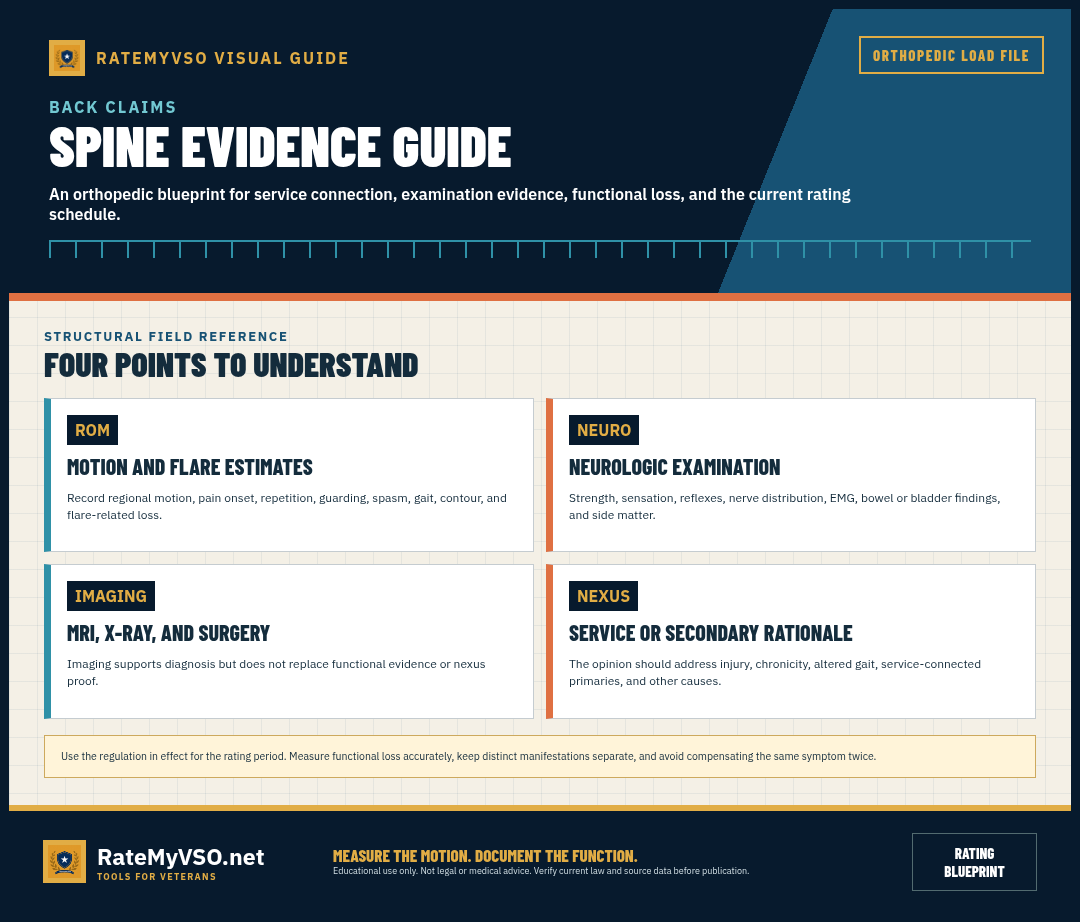 One-page guide: Spine Evidence Guide
Motion, neurologic, imaging, and nexus evidence. Opens the full-size chart, free to save or print.
One-page guide: Spine Evidence Guide
Motion, neurologic, imaging, and nexus evidence. Opens the full-size chart, free to save or print.
Evidence That Wins
We analyzed the Board's published DC 5237 decisions: a private nexus opinion in the file goes with a much higher grant rate, shown below.
- Range-of-motion measurements in degrees, forward flexion and the combined total, taken with a goniometer and including after repetitive use.
- Documented flare-ups and any abnormal gait or posture / muscle spasm, which can reach 20% even with decent flexion numbers.
- For IVDS, records of physician-prescribed bed rest and the physician's treatment showing the weeks of incapacitating episodes.
- A neurological exam capturing any leg sciatica (side, nerve, reflexes, strength, sensation) so the separate rating is not missed.
- Imaging (X-ray, MRI) confirming the diagnosis, and the back/spine DBQ. See the DBQ guide and C&P exam prep.
- A documented in-service injury or complaint in your service treatment records, such as a specific dated back injury or an ongoing pattern of back complaints during duty.
- A nexus opinion that explains its reasoning. The strongest opinions review the veteran's treatment records, medical history, and supporting medical literature, and explain why the back condition is linked to service, rather than stating a bare conclusion. The Board weighs the reasoning behind an opinion, not just its conclusion.
- Buddy and family lay statements, especially for an arthritis continuity-of-symptoms theory, describing back pain that began in service and continued or worsened over the years. See our Buddy & Lay Statements Guide.
Evidence Cited in Published Back and neck (spine) Decisions
We analyzed 295,592 published Board decisions involving back and neck (spine) for condition-specific evidence, counting only case-specific mentions (boilerplate recitations excluded). "Favorable" is the share of decisions citing that evidence where every issue was granted or the outcome was mixed; the baseline across all these decisions is 45.1%, combining every diagnostic code below. Evidence appearing in a decision does not mean it decided the case. Descriptive of the published record, not a prediction.
Bar length shows decisions citing the evidence.
By diagnostic code
These codes are grouped together above. They do not perform the same, so find your own code here rather than reading the combined figure. A code retired in the schedule rewrites appears without a link, because its decisions were judged under criteria that no longer apply.
Bar length shows published decisions reviewed.
Detected by phrase-reading the decision text with condition-specific vocabularies. Source: Board of Veterans' Appeals decisions, RateMyVSO analysis.
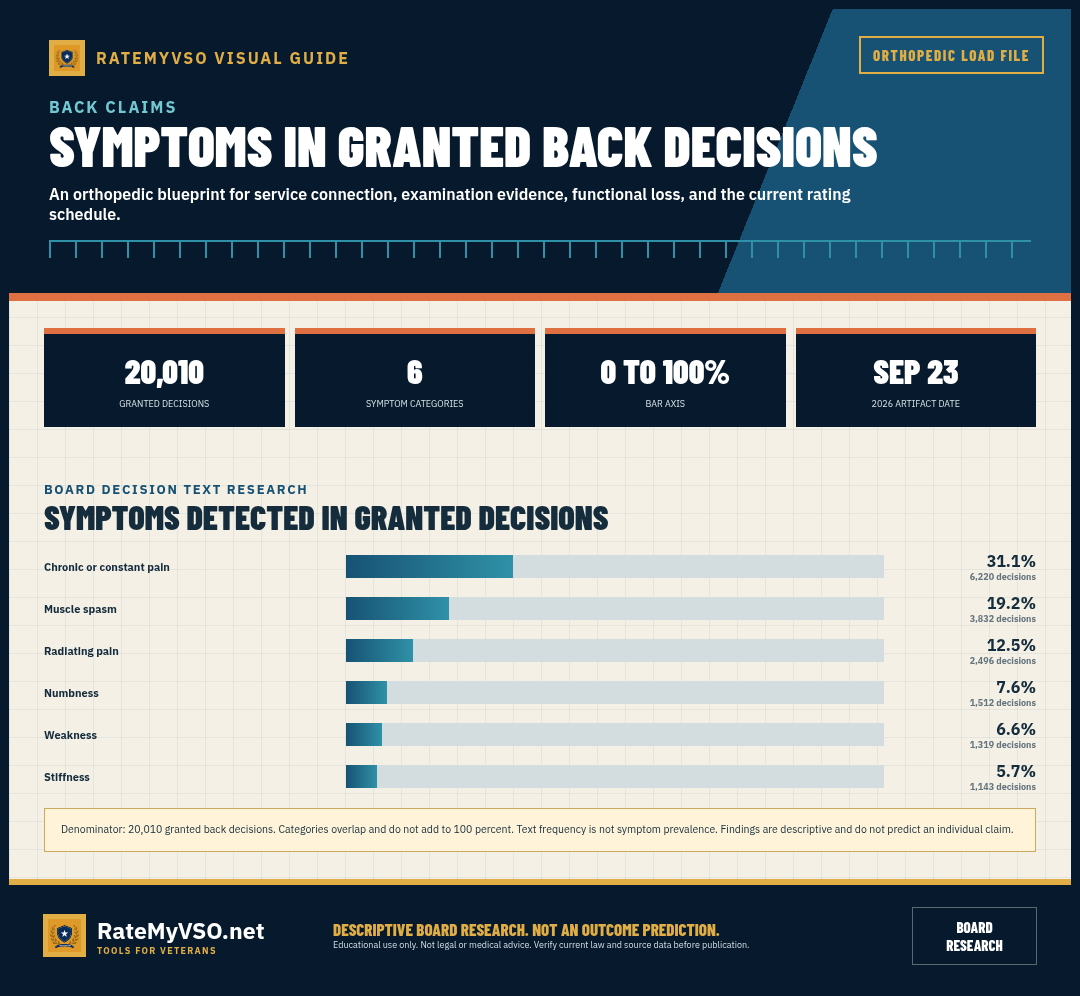 One-page guide: Symptoms in Granted Back Decisions
Back and spine: symptom frequencies across 20,010 granted Board decisions. Opens the full-size chart, free to save or print.
One-page guide: Symptoms in Granted Back Decisions
Back and spine: symptom frequencies across 20,010 granted Board decisions. Opens the full-size chart, free to save or print.
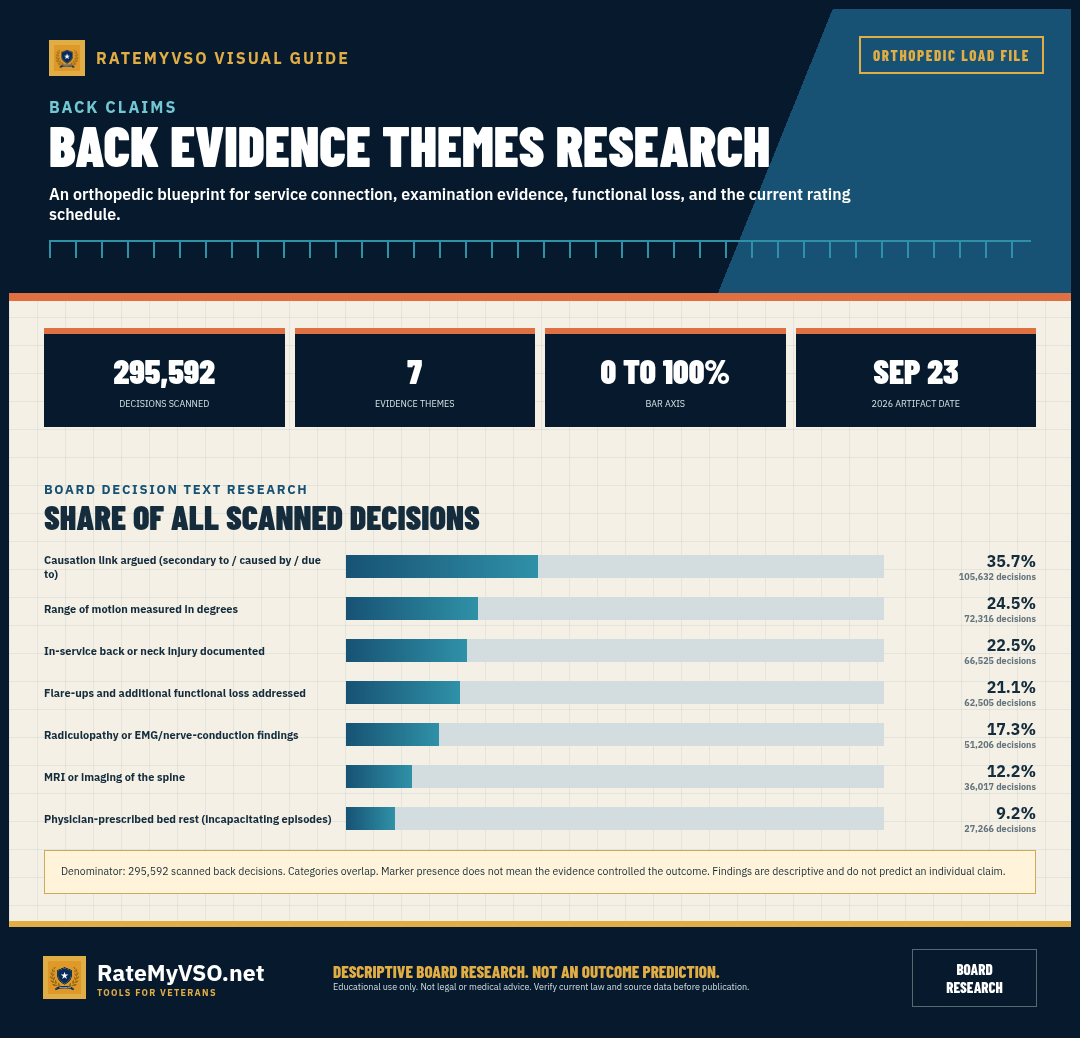 One-page guide: Back Evidence Themes Research
Back and spine: overlapping evidence-theme frequencies across 295,592 scanned Board decisions. Opens the full-size chart, free to save or print.
One-page guide: Back Evidence Themes Research
Back and spine: overlapping evidence-theme frequencies across 295,592 scanned Board decisions. Opens the full-size chart, free to save or print.
Board Grants, Dissected
The Board decisions below all involve claims for lumbosacral or cervical strain decided as direct service connection. In each case, the veteran had already been diagnosed with the strain and had documented some kind of injury or repeated stress in service. The real fight was over the "nexus," meaning whether the strain was actually caused by that in-service event. Several VA examiners tried to deny these claims by requiring proof of a "chronic" injury in service or a long paper trail of treatment. The Board rejected that approach again and again, explaining that your own consistent reports of pain since service can be enough. Remember that Board decisions are not binding on future cases, but the reasoning below shows a clear pattern.
Board rejects "isolated event" theory for back and neck strain Citation A26039270 (April 2026), Hearing docket
The record: The veteran had documented lumbar and cervical strain treatment in service and told VA examiners his back and neck pain had continued ever since. Two separate VA examiners gave negative opinions, reasoning that his in-service back and neck problems were "isolated" events with no proof of chronic issues near separation, and that his complaints didn't start again until years later.
Why it won: The Board found both negative opinions flawed. It wrote that examiners "imposed an improper standard when opining that a single in-service event cannot cause a chronic condition," and explained that a persistence of symptoms since service can establish a nexus "absent clear and convincing medical evidence to the contrary." A lack of medical evidence is not clear and convincing. The veteran's own competent, credible statements about ongoing pain carried the day.
Private nexus opinion outweighs a bare denial Citation A26039254 (April 2026), Hearing docket
The record: The veteran reported falling roughly 10 feet from a ladder onto his back during a deployment to Kuwait. Service treatment records did not document a back injury, but 12 years of lay statements and treatment records, including one from a fellow service member who witnessed the fall, told a consistent story. A private examiner opined it was "very highly likely" the back disability, including a vertebral fracture, was due to the fall, explaining that the forces needed to fracture vertebral endplates require trauma like this.
Why it won: The Board found the in-service injury established by the "internal consistency, facial plausibility, and consistency" of the lay and medical evidence, even without contemporaneous records. The private opinion was given significant weight because it acknowledged the in-service injury and gave a pathological explanation. Radiculopathy in both legs was also connected as secondary to the now-service-connected back disability.
VA's own examiner supplies the nexus Citation A26039236 (April 2026), Direct Review docket
The record: The veteran, a former petroleum supply specialist, was diagnosed with a cervical strain. A VA medical opinion was obtained to address whether the neck condition was secondary to his service-connected back condition. The examiner found no secondary relationship, but noted that the veteran's in-service job involved heavy lifting and stated the neck strain "was caused directly by his in service job."
Why it won: The Board found this statement offered "a clear conclusion based on the evidence of record" under the standard for adequate medical opinions. Even though the opinion was requested to answer a secondary-connection question, the examiner's own words established direct service connection, and the Board granted the claim on that basis.
Negative opinions fail to address the veteran's own statements Citation A26038688 (April 2026), Hearing docket
The record: The veteran, a former Navy SEAL trainee, described sharp neck pain and low back pain during BUDs/SEAL training, including carrying heavy weight overhead. He said he did not report these injuries at the time because he did not want them to reflect badly on him, but that the pain had continued since service. VA examiners gave negative nexus opinions for both the cervical strain and the low back disability.
Why it won: The Board gave the negative opinions no probative weight because they did not address the veteran's competent lay statements about when his symptoms started and that they had continued. Citing Buchanan v. Nicholson, the Board found the veteran's own reports, standing alone, were enough to establish that his cervical strain and low back disability began in service and continued afterward.
"No chronicity of care" is not a valid reason to deny Citation A26038687 (April 2026), Hearing docket
The record: The veteran, who served in the Army National Guard, said his low back pain began during basic training. A line of duty investigation found his back pain did not occur in the line of duty, though the veteran said he had reported the pain to his Drill Sergeant and was told it was just his body adjusting. A VA examiner gave a negative opinion stating there was "no evidence of chronicity of care" for his back pain in service.
Why it won: The Board found the examiner's opinion inadequate because "chronicity of care" is not required to establish service connection, and a veteran is competent to report the onset and continuity of his own symptoms. The Board also noted the opinion relied on an inaccurate factual premise, since treatment records showed continuing complaints of back pain in the years after service. Resolving doubt in the veteran's favor, the claim was granted.
Why These Claims Get Denied
Beyond a missing nexus, a few specific denial patterns show up often enough in published low back decisions to call out on their own.
- A confirmed diagnosis with no connection to service. A current back diagnosis is not enough by itself. Claims have been denied where the veteran had a confirmed strain and credible testimony of in-service soreness, but the record showed the injury that actually caused the current condition, for example a construction-work injury, happened after service, breaking the link.
- An appeal deadline that passed. Once a VA denial becomes final because it was not appealed within one year, it locks in that effective date. Veterans have lost years of potential back pay this way, even when their back condition clearly predated the claim.
- Assuming a representative's mistake will be excused. A representative's error, including missing a filing deadline, does not excuse a late filing or move the effective date. Responsibility for meeting VA deadlines stays with the veteran.
- Missing a scheduled VA examination. If VA needs an exam to rate the claim and the veteran does not appear without good reason, the claim can be denied automatically as a matter of law (38 CFR § 3.655(b)).
- Expecting pain alone to raise the rating. The back rating turns on measured range of motion and related findings, not pain by itself. A veteran with pain but good range of motion has been denied a higher rating on the basis that pain without a resulting loss of function does not earn it.
- Assuming an earlier effective date because the disability existed sooner. The effective date is usually the date VA received the claim, not the date the disability actually started (38 CFR § 3.400). Veterans have been denied earlier dates even though their back problems clearly predated the claim.
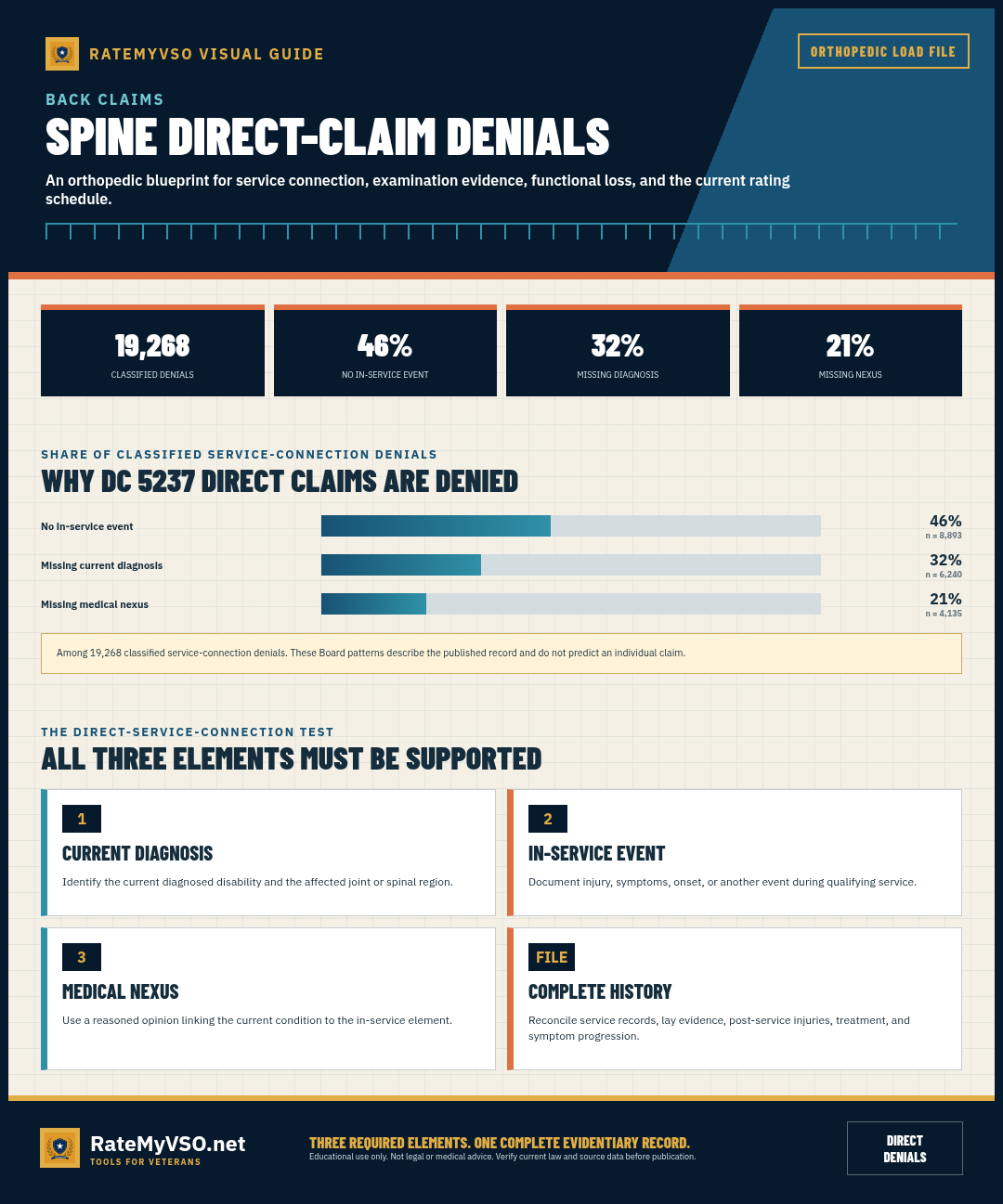 One-page guide: Spine Direct-Claim Denials
19,268 classified spine service-connection denials split by the missing element, with the three required direct-claim elements. Opens the full-size chart, free to save or print.
One-page guide: Spine Direct-Claim Denials
19,268 classified spine service-connection denials split by the missing element, with the three required direct-claim elements. Opens the full-size chart, free to save or print.
How it played out: five real denials, and how the Board answered
| VA examiner's rationale | How the Board answered it |
|---|---|
| The in-service back injury was an "isolated" strain, so it could not cause a chronic condition years later. | The Board called this an improper legal standard. A single in-service event can cause a chronic disability, and persistence of symptoms since service can establish a nexus unless there is clear and convincing evidence to the contrary (A26039270, cited approvingly in denials applying the same standard). |
| There was no "chronicity of care" documented for the strain in service, so no link to the current diagnosis could be found. | The Board found this an invalid basis for denial. Continuity of care is not a legal requirement, and a veteran's own reports of ongoing pain are competent evidence of continuity (A26038687). |
| The examiner could not confirm a current neck diagnosis because the veteran gave a suboptimal effort during strength testing. | The Board found the opinion could not establish a current disability on this record, and without a confirmed diagnosis, the claim for the cervical spine condition was denied (A26038527). |
| A private chiropractor's opinion stated the strain was linked to service, without explaining the reasoning or showing that service records were reviewed. | The Board gave the opinion low probative value as conclusory and unsupported, and found it did not outweigh two detailed VA opinions finding no chronic in-service back condition (A26038223). |
| The veteran did not appear for his scheduled VA examination for the claimed neck strain. | The Board decided the claim on the evidence already in the file. Because there was no diagnosis of a current neck strain in that record, the claim was denied for lack of a current disability (A26038152). |
Common Mistakes
Patterns the published DC 5237 decisions and the rating rule flag most often. In the Board's classified service-connection denials for the low back, no in-service event is the single largest reason.
- No nexus opinion in the file. A useful opinion names the in-service injury or the service-connected primary and explains the link.
- Letting the exam skip range-of-motion in degrees. The General Rating Formula turns on forward flexion and combined range of motion measured with a goniometer. When the exam records pain without the degree numbers, the rater has nothing to map to the table.
- Missing the separately rated leg sciatica. The spine formula directs the VA to rate associated radiculopathy separately, one rating for each affected leg. When the neurological exam does not document radiating leg symptoms, that add-on rating is often lost.
- Claiming IVDS without physician-prescribed bed rest. The incapacitating-episode path counts only bed rest prescribed by a physician together with treatment by a physician. Self-directed rest during flares does not qualify.
- Overlooking the abnormal-gait or muscle-spasm route to 20%. Muscle spasm or guarding severe enough to cause an abnormal gait or spinal contour reaches 20% on its own, independent of the flexion number, and this basis is easy to miss when the exam focuses only on motion.
Do's and Don'ts
A condensed version of everything above, in the order it actually matters when you sit down to build your file.
- Get a current diagnosis from a doctor and keep the imaging and treatment records.
- Find and submit the service record of any in-service back injury, complaint, or heavy-duty work.
- Ask a doctor for a nexus opinion that reviews your file and explains, with reasons, why your back is linked to service.
- If you have arthritis, gather buddy and family statements describing back pain that started in service and never stopped.
- Make sure the exam records range of motion in degrees, not just a description of pain.
- Point out where a VA exam ignored your account, got the facts wrong, or missed the in-service injury.
- If you have leg symptoms, make sure the neurological exam documents them so the separate sciatica rating is not missed.
- Get physician-prescribed bed rest documented if your disc disease flares put you down.
- Appeal any denial within one year using a Notice of Disagreement, Higher-Level Review, or Supplemental Claim.
- Attend every scheduled VA examination, and tell VA right away if you cannot make it.
- Don't assume a diagnosis alone wins the claim, you still need the connection to service.
- Don't let a post-service injury go unexplained in the record if your real link is to something that happened in service.
- Don't miss the one-year appeal deadline, and don't assume a representative's error will excuse it.
- Don't skip a scheduled VA exam without telling VA, it can end the claim as a matter of law.
- Don't expect pain alone, without a measured loss of motion or function, to raise your rating.
- Don't assume your effective date will reach back to when the disability actually started, it is usually the date VA received your claim.
- Don't claim IVDS incapacitating episodes without physician-prescribed bed rest and physician treatment, self-directed rest does not qualify.
- Don't let the exam skip range-of-motion in degrees, without it the rater has nothing to map to the table.
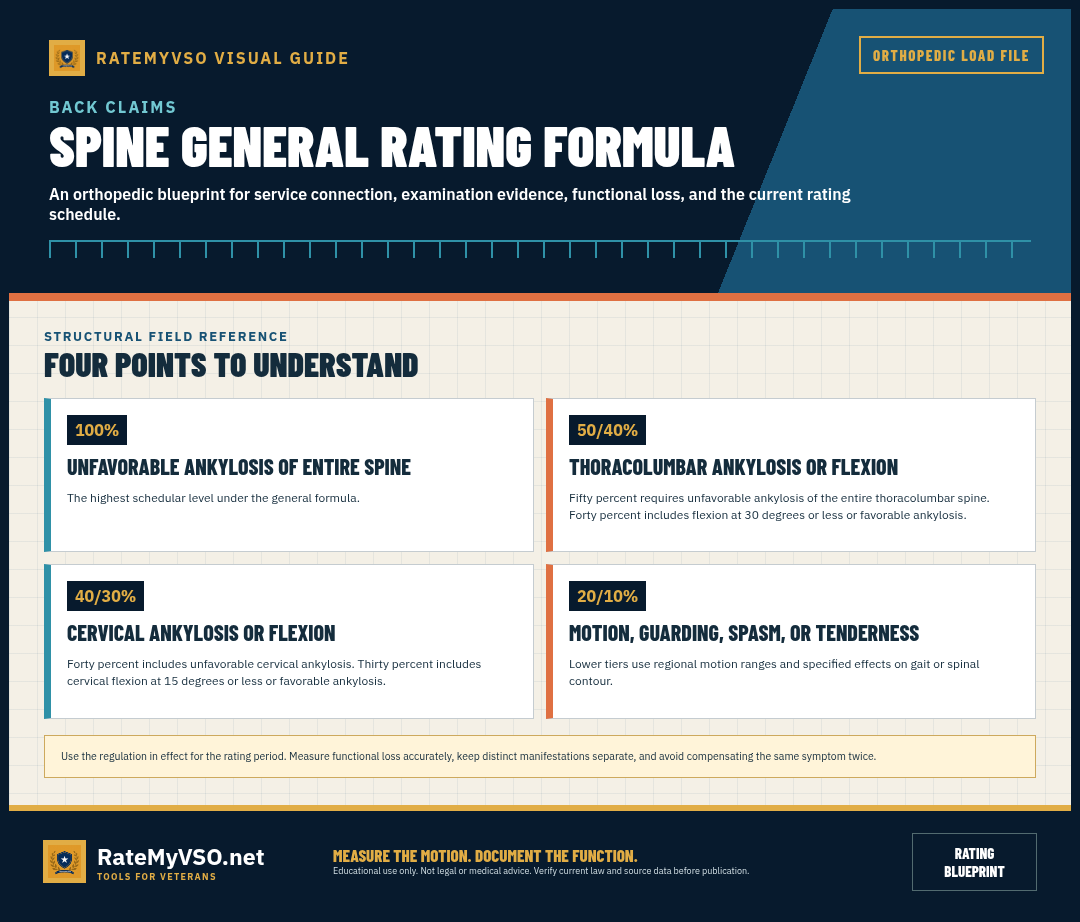
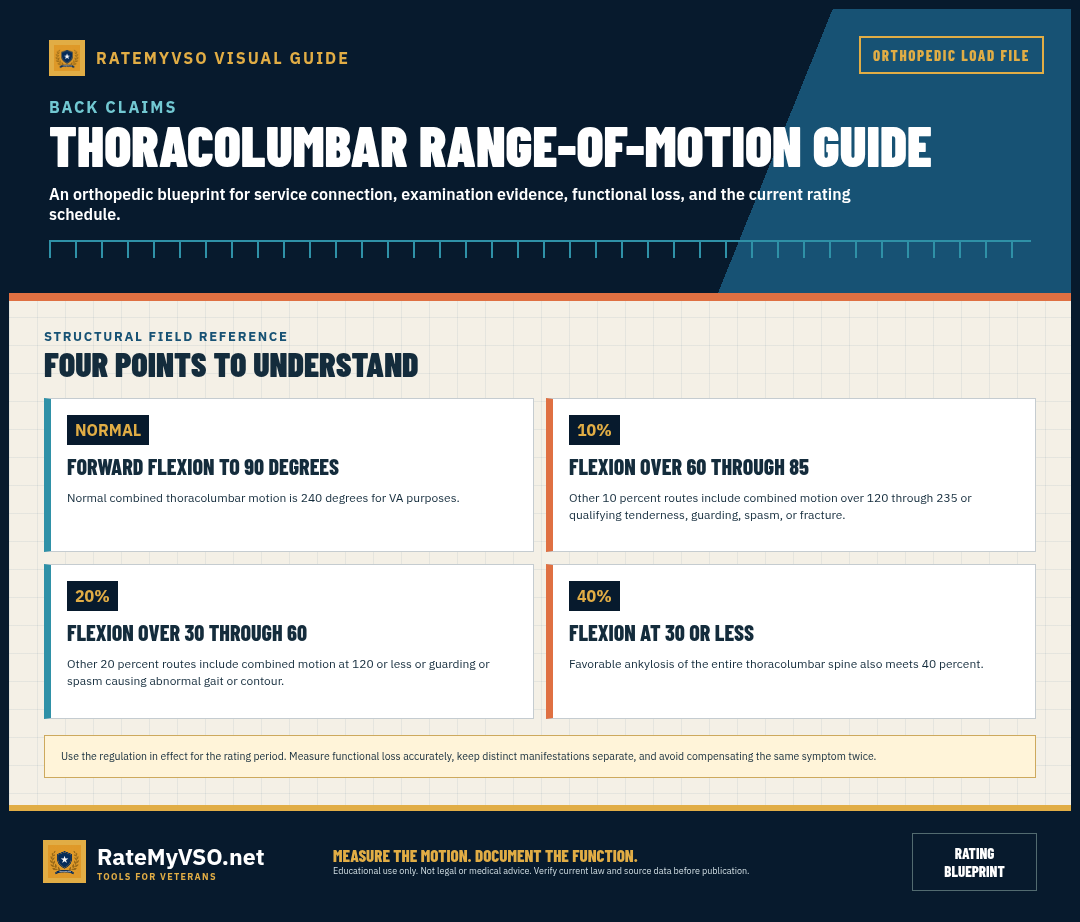
The Low Back Rating Table
A 100% rating exists only for unfavorable ankylosis of the entire spine (back and neck fused together), which is rare. Whichever measure gets you the higher level applies, so a near-normal flexion number can still reach 20% if muscle spasm causes an abnormal posture or gait.
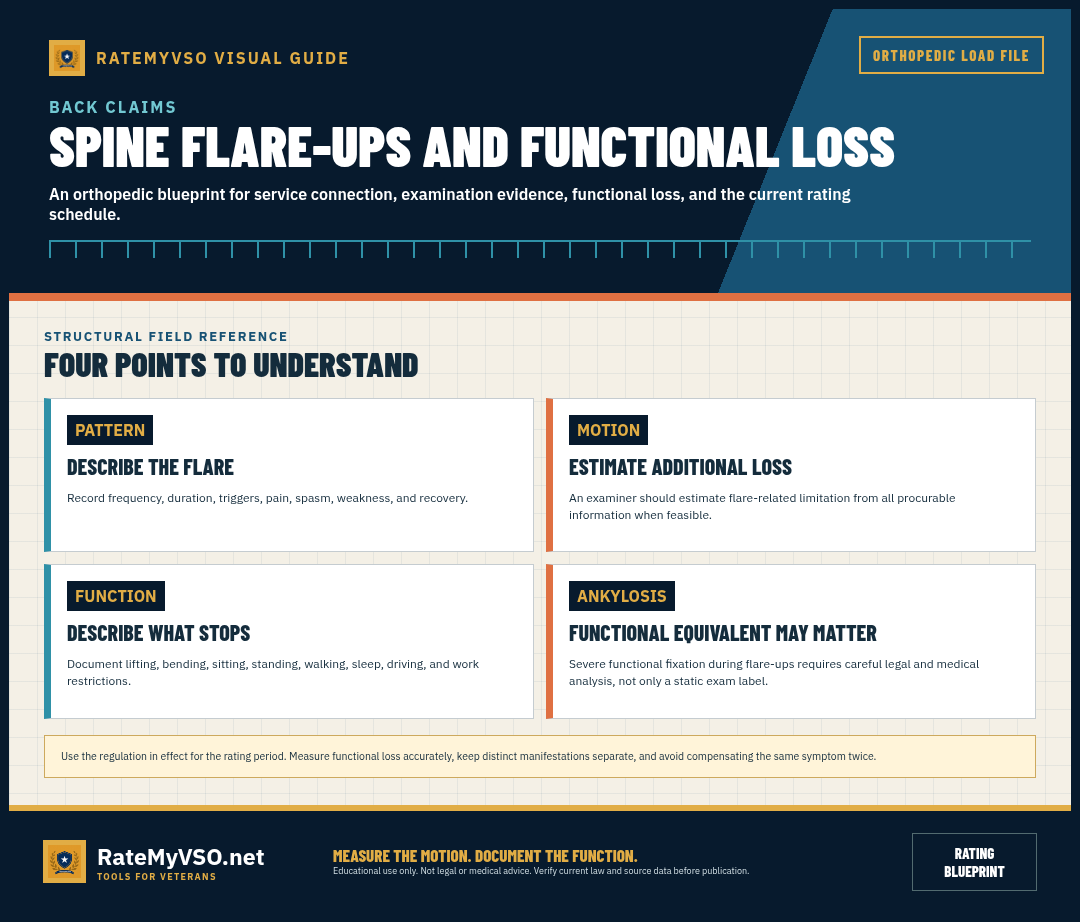 One-page guide: Spine Flare-Ups and Functional Loss
Flare pattern, motion estimate, stopped activity, and functional-ankylosis analysis. Opens the full-size chart, free to save or print.
One-page guide: Spine Flare-Ups and Functional Loss
Flare pattern, motion estimate, stopped activity, and functional-ankylosis analysis. Opens the full-size chart, free to save or print.
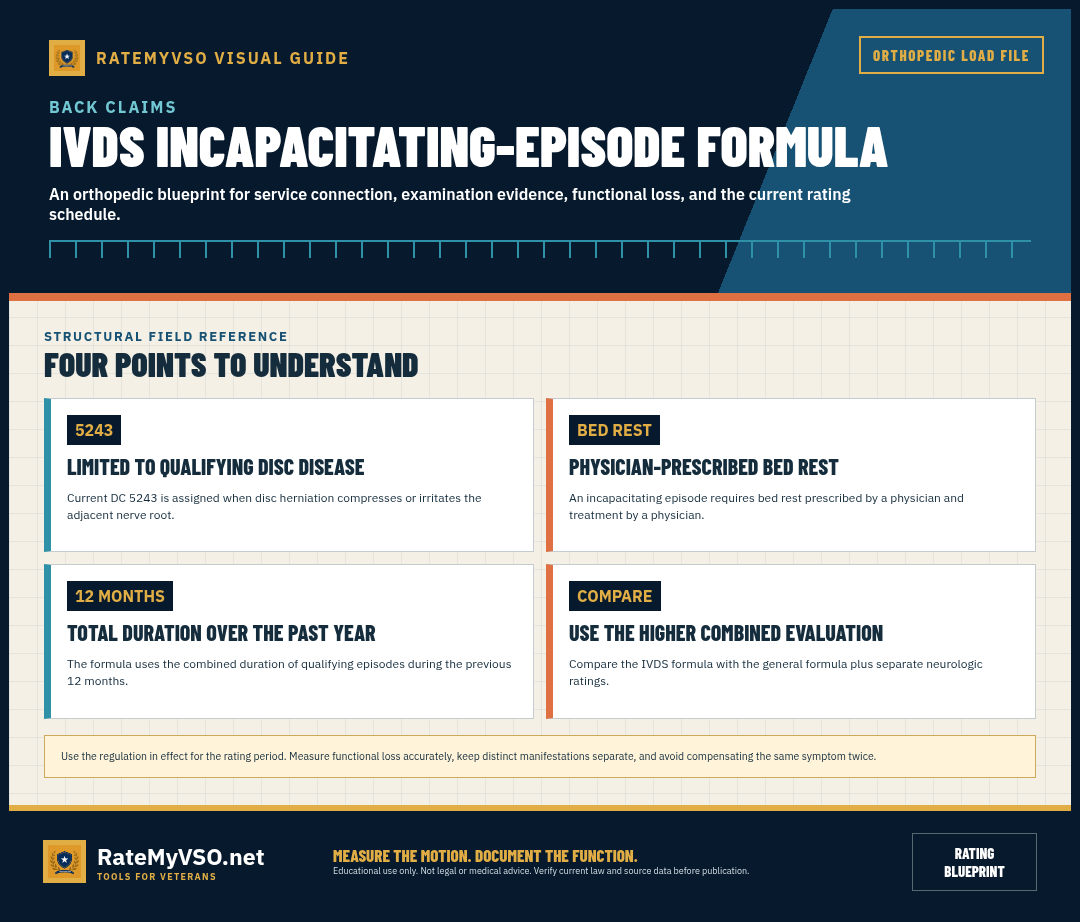
Disc Disease: The IVDS Alternative
If your low back condition is intervertebral disc syndrome (DC 5243), the VA can rate it either by the range-of-motion table above or by the Formula for Incapacitating Episodes, whichever gives the higher rating. An "incapacitating episode" is a period of acute signs and symptoms due to IVDS that required bed rest prescribed by a physician and treatment by a physician, over the past 12 months. Both parts are required: prescribed bed rest on its own does not meet the definition, and self-directed rest never does.
Go deeper: open the full DC 5243 breakdown- What the VA measures at your C&P exam
- Evidence that has won at the Board
- Inside the rater's playbook: grant, denial, and remand rates
- Secondary condition map
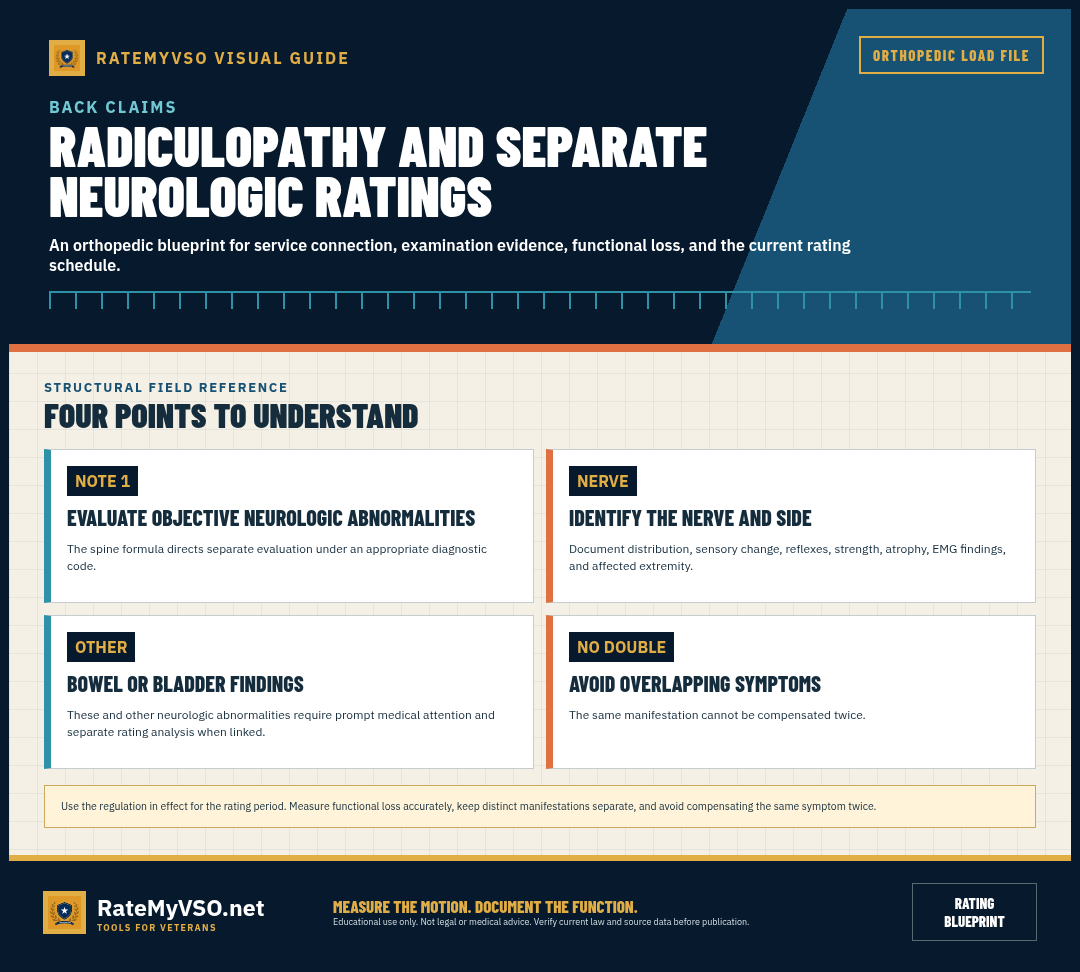
Leg Symptoms: Separately Rated Sciatica
A bad low back is the number-one cause of sciatica: a pinched nerve root sending pain, numbness, or weakness down the leg. The spine formula expressly directs the VA to rate that associated radiculopathy separately from the back itself, one rating for each affected leg, under the sciatic nerve code. So a single low-back condition can yield a back rating plus one or two leg-nerve ratings, often a substantial add-on. The severity scale and the "wholly sensory" cap are covered in the sciatica and radiculopathy guide. Make sure the exam documents any radiating leg symptoms. It is one of the most commonly missed ratings in a back claim.
Quick Checklist Before You File
Bring these together before you submit anything.
- A current diagnosis of your back condition from a doctor, with the records kept.
- The service record of any in-service back injury, complaint, or heavy-duty work.
- A nexus opinion that reviews your file and explains, with reasons, why your back is linked to service.
- Buddy and family statements describing your back pain since service, especially if you have arthritis.
- A read-through of every VA exam, noting anywhere it ignored your account or got the facts wrong.
- Range-of-motion measurements in degrees and, if relevant, documentation of any leg sciatica.
- Records of physician-prescribed bed rest and the physician's treatment if you're raising the IVDS incapacitating-episode path.
For the mechanics of actually submitting the claim, see the Standard Claim Guide and the Fully Developed Claim Guide (filing with all your evidence up front can speed up the decision).
The Claims Process, Step by Step
Once you file, your claim moves through a series of hand-offs. Understanding who does what helps you know who to contact, and what to expect, at each stage.
- You file the claim. Directly with VA, through VA.gov, or with the help of an accredited representative.
- VA acknowledges the claim and assigns it for development. A Veteran Service Representative (VSR) is assigned to gather your service treatment records, VA and private medical records, and any other evidence needed.
- The VSR orders a Compensation & Pension (C&P) exam if one is needed. Most low back claims require one, to measure range of motion and, on a secondary claim, to obtain a nexus opinion.
- The C&P exam is conducted. By a VA clinician or a contracted examiner, who completes a Disability Benefits Questionnaire (DBQ) documenting the diagnosis, range-of-motion measurements, any flare-up loss, leg sciatica findings, and, where relevant, a nexus opinion.
- The file goes to a Rating Veteran Service Representative (RVSR), the "rater." The rater reviews the complete file, including the exam results, and decides whether service connection is warranted and at what percentage.
- A senior reviewer may review the decision before it's finalized, depending on the complexity of the claim.
- VA issues the decision letter. This states whether the claim is granted or denied, the rating percentage if granted, and the reasons behind the decision.
- If you disagree, you choose an appeal lane. Higher-Level Review, Supplemental Claim, or a Board appeal, covered next in this guide.
Who's who: VSO vs. VSR vs. Rater vs. C&P Examiner
Your VSO
An accredited representative from a veterans service organization, or an accredited attorney or claims agent. Not a VA employee. Helps you prepare, gather evidence, and file, and can represent you through an appeal. Has no authority to decide your claim.
VSR (Veteran Service Representative)
VA staff who "develops" your claim: requests records, schedules the C&P exam, and assembles the file. Does not decide the rating.
Rater (RVSR)
VA staff who reviews the completed file and makes the actual decision, service connection or denial, and the percentage. This is the person whose judgment the decision letter reflects.
C&P Examiner
A VA clinician or a contracted medical examiner who conducts the exam, measures range of motion, and completes the DBQ. Documents findings and, where asked, a nexus opinion. Does not decide the claim.
For the full walkthrough of every stage with more detail, see Inside Your Claim and Claim Stages.
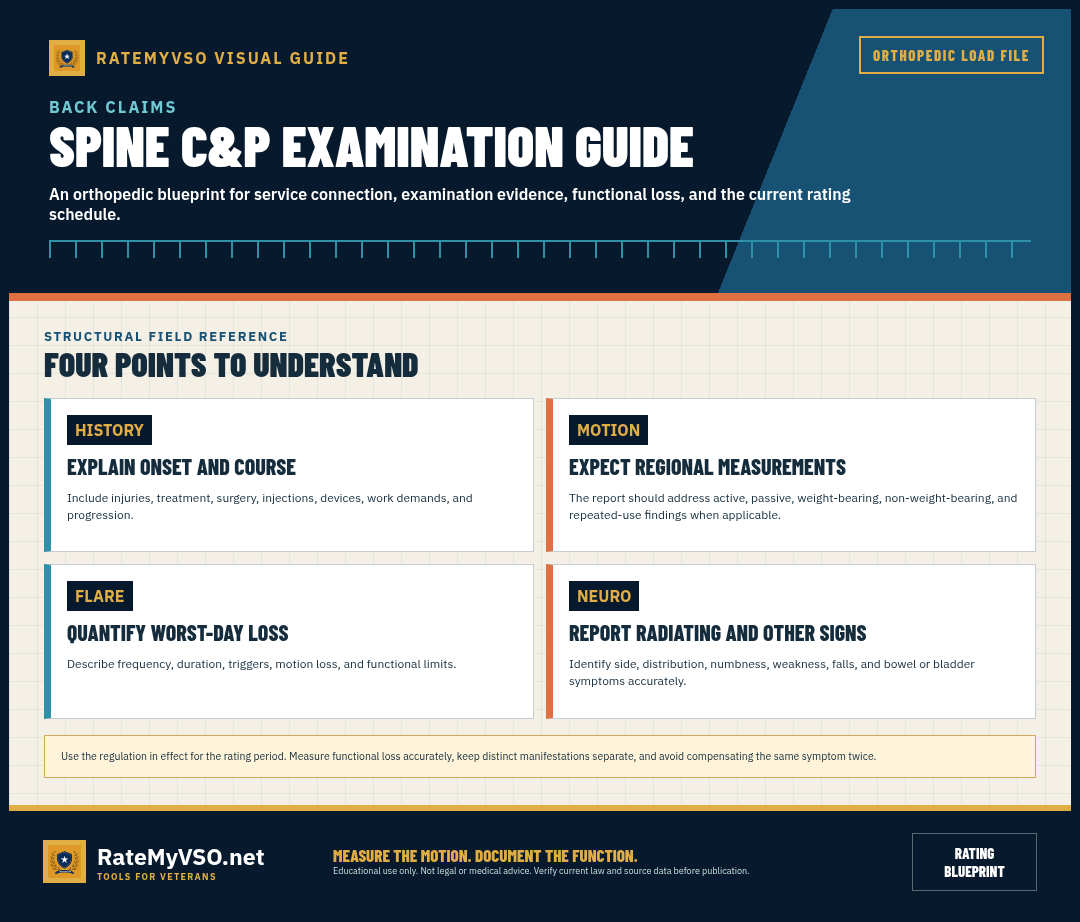 One-page guide: Spine C&P Examination Guide
History, motion testing, flare loss, and neurologic signs. Opens the full-size chart, free to save or print.
One-page guide: Spine C&P Examination Guide
History, motion testing, flare loss, and neurologic signs. Opens the full-size chart, free to save or print.
DBQs and Your C&P Exam
A Disability Benefits Questionnaire (DBQ) is the standardized form an examiner completes for your condition. For the back, that includes goniometer-measured forward flexion and combined range of motion, any additional loss on repetitive use or flare-ups, muscle spasm or abnormal gait findings, IVDS incapacitating-episode history, and a neurological check for leg sciatica. See the DBQ Guide for how these forms work, including whether a private DBQ completed by your own doctor can be submitted instead of relying solely on a VA exam.
Before your C&P exam, bring a clear, specific account of your symptoms, focus on your worst days and flare-ups, not just how your back feels on an average day, and mention any radiating leg pain, numbness, or weakness so the examiner tests for it. Be consistent with what's already in your medical records and prior statements. For a full walkthrough of what to expect and how to prepare, see the C&P Exam Prep Guide.
Reading Your Decision Letter, and What to Do If Denied
Your decision letter has two parts: a narrative section explaining the reasoning (often called "reasons and bases"), and a codesheet showing the actual rating percentage, the effective date, and the diagnostic code used. See the Reading Your Decision Letter Guide for how to find and interpret each part, or use the Letter Interpreter tool to upload your own letter and get a plain-English breakdown.
If your claim is denied, or the rating is lower than you expected, you have three main lanes, and you generally need to act within one year to protect your effective date (38 CFR § 3.2500):
- Supplemental Claim: refile with new and relevant evidence, such as a new nexus opinion, updated imaging, or fresh range-of-motion measurements. See Supplemental Claim Guide.
- Higher-Level Review (HLR): a senior reviewer looks at the same evidence again for a difference of opinion, no new evidence is added. See HLR Guide.
- Board Appeal: your case goes to a Veterans Law Judge at the Board of Veterans' Appeals, with options for a direct review, an evidence docket, or a hearing. See Board Appeal Guide.
Not sure which lane fits your situation? See the Appeals decision guide for a side-by-side comparison of all three.
After You Win: Maintaining and Protecting Your Rating
A grant is not always the end of the story. Keep your treatment consistent, continued follow-up with imaging and range-of-motion measurements, and documentation of any ongoing flare-ups or leg symptoms protects you if VA schedules a future reexamination or proposes a reduction. VA generally cannot reduce a rating based on an exam that fails to account for factors like pain medication or flare-ups. Not every rating gets reexamined; understand when a rating becomes protected from future review and what to do if VA proposes to reduce it. See Protect Your Rating and Future Reexaminations for the specifics.
If your back condition worsens after the initial grant, for example your flare-ups increase or your range of motion drops further, you can file for an increased rating. Fresh range-of-motion records from close to the time you file support the correct rating for that period. See the Rating Increase Guide.
Common Secondary Conditions
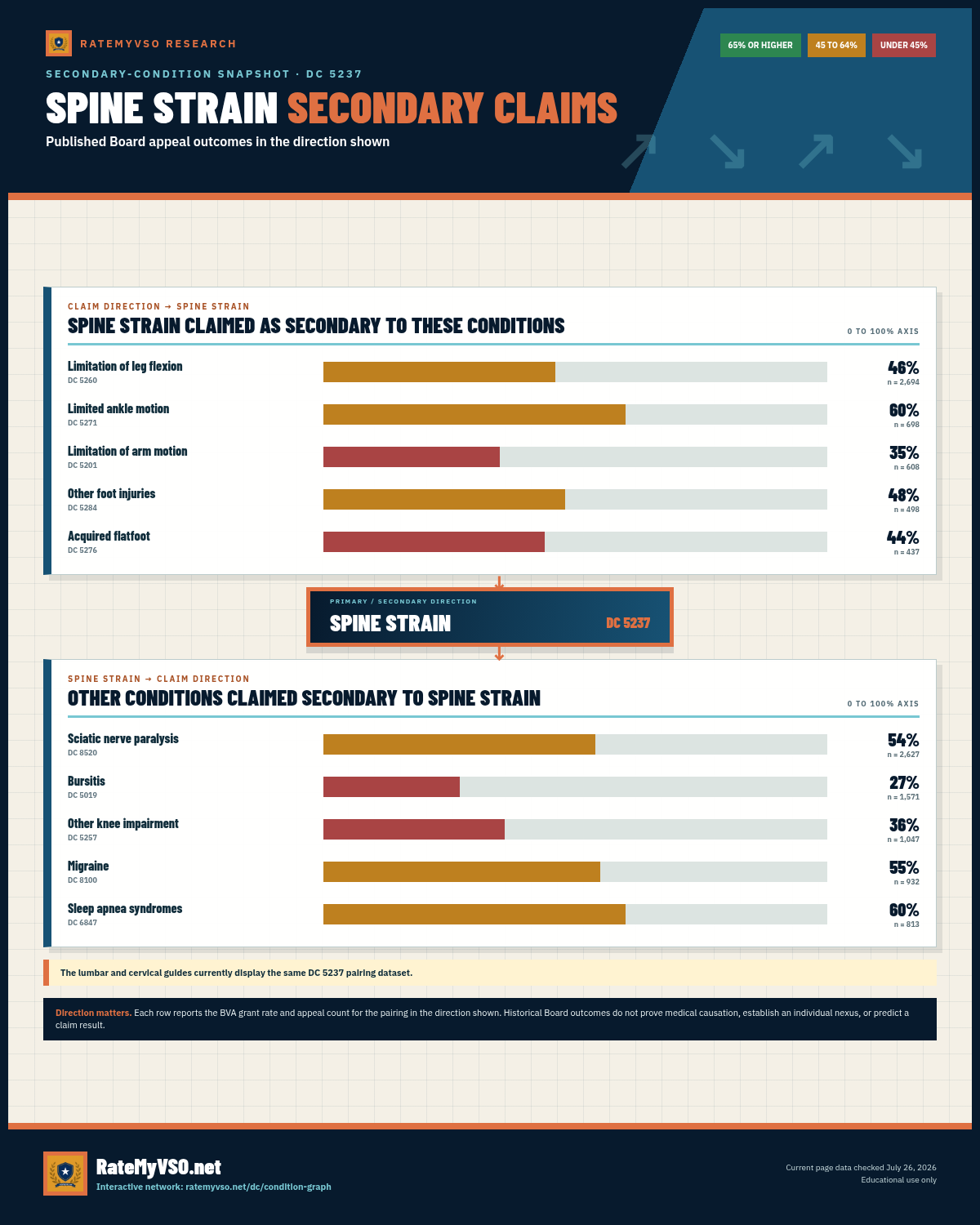
We found these are the conditions most often linked with a lumbar spine condition in the Board's published decisions. Each bar is the BVA grant rate for DC 5237, with the number of decisions below it. They describe what the Board's record shows across many veterans, not a prediction about any one claim.
Conditions that can cause a lumbar spine condition (ways to connect via another condition)
Claims where a low back condition was argued as secondary to an already service-connected condition. This is often the easier route into a grant when a direct in-service injury is not well documented:
Conditions a lumbar spine condition can cause (a lumbar spine condition as the primary)
Conditions veterans have claimed as caused or aggravated by a service-connected lumbar spine condition, including the leg sciatica discussed above:
 One-page guide: Spine Secondary-Claim Snapshot
Two-direction secondary-claim snapshot for SPINE STRAIN, showing BVA grant rates and appeal counts for conditions claimed toward and away from SPINE STRAIN. Opens the full-size chart, free to save or print.
One-page guide: Spine Secondary-Claim Snapshot
Two-direction secondary-claim snapshot for SPINE STRAIN, showing BVA grant rates and appeal counts for conditions claimed toward and away from SPINE STRAIN. Opens the full-size chart, free to save or print.
Quick Reference Tables
Secondary Connection Pathways
| Primary Condition | Mechanism | Evidence Needed |
|---|---|---|
| Knee, ankle, or foot disability | Altered gait shifting load onto the low back | Gait analysis + nexus opinion linking the joint condition to the back |
| Another service-connected joint condition (hip, opposite knee) | Compensatory strain from favoring the affected side | Treatment records + nexus opinion explaining the mechanical chain |
| Pre-existing back condition | Aggravation beyond natural progression during service | Baseline records before service + evidence of the in-service worsening |
From Filing to Decision: Who Does What
| Role | Does | Decides your rating? |
|---|---|---|
| VSO / accredited representative | Helps prepare, gather evidence, and file; represents you on appeal | No |
| VSR | Develops the claim: orders records and the C&P exam | No |
| C&P Examiner | Conducts the exam, measures range of motion, completes the DBQ, may give a nexus opinion | No / but has a strong impact |
| Rater (RVSR) | Reviews the full file and decides service connection and percentage | Yes |
Frequently Asked Questions
Does my exact back diagnosis change the rating?
My flexion is decent but my back is always tight and my posture is off. Any rating?
What is the highest back-only rating?
I have shooting pain down my leg. Is that extra?
My flares put me in bed but I never got a prescription for bed rest. Does IVDS still help?
I have arthritis but no formal nexus opinion. Am I out of luck?
I missed my VA denial's one-year appeal deadline. Is my claim done?
Related Tools and Guides
Sources
- 38 CFR § 4.71a, DC 5237/5242/5243, General Rating Formula for Diseases and Injuries of the Spine
- 38 CFR § 3.303, basic rules for service connection, including continuity of symptomatology under 3.303(b)
- 38 CFR § 3.307 and 3.309, presumptive service connection for chronic diseases such as arthritis
- 38 CFR § 3.310, Secondary Service Connection
- 38 CFR § 3.102, benefit of the doubt
- 38 CFR § 3.6, active duty for training and line-of-duty injuries
- 38 CFR § 3.400, effective dates
- 38 CFR § 3.155, intent to file; 38 CFR § 3.156 and 3.2501, new and material / new and relevant evidence, supplemental claims
- 38 CFR § 3.344, 3.105(e), and 3.655, rating reductions and failure to report for examination
- 38 CFR § 4.40, 4.45, and 4.59, functional loss and painful motion
- 38 USC § 1110 and 1131, basic service connection
- 38 USC § 1154(b), combat presumption
- 38 USC § 5107(b), benefit of the doubt
- 38 USC § 5110, effective dates
- CCK Law, low back pain ratings
- CCK Law, lumbosacral strain
Educational only, not legal advice, and not a prediction of any individual claim. Rating criteria change; confirm current details in 38 CFR 4.71a. For help with your claim, find a VA-accredited representative.