Sinusitis and Rhinitis Claims Guide
Chronic sinusitis and rhinitis are among the most common conditions veterans bring home, especially after burn-pit and dust exposure. They are rated in very different ways: sinusitis is scored by counting your flare-ups over a year, while rhinitis turns on whether you have nasal polyps or a blocked airway. This guide explains how service connection works, the direct and secondary pathways, how DC 6510 and DC 6522 are rated, why both are burn-pit presumptives under the PACT Act, the evidence that wins, why these claims get denied, the claims process step by step, and what to do whether you win or you're denied.
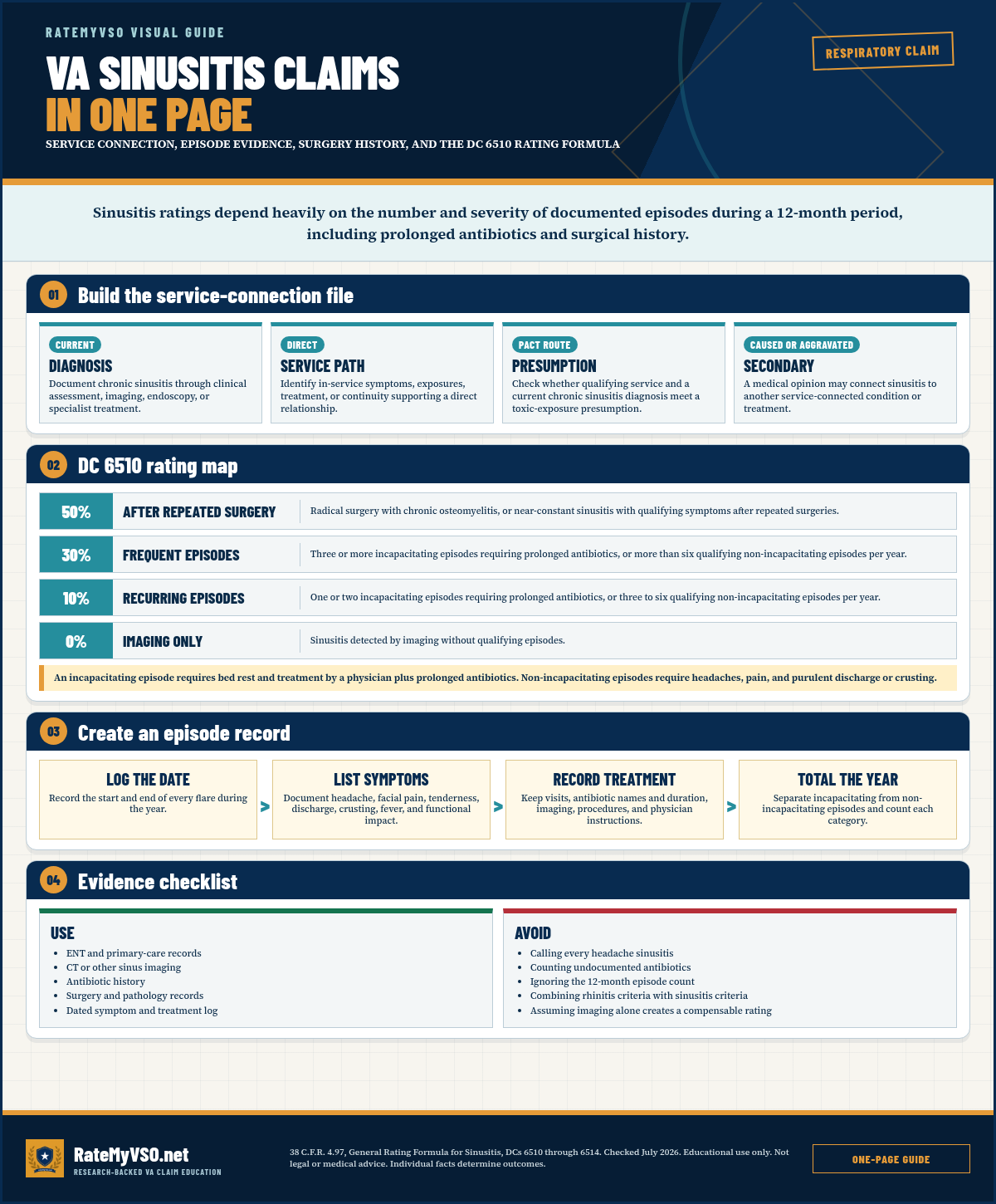 One-page guide: VA Sinusitis Claims In One Page
See the service-connection routes, episode definitions, DC 6510 tiers, and evidence log. Opens the full-size chart, free to save or print.
One-page guide: VA Sinusitis Claims In One Page
See the service-connection routes, episode definitions, DC 6510 tiers, and evidence log. Opens the full-size chart, free to save or print.
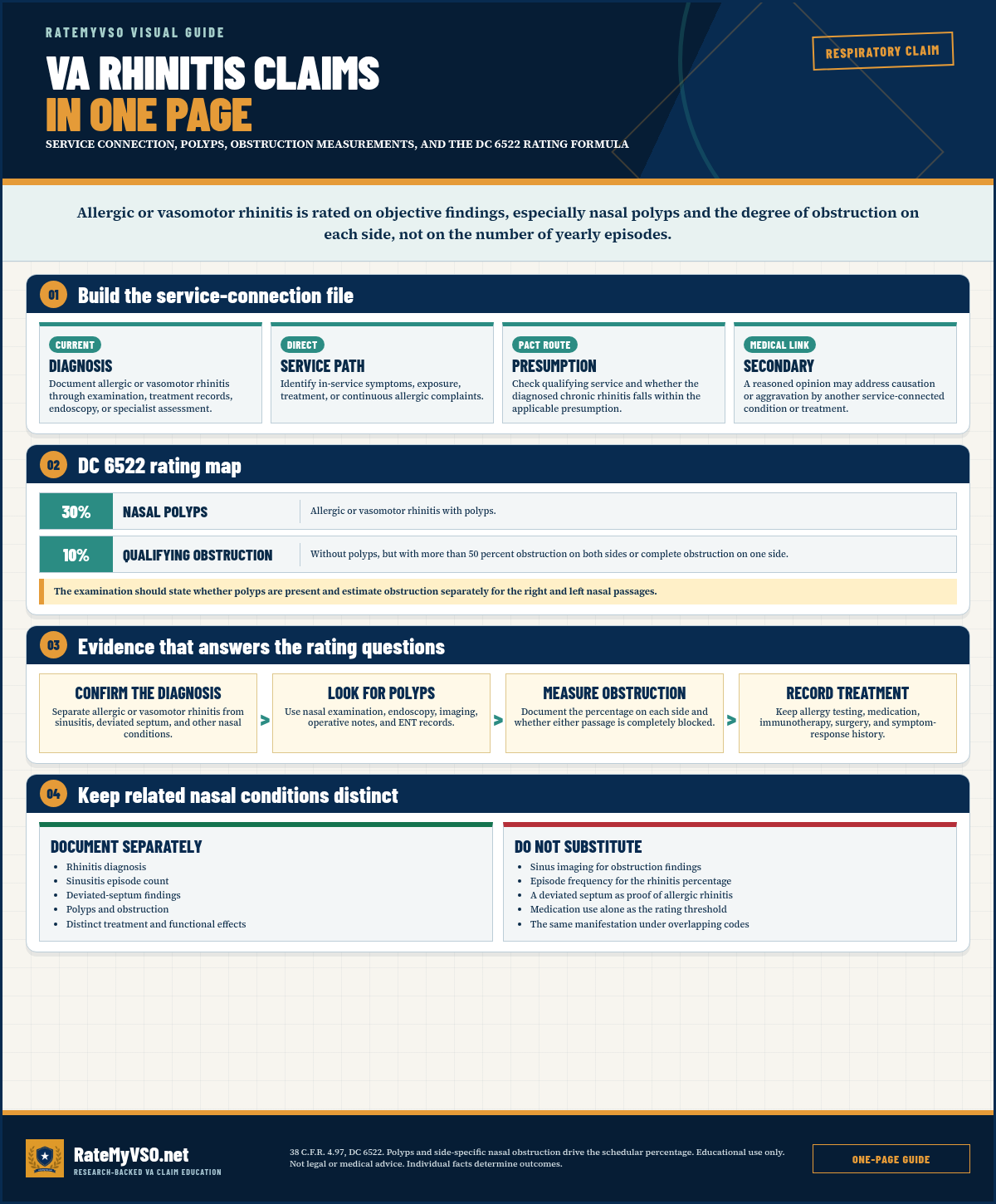 One-page guide: VA Rhinitis Claims In One Page
See the service-connection routes, polyp finding, side-specific obstruction, and DC 6522 tiers. Opens the full-size chart, free to save or print.
One-page guide: VA Rhinitis Claims In One Page
See the service-connection routes, polyp finding, side-specific obstruction, and DC 6522 tiers. Opens the full-size chart, free to save or print.
Start with the essentials
- 01Service Connection
The ways service connection can be established for this condition.
- 02Diagnosis and Evidence
Common symptoms and the evidence cited in published Board appeals.
- 03Your History
What you experienced, what others observed, and what treatment changed.
Understand the claim
Overview
Sinusitis and rhinitis are both long-term inflammation conditions of the airway, sinusitis in the sinuses, rhinitis in the nasal lining, and both sit in the respiratory schedule at 38 CFR § 4.97. They are rated on completely different criteria: sinusitis (DC 6510, and the related sinus codes 6511 to 6514) is scored by counting incapacitating and non-incapacitating episodes over a year, while rhinitis (DC 6522) is scored on physical findings, nasal polyps and the percentage of airway obstruction. This guide walks the whole path: what VA requires to service connect either condition, the direct and secondary pathways, the PACT Act burn-pit presumption, the evidence that wins, why these claims get denied, a filing checklist, the claims process step by step, how to read your decision letter, and what to do whether you win or you're denied.
ICD-10 Diagnosis Codes
The ICD-10 diagnosis codes most commonly used for DC 6510, Sinusitis, pansinusitis, chronic (the kind on your medical records, decision letter, or C&P exam report). VA rates the disability and its residuals, not the diagnosis itself, so coding can vary.
How Service Connection Works, At a High Level
Before getting into the specific pathways below, it helps to understand the three things every sinusitis or rhinitis claim ultimately has to show. This is the same basic test that applies to any VA disability claim, just applied to these two conditions.
- A current diagnosis. You must actually have sinusitis or rhinitis now, confirmed by a medical exam or imaging, not just symptoms. This part is often where these claims fail, symptoms alone, without a documented diagnosis, do not carry a claim.
- An in-service cause or event. Something in service, such as a documented sinus problem, or exposure to burn pits, smoke, dust, or chemicals, must connect to the condition.
- A medical nexus. A doctor's opinion, continuity of symptoms since service, or an applicable presumption must tie the current condition to service.
Service Connection Pathways: Presumptive, Direct, and Secondary
Chronic sinusitis and chronic rhinitis can be established through a presumption, through direct proof, or as secondary to another service-connected condition.
Across published DC 6510 decisions, here is how often the Board granted by the legal theory the claim was argued on:
Grant rate by exposure flag
How often the Board granted DC 6510 issues that carried each exposure signal, next to the overall baseline:
Established pathways include:
PACT Act Burn-Pit and Gulf War Presumption (38 CFR § 3.320)
Chronic sinusitis, chronic rhinitis (including rhinosinusitis), and asthma are presumptively service connected for veterans with qualifying Southwest Asia, Afghanistan, or other burn-pit and airborne-hazard exposure under the PACT Act. Veterans with qualifying service are presumed to have been exposed to fine particulate matter unless there is affirmative evidence otherwise, so a current diagnosis plus qualifying service can be enough on its own, without proving a medical nexus. See the PACT Act and burn-pit presumptives.
Direct Service Connection
A veteran demonstrates that sinusitis or rhinitis began during, or was caused by, active military service, for example a documented in-service sinus problem, or a specific exposure such as smoke or firefighting chemicals. Supporting evidence includes service treatment records documenting sinus complaints, continuity of symptoms since service (a veteran is competent to describe their own symptoms over time), and a medical nexus opinion connecting the current diagnosis to service. This is a common pathway when a sinus condition was diagnosed in service and treatment, such as a daily nasal spray, has continued ever since. See our Service Connection Guide.
Secondary to a deviated septum or nasal trauma
A deviated septum is rated separately under its own diagnostic code, but structural nasal damage can also cause or worsen chronic sinusitis or rhinitis by narrowing the airway and promoting recurring infection. See our Secondary Service Connection Guide for how the causation-and-aggravation analysis works.
Secondary to GERD or other chronic irritants
Chronic acid reflux (GERD) and similar sources of ongoing airway irritation are a recognized route to secondary service connection for sinusitis or rhinitis, when a medical opinion explains how the service-connected condition drives the sinus or nasal inflammation. See our GERD Claims Guide.
What VA Looks For: Tests, Records, and Diagnostic Codes
Whether you are filing directly, on a presumptive basis, or secondary to another condition, the record VA actually reviews centers on a small set of documents and data points.
- Imaging or an exam confirming the diagnosis: an x-ray or CT scan showing sinusitis, or a physical exam of the nasal passages documenting polyps and the percentage of obstruction for rhinitis.
- Treatment records: documented sinus or respiratory treatment during service, prescriptions, and follow-up care showing the condition is being managed.
- An episode log for sinusitis: the dates, symptoms, whether a physician was seen, and the antibiotics prescribed and for how long, this is what the count-based rating is built from.
- The diagnostic codes involved: DC 6510 through 6514 for sinusitis, DC 6522 for rhinitis, and, where relevant, DC 8100 for sinus headaches rated separately as migraines.
- Proof of a qualifying exposure for the presumptive path: deployment records or the burn-pit registry.
- The Sinusitis and Rhinitis DBQ: the standardized exam form that captures episodes, polyps, and obstruction, discussed in more detail later in this guide. See the DBQ Guide.
What Sinusitis and Rhinitis Are
Sinusitis is inflammation of the sinuses that keeps coming back, with facial pain and pressure, headaches, congestion, and discharge. It is rated under diagnostic code 6510 and the related sinus codes (6511 to 6514), all on the same scale. Rhinitis is chronic inflammation of the nasal lining, allergic or vasomotor, with a runny or blocked nose and sometimes polyps, rated under diagnostic code 6522. Both sit in the respiratory schedule (see 38 CFR § 4.97).
Neither condition is established by symptoms alone. A diagnosis has to be confirmed by an exam or imaging, an x-ray or CT scan for sinusitis, or a physical exam of the nose for rhinitis. Reporting congestion, pressure, or drainage without that documentation is the single most common reason these claims stall before they ever reach the service-connection question.
Symptoms and rating
Symptoms Recorded in Granted Sinusitis and rhinitis Decisions
We analyzed 2,246 granted Board decisions involving sinusitis and rhinitis for symptoms named in sentences about the condition (rating-criteria recitations excluded). Descriptive of the published record, what the Board wrote down, not a checklist of what to report.
Bar length shows decisions. Percentages remain context.
Detected by phrase-reading the decision text with condition-specific vocabularies. Source: Board of Veterans' Appeals decisions, RateMyVSO analysis.
How the VA Rates Sinusitis (DC 6510): Count the Episodes
Sinusitis is scored almost entirely by how often it flares in a 12-month period, and how bad those flares are. The rating counts two kinds of episode:
- Incapacitating episode: a flare that requires bed rest and treatment by a physician, and prolonged (4 to 6 weeks) antibiotics. Treating yourself at home without seeing a doctor does not count as incapacitating.
- Non-incapacitating episode: a flare with headaches, pain, and purulent discharge or crusting, but that does not put you in bed under a doctor's care.
| Rating | What it takes over 12 months |
|---|---|
| 50% | Following radical surgery with chronic osteomyelitis, or near-constant sinusitis with headaches, pain, tenderness, and discharge or crusting after repeated surgeries |
| 30% | Three or more incapacitating episodes needing prolonged antibiotics, or more than six non-incapacitating episodes |
| 10% | One or two incapacitating episodes, or three to six non-incapacitating episodes |
| 0% | Detected by imaging only, with no qualifying episodes |
How the VA Rates Rhinitis (DC 6522): Polyps and Obstruction
Rhinitis is rated on physical findings, not episode counts.
| Rating | Finding |
|---|---|
| 30% | Allergic or vasomotor rhinitis with nasal polyps |
| 10% | Without polyps, but with more than 50% obstruction of the nasal passage on both sides, or complete obstruction on one side |
The key facts are whether polyps are present and how blocked the airway is, so the exam should look inside the nose and document both. A deviated septum is rated separately under its own code and can be claimed alongside rhinitis.
Evidence and Board research
Evidence That Wins
We analyzed the Board's published DC 6510 decisions: a private nexus opinion in the file goes with a much higher grant rate, shown below.
- An episode log for sinusitis, dated, with symptoms, doctor visits, and the antibiotics and their length. This is what the count-based rating is built from.
- Treatment records showing the pattern over the past year, prescriptions, imaging, and any surgeries.
- An exam of the nose for rhinitis, documenting polyps and the percentage of nasal obstruction on each side.
- Imaging confirming a current diagnosis, an x-ray or CT scan showing sinusitis, not just a description of symptoms.
- Proof of a qualifying exposure for the presumptive path: deployment records or the burn-pit registry.
- Continuity of symptoms since service, a personal statement describing when your sinus or nasal problems began and that they have continued, backed by ongoing treatment records such as a daily nasal spray.
- A nexus opinion that explains its reasoning, addressing your specific medical history rather than stating a bare conclusion. A weak or incomplete VA opinion, one that ignores your treatment history, gives no real reasoning, or relies only on the absence of records during service, can be challenged directly.
- A named, documented in-service exposure matched to a medical opinion, for example smoke or firefighting-chemical exposure linked by a treating provider to your current sinus congestion, drainage, and headaches.
- The Sinusitis and Rhinitis DBQ, which captures the episodes, polyps, and obstruction the ratings depend on. See the DBQ guide.
Rhinitis-specific evidence
Rhinitis (DC 6522) decisions turn on the same current-diagnosis and nexus questions, with a private opinion in the file again tracking a higher grant rate:
Evidence Cited in Published Sinusitis and rhinitis Decisions
We analyzed 33,123 published Board decisions involving sinusitis and rhinitis for condition-specific evidence, counting only case-specific mentions (boilerplate recitations excluded). "Favorable" is the share of decisions citing that evidence where every issue was granted or the outcome was mixed; the baseline across all these decisions is 60.7%, combining every diagnostic code below. Evidence appearing in a decision does not mean it decided the case. Descriptive of the published record, not a prediction.
Bar length shows decisions citing the evidence.
By diagnostic code
These codes are grouped together above. They do not perform the same, so find your own code here rather than reading the combined figure. A code retired in the schedule rewrites appears without a link, because its decisions were judged under criteria that no longer apply.
Bar length shows published decisions reviewed.
Detected by phrase-reading the decision text with condition-specific vocabularies. Source: Board of Veterans' Appeals decisions, RateMyVSO analysis.
Board Grants, Dissected
Several Board decisions have granted direct service connection for chronic sinusitis and pansinusitis. Because published Board decisions are not binding precedent, no single case predicts how another veteran's claim will turn out. But the pattern across these cases shows what kinds of evidence the Board found persuasive. In each grant below, the current disability was not seriously disputed. The fight was almost always over whether the condition began in service or is related to an in-service exposure, and whether the VA examiner's negative opinion held up.
Presumption of soundness worked in the veteran's favor Citation A26038294 (April 23, 2026), Hearing docket
The record: The veteran had a pre-service history of hay fever, but his entrance exam noted no defects. Service treatment records documented worsening symptoms across multiple enlistments, from occasional allergies to near-daily medication use. A May 2021 VA examiner acknowledged the symptoms worsened in service but concluded, without explanation, that this was just the natural progression of the disease.
Why it won: The Board found the presumption of soundness applied because there was no notation of the condition at entrance. Since the government did not carry its burden, the Board gave the May 2021 VA opinion "little to no probative value" because it offered no rationale for its "natural progression" conclusion. The Board wrote: "the evidence is at least in relative equipoise that the Veteran's allergic rhinitis had its onset during service."
Inadequate VA opinion could not stand up to the veteran's hearing testimony Citation A26018191 (February 27, 2026), Hearing docket
The record: The veteran testified that he was exposed to burn pits, burning oil wells, and trash pit smoke in Iraq, and that he still uses steroid packs, antibiotics, and Flonase almost daily. A September 2020 VA examiner found no chronic sinusitis diagnosis, calling the veteran's symptoms "subjective only," and noted no evidence of treatment in the medical records.
Why it won: The Board found the September 2020 VA opinion inadequate because the examiner did not explain why there was no current diagnosis and never addressed the veteran's lay statement about his symptoms. The Board found the veteran's hearing testimony about his symptoms and their onset competent and credible. The Board noted the veteran also qualified for the PACT Act presumption, but decided the claim on a direct basis because it was the "greater benefit."
In-service diagnosis plus continuous treatment outweighed an unexplained denial Citation A26018128 (February 27, 2026), Hearing docket
The record: Service treatment records showed the veteran was diagnosed with sinusitis and placed on a medical profile in April 2013. VA treatment records from 2016 through 2019 documented ongoing sinus treatment, including daily nasal spray. A November 2020 VA examiner gave an unfavorable nexus opinion.
Why it won: The Board found the November 2020 VA opinion inadequate because it did not address the veteran's documented treatment history and lacked sufficient rationale. Citing Reonal v. Brown, the Board explained it may reject a medical opinion based on an inaccurate factual basis. The Board found the veteran competent and credible in reporting continuous symptoms since service.
PACT Act presumption applied based on confirmed Southwest Asia service Citation A26018038 (February 27, 2026), Evidence Submission docket
The record: Personnel records confirmed the veteran served in Southwest Asia from January to April 1991, during the Persian Gulf War. A November 2023 VA examination confirmed a diagnosis of chronic sinusitis.
Why it won: Under 38 C.F.R. § 3.320, chronic sinusitis is presumed related to particulate matter exposure for veterans who served in the Southwest Asia theater during the Persian Gulf War. Because both the qualifying service and the current diagnosis were established, the Board found the presumption applied and granted the claim without needing a nexus opinion at all.
Two VA sources on related conditions filled the gap the sinusitis examiner left open Citation A26017796 (February 26, 2026), Hearing docket
The record: The veteran, a firefighter during service, was later diagnosed with allergic rhinitis that a March 2025 VA examiner tied to smoke and firefighting chemical exposure. A June 2025 VA examiner diagnosed chronic sinusitis but said it was not related to service, addressing only jet fuel exposure and not smoke or chemicals. A September 2025 VA treatment note from the veteran's own provider linked his "mixed rhinitis" symptoms to his in-service fume exposure.
Why it won: The Board found the March 2025 opinion and the September 2025 treatment note, taken together, sufficient to connect the veteran's sinusitis symptoms (congestion, drainage, sinus headaches, pressure, and pain) to service. Because the June 2025 negative opinion only addressed jet fuel and did not contradict the smoke and chemical exposure findings, the Board found it did not outweigh the favorable evidence and resolved doubt in the veteran's favor.
Why These Claims Get Denied
Beyond the general "no nexus" and "no diagnosis" reasons covered above, a few specific denial patterns show up often enough to call out on their own.
- No current diagnosis at all. Feeling sinus pain, congestion, or drainage is not enough by itself. Claims are denied where exams and imaging show no sinusitis or rhinitis, even with real qualifying service or a documented history of symptoms.
- Symptoms already explained by another service-connected condition. Where a veteran's congestion or drainage is already attributed to an existing service-connected diagnosis, for example rhinitis, a separate claim for sinusitis can be denied unless a distinct, additional diagnosis is documented.
- An unconfirmed toxic-exposure theory. A claim that rests only on an exposure VA cannot verify, with no current diagnosis to back it, is a weak claim on its own. If the exposure itself is unconfirmed and there is no diagnosis, the theory fails regardless of how sincerely it's argued.
- Confusing a rating or effective-date fight with the underlying service-connection question. Once you are already service connected, the argument shifts to how severe your condition is and how far back your effective date should go, not the three elements above. Treating the two fights the same way wastes the argument.
Pitfalls and Common Mistakes
The same handful of missteps account for most lost or under-rated sinus and nasal claims. Among the Board's classified service-connection denials for sinusitis, here is what claims most often fell short on:
- Not documenting the episodes. Sinusitis is rated by counting flares. Without dated records of how many episodes you had and whether they were incapacitating, the rating comes in low.
- Confusing incapacitating with non-incapacitating. An incapacitating episode requires bed rest, a physician, and prolonged antibiotics. Mixing the two up sends the count to the wrong row.
- Missing polyps or obstruction for rhinitis. Rhinitis turns on polyps and the percentage of nasal blockage. If the exam did not look for them, the finding that earns the rating is absent.
- Skipping the presumptive path. Chronic sinusitis and rhinitis are burn-pit presumptives. Veterans with qualifying exposure sometimes try to prove a direct link the presumption already covers.
- Claiming one when you have both. Sinusitis and rhinitis are separate conditions on separate scales. If you have both, claim both.
- Sitting back after filing a Fully Developed Claim. That program asks you to submit your own private evidence up front. Not responding to VA's follow-up requests for records can sink a claim, VA's duty to assist is a two-way street.
- Skipping your scheduled C&P exam. The exam is often the only place a current diagnosis gets documented. Missing it without a good reason can result in a denial for lack of a current disability.
- Leaning on another veteran's Board decision. Board decisions apply only to the case decided and are not precedent. Citing someone else's outcome as if it controls your claim carries little weight, each case turns on its own facts.
Do's and Don'ts
A condensed version of everything above, in the order it actually matters when you sit down to build your file.
- Get a current diagnosis in writing, confirmed by an exam or imaging (x-ray or CT scan), not just a list of symptoms.
- Claim the PACT Act burn-pit or Gulf War presumption if you have qualifying service, it can carry the case without a separate nexus.
- Document that your symptoms began in service and have continued since, with treatment records to back it up.
- Ask your doctor for a nexus opinion that explains its reasoning and addresses your specific medical history.
- Point out a VA medical opinion that ignored your treatment history or lay statements, or leaned only on the absence of in-service records.
- Tie your condition to a specific documented in-service exposure when you have one.
- Keep a dated episode diary for sinusitis: the date, symptoms, doctor visit, and antibiotics and their length.
- Make sure the exam looks inside the nose for rhinitis and records polyps and the percentage of obstruction on each side.
- Claim both conditions if you have both, they're separate diagnoses on separate scales.
- File each appeal or review option within a year of the prior decision to protect your effective date.
- Don't rely on symptoms alone, sinusitis and rhinitis both require a documented current diagnosis.
- Don't assume a toxic exposure VA hasn't confirmed will carry the claim by itself.
- Don't sit back after filing a Fully Developed Claim, VA's duty to assist runs both ways.
- Don't skip your scheduled C&P exam.
- Don't cite another veteran's Board decision as if it controls your case, it doesn't.
- Don't confuse a fight over your rating percentage or effective date with the underlying service-connection question.
- Don't let a vague description substitute for a dated episode log.
- Don't forget that a deviated septum is rated separately from rhinitis, even though the two often overlap.
Secondary relationships
Secondary Conditions
Chronic sinus and nasal disease connects to other claims in both directions, often through a shared airway problem or exposure. Each bar below is the Board's grant rate for the given code in that pairing, with the number of decisions under it. They describe the published record across many veterans, not a prediction about any one claim.
Conditions linked as causing sinusitis (sinusitis as the secondary)
Claims where sinusitis was argued as secondary to an already service-connected condition:
Conditions sinusitis is linked to causing (sinusitis as the primary)
Conditions veterans have claimed as caused or aggravated by service-connected sinusitis, including the sleep apnea pathway noted above once sinusitis itself is service connected:
Conditions linked as causing rhinitis (rhinitis as the secondary)
The same pairing, for rhinitis specifically:
Conditions rhinitis is linked to causing (rhinitis as the primary)
Prepare and take the next step
Prepare: your own working pages
Optional. These are your own notes, in your own words. They are not a VA form, they are not sent to the VA, and nothing here is a medical finding or a prediction about your claim.
Three reminders while you prepare
- Start with the diagnosis and objective testing
Record the diagnosed condition, testing, imaging, and treatment. Keep different respiratory or nasal diagnoses separate. Go to this part
- Track episodes and treatment requirements
Note flare frequency, infections or attacks, medicines, procedures, and urgent or routine care as the record describes them. Go to this part
- Describe breathing and daily effects
Record what exertion, sleep, work, or ordinary activities are limited, without estimating test results or assigning yourself a rating. Go to this part
Sign in or create an account to save your answers and come back to them later. You can fill these in and print them without an account.
Respiratory symptom and episode log
Testing and treatment record
Connection and examination questions
Records and unanswered questions
Decision-letter reading sheet
Quick Checklist Before You File
Bring these together before you submit anything.
- A current diagnosis in writing, ideally confirmed by an x-ray or CT scan, not just a list of symptoms.
- Service records showing in-service sinus or respiratory treatment, or a documented toxic exposure.
- If you served in the Gulf War or near burn pits, the PACT Act presumption for sinusitis and rhinitis.
- A short personal statement describing when your symptoms began and that they have continued since service.
- A nexus opinion from a doctor that explains its reasoning and addresses your medical history.
- For rating purposes, a dated log of episodes per year, purulent discharge, crusting, and headaches, and any surgeries.
- For rhinitis, an exam that documents polyps and the percentage of nasal obstruction.
- Confirmation that you filed each appeal or review option on time to protect your effective date.
For the mechanics of actually submitting the claim, see the Standard Claim Guide and the Fully Developed Claim Guide (filing with all your evidence up front can speed up the decision).
The Claims Process, Step by Step
Once you file, your claim moves through a series of hand-offs. Understanding who does what helps you know who to contact, and what to expect, at each stage.
- You file the claim. Directly with VA, through VA.gov, or with the help of an accredited representative.
- VA acknowledges the claim and assigns it for development. A Veteran Service Representative (VSR) is assigned to gather your service treatment records, VA and private medical records, and any other evidence needed.
- The VSR orders a Compensation & Pension (C&P) exam if one is needed. Most sinusitis and rhinitis claims involve one, since imaging or a physical nasal exam is usually what establishes the current diagnosis.
- The C&P exam is conducted. By a VA clinician or a contracted examiner, who completes a Disability Benefits Questionnaire (DBQ) documenting the diagnosis, episode history or polyp/obstruction findings, and, where relevant, a nexus opinion.
- The file goes to a Rating Veteran Service Representative (RVSR), the "rater." The rater reviews the complete file, including the exam results, and decides whether service connection is warranted and at what percentage.
- A senior reviewer may review the decision before it's finalized, depending on the complexity of the claim.
- VA issues the decision letter. This states whether the claim is granted or denied, the rating percentage if granted, and the reasons behind the decision.
- If you disagree, you choose an appeal lane. Higher-Level Review, Supplemental Claim, or a Board appeal, covered later in this guide.
Who's who: VSO vs. VSR vs. Rater vs. C&P Examiner
Your VSO
An accredited representative from a veterans service organization, or an accredited attorney or claims agent. Not a VA employee. Helps you prepare, gather evidence, and file, and can represent you through an appeal. Has no authority to decide your claim.
VSR (Veteran Service Representative)
VA staff who "develops" your claim: requests records, schedules the C&P exam, and assembles the file. Does not decide the rating.
Rater (RVSR)
VA staff who reviews the completed file and makes the actual decision, service connection or denial, and the percentage. This is the person whose judgment the decision letter reflects.
C&P Examiner
A VA clinician or a contracted medical examiner who conducts the exam and completes the DBQ. Documents findings and, where asked, a nexus opinion. Does not decide the claim.
For the full walkthrough of every stage with more detail, see Inside Your Claim and Claim Stages.
DBQs and Your C&P Exam
The Sinusitis and Rhinitis Disability Benefits Questionnaire (DBQ) is the standardized form an examiner completes for these conditions, it structures the exam findings into the specific data points VA's rating schedule requires: for sinusitis, the episode history and whether surgery has been performed; for rhinitis, the presence of polyps and the percentage of nasal obstruction. See the DBQ Guide for how these forms work, including whether a private DBQ completed by your own doctor can be submitted instead of relying solely on a VA exam.
Before your C&P exam, bring your episode log if you're claiming sinusitis, and be ready to describe any nasal blockage or polyp history for rhinitis. Be consistent with what's already in your medical records and prior statements. For a full walkthrough of what to expect and how to prepare, see the C&P Exam Prep Guide.
Reading Your Decision Letter, and What to Do If Denied
Your decision letter has two parts: a narrative section explaining the reasoning (often called "reasons and bases"), and a codesheet showing the actual rating percentage, the effective date, and the diagnostic code used. See the Reading Your Decision Letter Guide for how to find and interpret each part, or use the Letter Interpreter tool to upload your own letter and get a plain-English breakdown.
If your claim is denied, or the rating is lower than you expected, you have three main lanes:
- Supplemental Claim: refile with new and relevant evidence, such as a new nexus opinion, updated imaging, or a dated episode log. See Supplemental Claim Guide.
- Higher-Level Review (HLR): a senior reviewer looks at the same evidence again for a difference of opinion, no new evidence is added. See HLR Guide.
- Board Appeal: your case goes to a Veterans Law Judge at the Board of Veterans' Appeals, with options for a direct review, an evidence docket, or a hearing. See Board Appeal Guide.
Not sure which lane fits your situation? See the Appeals decision guide for a side-by-side comparison of all three.
After You Win: Rating, Effective Date, and Maintaining Your Rating
A grant is not always the end of the story, and several sinus and nasal claims that reach the Board are really fights over the rating percentage or the effective date, not over service connection itself.
- Protect your effective date by continuously pursuing the claim. Filing the next review option (a Supplemental Claim, HLR, or Board appeal) within one year of each decision keeps your original claim date, rather than resetting it to a later filing.
- Keep documenting after the grant. Continued treatment records, an ongoing episode log for sinusitis, or follow-up exams noting polyps and obstruction for rhinitis, protect you if VA schedules a future reexamination and support a later increased-rating claim if the condition worsens. See Protect Your Rating and Future Reexaminations for when a rating becomes protected and what to do if VA proposes to reduce it.
- If your condition worsens, for example more frequent or more severe episodes, you can file for an increased rating. See the Rating Increase Guide.
References and related resources
Quick Reference Tables
Service Connection Pathways
| Pathway | What It Takes | Evidence Needed |
|---|---|---|
| PACT Act / burn-pit presumption | Qualifying Southwest Asia, Afghanistan, or burn-pit service | Current diagnosis + service/deployment records showing qualifying service |
| Direct | Onset or continuity from a documented in-service event | Service treatment records + current diagnosis + nexus opinion or continuity statement |
| Secondary to deviated septum / nasal trauma | Structural damage causing or worsening the sinus/nasal condition | Nexus opinion linking the structural finding to the sinusitis or rhinitis diagnosis |
| Secondary to GERD or chronic irritation | An already service-connected source of ongoing airway irritation | Nexus opinion explaining the causal mechanism |
Sinusitis Rating (DC 6510)
| Rating | What it takes over 12 months |
|---|---|
| 50% | Following radical surgery with chronic osteomyelitis, or near-constant sinusitis with headaches, pain, tenderness, and discharge or crusting after repeated surgeries |
| 30% | Three or more incapacitating episodes needing prolonged antibiotics, or more than six non-incapacitating episodes |
| 10% | One or two incapacitating episodes, or three to six non-incapacitating episodes |
| 0% | Detected by imaging only, with no qualifying episodes |
Rhinitis Rating (DC 6522)
| Rating | Finding |
|---|---|
| 30% | Allergic or vasomotor rhinitis with nasal polyps |
| 10% | Without polyps, but with more than 50% obstruction of the nasal passage on both sides, or complete obstruction on one side |
From Filing to Decision: Who Does What
| Role | Does | Decides your rating? |
|---|---|---|
| VSO / accredited representative | Helps prepare, gather evidence, and file; represents you on appeal | No |
| VSR | Develops the claim: orders records and the C&P exam | No |
| C&P Examiner | Conducts the exam, completes the DBQ, may give a nexus opinion | No / but has a strong impact |
| Rater (RVSR) | Reviews the full file and decides service connection and percentage | Yes |
Frequently Asked Questions
How does the VA rate chronic sinusitis?
What gets rhinitis to 30 percent?
Are sinusitis and rhinitis covered by the PACT Act?
Can I get a rating for both sinusitis and rhinitis?
What counts as an incapacitating episode?
Can sinus headaches be rated separately from sinusitis?
What if I'm already service connected and just disagree with the rating or effective date?
Related Tools and Guides
Sources
- 38 CFR § 4.97, Diagnostic Codes 6510 to 6514, General Rating Formula for Sinusitis
- 38 CFR § 4.97, Diagnostic Code 6522, allergic or vasomotor rhinitis
- 38 CFR § 4.124a, Diagnostic Code 8100, migraine and sinus headaches
- 38 CFR § 3.303, basic rules for service connection (current disability, in-service event, nexus), including § 3.303(b) continuity of symptoms and § 3.303(d) disease diagnosed after service
- 38 CFR § 3.320, presumptive service connection for asthma, rhinitis, and sinusitis based on exposure to fine particulate matter
- 38 CFR § 3.317, Persian Gulf War undiagnosed illness and chronic multi-symptom illness
- Pub. L. 117-168 (the PACT Act), toxic-exposure presumptions
- 38 CFR § 3.102, and 38 USC § 5107(b), benefit of the doubt / reasonable doubt resolved for the veteran
- 38 CFR § 3.104(c), favorable findings are binding on later adjudicators
- 38 CFR § 3.400, effective dates; 38 CFR § 3.2500, continuous pursuit of a claim to protect the effective date
- 38 CFR § 3.156(b), new and material evidence within the appeal period
- 38 CFR § 20.1303, Board decisions are not precedential
- VA, burn-pit and airborne hazards
- CCK Law, sinusitis