When a Spouse Isn’t Enough
His wife said she was the reason he could remain at home. The Board agreed that he needed regular help, but still denied the benefit that could pay at the SMC-R2 level.
His wife was not describing occasional help. She showered him because he was unsteady. She dressed the lower half of his body, cooked every meal because she feared he would start a fire, drove him everywhere, tracked his appointments, handled his medication, and monitored him all day for his safety. She told the Board that if she could no longer do it, he would need to live in a care facility.
The Board recognized that he needed regular aid and attendance. It also increased his special monthly compensation to the M-Half rate. But it denied SMC-T, the TBI benefit that can pay at the SMC-R2 level. Read quickly, that sounds like the veteran tried to jump straight from M-Half to R2. He did not. The Board was answering two different questions, under two different routes.
Two questions, not one ladder
The first question was how high the veteran's existing disabilities moved his basic SMC rate. That answer was M-Half. The second was whether the care his wife provided met the much narrower standard for an enhanced aid-and-attendance benefit. Because his need for help was tied in part to a traumatic brain injury, the Board considered SMC-T as a separate route.
How he reached M-Half
The veteran already received SMC-L because his service-connected disabilities left him in need of regular aid and attendance. Later, a separate 100 percent rating for TBI residuals with PTSD moved him from SMC-L to SMC-M. A separate 50 percent migraine rating added another half-step, moving him from SMC-M to SMC-M-Half.
Those increases came from separate disability ratings. They did not decide whether the care in his home was ordinary aid and attendance or higher-level health care. They also did not place him at the gateway for SMC-R1 or SMC-R2. The ordinary R route generally requires SMC-O or the maximum SMC-P rate, or SMC-N-Half together with SMC-K. He had not reached that point.
Why the Board considered SMC-T anyway
Congress created SMC-T for veterans who need aid and attendance because of service-connected traumatic brain injury. It provides a separate route to compensation paid at the R2 level without first requiring the veteran to reach SMC-O or another ordinary R-level gateway.
SMC-T still has a demanding test, but it is not the R2 professional-care test. The veteran must need regular aid and attendance because of service-connected TBI residuals and show that, without that help, he would require hospitalization, nursing-home care, or another form of residential institutional care. After Laska v. McDonough, that regular help may be provided by a spouse or another family member. It does not have to be licensed or professionally supervised care.
The wife who was keeping him at home
The veteran and his wife participated in the VA's Program of Comprehensive Assistance for Family Caregivers. The record documented years of help with washing, dressing, balance, meals, driving, medication, appointments, household finances, and protection from everyday hazards.
Her December 2023 statement made the stakes unmistakable. She said he needed 24-hour care and monitoring. She worried that he would become lost while driving or start a house fire while cooking. She received his medical instructions because he could not remember them. She ordered and administered his medication. In her view, her care was the reason he could remain at home.
Why the Board still said no
The Board classified most of what she did as regular aid and attendance: bathing, dressing, preparing meals, driving, medication reminders, and keeping him safe. It then also evaluated whether she was providing licensed or professionally supervised higher-level health care. That is the R2 standard, not the SMC-T standard after Laska v. McDonough. The 2025 Donnelly decision shows the Board still applying the two standards inconsistently.
The Board gave a separate reason for denying SMC-T that still mattered after Laska. It found insufficient evidence that, without his wife's regular aid and attendance, the veteran would require institutional care. It relied on medical records describing milder memory problems, appropriate orientation, and no finding that he was a danger to himself or unable to manage his own affairs. The wife's statement described the life she was preventing. The Board focused on the condition it could see while she was still doing all of that work.
What the wider Board record shows
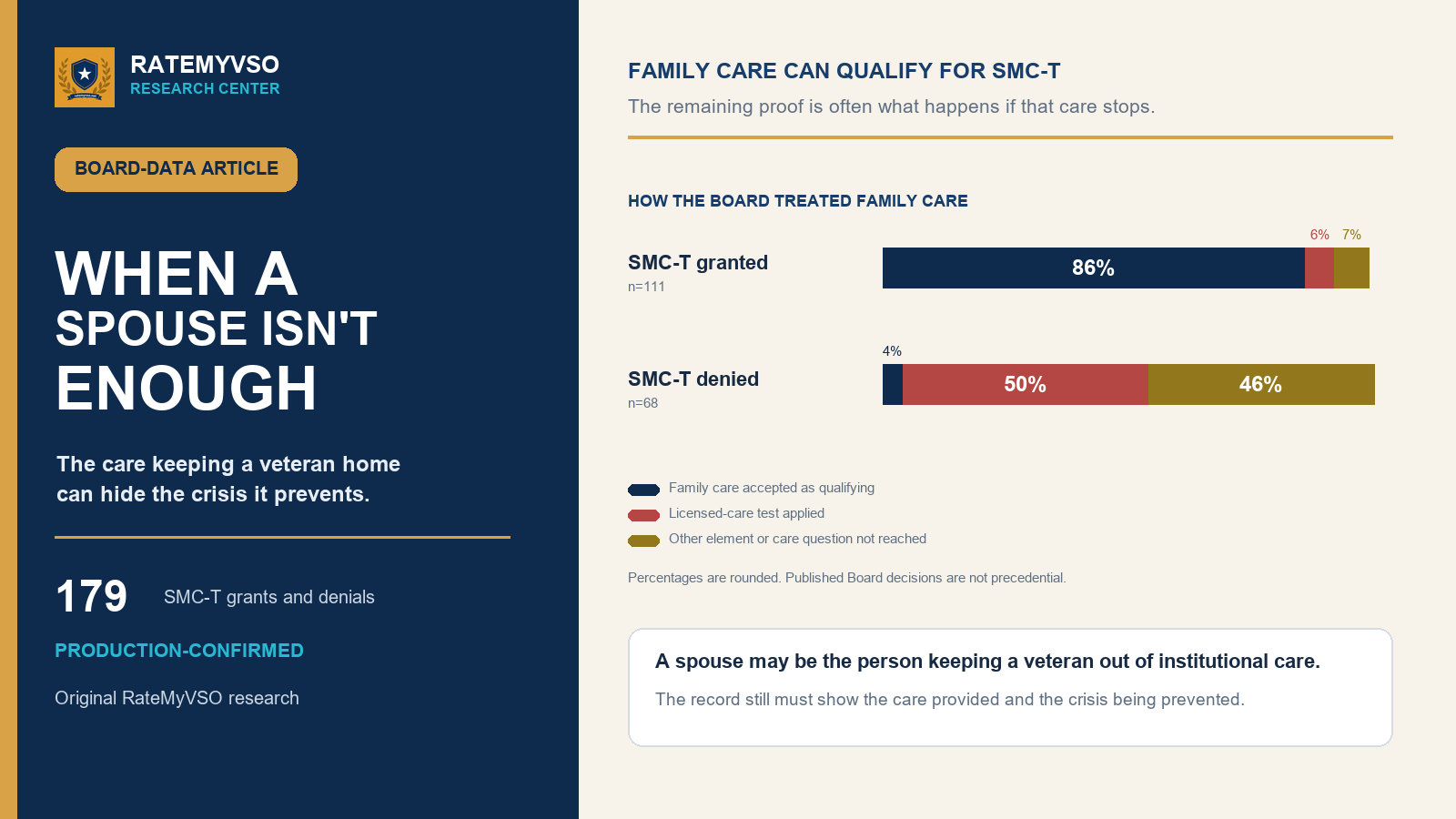
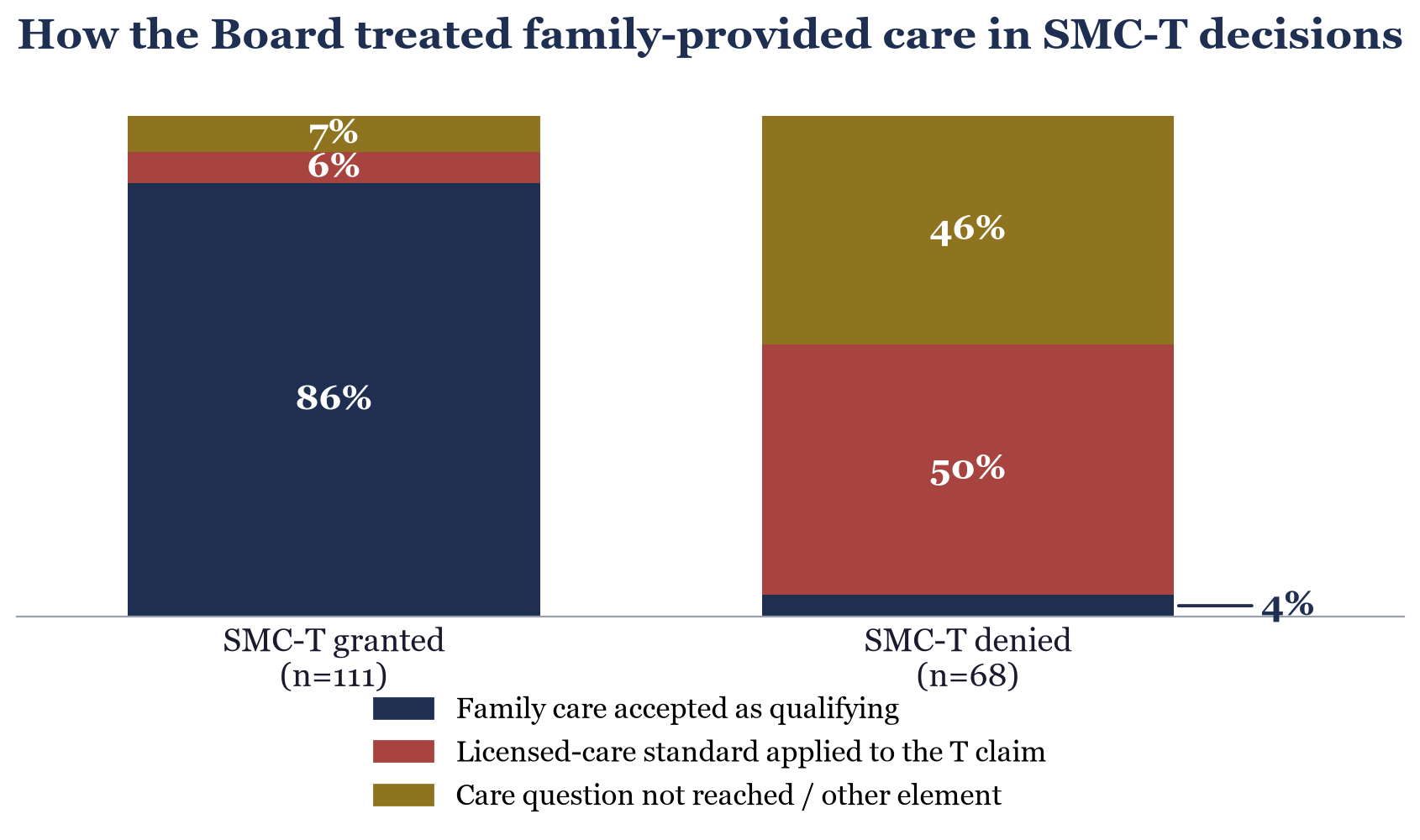
Donnelly was not an isolated example of the Board mixing these care standards. In the 111 SMC-T grants readable for this question, the Board accepted family care as capable of qualifying in 96, or 86 percent. In 68 denials, however, the Board applied the licensed-care standard to the SMC-T claim in 34, or 50 percent. Family care does not guarantee SMC-T; the veteran still must establish TBI-based aid and attendance and the institutional-care test. But family care cannot be rejected merely because the caregiver is not licensed.
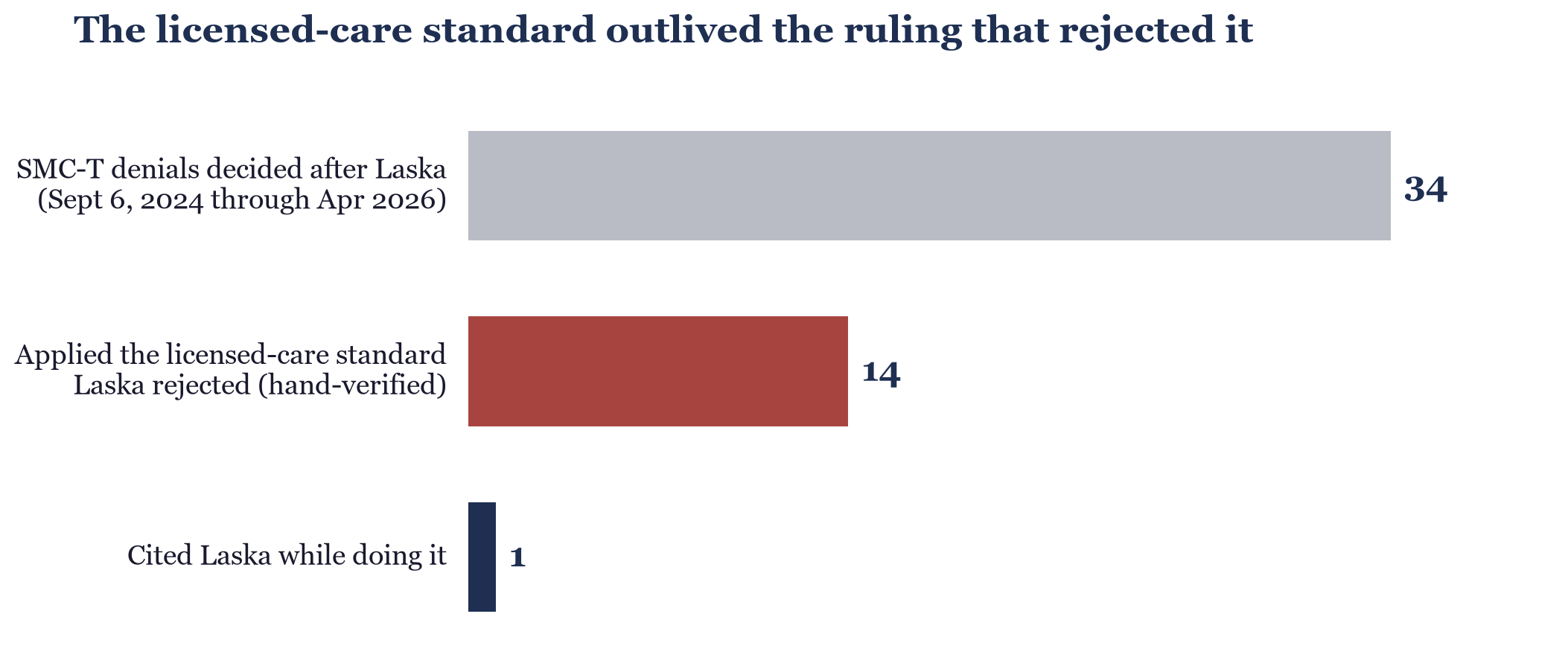
The timing is what makes Donnelly more than a historical footnote. Among 34 SMC-T denials decided after Laska, at least 14 still applied the licensed-care standard that Laska rejected. Only one of those 14 decisions cited Laska. The remaining 20 denials were not hand-verified for this question, so 14 is a floor, not necessarily the full count.
Why the same problem matters under SMC-R2
SMC-R2 reaches the same care question through a different entrance. A veteran must first meet the ordinary R-level gateway. After that, regular aid and attendance supports R1. R2 requires the higher level of daily health care and proof that hospitalization, nursing-home care, or other residential care would otherwise be required.
A spouse is not disqualified from providing higher-level care. But for R2, the spouse generally must be a licensed health-care professional or must carry out prescribed personal health-care services under regular supervision from one. The regulation describes that supervision as following a professional care regimen with consultation at least once each month. SMC-T shares the institutional-care question, but not R2's licensed or professionally supervised care requirement.
Knope shows the R2 version of the same dispute. That veteran had reached the required SMC-N-Half plus SMC-K gateway and was granted SMC-R1. His wife helped with balance, meals, medication, and hygiene. Private examiners said he would likely need a nursing home or home health aide without her. The Board nevertheless denied R2 because other records showed substantial independence and did not establish daily licensed or professionally supervised health care.
Martz Ames shows what can happen when that medical question has not been properly answered. The Board sent the R2 issue back for a physician to determine whether the veteran actually needed higher-level care. The spouse's account mattered, but the regulation required a medical determination directed at the care standard itself.
What the larger R2 record shows
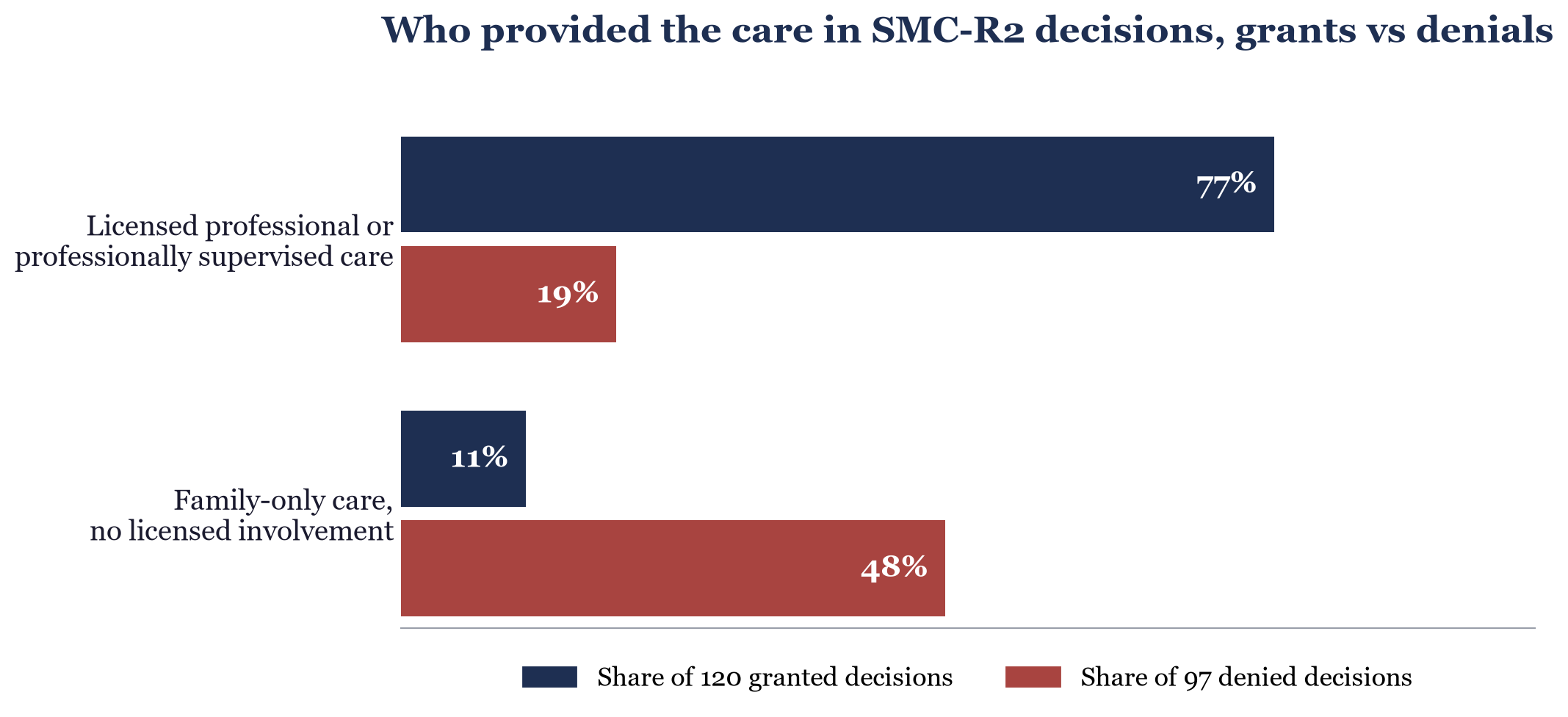
The larger R2 record shows why professional direction matters on that route. Licensed or professionally supervised care appeared in 77 percent of 120 R2 grants, compared with 19 percent of 97 denials. Family-only care appeared in 11 percent of grants but 48 percent of denials. Those percentages are not an odds calculator. They show the evidence pattern that separated the published records the Board was deciding.
The shortest possible map
| Term | What it meant in this story |
|---|---|
| SMC-M-Half | The veteran's base SMC rate after separate disabilities moved him above SMC-L. It was not the doorway to SMC-R2. |
| SMC-R1 | An additional regular aid-and-attendance allowance after the veteran first reaches the required R-level gateway. |
| SMC-R2 | The higher allowance after that same gateway when daily higher-level health care and the institutional-care test are met. |
| SMC-T | A separate TBI route that bypasses the ordinary R-level gateway and pays at the R2 level. It requires TBI-based regular aid and attendance and proof that institutional care would otherwise be necessary, but it does not require licensed or professionally supervised higher-level care. |
The spouse-care catch-22
The veteran's wife was doing the work that kept him at home. She monitored him around the clock, helped him shower, prepared his meals, drove him, and managed his medication. The argument was simple: without her, he would need nursing-home care.
The Board treated what she provided as regular aid and attendance rather than professionally directed higher-level health care. That distinction controls R2, but not SMC-T after Laska. For SMC-T, the remaining questions were whether his regular need for her help came from his service-connected TBI and whether he would require institutional care without it.
The routes are different. R2 requires the veteran to reach the ordinary R-level gateway, need licensed or professionally supervised higher-level care, and face institutional care without it. SMC-T instead requires regular aid and attendance because of service-connected TBI residuals and the need for institutional care without that help. The critical evidence they share is what the spouse actually does and what would happen if that care stopped.
That is the bind exposed by this case. A spouse may be the only person keeping a veteran out of a nursing home. For R2, the record must document the medical nature and professional direction of that care. For SMC-T, it must show that the regular help is needed because of service-connected TBI and that institutional care would be required without it. In either route, the wife's full-time work can hide the crisis she is preventing.
What the record must make visible
These decisions repeatedly turn on details that are easy to lose in a general statement that a spouse provides full-time care. For R2, the record must show the exact personal health-care services, how often they are needed, which require medical training or a prescribed regimen, and who supervises that regimen. For SMC-T, it must show which needs come from the service-connected TBI, what regular help the spouse supplies, and why institutional care would be required without that help. In both, the record must address entries that make the veteran look more independent because the spouse is already preventing the crises those records never capture.
Reiss discussed another way a veteran might reach a higher basic SMC rate through qualifying loss of use. That is a separate path, not a care level between M-Half and R2. It helps explain why other SMC letters appear in these decisions, but it does not change the central question in this story: what kind of care was the spouse actually providing, and what would happen if she stopped?
The cases behind this piece
| Decision | Date | What it shows |
|---|---|---|
| Donnelly, A25072861 | Aug. 28, 2025 | The central story: SMC-M-Half granted; SMC-T denied after the Board used an R2-like professional-care analysis and separately found that institutional care was not established. |
| Knope, A26039775 | Apr. 28, 2026 | SMC-R1 granted, but SMC-R2 denied after the Board rejected the claimed need for institutional care without the spouse. |
| Martz Ames, A25037222 | Apr. 23, 2025 | SMC-R2 remanded so a physician could address whether higher-level care was needed. |
| Reiss, 25009598 | Jul. 24, 2025 | Loss of use as a separate possible route to a higher base SMC rate, not a care step between M-Half and R2. |
A note on method and confidence
Donnelly is the central case in this article. Knope and Martz Ames show how the spouse-care and institutional-care questions arise under SMC-R2. Reiss supplies background on a separate loss-of-use route to a higher basic SMC rate. Laska v. McDonough is a precedential Veterans Court decision holding that SMC-T requires regular aid and attendance, not R2's licensed higher-level-care standard. Donnelly was issued after Laska, did not mention it, and still applied the professional-care test before separately finding that institutional care had not been established. The Board decisions are fact-specific and do not create binding rules for other veterans.
The wider charts use every production-confirmed published Board ruling in the RateMyVSO corpus that was granted or denied at SMC-R2 or SMC-T and produced a usable extraction for the measure shown. The R2 chart includes 120 grants and 97 denials. The SMC-T care-standard chart includes 111 grants and 68 denials. The 14 post-Laska decisions were verified against the full decision text. These decisions are fact-specific and do not create binding rules for other veterans. The percentages describe the published Board record; they do not predict the outcome of another claim.