Cardiovascular Conditions Rating Guide
Heart and blood-vessel conditions share one framework under 38 CFR § 4.104. Most heart conditions are scored by how much physical exertion you can do before symptoms start, measured in a unit called METs. A weak heart, a bad valve, and coronary artery disease are read through the same handful of rules. Learn that metric once and you understand how your rating is set. This guide explains the shared rules, then points you to the detailed guide for your specific condition.

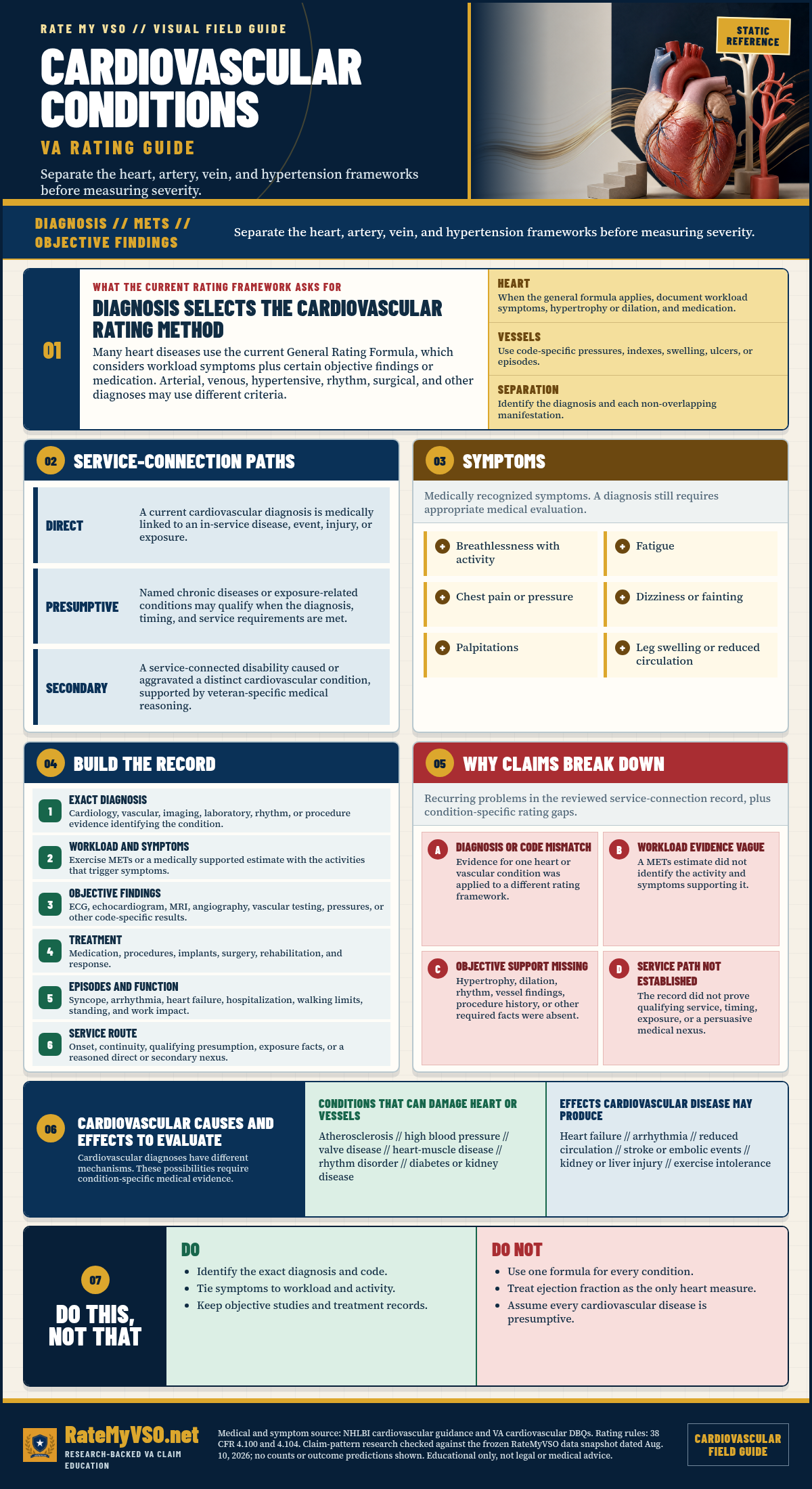 One-page guide: Cardiovascular Conditions Rating Guide in One Page
Cardiovascular-system guide separating heart, artery, vein, rhythm, hypertension, and other rating methods, with symptoms, METs and objective evidence, service paths, and common claim gaps. Opens the full-size chart, free to save or print.
One-page guide: Cardiovascular Conditions Rating Guide in One Page
Cardiovascular-system guide separating heart, artery, vein, rhythm, hypertension, and other rating methods, with symptoms, METs and objective evidence, service paths, and common claim gaps. Opens the full-size chart, free to save or print.
The Rules That Decide Every Cardiovascular Claim
Most heart codes are rated on workload: how much physical exertion you can do before heart symptoms begin. That workload is measured in METs, and two other measures sit alongside it. Learn these rules once and they apply across almost every heart condition in the schedule.
1. Most heart conditions are rated on workload in METs
METs stands for metabolic equivalents, the level of exertion at which shortness of breath, fatigue, chest pain (angina), dizziness, or fainting begins. Light activity like walking slowly is a low number of METs; harder activity like climbing stairs quickly or heavy yard work is a higher number. The lower the METs level at which symptoms start, the higher the rating. A heart that produces symptoms with very little exertion is rated far higher than one that only struggles under heavy exertion.
2. Two alternate paths sit beside METs; ejection fraction is not one of them
The current general formula has two alternate paths at the lower levels: cardiac hypertrophy or dilatation confirmed by qualifying imaging supports 30 percent, and the need for continuous medication supports 10 percent. The heart's ejection fraction is clinically useful evidence of how the heart is doing, but it is not a percentage level in the current general formula; the old ejection-fraction and congestive-heart-failure-episode thresholds belong to the pre-November 14, 2021 schedule.
3. When exercise testing is not safe, a METs estimate is allowed (38 CFR 4.100)
Some veterans cannot safely complete an exercise stress test because of the severity of their heart condition or another medical reason. When that is the case, 38 CFR § 4.100 allows the examiner to record a medically-supported estimate of the METs level instead. A test that could not be done safely is not a reason to deny or lower a rating.
4. Hypertension is the exception, rated on blood-pressure readings
Hypertension (high blood pressure, DC 7101) is not rated on METs. It is rated on your diastolic and systolic pressure readings, the two numbers in a blood-pressure measurement. Because a single reading can be misleading, the rating requires blood pressure confirmed by readings on multiple days, not one measurement taken at a single visit.
5. Ischemic heart disease and hypertension are herbicide presumptives
Ischemic heart disease (reduced blood flow to the heart, which includes coronary artery disease) is on the VA's list of conditions presumptively linked to herbicide exposure, and hypertension is now on that list as well. Veterans with qualifying Agent Orange or other herbicide exposure do not have to prove the medical link for those specific conditions. The presumption covers the listed conditions only, not all heart disease. See the Agent Orange presumptive list and the PACT Act guide.
Choose the Cardiovascular Rating Lane Before Reading the METs
For most diseases of the heart, the current general formula asks at what workload heart-failure symptoms begin. It does not use the old ejection-fraction and congestive-heart-failure episode thresholds that appeared in the pre-November 14, 2021 schedule.
| Evidence | How the current formula uses it |
|---|---|
| Symptom-limited METs | Main 100/60/30/10 path for most heart diseases |
| Cardiac hypertrophy or dilatation | Alternate path to 30 percent when confirmed by qualifying imaging |
| Continuous medication | Alternate path to 10 percent |
| Ejection fraction | Clinically useful, but not a percentage level in the current general formula |
| Exercise test contraindicated | A medical examiner may estimate METs using specific activities that produce symptoms |
The general formula is only one lane. Identify which lane the diagnosis is in before reading any single number:
| Rating lane | What controls | Records that show it |
|---|---|---|
| General heart formula | What controlsSymptom-limited METs, qualifying hypertrophy or dilatation, and continuous medication | Records that show itExercise METs test when appropriate, medically supported interview estimate when testing is contraindicated, imaging, medication history |
| Hypertension | What controlsConfirmed blood-pressure history and the treatment or pressure findings named by DC 7101 | Records that show itSerial blood-pressure readings, diagnosis and medication history, clinician records |
| Arrhythmia | What controlsType, documented episodes or interventions, and device status under the exact code | Records that show itElectrocardiogram, Holter or event monitor, electrophysiology and cardioversion or ablation records, implanted-device record |
| Arterial or vascular disease | What controlsThe code-specific circulation, pressure, ischemia, aneurysm, or functional findings | Records that show itVascular testing, imaging, examination, treatment and procedure history |
| Procedure, device, infection, or transplant | What controlsActive state, admission or discharge date, device status, mandatory examination, and later residuals | Records that show itHospital and operative record, device card and follow-up, treatment-end date, post-treatment examination |
Not every cardiovascular code uses the general formula. Hypertension, arrhythmias, vascular disease, aneurysms, and some surgery and transplant periods have their own criteria; the code atlas below shows the exact code. And one heart condition is rated somewhere else entirely: 38 CFR § 4.104 directs VA to evaluate cor pulmonale, right-heart disease caused by lung disease, as part of the pulmonary condition that causes it, not as a separate secondary heart claim.
Heart Events, Devices, and Procedures Can Change the Rating Over Time
Several cardiovascular codes assign a total evaluation for a set period after an event or procedure, then move to a different question. The dates are what drive those transitions.
| Event or treatment | Current schedule transition to explain |
|---|---|
| Myocardial infarction | Current schedule transition to explainTotal evaluation during and for three months after the infarction, then the general formula |
| Pacemaker implantation | Current schedule transition to explainTotal evaluation for one month following hospital discharge, then the applicable formula or code |
| Implanted defibrillator | Current schedule transition to explainThe ventricular-arrhythmia code provides a total evaluation while an automatic implantable cardioverter-defibrillator is in place |
| Heart-valve replacement | Current schedule transition to explainTotal evaluation through the specified post-admission period, a mandatory examination after discharge, then residual evaluation |
| Coronary bypass surgery | Current schedule transition to explainTotal evaluation for the code's post-admission period, then the general formula |
| Heart transplant | Current schedule transition to explainTotal evaluation for at least one year, a mandatory examination, then residual evaluation with the code's minimum |
The date that matters may be admission, discharge, implantation, treatment end, or the scheduled post-treatment examination, depending on the code. The operative report and the follow-up timeline can therefore be as important as the diagnosis label.
Not Every Heart Condition Uses the Same Service-Connection Route
Presumptions in this body system attach to named diseases, not to the cardiovascular system as a whole.
- Herbicide presumption: ischemic heart disease and hypertension are on VA's herbicide-presumptive lists when the exposure and service requirements are met. Ischemic heart disease does not include hypertension, peripheral vascular disease, stroke, or every other heart diagnosis.
- Chronic-disease presumption: listed cardiovascular-renal diseases may qualify when the requirements, including the applicable manifestation period, are met (see 38 CFR § 3.307 and § 3.309).
- Direct: a current disease, an in-service disease, injury, or exposure, and a competent medical connection between them.
- Secondary or aggravated: a current cardiovascular disability caused or aggravated by a service-connected disability or its treatment, with the required medical link and, for aggravation, the applicable baseline analysis.
- Condition-specific rule: some former-prisoner-of-war, exposure, and treatment relationships use narrower rules. One presumption does not generalize to the whole cardiovascular system.
Find the Guide for Your Condition
The rules above apply across the board. For the exact rating table, the C&P exam, and the Board data for your specific condition, open the dedicated guide:
| Area | Guide | DC codes |
|---|---|---|
| Coronary artery disease | Coronary Artery Disease Guide | 7005 |
| Hypertension | Hypertension Guide | 7101 |
| Cold injury residuals | Cold Injury Guide | 7122 |
For any code not listed, including arrhythmias, valve conditions, and vascular disease, open its condition lookup page for the rating levels and Board data.
Every Cardiovascular Diagnostic Code, With Board Outcomes
Every diagnostic code in this body system, ordered by how often it reaches the Board of Veterans' Appeals. Percentages are the share of each code's Board issues granted, denied, or remanded (sent back for more development); dismissed and other outcomes are not shown, so rows do not sum to 100%. Each code links to its full page: rating criteria, evidence notes, and secondary-condition data.
Show 12 more codes with too few Board appeals to report (expand)
| DC | Condition | Board appeals | Granted | Denied | Remanded |
|---|---|---|---|---|---|
| 7001 | Endocarditis, or | Too few Board appeals to report | |||
| 7003 | Pericardial adhesions | Too few Board appeals to report | |||
| 7004 | Syphilitic heart disease | Too few Board appeals to report | |||
| 7008 | Hyperthyroid heart disease | Too few Board appeals to report | |||
| 7016 | Heart valve replacement (prosthesis) | Too few Board appeals to report | |||
| 7019 | Cardiac transplantation | Too few Board appeals to report | |||
| 7112 | Aneurysm, any small artery | Too few Board appeals to report | |||
| 7113 | Arteriovenous fistula, traumatic | Too few Board appeals to report | |||
| 7115 | Thrombo-angiitis obliterans (Buerger's Disease) | Too few Board appeals to report | |||
| 7119 | Erythromelalgia | Too few Board appeals to report | |||
| 7123 | Soft tissue sarcoma (of vascular origin) | Too few Board appeals to report | |||
| 7124 | Raynaud's disease (also known as primary Raynaud's) | Too few Board appeals to report | |||
Counts from RateMyVSO's index of published BVA decisions, refreshed weekly. A remand is not a loss; it means the Board needed more evidence before deciding. Descriptive of the published record, not a prediction for any claim.
Common Secondary Conditions
Heart and vascular conditions are closely tied to other service-connected conditions, both as a cause and as a result. These are common secondary-claim pairings:
- Heart disease alongside diabetes or hypertension. Heart disease may be considered secondary to service-connected diabetes or high blood pressure when competent evidence establishes causation or aggravation in the individual record. Two diagnoses in the same file do not establish that link by themselves.
- Hypertension alongside other conditions. High blood pressure may be considered secondary to a service-connected condition such as sleep apnea, kidney disease, or PTSD when competent evidence establishes causation or aggravation in the individual record.
- The ischemic-heart-disease presumptive. For veterans with qualifying herbicide exposure, ischemic heart disease is presumptively service-connected, a direct path rather than a secondary one.
- Mental health after a cardiac event. Depression or anxiety following a heart attack or living with chronic heart disease can be claimed as secondary to the physical condition.
See secondary conditions for how these links are established.
Records That Show What the Schedule Measures
What the file needs depends on the lane, and the dates matter as much as the findings:
- Exact diagnosis and code lane: the specific cardiovascular diagnosis, so it is clear whether the general formula, a hypertension code, an arrhythmia code, a vascular code, or a procedure code applies.
- Symptom-limited METs: an exercise test reporting the exertion level at which heart symptoms begin, or a medically supported interview estimate with the specific activities that produce symptoms when testing is contraindicated.
- Imaging for hypertrophy or dilatation: an echocardiogram, multigated acquisition scan, or MRI, which is the alternate path to 30 percent. Ejection fraction remains useful clinical information but is not a rating threshold in the current general formula.
- Rhythm and pressure records: electrocardiogram, Holter or event monitoring, ablation or cardioversion records for an arrhythmia, and serial blood-pressure readings where hypertension is claimed, since a single reading does not establish it.
- Medication and procedure history: continuous medication as the alternate path to 10 percent, plus operative reports, device records, and the admission, discharge, and treatment-end dates that move a claim between rating states.
- Ordinary functional impact: stairs, walking distance, carrying, sleep, and work limits described in everyday terms.
The matching DBQ prompts an examiner to capture the METs level, the imaging, and the medication history in the schedule's own terms.
Evidence Cited in Published Coronary artery disease Decisions
We analyzed 42,431 published Board decisions involving coronary artery disease for condition-specific evidence, counting only case-specific mentions (boilerplate recitations excluded). "Favorable" is the share of decisions citing that evidence where every issue was granted or the outcome was mixed; the baseline across all these decisions is 43.7%, combining every diagnostic code below. Evidence appearing in a decision does not mean it decided the case. Descriptive of the published record, not a prediction.
Bar length shows decisions citing the evidence.
By diagnostic code
These codes are grouped together above. They do not perform the same, so find your own code here rather than reading the combined figure. A code retired in the schedule rewrites appears without a link, because its decisions were judged under criteria that no longer apply.
Bar length shows published decisions reviewed.
Evidence Cited in Published Hypertension Decisions
We analyzed 72,000 published Board decisions involving hypertension for condition-specific evidence, counting only case-specific mentions (boilerplate recitations excluded). "Favorable" is the share of decisions citing that evidence where every issue was granted or the outcome was mixed; the baseline across all these decisions is 59%. Evidence appearing in a decision does not mean it decided the case. Descriptive of the published record, not a prediction.
Bar length shows decisions citing the evidence.
Evidence Cited in Published Peripheral vascular disease Decisions
We analyzed 19,044 published Board decisions involving peripheral vascular disease for condition-specific evidence, counting only case-specific mentions (boilerplate recitations excluded). "Favorable" is the share of decisions citing that evidence where every issue was granted or the outcome was mixed; the baseline across all these decisions is 58%, combining every diagnostic code below. Evidence appearing in a decision does not mean it decided the case. Descriptive of the published record, not a prediction.
Bar length shows decisions citing the evidence.
By diagnostic code
These codes are grouped together above. They do not perform the same, so find your own code here rather than reading the combined figure. A code retired in the schedule rewrites appears without a link, because its decisions were judged under criteria that no longer apply.
Bar length shows published decisions reviewed.
Detected by phrase-reading the decision text with condition-specific vocabularies. Source: Board of Veterans' Appeals decisions, RateMyVSO analysis.
Symptoms Recorded in Granted Coronary artery disease Decisions
We analyzed 3,006 granted Board decisions involving coronary artery disease for symptoms named in sentences about the condition (rating-criteria recitations excluded). Descriptive of the published record, what the Board wrote down, not a checklist of what to report.
Bar length shows decisions. Percentages remain context.
Symptoms Recorded in Granted Peripheral vascular disease Decisions
We analyzed 1,834 granted Board decisions involving peripheral vascular disease for symptoms named in sentences about the condition (rating-criteria recitations excluded). Descriptive of the published record, what the Board wrote down, not a checklist of what to report.
Bar length shows decisions. Percentages remain context.
Detected by phrase-reading the decision text with condition-specific vocabularies. Source: Board of Veterans' Appeals decisions, RateMyVSO analysis.
Common Mistakes
- No stress test or METs estimate in the file. When the METs level is missing, the primary metric for the rating is missing. If a stress test could not be done safely, ask for a documented estimate under 38 CFR 4.100.
- Relying on a single blood-pressure reading. Hypertension needs readings confirmed on multiple days. One measurement is not enough to establish or raise the rating.
- Missing the Agent Orange presumptive. Ischemic heart disease is presumptively service-connected for veterans with qualifying herbicide exposure. Do not try to prove a link the presumption already provides.
- Not connecting heart disease to service-connected diabetes. Diabetes damages the heart. Heart disease that follows a service-connected diabetes diagnosis is a common secondary claim that is easy to overlook.
Frequently Asked Questions
How does the VA rate heart conditions?
What are METs?
How is high blood pressure rated?
Is every heart condition presumptive after herbicide exposure?
What changes after a pacemaker, bypass, valve procedure, or transplant?
Does ejection fraction still set the general heart percentage?
Related Tools and Guides
Sources: 38 CFR 4.104, cardiovascular ratings. Educational only, not legal advice, and not a prediction of any individual claim. Rating criteria and case law change; confirm current details in 38 CFR Part 4. For help with your claim, find a VA-accredited representative.