VA Dental and Oral Claims Guide
Dental claims work differently from every other body system. For most tooth and gum problems, the VA offers treatment, not a disability rating. The rating schedule for dental and oral conditions, 38 CFR § 4.150, pays compensation only for a narrow set of structural jaw and mouth problems: jaw bone loss, nonunion of the jaw, limited jaw motion, and bone infection. Knowing which path your condition falls into, treatment or compensation, before you file will save you a denial. This guide explains that difference, then walks through how service connection works, direct and secondary pathways (including through PTSD, anxiety, depression, and tinnitus), the evidence that wins, why claims get denied, the filing checklist, the claims process step by step, and what to do whether you win or you're denied.
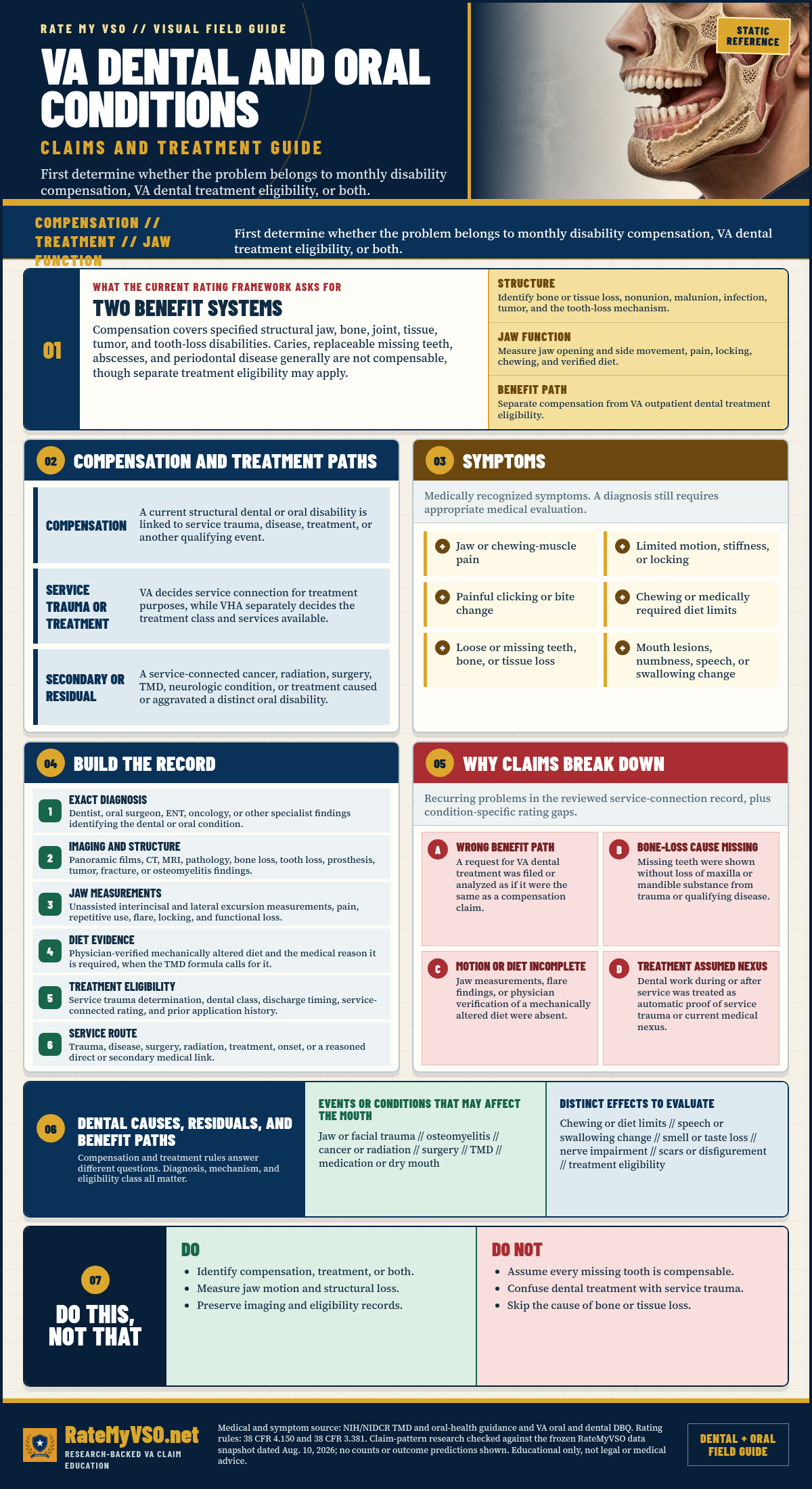 One-page guide: VA Dental and Oral Conditions Claims in One Page
Dental and oral guide separating compensation from VA treatment eligibility, with structural loss, jaw motion, mechanically altered diet, service trauma, symptoms, evidence, and common claim gaps. Opens the full-size chart, free to save or print.
One-page guide: VA Dental and Oral Conditions Claims in One Page
Dental and oral guide separating compensation from VA treatment eligibility, with structural loss, jaw motion, mechanically altered diet, service trauma, symptoms, evidence, and common claim gaps. Opens the full-size chart, free to save or print.
The Rules That Decide Every Dental and Oral Claim
The single most important thing to understand about dental claims is the split between treatment and compensation. Most dental conditions never get a disability rating at all; instead they qualify a veteran for VA dental care. A much smaller list of structural jaw and mouth problems is rated for compensation under 38 CFR § 4.150. These rules sort your condition into the right path.
1. Most dental conditions are not compensable
Ordinary tooth loss, cavities, and gum (periodontal) disease generally do not carry a disability rating. Instead, they can qualify a veteran for VA dental treatment under one of the dental eligibility classes. This is a real and valuable benefit, but it is a health-care benefit, not monthly compensation. Filing for a rating on these conditions usually ends in a denial because there is no rating to award.
2. Compensation is limited to specific structural problems
Under 38 CFR § 4.150, loss of teeth is compensable only when it is caused by loss of substance of the jawbone (the maxilla or the mandible) from trauma or disease, and where the bone loss cannot be corrected with a prosthesis. Teeth lost to gum disease or ordinary decay do not qualify. The distinction the VA draws is the cause: bone loss from injury or disease, not periodontal disease.
3. Loss or nonunion of part of the jaw is compensable
The jaw itself is rated. Nonunion or malunion of the mandible (a jaw that did not heal, or healed in the wrong position), and loss of part of the mandible, maxilla, hard palate, ramus, or condyloid process, each carry a rating under 4.150. The rating turns on how much bone is lost and whether the loss affects motion and function.
4. Jaw joint (TMJ) impairment is rated on limited motion
Temporomandibular (jaw joint, or TMJ) impairment, also called TMD, is rated on how much your jaw can move, measured by how far the mouth opens and how far it moves side to side. Less motion means a higher rating. Because the rating depends on those measurements, a TMJ claim needs an exam that actually records inter-incisal (open-mouth) range and lateral (side-to-side) range in millimeters. In the published decisions behind this guide, TMJ/TMD was by far the most common dental or oral condition claimed, more common than every other dental issue combined, including bruxism (teeth grinding) and jaw problems blamed on wisdom-tooth extraction.
5. Osteomyelitis and osteoradionecrosis of the jaw are compensable
Infection or radiation damage of the jawbone is rated. Osteomyelitis (bone infection) and osteoradionecrosis (bone death from radiation, often after radiation therapy for a head or neck cancer) of the mandible or maxilla each carry a rating under 4.150. These are structural bone conditions, the kind the dental schedule is built to compensate.
Find the Guide for Your Condition
This system does not have a dedicated per-condition guide yet. For dental care eligibility, use the dental benefits guide; for a specific jaw or TMJ rating, open the condition lookup:
| Area | Guide | DC codes |
|---|---|---|
| VA dental care eligibility | VA Dental Benefits Guide | treatment |
| Jaw and TMJ conditions | Condition Lookup | 9900-9916 |
For a specific jaw or oral condition, open its condition lookup page for the rating levels and Board data, for example DC 9905 (TMJ/TMD) or DC 9913 (tooth loss from jaw bone loss).
ICD-10 Diagnosis Codes
The ICD-10 diagnosis codes most commonly used for DC 9905, Temporomandibular disorder (TMD) (the kind on your medical records, decision letter, or C&P exam report). VA rates the disability and its residuals, not the diagnosis itself, so coding can vary.
How Service Connection Works, At a High Level
Before the specific pathways below, here are the three things every jaw or oral service-connection claim ultimately has to show (38 CFR § 3.303). This is the same basic test that applies to any VA disability claim, just applied to this condition.
- A current diagnosis. A real, current jaw or oral disability, not pain alone. An exam that documents only a mild ache, with no loss of jaw motion and no functional impairment, does not establish a disability to service connect.
- An in-service event. An injury, disease, or documented complaint in service that could explain the condition, for example a blow to the jaw or head, a training injury, or dental treatment records noting jaw pain.
- A medical nexus. A qualified professional connecting the current condition to the in-service event, or to an already service-connected condition. Whether a jaw disorder was caused by service is treated as a medical question, so a veteran's own belief about the cause, without a supporting opinion, does not carry the claim.
Service Connection Pathways: Direct and Secondary
A jaw or oral condition is not a VA presumptive condition for any exposure category as of this writing. Service connection must be established through one of the following pathways.
Direct Service Connection
A veteran shows that the jaw or oral condition began during, or was caused by, an event in active military service. Direct wins have been anchored to a documented in-service head injury, a jaw injury from training equipment (such as a pugil stick) with a dislocation noted in service, and in-service dental records documenting jaw pain. Teeth or jaw damage documented in a service record, when the trauma itself is in the file, can also support a claim tied to that event. See our Service Connection Guide.
Secondary Service Connection (38 CFR § 3.310)
A veteran shows that the jaw or oral condition was caused or aggravated by a condition that is already service connected. This is a well-documented and often easier path than proving a direct in-service cause, because the mechanism connecting the underlying condition to jaw symptoms is one examiners can explain by citing the medical literature. See our Secondary Service Connection Guide.
Secondary to PTSD (DC 9411)
A jaw disorder, including TMJ pain and teeth grinding (bruxism), can be granted as aggravated by service-connected PTSD, when an examiner explains, citing supporting studies, that trauma and chronic stress trigger jaw clenching and grinding, including in veterans. See our PTSD Claims Guide.
Secondary to anxiety, depression, or an adjustment disorder
A jaw disorder with bruxism has been granted as secondary to a service-connected adjustment disorder with anxiety and depression, supported by both VA and private opinions. If you already have a service-connected mental health condition and also grind or clench your teeth, ask a provider whether the two are connected.
Secondary to tinnitus (DC 6260)
A jaw disorder (TMD) has been granted as caused by service-connected tinnitus, where an examiner explained that people with tinnitus have a higher rate of jaw disorders. This is a less obvious pathway worth raising with a provider if you have both conditions.
Secondary to a service-connected head injury
Jaw or TMJ problems that follow a service-connected head injury or facial trauma, including TBI (DC 8045), can be claimed as secondary to that injury. This is distinct from the direct pathway above: here, the head injury is already service connected and the jaw problem is argued as a downstream effect.
Osteoradionecrosis after cancer treatment
Bone death of the jaw from radiation given for a service-connected head or neck cancer can be claimed as secondary to that cancer. This is one of the structural bone conditions the dental compensation schedule is built to rate.
Service Connection by Aggravation
When a veteran had a documented pre-service jaw or dental condition that was significantly worsened beyond its natural progression by military service, aggravation-based service connection under 38 CFR § 3.306 is available.
What VA Looks For: Tests, Records, and Diagnostic Codes
Whether you're filing directly or as secondary to another condition, the record VA actually reviews centers on a small set of measurements and documents.
- Jaw motion measurements: for a temporomandibular joint (TMJ/TMD) claim, the interincisal range (how far the mouth opens, in millimeters) and the lateral excursion range (side-to-side movement), the two numbers the DC 9905 rating is built on.
- Diet documentation: whether a physician has recorded or verified a need for mechanically altered foods (soft, semi-solid, pureed, or full liquid), which raises the DC 9905 rating tier.
- Imaging: X-ray, panoramic, or CT imaging showing bone loss, nonunion, malunion, or fracture of the jaw, the objective evidence behind a DC 9913 tooth-loss claim or a mandible/maxilla claim.
- Service dental and treatment records: documentation of the original in-service trauma or complaint that anchors a direct claim.
- The DBQ: the Dental and Oral Conditions Disability Benefits Questionnaire, which prompts the examiner to capture the measurements and findings the rating depends on. See the DBQ Guide.
Evidence That Wins
- Dental and oral-surgery records, showing the diagnosis and the structural problem, not just a treatment history.
- Imaging of the jaw (X-ray, panoramic, or CT) showing bone loss, nonunion, or a fracture, the objective backbone of a 4.150 claim.
- A measurement of jaw motion for a TMJ claim, recording open-mouth (inter-incisal) and side-to-side (lateral) range in millimeters, plus physician verification of any soft, pureed, or liquid diet restriction.
- Service dental records showing the original trauma or the in-service event that caused the damage.
- The matching DBQ for the dental or oral condition, which prompts the examiner to capture the measurements and findings the rating depends on. See the DBQ guide.
- A nexus opinion that explains its reasoning. The opinions that have persuaded the Board didn't just give an answer, they explained why, often citing medical studies connecting the jaw disorder to PTSD, tinnitus, or another condition. A bare conclusion with no rationale carries little weight. See our Nexus Letters Guide.
- Private dentist letters and buddy or family statements. Private nexus opinions plus statements from people who witnessed the veteran's jaw problems since service can outweigh a negative VA opinion. Statements describing clicking, popping, or pain over the years support continuity of symptoms. See our Buddy & Lay Statements Guide.
- A note if a VA opinion ignored your history. A negative medical opinion built on a wrong or incomplete set of facts can be found to carry little weight. If an examiner overlooked private treatment records or your reported symptoms, say so in writing.
Evidence Cited in Published TMJ / TMD Decisions
We analyzed 6,655 published Board decisions involving tmj / tmd for condition-specific evidence, counting only case-specific mentions (boilerplate recitations excluded). "Favorable" is the share of decisions citing that evidence where every issue was granted or the outcome was mixed; the baseline across all these decisions is 56.6%. Evidence appearing in a decision does not mean it decided the case. Descriptive of the published record, not a prediction.
Bar length shows decisions citing the evidence.
Detected by phrase-reading the decision text with condition-specific vocabularies. Source: Board of Veterans' Appeals decisions, RateMyVSO analysis.
Why These Claims Get Denied
Beyond the general "no nexus" and "not compensable" reasons covered elsewhere in this guide, a few specific denial patterns show up often enough in published Board decisions to call out on their own.
- A diagnosis without any functional impact. Jaw pain by itself, without a diagnosed disability, loss of motion, or documented functional impairment, is not enough. An exam that finds only a mild ache, with no loss of jaw motion and no effect on eating or daily function, does not establish a current disability to service connect.
- The veteran's own belief about the cause, without a nexus opinion behind it. Whether a jaw disorder was caused by service is treated as a medical question a non-doctor cannot answer alone. A veteran's personal opinion linking the condition to service, without a supporting medical opinion, does not carry the claim, even when the in-service event and current pain are not in dispute.
- Ordinary dental problems claimed as if they were compensable. Cavities, gum (periodontal) disease, and simple tooth loss without documented jaw bone loss are not compensable no matter how severe. They can support VA dental treatment eligibility, but not a disability rating.
- No in-service record or event tied to the current condition. Without a documented in-service injury, complaint, or exposure, and without a nexus opinion bridging the gap between then and now, a jaw or oral claim is denied.
Rating Criteria Under DC 9905 (Jaw/TMJ) and DC 9913 (Tooth Loss)
Once a jaw or oral condition is service connected, the rating percentage depends on which structural problem is involved. The most commonly claimed condition, temporomandibular joint (TMJ/TMD) impairment, is rated under DC 9905, 38 CFR § 4.150, based on how far the mouth opens (interincisal range) and whether a physician has recorded or verified a need for a mechanically altered diet.
Common Mistakes
- Expecting a disability rating for ordinary tooth loss or gum disease. These are treatment eligibility, not compensation. Filing for a rating on them usually ends in a denial.
- Not measuring jaw motion for a TMJ claim. The rating turns on open-mouth and side-to-side range in millimeters. An exam that skips those measurements cannot support the claim.
- Not distinguishing the cause of tooth loss. Teeth lost to jawbone loss from trauma or disease can be compensable; teeth lost to periodontal disease are not. The cause decides the claim.
- Overlooking VA dental treatment eligibility. Even when there is no rating to award, you may still qualify for VA dental care. That is a separate benefit worth claiming on its own.
- Filing a separate claim for teeth grinding that's already part of your jaw rating. Bruxism reflected in a jaw (TMJ) rating cannot be rated a second time, rating the same symptom twice is prohibited pyramiding. Grinding is usually folded into the jaw disorder rating, not rated on its own.
- Giving inconsistent accounts of your symptoms or diet. Conflicting statements between separate claims, for example about how restricted your diet actually is, can cost you credibility and a higher rating.
- Waiting to file after symptoms worsen and expecting years of back pay. The effective date is generally the date you file, not the date your condition worsened. An earlier effective date is available only where the record clearly shows the worsening was factually ascertainable within the year before you filed.
Do's and Don'ts
A condensed version of everything above, in the order it actually matters when you sit down to build your file.
- Get a jaw motion measurement (interincisal and lateral excursion range) recorded at your exam.
- Get a nexus opinion that explains its reasoning and cites supporting literature, not a bare conclusion.
- Ask whether an already service-connected condition, PTSD, anxiety, depression, an adjustment disorder, or tinnitus, could be causing or worsening your jaw clenching or pain.
- Point VA to the exact service record documenting the in-service jaw or head injury.
- Collect private dentist letters and buddy or family statements describing clicking, popping, or pain since service.
- If a VA opinion overlooked your treatment history or your statements, say so in writing.
- Keep your diet and symptom descriptions consistent across every statement and exam.
- Get physician verification if you need a soft, pureed, or liquid diet, so it counts toward your rating.
- Don't assume jaw pain alone will win the claim, you need a diagnosed disability with documented functional impairment.
- Don't rely on your own opinion about what caused your jaw condition, causation for a jaw disorder is treated as a medical question.
- Don't expect compensation for ordinary cavities, gum disease, or simple tooth loss, those support dental treatment eligibility, not a rating.
- Don't file a separate claim for teeth grinding that's already part of your jaw disorder rating.
- Don't give inconsistent accounts of your diet or symptoms between claims.
- Don't wait to file after symptoms worsen, back pay generally starts at your filing date, not when the symptoms began.
Quick Checklist Before You File
Bring these together before you submit anything.
- A current diagnosis of your jaw or oral condition, noting how it limits eating, talking, or opening your mouth.
- The service record of the in-service event, a jaw or head injury, a dislocation, or documented jaw complaints.
- If you have a service-connected condition like PTSD, anxiety, depression, or tinnitus, ask a provider whether it caused or worsened your jaw problem.
- A medical or dental nexus opinion that explains its reasoning, ideally citing medical literature.
- Buddy or family statements describing jaw clicking, popping, grinding, or pain over the years.
- If a VA opinion got your facts wrong or ignored your history, note that in writing.
- For a higher rating, document your mouth-opening limits and any physician-verified soft, pureed, or liquid diet.
For the mechanics of actually submitting the claim, see the Standard Claim Guide and the Fully Developed Claim Guide (filing with all your evidence up front can speed up the decision).
The Claims Process, Step by Step
Once you file, your claim moves through a series of hand-offs. Understanding who does what helps you know who to contact, and what to expect, at each stage.
- You file the claim. Directly with VA, through VA.gov, or with the help of an accredited representative.
- VA acknowledges the claim and assigns it for development. A Veteran Service Representative (VSR) is assigned to gather your service treatment records, VA and private dental records, and any other evidence needed.
- The VSR orders a Compensation & Pension (C&P) exam if one is needed. Not every claim requires one, but most jaw and TMJ claims do, especially secondary claims where a nexus opinion is required.
- The C&P exam is conducted. By a VA clinician or a contracted examiner, who completes a Disability Benefits Questionnaire (DBQ) documenting the diagnosis, jaw motion measurements, and, where relevant, a nexus opinion.
- The file goes to a Rating Veteran Service Representative (RVSR), the "rater." The rater reviews the complete file, including the exam results, and decides whether service connection is warranted and at what percentage.
- A senior reviewer may review the decision before it's finalized, depending on the complexity of the claim.
- VA issues the decision letter. This states whether the claim is granted or denied, the rating percentage if granted, and the reasons behind the decision.
- If you disagree, you choose an appeal lane. Higher-Level Review, Supplemental Claim, or a Board appeal, covered later in this guide.
Who's who: VSO vs. VSR vs. Rater vs. C&P Examiner
Your VSO
An accredited representative from a veterans service organization, or an accredited attorney or claims agent. Not a VA employee. Helps you prepare, gather evidence, and file, and can represent you through an appeal. Has no authority to decide your claim.
VSR (Veteran Service Representative)
VA staff who "develops" your claim: requests records, schedules the C&P exam, and assembles the file. Does not decide the rating.
Rater (RVSR)
VA staff who reviews the completed file and makes the actual decision, service connection or denial, and the percentage. This is the person whose judgment the decision letter reflects.
C&P Examiner
A VA clinician or a contracted medical examiner who conducts the exam and completes the DBQ. Documents jaw motion findings and, where asked, a nexus opinion. Does not decide the claim.
For the full walkthrough of every stage with more detail, see Inside Your Claim and Claim Stages.
DBQs and Your C&P Exam
A Disability Benefits Questionnaire (DBQ) is the standardized form an examiner completes for your condition, it structures the exam findings into the specific data points VA's rating schedule requires (for a jaw or TMJ claim, that includes the interincisal and lateral excursion measurements and any diet restriction). See the DBQ Guide for how these forms work, including whether a private DBQ completed by your own dentist can be submitted instead of relying solely on a VA exam.
Before your C&P exam, bring a clear, specific account of your symptoms, focus on your worst days and how the condition affects eating and daily function, not just how you feel on an average day. Be consistent with what's already in your medical and dental records and prior statements. For a full walkthrough of what to expect and how to prepare, see the C&P Exam Prep Guide.
Reading Your Decision Letter, and What to Do If Denied
Your decision letter has two parts: a narrative section explaining the reasoning (often called "reasons and bases"), and a codesheet showing the actual rating percentage, the effective date, and the diagnostic code used. See the Reading Your Decision Letter Guide for how to find and interpret each part, or use the Letter Interpreter tool to upload your own letter and get a plain-English breakdown.
If your claim is denied, or the rating is lower than you expected, you have three main lanes:
- Supplemental Claim: refile with new and relevant evidence, such as a new nexus opinion or updated jaw motion measurements. See Supplemental Claim Guide.
- Higher-Level Review (HLR): a senior reviewer looks at the same evidence again for a difference of opinion, no new evidence is added. See HLR Guide.
- Board Appeal: your case goes to a Veterans Law Judge at the Board of Veterans' Appeals, with options for a direct review, an evidence docket, or a hearing. See Board Appeal Guide.
Not sure which lane fits your situation? See the Appeals decision guide for a side-by-side comparison of all three.
After You Win: Maintaining Your Rating
A grant is not always the end of the story. Keep your treatment consistent, continued follow-up with a dentist or oral surgeon, and imaging showing the current state of any jaw bone loss, protects you if VA schedules a future reexamination. Not every rating gets reexamined; understand when a rating becomes protected from future review and what to do if VA proposes to reduce it. See Protect Your Rating and Future Reexaminations for the specifics.
If your jaw condition worsens after the initial grant, for example your mouth opening narrows further or your diet becomes more restricted, you can file for an increased rating. Document the change with a new measurement and, if applicable, physician verification of the diet restriction. See the Rating Increase Guide.
Quick Reference Tables
DC 9905: Temporomandibular Disorder (Jaw/TMJ)
| Interincisal range | Diet restriction | Rating |
|---|---|---|
| 0 to 10 mm | All mechanically altered foods | 50% |
| 0 to 10 mm | None | 40% |
| 11 to 20 mm | Mechanically altered foods | 40% |
| 21 to 29 mm | Full liquid and pureed foods | 40% |
| 11 to 20 mm | None | 30% |
| 21 to 29 mm | Soft and semi-solid foods | 30% |
| 30 to 34 mm | Full liquid and pureed foods | 30% |
| 21 to 29 mm | None | 20% |
| 30 to 34 mm | Soft and semi-solid foods | 20% |
| 30 to 34 mm | None | 10% |
| Lateral excursion 0 to 4 mm | (rated on side-to-side motion instead) | 10% |
Ratings for limited interincisal (open-mouth) movement are not combined with ratings for limited lateral excursion. Normal unassisted vertical jaw opening, for VA compensation purposes, is 35 to 50 mm. A texture-modified diet must be recorded or verified by a physician to count toward a higher tier. Source: 38 CFR § 4.150, DC 9905.
DC 9913: Loss of Teeth Due to Loss of Jaw Bone (Not Replaceable by Prosthesis)
| Extent of tooth loss | Rating |
|---|---|
| Loss of all teeth | 40% |
| Loss of all upper teeth | 30% |
| Loss of all lower teeth | 30% |
| All upper and lower posterior teeth missing | 20% |
| All upper and lower anterior teeth missing | 20% |
| All upper anterior teeth missing | 10% |
| All lower anterior teeth missing | 10% |
| All upper and lower teeth on one side missing | 10% |
| Any of the above, where the lost chewing surface can be restored by a suitable prosthesis | 0% |
These ratings apply only to bone loss through trauma or disease, such as osteomyelitis, not to loss of the alveolar process (the tooth-socket ridge) from periodontal disease, which is not considered disabling. Source: 38 CFR § 4.150, DC 9913.
From Filing to Decision: Who Does What
| Role | Does | Decides your rating? |
|---|---|---|
| VSO / accredited representative | Helps prepare, gather evidence, and file; represents you on appeal | No |
| VSR | Develops the claim: orders records and the C&P exam | No |
| C&P Examiner | Conducts the exam, completes the DBQ, may give a nexus opinion | No / but has a strong impact |
| Rater (RVSR) | Reviews the full file and decides service connection and percentage | Yes |
Frequently Asked Questions
Is a dental condition compensable?
Which dental conditions do carry a rating?
How is TMJ (jaw joint) rated?
Can I get VA dental care?
Are jaw fracture residuals ratable?
Can a jaw condition be secondary to PTSD, anxiety, or tinnitus?
Is teeth grinding (bruxism) rated separately from a jaw condition?
Related Tools and Guides
Sources
- 38 CFR § 4.150, Dental and Oral Conditions (including DC 9905, Temporomandibular Disorder, and DC 9913, Loss of Teeth Due to Loss of Substance of the Body of the Maxilla or Mandible)
- 38 CFR § 3.303, basic rules for service connection, including continuity of symptoms
- 38 CFR § 3.310, Secondary Service Connection
- 38 CFR § 3.306, Aggravation of Pre-Service Disability
- 38 CFR § 3.381, which dental conditions may be service connected
- 38 CFR § 3.102 and 38 U.S.C. § 5107(b), benefit of the doubt when the evidence is roughly balanced
- 38 CFR § 4.14, rule against pyramiding (rating the same symptom twice)
- 38 CFR § 3.400, effective dates
- 38 U.S.C. §§ 1110 and 1131, basic service-connection authority