Genitourinary Conditions Rating Guide
Kidney, bladder, and reproductive conditions share one rating framework under 38 CFR § 4.115. Whatever the specific diagnosis, most codes point the rater at a shared set of dysfunction tables, renal function, urine leakage, urinary frequency, obstructed voiding, and infection, and the predominant area of dysfunction sets the rating. Learn that framework once and the rest falls into place. This guide explains the shared rules that decide every genitourinary rating, then points you to the detailed guide for your specific condition.
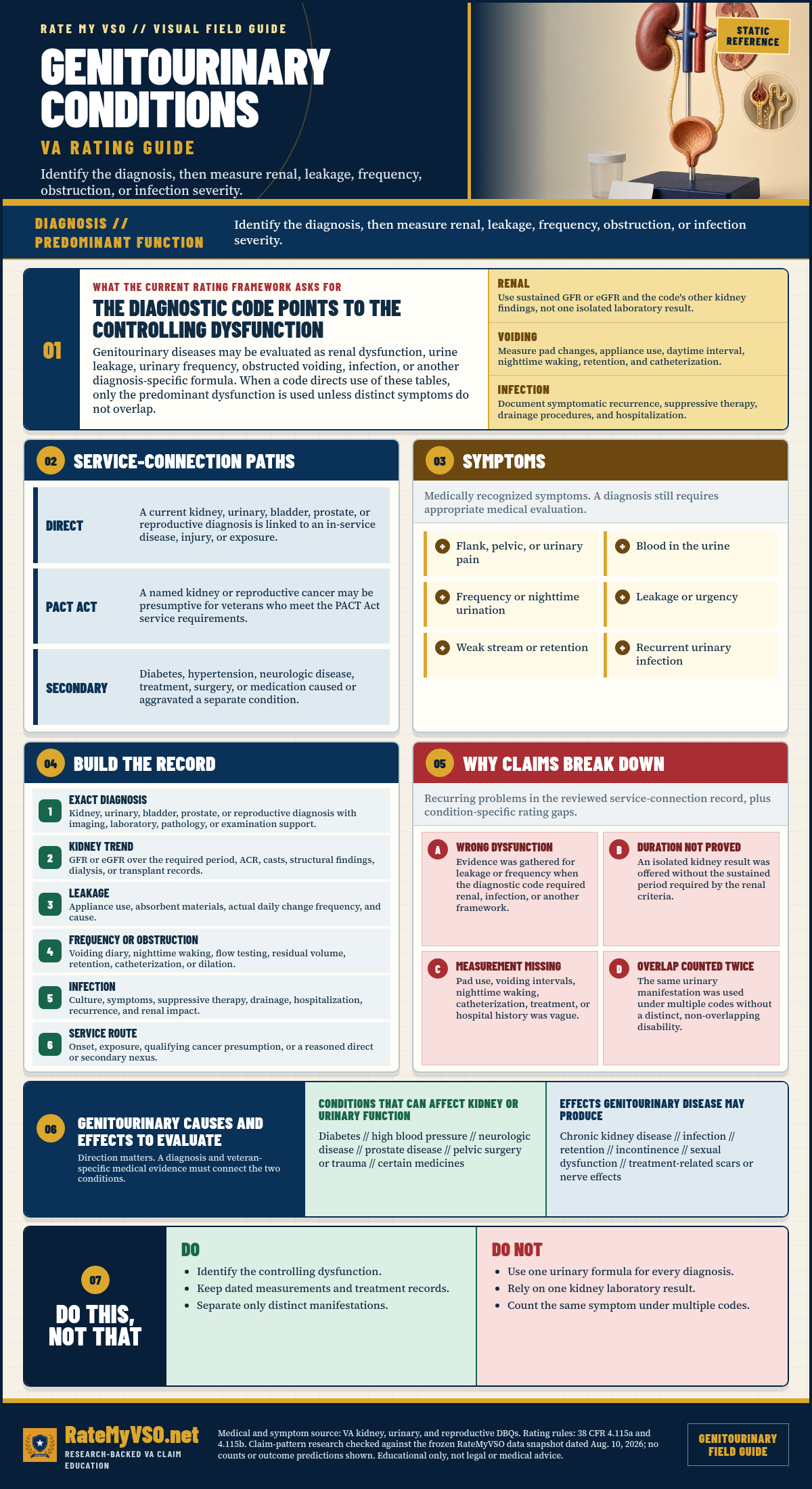 One-page guide: Genitourinary Conditions Rating Guide in One Page
Genitourinary-system guide separating renal, leakage, frequency, obstruction, infection, and diagnosis-specific rating methods, with symptoms, service paths, required measurements, evidence, and common claim gaps. Opens the full-size chart, free to save or print.
One-page guide: Genitourinary Conditions Rating Guide in One Page
Genitourinary-system guide separating renal, leakage, frequency, obstruction, infection, and diagnosis-specific rating methods, with symptoms, service paths, required measurements, evidence, and common claim gaps. Opens the full-size chart, free to save or print.
The Rules That Decide Every Genitourinary Claim
Genitourinary conditions cover a lot of ground, the kidneys, the bladder, and the reproductive organs, but they are scored by a small set of shared rules under 38 CFR § 4.115a and 4.115b. Understanding those rules tells you what the rating actually depends on and which numbers your evidence needs to capture.
1. The code points to the dysfunction tables, and the predominant area is rated
Many genitourinary diagnostic codes direct the rater to the shared dysfunction tables in 38 CFR § 4.115a: renal dysfunction, urine leakage, urinary frequency, obstructed voiding, and urinary tract infection. When a code does that, only the predominant area of dysfunction is rated; you do not rate several areas and add them together. It is not an automatic higher-of-two comparison. Distinct disabilities whose symptoms do not overlap can be evaluated separately under § 4.14. This one choice drives the majority of genitourinary ratings.
2. Voiding dysfunction is scored on the specific problem
If voiding dysfunction is the higher path, the rating turns on the specific type of problem:
- Urine leakage: scored on how often you must change absorbent pads or appliances, and whether an appliance is required.
- Urinary frequency: scored on how short the daytime interval between voidings is and how many times you wake at night to void.
- Obstructed voiding: scored on symptoms like a weak stream, retention, and whether catheterization or dilation is needed.
3. Renal dysfunction is scored on kidney filtration over time
Since November 14, 2021, the renal table is built mainly on the glomerular filtration rate (GFR or eGFR) sustained for at least three consecutive months during the past year. The 0-percent level covers specified findings such as a qualifying albumin/creatinine ratio, recurring casts in the urine, or structural kidney abnormalities; the 100-percent level covers GFR under 15, regular dialysis, or kidney-transplant eligibility. A clinician may use creatinine to calculate eGFR, but a raw BUN or creatinine value is no longer the rating table. The kidney numbers over time, not symptoms alone, set this rating.
4. Urinary tract infections are rated on how often they recur
A recurrent urinary tract infection is rated on its own scale that turns on how often the infection comes back and needs treatment, including whether it requires long-term drug therapy, drainage, or frequent hospitalization. This is a distinct path from the voiding-versus-renal choice above.
5. Loss of a reproductive organ can carry SMC
Loss or removal of a reproductive organ, and conditions such as erectile dysfunction, can carry special monthly compensation (SMC) for loss of use of a creative organ, paid on top of any schedular rating. A 0-percent schedular evaluation for erectile dysfunction or another creative-organ condition does not by itself answer the SMC question; entitlement to SMC-K is a separate determination, and it is separate money that is easy to miss.
Choose the Genitourinary Rating Lane and Record Its Measurements
Each of the five dysfunction tables reads a different record. Match the path to the evidence before the exam, so the file can show which area is predominant:
| Path | Evidence VA actually reads |
|---|---|
| Renal dysfunction | GFR/eGFR pattern sustained for three months; qualifying ACR, casts, or structural findings at the 0-percent level; dialysis or transplant eligibility at the highest level |
| Urine leakage | Appliance use and absorbent-material changes per day |
| Urinary frequency | Daytime voiding interval and nighttime awakenings |
| Obstructed voiding | Retention, catheterization, post-void residual, uroflowmetry, recurrent obstruction-related infection, or dilation history |
| Urinary tract infection | Hospitalizations, drainage, duration of suppressive therapy, and intensive management |
The diagnosis itself adds a second layer, because several conditions and states carry their own rating path on top of the dysfunction tables:
| Diagnosis or state | Rating path | Records that show it |
|---|---|---|
| Chronic kidney or renal disease | Rating pathGlomerular filtration rate sustained for the required period, plus the schedule's qualifying albumin, casts, structural findings, dialysis, or transplant facts | Records that show itLongitudinal renal labs, urine testing, nephrology records, dialysis or transplant status |
| Prostate or urinary residual | Rating pathPredominant voiding dysfunction, or the urinary-tract-infection path when the code directs it | Records that show itPad changes, daytime interval, nighttime waking, catheter or dilation history, infection treatment and hospitalization |
| Neurogenic bladder | Rating pathThe voiding, frequency, obstruction, or infection manifestations plus the neurologic diagnosis and the medical relationship | Records that show itUrology and neurologic examinations, testing, catheter and medication history, nexus evidence when claimed as secondary |
| Active genitourinary cancer | Rating pathActive malignancy or treatment, the treatment-end date, a mandatory examination, and later residuals | Records that show itPathology, oncology and operative records, treatment dates, follow-up examination |
| Kidney transplant | Rating pathTransplant admission, the one-year examination, and later residual renal dysfunction | Records that show itHospital record, transplant follow-up, immunosuppression and renal-function history |
| Erectile or creative-organ condition | Rating pathThe exact schedular code plus a separate review for special monthly compensation when applicable | Records that show itDiagnosis, anatomy and function findings, treatment history, the facts the SMC question turns on |
Condition detail: urinary conditions, erectile dysfunction, diabetes (a common cause of both renal and voiding problems), and SMC.
Cancer Treatment, Surgery, and Transplant Create Separate Rating States
A genitourinary cancer claim is not one rating question. It moves through states, and the record for each is different:
- Active malignancy or treatment: the applicable cancer code provides the active-treatment evaluation.
- Treatment ends: the code keeps the active evaluation through its specified period.
- Mandatory examination: VA evaluates whether the cancer remains active and identifies chronic residuals.
- Residual rating: with no recurrence or metastasis, VA rates the predominant renal or voiding dysfunction, or another distinct residual named by the code.
- Kidney transplant: the transplant code uses its own admission, examination, minimum, and residual rules.
A new, narrow cancer presumption
A presumption of exposure and service connection now covers urinary bladder cancer, including overlapping sites of the bladder, and ureter cancer, including the ureteric orifice and urachus, for covered veterans who meet its service-location and time requirements, subject to the regulation's exceptions (see 38 CFR § 3.320a). This is a cancer-specific rule. It does not make kidney disease, urinary frequency, prostate enlargement, erectile dysfunction, or every genitourinary condition presumptive.
Find the Guide for Your Condition
The rules above apply across the board. For the exact rating table, the C&P exam, and the Board data for your specific condition, open the dedicated guide:
| Area | Guide | DC codes |
|---|---|---|
| Urinary conditions (frequency, leakage) | Urinary Claims Guide | 7527, 7542 |
| Erectile dysfunction | Erectile Dysfunction Guide | 7522 |
| Genitourinary cancer | Cancer Claims Guide | 7528 |
For any code not listed, open its condition lookup page for the rating levels and Board data.
Every Genitourinary Diagnostic Code, With Board Outcomes
Every diagnostic code in this body system, ordered by how often it reaches the Board of Veterans' Appeals. Percentages are the share of each code's Board issues granted, denied, or remanded (sent back for more development); dismissed and other outcomes are not shown, so rows do not sum to 100%. Each code links to its full page: rating criteria, evidence notes, and secondary-condition data.
Show 12 more codes with too few Board appeals to report (expand)
Counts from RateMyVSO's index of published BVA decisions, refreshed weekly. A remand is not a loss; it means the Board needed more evidence before deciding. Descriptive of the published record, not a prediction for any claim.
Common Secondary Conditions
Genitourinary problems are often not the first injury. Many are caused by another service-connected condition, which makes them secondary claims:
- Erectile dysfunction as a secondary claim. Erectile dysfunction is frequently secondary to diabetes, a prostate condition, blood-pressure medication, or a service-connected mental-health condition, and it can carry the related SMC-K for loss of use of a creative organ.
- Kidney disease from diabetes or hypertension. Long-standing diabetes or high blood pressure can damage the kidneys over time, so kidney disease is a common secondary to either one.
- Urinary problems from a spine condition. A back or spine condition that affects the nerves controlling the bladder can produce urinary frequency, urgency, or retention as a secondary claim.
- Depression from chronic dysfunction. Long-term urinary or sexual dysfunction takes a mental toll, and depression can be claimed as secondary to the physical condition. See secondary conditions.
Records That Show What the Schedule Measures
Each path reads a different measurement, so the record is organized by path rather than by symptom:
- Renal: glomerular filtration rate documented over time, qualifying urine findings such as an albumin-to-creatinine ratio or casts, structural findings, and dialysis or transplant status and eligibility.
- Leakage: appliance use and the number of absorbent-material changes per day.
- Frequency: the daytime interval between voidings and the number of nighttime awakenings.
- Obstruction: retention, catheterization, post-void residual, flow testing, dilation history, and obstruction-related infection.
- Urinary tract infection: suppressive treatment, intensive management, drainage procedures, and hospitalization.
- Cancer or surgery: pathology, treatment dates, the operative report, the required follow-up examination, and the distinct residuals that remain.
Documentation of loss or loss of use of a creative organ supports the separate special monthly compensation question, and the matching DBQ prompts an examiner to capture these findings in the schedule's own terms.
Evidence Cited in Published Urinary conditions Decisions
We analyzed 19,440 published Board decisions involving urinary conditions for condition-specific evidence, counting only case-specific mentions (boilerplate recitations excluded). "Favorable" is the share of decisions citing that evidence where every issue was granted or the outcome was mixed; the baseline across all these decisions is 51.6%, combining every diagnostic code below. Evidence appearing in a decision does not mean it decided the case. Descriptive of the published record, not a prediction.
Bar length shows decisions citing the evidence.
By diagnostic code
These codes are grouped together above. They do not perform the same, so find your own code here rather than reading the combined figure. A code retired in the schedule rewrites appears without a link, because its decisions were judged under criteria that no longer apply.
Bar length shows published decisions reviewed.
Evidence Cited in Published Erectile dysfunction Decisions
We analyzed 25,602 published Board decisions involving erectile dysfunction for condition-specific evidence, counting only case-specific mentions (boilerplate recitations excluded). "Favorable" is the share of decisions citing that evidence where every issue was granted or the outcome was mixed; the baseline across all these decisions is 62.4%. Evidence appearing in a decision does not mean it decided the case. Descriptive of the published record, not a prediction.
Bar length shows decisions citing the evidence.
Detected by phrase-reading the decision text with condition-specific vocabularies. Source: Board of Veterans' Appeals decisions, RateMyVSO analysis.
Symptoms Recorded in Granted Urinary conditions Decisions
We analyzed 1,120 granted Board decisions involving urinary conditions for symptoms named in sentences about the condition (rating-criteria recitations excluded). Descriptive of the published record, what the Board wrote down, not a checklist of what to report.
Bar length shows decisions. Percentages remain context.
Detected by phrase-reading the decision text with condition-specific vocabularies. Source: Board of Veterans' Appeals decisions, RateMyVSO analysis.
Common Mistakes
- Trying to combine a voiding rating and a renal rating. The schedule pays only the higher of the two, not both added together. Documenting both sides lets the rater assign the higher one; it does not create two separate ratings.
- Not documenting pad changes or urinary frequency. These are the exact numbers the voiding-dysfunction rating is built on. Vague notes will not carry the rating; the counts will.
- Missing SMC-K. Erectile dysfunction and the loss or removal of a reproductive organ can carry special monthly compensation for loss of use of a creative organ. It is separate money that is often overlooked.
- Not connecting kidney disease to a service-connected cause. Kidney disease that developed from service-connected diabetes or hypertension is a secondary claim. Stopping at the primary condition leaves that connection unmade.
Frequently Asked Questions
How does the VA rate genitourinary conditions?
Does VA always choose whichever dysfunction table gives the higher number?
Does a raw creatinine value set the current renal rating?
Which genitourinary cancers are covered by the newer presumption?
Voiding dysfunction versus renal dysfunction, which one applies?
What is SMC-K?
Is erectile dysfunction ratable?
How are recurring UTIs rated?
Related Tools and Guides
Sources: 38 CFR 4.115b, genitourinary ratings. Educational only, not legal advice, and not a prediction of any individual claim. Rating criteria and case law change; confirm current details in 38 CFR Part 4. For help with your claim, find a VA-accredited representative.