VA Urinary and Bladder Claims Guide
The genitourinary (GU) system covers the kidneys, ureters, bladder, urethra, and male genital structures. The VA rates these conditions under a single governing rule at 38 CFR 4.115a, which divides all GU dysfunction into three pathways: renal dysfunction, voiding dysfunction, and urinary tract infection. Which pathway your rater uses determines both your maximum possible rating and what evidence actually matters. This guide explains all three pathways, the exact tier values, how the VA picks the predominant one, how to build evidence for each, how service connection works (directly and secondary to another condition), why these claims get denied, a checklist before you file, the claims process step by step, and what to do whether you're denied or you win.
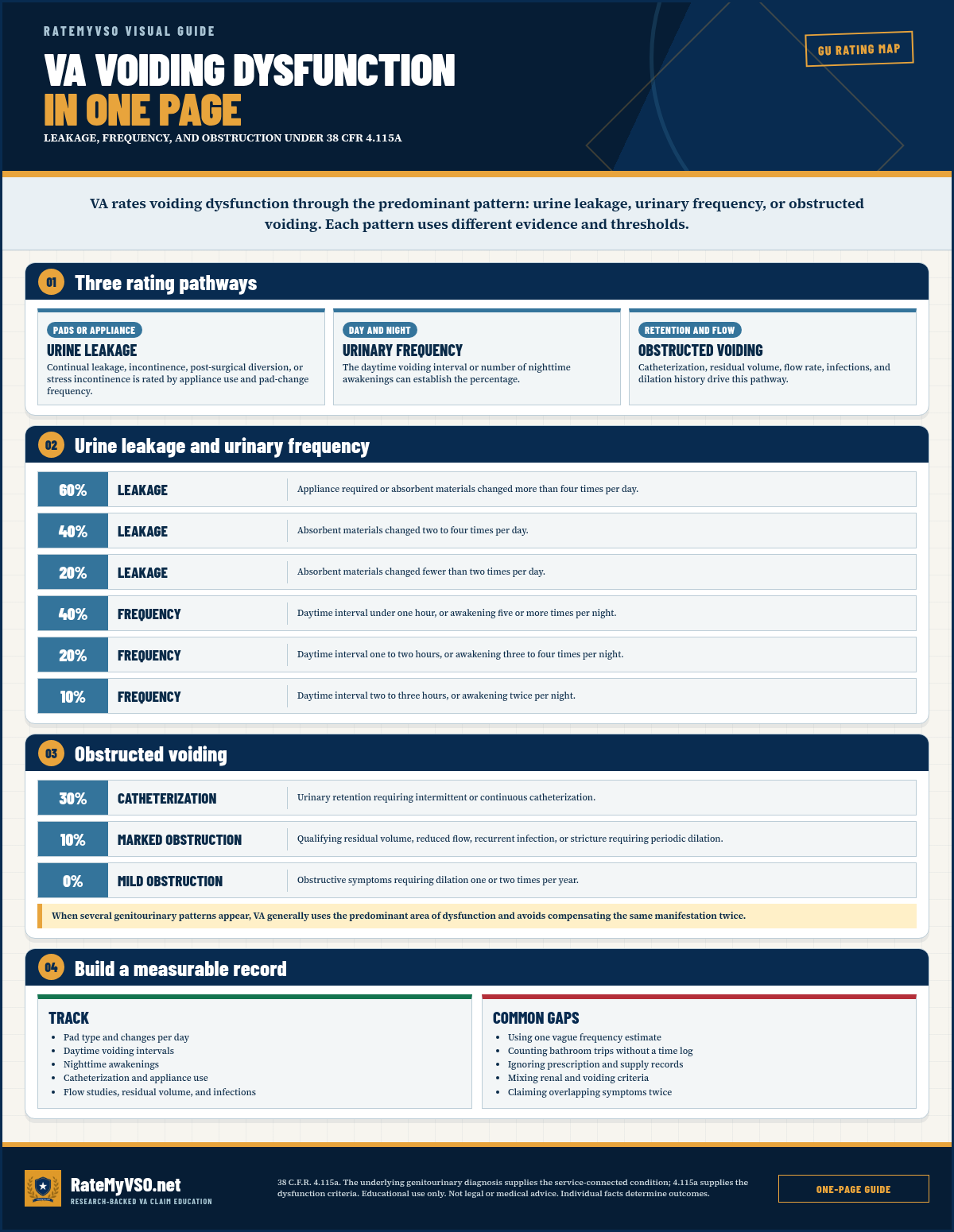 One-page guide: VA Voiding Dysfunction In One Page
Compare leakage, frequency, and obstructed-voiding pathways under 38 CFR 4.115a. Opens the full-size chart, free to save or print.
One-page guide: VA Voiding Dysfunction In One Page
Compare leakage, frequency, and obstructed-voiding pathways under 38 CFR 4.115a. Opens the full-size chart, free to save or print.
Start with the essentials
- 01Service Connection
The ways service connection can be established for this condition.
- 02Diagnosis and Evidence
Common symptoms and the evidence cited in published Board appeals.
- 03Your History
What you experienced, what others observed, and what treatment changed.
Understand the claim
Overview
Genitourinary claims cover a wide range of diagnoses, chronic nephritis and pyelonephritis (renal dysfunction), neurogenic bladder and prostate conditions (voiding dysfunction), and chronic cystitis (urinary tract infection). Despite the variety of diagnoses, nearly every one of them is rated using the same three pathways at 38 CFR 4.115a.
Across published Board of Veterans' Appeals decisions for urinary and bladder conditions, most veterans who win did not injure the bladder directly in service. Instead, the bladder problem grew out of another condition VA had already service-connected, most often a back or spine injury, sleep apnea, or a prostate condition. That path, secondary service connection, is central to this guide and is usually the more available route into a grant. A smaller share of claims are decided on the rating percentage or the effective date (the start date for back pay) rather than on whether service connection is owed at all, and it matters to know which fight you're actually in before you build your evidence.
ICD-10 Diagnosis Codes
The ICD-10 diagnosis codes most commonly used for DC 7542, Neurogenic bladder (the kind on your medical records, decision letter, or C&P exam report). VA rates the disability and its residuals, not the diagnosis itself, so coding can vary.
How Service Connection Works, At a High Level
Before getting into the specific pathways below, it helps to understand the three things every urinary or bladder claim ultimately has to show. This is the same basic test that applies to any VA disability claim, just applied to this body system.
- A current diagnosis. A real, current bladder or urinary disability, such as overactive bladder, neurogenic bladder, chronic cystitis, or a renal condition. Claims have failed precisely because no doctor found a current bladder disability, the symptoms were traced to an unrelated condition instead. Even pain or a clear loss of function, without a formal diagnosis label, can sometimes count as a disability.
- An in-service event, or a service-connected condition it flows from. This can be an injury or event documented during service, or a disability VA already recognizes, such as a spine injury, sleep apnea, or a prostate condition, that caused or worsened the GU problem.
- A medical nexus. A doctor's opinion connecting your GU condition to service, or to the service-connected condition, and explaining the reasoning, not just stating a conclusion.
The Three Pathways
Every genitourinary claim is channeled into one of three pathways. The pathway is set by your diagnosis and the dominant symptom picture, not by your preference. Understanding the pathway determines what evidence you need to gather. (see 38 CFR § 4.115a)
Renal Dysfunction
Kidney function measured by glomerular filtration rate (GFR) lab results. Ratings are based on GFR readings taken at least three times over a 12-month period. Maximum rating: 100%. Evidence: blood-work showing GFR, dialysis records, or transplant status.
Voiding Dysfunction
How you produce and expel urine. Split into three sub-categories: urine leakage (absorbent materials), urinary frequency (how often you void day and night), and obstructed voiding (catheter use). Maximum rating: 60% under leakage. Evidence varies by sub-category.
Urinary Tract Infection (UTI)
Recurrent symptomatic infections requiring hospitalization, drainage procedures, or continuous suppressive therapy. Maximum rating: 30%. Evidence: hospitalization records, infection documentation, prescribed suppressive antibiotic therapy.
What VA Looks For: Tests, Records, and Diagnostic Codes
Whether you are filing directly or secondary to another condition, the record VA actually reviews centers on a small set of documents and data points, and which ones matter depends on your pathway.
- Lab results: for the renal pathway, glomerular filtration rate (GFR) readings from at least three separate months, plus dialysis or transplant records if applicable.
- Symptom logs and prescriptions: for voiding dysfunction, a physician's prescription for absorbent pads with documented change frequency, a urinary frequency log, or catheter prescription and post-void residual (PVR) measurements.
- Infection records: for the UTI pathway, hospitalization records, drainage procedure records (stent or nephrostomy), and prescription records for suppressive antibiotic therapy.
- The diagnostic codes involved: DC 7530 for renal dysfunction, DC 7542 for neurogenic bladder and most voiding dysfunction, DC 7512 for chronic cystitis, and DC 7527 for prostate gland conditions, plus whatever code applies to the condition you're connecting it to.
- The actual form the examiner fills out: a genitourinary Disability Benefits Questionnaire (DBQ), discussed in more detail later in this guide.
Common Diagnostic Codes
These codes appear in the schedule at 38 CFR 4.115b. Most instruct the rater to apply the 4.115a pathways rather than using code-specific tiers.
| DC | Condition | How Rated |
|---|---|---|
| 7512 | Chronic cystitis (bladder inflammation) | Rate as voiding dysfunction |
| 7517 | Bladder injury | Rate as voiding dysfunction |
| 7518 | Urethral stricture | Rate as voiding dysfunction |
| 7527 | Prostate gland injuries or infections (including BPH and prostatitis) | Rate as voiding dysfunction or urinary tract infection, whichever is predominant |
| 7542 | Neurogenic bladder | Rate as voiding dysfunction or urinary tract infection, whichever is predominant |
| 7545 | Bladder diverticulum | Rate as voiding dysfunction or urinary tract infection, whichever is predominant |
| 7502 | Chronic nephritis | Rate as renal dysfunction |
| 7504 | Chronic pyelonephritis | Rate as renal dysfunction |
Service Connection for GU Conditions
Direct service connection
Any genitourinary condition that began during active duty or was aggravated by service can be service-connected directly. You need: a current diagnosis, an in-service event or onset, and a nexus (medical link) connecting the two. See nexus letters.
Secondary service connection
We analyzed published Board decisions and found the winning path for a GU claim is most often secondary service connection, meaning the bladder or urinary problem was caused or worsened by a condition VA already covers. A GU condition can be service connected if it is caused or aggravated (made worse) by a service-connected disability, under 38 CFR § 3.310. The Federal Circuit has also held that this "but for" causation standard reaches beyond a direct cause-and-effect relationship: a service-connected condition that delays, interferes with, or prevents treatment of a separate condition, making it worse than it otherwise would have been, can support secondary connection too (Spicer v. McDonough, 61 F.4th 1360 (Fed. Cir. 2023)). See our Secondary Service Connection Guide.
Neurogenic bladder secondary to a spinal condition
The nerves that control the bladder come out of the spine, so nerve damage from a service-connected back injury, spinal stenosis, or disc disease can cause neurogenic bladder (DC 7542). Board decisions have credited a private doctor's opinion that clearly explains this chain, particularly where it was more detailed and better reasoned than a bare VA opinion reaching the opposite conclusion.
Neurogenic bladder secondary to diabetes mellitus
Diabetic neuropathy frequently causes urinary retention and bladder dysfunction. If you have service-connected diabetes, a neurogenic bladder caused or worsened by diabetic neuropathy can be claimed as secondary. Ask the examiner to address aggravation, not just cause, because a bladder condition can be service connected on either theory; where the only opinion of record on aggravation favored the veteran, VA has granted the claim rather than hold the gap against him. See secondary vs. aggravation.
Urinary dysfunction secondary to a prostate condition
If a service-connected condition required surgery, radiation, or other treatment that damaged bladder or urethral function, residual voiding dysfunction is secondarily connected. This pathway has also worked where a service-connected prostate cancer was itself linked to an in-service exposure, such as contaminated water at Camp Lejeune (38 CFR § 3.307, 3.309(f)), which then supported the secondary bladder claim built on top of it.
Chronic UTI secondary to a catheter-dependent condition
Recurrent infections arising from catheter use tied to a service-connected spinal or bladder condition are secondarily connected. Because catheter use itself is rated under obstructed voiding rather than the UTI pathway, an examiner's opinion should keep the two theories, the catheter-driven voiding rating and the secondary infection claim, clearly separated.
Aggravation
A pre-existing GU condition that service permanently worsened beyond its natural progression can be rated for the degree of aggravation. Compensation is limited to the increase in disability over the pre-aggravation baseline, not the whole condition (Allen v. Brown, 7 Vet. App. 439 (1995)). See secondary vs. aggravation.
Symptoms and rating
Symptoms Recorded in Granted Urinary conditions Decisions
We analyzed 1,120 granted Board decisions involving urinary conditions for symptoms named in sentences about the condition (rating-criteria recitations excluded). Descriptive of the published record, what the Board wrote down, not a checklist of what to report.
Bar length shows decisions. Percentages remain context.
Detected by phrase-reading the decision text with condition-specific vocabularies. Source: Board of Veterans' Appeals decisions, RateMyVSO analysis.
Renal Dysfunction Rating Tiers (38 CFR 4.115a)
Renal dysfunction is rated almost entirely on lab results. The GFR value must appear in at least three separate readings during the prior 12 months. A single low reading is not enough to lock in a rating. If you do not yet have three readings, the rater will schedule a future exam, which delays your effective date.
- What the VA measures at your C&P exam
- Evidence that has won at the Board
- Inside the rater's playbook: grant, denial, and remand rates
- Secondary condition map
Voiding Dysfunction Rating Tiers (38 CFR 4.115a)
Voiding dysfunction has three sub-categories, each with its own tiers. The rater uses whichever sub-category best fits the evidence. If more than one applies, the higher rating controls.
Sub-category 1: Urine Leakage (Continual Leakage or Incontinence)
Rated on how often absorbent materials (pads or similar) must be changed. This includes continual urine leakage, post-surgical urinary diversion, urinary incontinence, and stress incontinence.
Sub-category 2: Urinary Frequency
Rated on how often you void during the day OR how many times you wake at night. This is an "or" standard: you only need to meet one side. Frequency logging and lay statements from household members are the primary evidence here.
Sub-category 3: Obstructed Voiding
Rated on whether you require catheterization and how severe residual symptoms are.
Go deeper: open the full voiding dysfunction breakdown- What the VA measures at your C&P exam
- Evidence that has won at the Board
- Inside the rater's playbook: grant, denial, and remand rates
- Secondary condition map
Urinary Tract Infection (UTI) Rating Tiers (38 CFR 4.115a)
The UTI pathway requires recurrent symptomatic infections documented in medical records. This is largely an objective, records-based pathway. It tops out at 30%.
- What the VA measures at your C&P exam
- Evidence that has won at the Board
- Inside the rater's playbook: grant, denial, and remand rates
- Secondary condition map
How the VA Picks the Predominant Pathway
The rule at 38 CFR 4.115a says the VA rates only the predominant area of dysfunction. Here is how that plays out in practice.
- Renal dysfunction takes precedence over voiding dysfunction. If your condition involves kidney failure measured by GFR, renal dysfunction is the pathway, even if you also have voiding symptoms. The renal rating scale goes higher (up to 100%) and its tiers are based on lab results, not symptom counts. The anti-pyramiding rule prevents double-counting both pathways.
- The examiner's DBQ drives the pathway for voiding dysfunction. For conditions rated as voiding dysfunction, the C&P examiner checks boxes on the genitourinary DBQ: leakage frequency, catheter use, voiding interval, nighttime awakenings. Whatever the examiner records is what the rater enters. If the examiner fills out the wrong section or leaves it blank, the rating suffers.
- Multiple voiding sub-categories: highest wins. If your evidence supports both urinary frequency (40%) and urine leakage (60%), the rater uses the one that results in the higher rating. You do not need to pick one when filing.
- UTI plus voiding dysfunction: whichever is predominant. Several diagnostic codes (7527, 7542, 7545) instruct the rater to use voiding dysfunction or UTI, whichever is predominant. If your infection rate is lower than your leakage or frequency burden, voiding dysfunction will produce a higher number.
Evidence and Board research
Evidence That Matters by Pathway
We analyzed the Board's published neurogenic bladder decisions (DC 7542): a private nexus opinion in the file goes with a much higher service-connection grant rate, shown below.
The right evidence depends entirely on which pathway applies to your condition.
For renal dysfunction
- GFR lab results: at least three readings from separate months within the past 12 months. These are the primary rating input.
- Dialysis records if dialysis-dependent, which goes directly to 100%.
- Transplant records if you received or are eligible for a kidney transplant.
- A current diagnosis of chronic kidney disease or another renal condition listed in 4.115b as rated under renal dysfunction.
For voiding dysfunction (urine leakage)
- Physician prescription for absorbent pads with documented change frequency.
- Medical records noting incontinence or leakage and its frequency or severity.
- Personal statement and buddy statements describing daily impact, corroborating the frequency.
For voiding dysfunction (urinary frequency)
- A urinary frequency log recording daytime voiding intervals and nighttime awakenings, dated consistently over several weeks.
- Lay statements from household members who can corroborate nocturia frequency.
- Medical records noting urinary frequency complaints, even if the provider did not quantify them precisely.
For voiding dysfunction (obstructed voiding)
- Catheter prescription records and catheter supply orders, which document that intermittent or continuous catheterization is medically required.
- Post-void residual (PVR) measurements showing retention above 150 mL.
- Urodynamic study results documenting reduced flow or obstruction.
For UTI pathway
- Hospitalization records for each UTI requiring inpatient treatment.
- Drainage procedure records (stent or nephrostomy placements).
- Prescription records for suppressive antibiotic therapy documenting duration of at least 6 months.
The genitourinary DBQ
The C&P examiner uses the genitourinary Disability Benefits Questionnaire (DBQ). The examiner's checkbox answers drive the rater's data entry into VBMS. If the examiner does not fill out the voiding dysfunction section (for example, leaving it blank while completing only the UTI section), the rater cannot rate voiding dysfunction even if your records support it. Review your DBQ after the exam before the rating decision issues if possible.
Evidence Cited in Published Urinary conditions Decisions
We analyzed 19,440 published Board decisions involving urinary conditions for condition-specific evidence, counting only case-specific mentions (boilerplate recitations excluded). "Favorable" is the share of decisions citing that evidence where every issue was granted or the outcome was mixed; the baseline across all these decisions is 51.6%, combining every diagnostic code below. Evidence appearing in a decision does not mean it decided the case. Descriptive of the published record, not a prediction.
Bar length shows decisions citing the evidence.
By diagnostic code
These codes are grouped together above. They do not perform the same, so find your own code here rather than reading the combined figure. A code retired in the schedule rewrites appears without a link, because its decisions were judged under criteria that no longer apply.
Bar length shows published decisions reviewed.
Detected by phrase-reading the decision text with condition-specific vocabularies. Source: Board of Veterans' Appeals decisions, RateMyVSO analysis.
Board Grants, Dissected
The Board decisions below show that neurogenic bladder and related voiding dysfunction claims are almost always won as secondary conditions, not as standalone injuries from service. In each case that succeeded, the veteran already had a service-connected disability, usually a back or spine condition, and presented evidence tying the bladder problem to that condition. Remember that Board decisions are not binding precedent. Each case is decided on its own record.
Private physician's nerve-compression explanation outweighs a thin VA denial Citation A26030088 (April 2026), Hearing docket
The record: The veteran was already rated for a lumbar spine disability. A private physician's April 2020 opinion explained that chronic low back pain causes "wear and tear along the spinal column," compressing nerves near the bladder and leading to neurogenic bladder. A July 2020 VA examiner actually agreed, finding the neurogenic bladder and erectile dysfunction were due to the spine disability, and noted there was "no more likely alternative etiology."
Why it won: The Board found both the private and VA opinions adequate and credible, and noted there was no contrary opinion on file. With the evidence at least in approximate balance, the Board resolved doubt in the veteran's favor.
A private DBQ tips the scale after two VA opinions disagreed with each other Citation A26021939 (March 2026), Hearing docket
The record: The veteran was rated for a lumbar sprain with thoracic spondylosis and scoliosis. A March 2018 private Disability Benefits Questionnaire (DBQ) diagnosed neurogenic bladder and found the urinary frequency was "a likely result of" the service-connected back condition. Two separate VA examiners, in March 2019 and September 2020, disagreed and said the veteran did not meet the criteria for a neurogenic bladder diagnosis at all, attributing her symptoms to a separately service-connected stress incontinence.
Why it won: The Board found the evidence on the existence of a current disability was in approximate balance, so it resolved that question in the veteran's favor. With a current disability established, the private DBQ's nexus opinion was enough to also put the causation question in approximate balance.
Overactive bladder tied to newly granted Camp Lejeune prostate cancer Citation A26017308 (February 2026), Direct Review docket
The record: The veteran served periods of active duty for training at Camp Lejeune. The Board first granted direct service connection for prostate cancer based on water contaminant exposure. A May 2024 VA examiner then found the veteran's overactive bladder was due to that prostate cancer, explaining the bladder symptoms were caused by "irritation and hyper irritability of the bladder muscle" from the prostate condition. A later October 2024 VA opinion also tied the overactive bladder to a newly granted chronic kidney disease claim.
Why it won: Once prostate cancer was granted, the VA examiner's own opinion connecting the overactive bladder to that condition supported secondary service connection. The Board noted it did not matter which service-connected condition caused the bladder problem, since either route supported the grant.
Unopposed private DBQ carries the day when VA never got around to examining the veteran Citation A26014569 (February 2026), Hearing docket
The record: The veteran had a service-connected low back disability. A September 2019 private DBQ from a physician and a physiatrist addressed several claimed conditions, including a bladder condition. The physician explained that "the nerves that are responsible for innervating and allowing for proper functioning of the bladder come out of the spine" and can become irritated by low back pain, leading to neurogenic bladder dysfunction. The veteran testified this worsened after back surgery. No VA examination or opinion was ever obtained on this issue.
Why it won: The Board found the private DBQ competent, credible, and the only medical evidence on point. With no competent evidence contradicting it, the Board resolved doubt in the veteran's favor even though it acknowledged further medical development could have been useful.
Spinal cord evaluation directly links bladder symptoms to a granted spine injury Citation A25110774 (December 2025), Evidence Submission docket
The record: The Board granted direct service connection for cervical and thoracolumbar spine disabilities based on a private physician's detailed opinion connecting an in-service fight and a fall to the veteran's spinal conditions. A June 2009 spinal cord evaluation found the veteran had "neurogenic bladder and bowel symptoms" and specifically related the incontinence to the spinal cord injury. A July 2019 medical note linked the bladder distention to the veteran's quadriplegia, which in turn came from the service-connected spine disabilities.
Why it won: With the spine disabilities granted, the medical evidence directly and clearly tied the bladder disability to that spine injury through the spinal cord. The Board found this evidence supported the secondary connection without any contrary medical opinion in the file.
Why These Claims Get Denied
Beyond the general "no nexus" and "no current diagnosis" reasons covered above, a few specific denial patterns show up often enough in published decisions to call out on their own.
- A confirmed diagnosis with no connection to service, or no confirmed diagnosis at all. The most common way to lose is having no current bladder or urinary disability. Claims have failed where reported symptoms were ultimately traced to an unrelated diagnosis, such as fibromyalgia, or to a different condition already accounted for, such as a service-connected prostate condition, rather than to a distinct bladder disability.
- The veteran's own belief about the cause, without a doctor's opinion behind it. VA treats the cause of a GU condition as a medical question a non-doctor cannot answer on their own. Arguing a bladder problem is service related without a supporting medical opinion does not carry the claim by itself.
- Claiming symptoms that are already rated under another condition (pyramiding). If your urinary symptoms are already explained and rated under a service-connected condition, for example voiding trouble already accounted for in a prostatitis rating, a separate award for the same symptoms is generally barred as pyramiding under 38 CFR 4.115a.
- Confusing a rating or effective-date dispute with a service-connection dispute. Many published GU decisions are not about whether service connection is owed at all; the veteran is already service-connected and is instead fighting over the rating percentage or the back-pay start date. The evidence you need for a rating fight is different from the evidence you need to establish service connection in the first place, know which fight you're actually in.
- An examiner's opinion applying too strict a standard, left unchallenged. An unfavorable opinion can be set aside where it is generic, ignores the record, or demands a stricter "direct and unequivocal" link than the law actually requires. VA only needs the evidence to be roughly balanced, not certain (Lynch v. McDonough, 21 F.4th 776 (Fed. Cir. 2021)). A denial that rests on an opinion like this is worth challenging rather than accepting.
Pitfalls and Common Mistakes
Patterns the published DC 7542 neurogenic bladder decisions and the 38 CFR 4.115a rating rules flag most often. Among the classified service-connection denials, no in-service event is the single largest reason, ahead of a missing medical nexus and no current diagnosis. Beyond the substantive reasons above, a few procedural mistakes come up repeatedly too.
- No nexus opinion in the file. A useful opinion names the in-service event or the service-connected primary (such as a spinal condition or diabetic neuropathy) and explains the link to the bladder dysfunction.
- Leaving the voiding dysfunction DBQ section blank. The rater enters whatever the examiner records. When the genitourinary DBQ has only the UTI section completed and the voiding dysfunction section is blank, the rater cannot rate voiding dysfunction even when the records support it.
- Filing on the wrong pathway. DC 7542 is rated as voiding dysfunction or urinary tract infection, whichever is predominant. Evidence built only around infection rate can land on the UTI pathway, which tops out lower, when leakage or frequency evidence would have produced a higher voiding dysfunction rating.
- Thin in-service documentation. Direct claims fail when the record shows no in-service event or onset tied to the bladder condition. Service treatment records and a nexus that names the in-service basis carry the timeline.
- No current diagnosis on file. A current diagnosis of neurogenic bladder is required before the pathway tiers apply. Symptom logs without a confirmed diagnosis do not establish the condition.
- Expecting back pay to start before you filed. For a secondary GU condition tied to a main disability, the effective date usually cannot be earlier than the main condition's effective date, and generally not before you filed (38 CFR 3.400). An earlier date is only available from the point the record makes clear the condition actually worsened, and only within the one-year window before your claim.
Do's and Don'ts
A condensed version of everything above, in the order it actually matters when you sit down to build your file.
- Get a current diagnosis of your bladder, urinary, or renal condition from a doctor before you file.
- If it stems from another service-connected condition (spine, diabetes, sleep apnea, prostate), claim it as secondary.
- Ask for a written medical opinion that explains its reasoning and cites your specific records, not a bare conclusion.
- Have the examiner address both cause and aggravation, whether the other condition made your GU problem worse, not just whether it started it.
- Add lay statements from you and your family describing your symptoms and when they began.
- Keep a bladder diary: how often you urinate day and night, and how many pads you change per day.
- If you're already service connected and fighting over the rating or effective date, learn the exact rating cutoffs so you can aim for the right level.
- If a VA opinion is generic, ignores your records, or demands a stricter standard than the law requires, say so directly in your response or appeal.
- If you were denied before, file a Supplemental Claim with new and relevant evidence rather than starting over.
- Don't file without a current, confirmed diagnosis, symptoms alone are not a disability.
- Don't rely only on your own opinion about what caused it, causation for a GU condition is treated as a medical question.
- Don't assume symptoms already rated under another service-connected condition can be counted, and paid, twice.
- Don't confuse a rating or effective-date fight with a service-connection fight, the evidence you need is different for each.
- Don't expect back pay to start before your filing date, or before the record shows the condition actually worsened.
- Don't leave the voiding dysfunction section of your DBQ blank if that's the pathway that fits your evidence, ask the examiner to complete it.
- Don't accept a VA opinion that ignores your records or applies too strict a legal standard without challenging it.
Secondary relationships
Common Secondary Conditions
We found these are the conditions most often linked with neurogenic bladder and voiding dysfunction (DC 7542) in the Board's published decisions. Each bar is the BVA grant rate for DC 7542, with the number of decisions below it. They describe what the Board's record shows across many veterans, not a prediction about any one claim.
Ways to connect via another condition (voiding dysfunction as the secondary)
Claims where a GU condition was argued as secondary to an already service-connected condition, such as a spinal condition, diabetes, sleep apnea, or a prostate condition. This is usually the easier route into a grant:
Conditions secondary to voiding dysfunction (voiding dysfunction as the primary)
Conditions veterans have claimed as caused or aggravated by a service-connected voiding dysfunction, once the GU condition itself is already service-connected:
Prepare and take the next step
Prepare: your own working pages
Optional. These are your own notes, in your own words. They are not a VA form, they are not sent to the VA, and nothing here is a medical finding or a prediction about your claim.
Three reminders while you prepare
- Record the diagnosis and history privately and precisely
Note the diagnosed condition, onset, treatment, and changes over time. Include only the personal detail needed for your own preparation. Go to this part
- Describe function and treatment effects
Organize symptoms, frequency, devices or materials, medicines, procedures, and practical effects without assigning yourself a rating. Go to this part
- Consider direct and secondary pathways separately
List the service history, other conditions, medicines, or treatment that may be relevant, then take medical-link questions to a clinician. Go to this part
Sign in or create an account to save your answers and come back to them later. You can fill these in and print them without an account.
Condition and treatment history
Symptoms and functional effects
Connection and examination questions
Records and unanswered questions
Decision-letter reading sheet
Quick Checklist Before You File
Bring these together before you submit anything.
- A current diagnosis of your bladder, urinary, or renal condition from a doctor.
- If it stems from another service-connected condition (spine, diabetes, sleep apnea, prostate), the paperwork to claim it as secondary.
- A written medical opinion that explains its reasoning and is tied to service or to a specific service-connected condition, covering both cause and aggravation.
- Lay statements from you and your family describing your symptoms and when they began.
- A bladder diary: how often you urinate day and night, and how many pads you change per day.
- GFR lab results (three readings from separate months) if renal dysfunction may apply.
- If you're already service connected: the rating cutoffs for your pathway, so you know what evidence you're aiming to support.
- If you were denied before: new and relevant evidence for a Supplemental Claim, not just a repeat of what was already considered.
For the mechanics of actually submitting the claim, see the Standard Claim Guide and the Fully Developed Claim Guide (filing with all your evidence up front can speed up the decision).
The Claims Process, Step by Step
Once you file, your claim moves through a series of hand-offs. Understanding who does what helps you know who to contact, and what to expect, at each stage.
- You file the claim. Directly with VA, through VA.gov, or with the help of an accredited representative.
- VA acknowledges the claim and assigns it for development. A Veteran Service Representative (VSR) is assigned to gather your service treatment records, VA and private medical records, and any other evidence needed.
- The VSR orders a Compensation & Pension (C&P) exam if one is needed. Not every claim requires one, but most GU claims do, especially secondary claims where a nexus opinion is required.
- The C&P exam is conducted. By a VA clinician or a contracted examiner, who completes a genitourinary Disability Benefits Questionnaire (DBQ) documenting the diagnosis, pathway, severity, and, where relevant, a nexus opinion.
- The file goes to a Rating Veteran Service Representative (RVSR), the "rater." The rater reviews the complete file, including the exam results, and decides whether service connection is warranted, which pathway applies, and at what percentage.
- A senior reviewer may review the decision before it's finalized, depending on the complexity of the claim.
- VA issues the decision letter. This states whether the claim is granted or denied, the rating percentage and pathway if granted, and the reasons behind the decision.
- If you disagree, you choose an appeal lane. Higher-Level Review, Supplemental Claim, or a Board appeal, covered later in this guide.
Who's who: VSO vs. VSR vs. Rater vs. C&P Examiner
Your VSO
An accredited representative from a veterans service organization, or an accredited attorney or claims agent. Not a VA employee. Helps you prepare, gather evidence, and file, and can represent you through an appeal. Has no authority to decide your claim.
VSR (Veteran Service Representative)
VA staff who "develops" your claim: requests records, schedules the C&P exam, and assembles the file. Does not decide the rating.
Rater (RVSR)
VA staff who reviews the completed file and makes the actual decision, service connection or denial, which pathway applies, and the percentage. This is the person whose judgment the decision letter reflects.
C&P Examiner
A VA clinician or a contracted medical examiner who conducts the exam and completes the DBQ. Documents findings and, where asked, a nexus opinion. Does not decide the claim.
For the full walkthrough of every stage with more detail, see Inside Your Claim and Claim Stages.
DBQs and Your C&P Exam
A Disability Benefits Questionnaire (DBQ) is the standardized form an examiner completes for your condition. For genitourinary conditions, it structures the exam findings into the specific data points VA's rating schedule requires, GFR values for renal dysfunction, leakage frequency and pad use, voiding interval and nighttime awakenings, catheter use and post-void residuals, and infection and hospitalization history. See the DBQ Guide for how these forms work, including whether a private DBQ completed by your own doctor can be submitted instead of relying solely on a VA exam.
Before your C&P exam, bring a clear, specific account of your symptoms, focus on your worst days and how the condition affects daily function, not just how you feel on an average day. If you keep a voiding log or a pad-use diary, bring it. Be consistent with what's already in your medical records and prior statements, and make sure the examiner actually fills out the section of the DBQ that matches your pathway. For a full walkthrough of what to expect and how to prepare, see the C&P Exam Prep Guide.
Reading Your Decision Letter, and What to Do If Denied
Your decision letter has two parts: a narrative section explaining the reasoning (often called "reasons and bases"), and a codesheet showing the actual rating percentage, the pathway and diagnostic code used, and the effective date. See the Reading Your Decision Letter Guide for how to find and interpret each part, or use the Letter Interpreter tool to upload your own letter and get a plain-English breakdown.
If your claim is denied, or the rating or pathway is lower than you expected, you have three main lanes:
- Supplemental Claim: refile with new and relevant evidence, such as a new nexus opinion, updated lab results, or a voiding log. See Supplemental Claim Guide.
- Higher-Level Review (HLR): a senior reviewer looks at the same evidence again for a difference of opinion, no new evidence is added. If your diagnosis is listed in 38 CFR 4.115b under a specific pathway and the rater used a different one, that mismatch is a clear-and-unmistakable-error argument well suited to an HLR. See HLR Guide.
- Board Appeal: your case goes to a Veterans Law Judge at the Board of Veterans' Appeals, with options for a direct review, an evidence docket, or a hearing. See Board Appeal Guide.
Not sure which lane fits your situation? See the Appeals decision guide for a side-by-side comparison of all three.
After You Win: Maintaining Your Rating
A grant is not always the end of the story. Continued treatment and follow-up records, lab work for a renal rating, pad-use or voiding logs for voiding dysfunction, protects you if VA schedules a future reexamination. A rating cannot be reduced unless VA can show real, lasting improvement in your day-to-day function, an improperly reduced rating can be reversed and restored on appeal (38 CFR § 3.344). Not every rating gets reexamined; understand when a rating becomes protected from future review (including Permanent and Total status) and what to do if VA proposes to reduce it. See Protect Your Rating and Future Reexaminations for the specifics.
If your GU condition worsens after the initial grant, for example progressing to a higher leakage or frequency tier, or GFR declining into a higher renal tier, you can file for an increased rating. An earlier effective date for that increase is available only from the date the record makes clear the condition actually got worse, and only within the one-year window before you filed (38 CFR 3.400(o)). See the Rating Increase Guide.
References and related resources
Quick Reference Tables
Secondary Connection Pathways
| Primary Condition | Mechanism | Evidence Needed |
|---|---|---|
| Spinal condition (back injury, spinal stenosis, disc disease) | Nerve damage to the bladder-control nerves that exit the spine | Nexus opinion explaining the neurological chain from the spine to the bladder |
| Diabetes mellitus | Diabetic neuropathy causing urinary retention or bladder dysfunction | Nexus opinion addressing both cause and aggravation |
| Prostate condition (including a Camp Lejeune-linked prostate cancer) | Surgery or radiation damaging bladder or urethral function | Treatment records + nexus opinion tying the treatment to the resulting dysfunction |
| Catheter-dependent spinal or bladder condition | Recurrent infection risk from catheter use | Catheter prescription records + infection/hospitalization documentation |
| Sleep apnea (DC 6847) | Documented medical link between sleep apnea and bladder dysfunction (cause or aggravation) | Nexus opinion + sleep study/treatment records |
From Filing to Decision: Who Does What
| Role | Does | Decides your rating? |
|---|---|---|
| VSO / accredited representative | Helps prepare, gather evidence, and file; represents you on appeal | No |
| VSR | Develops the claim: orders records and the C&P exam | No |
| C&P Examiner | Conducts the exam, completes the genitourinary DBQ, may give a nexus opinion | No / but has a strong impact |
| Rater (RVSR) | Reviews the full file, picks the pathway, and decides service connection and percentage | Yes |
Frequently Asked Questions
Can the VA rate me under renal dysfunction and voiding dysfunction at the same time?
My condition is not listed anywhere in 38 CFR 4.115b. What happens?
What is the highest possible rating under the voiding dysfunction pathway?
I have neurogenic bladder secondary to my service-connected back injury. How do I claim that?
The rater used the wrong pathway for my condition. Can I challenge that?
My urinary symptoms are already rated under a different service-connected condition. Can I get a separate award?
Related Tools and Guides
Sources
- 38 CFR 4.115a, rating criteria for genitourinary conditions (Cornell LII)
- 38 CFR 4.115b, diagnostic codes for genitourinary conditions (Cornell LII), including DC 7512 (cystitis) and DC 7527 (prostate conditions)
- 38 CFR § 3.303, basic rules for service connection
- 38 CFR § 3.310, secondary service connection: caused or aggravated by a service-connected disability
- 38 CFR § 3.102 and 38 USC § 5107(b), benefit of the doubt when evidence is in approximate balance
- 38 CFR § 3.307 and 3.309(f), Camp Lejeune contaminated water exposure
- 38 CFR § 3.344, rules for reducing a rating
- 38 CFR § 3.400 and 38 USC § 5110, effective dates and back pay
- 38 USC §§ 1110 and 1131, basic service connection
- Shedden v. Principi, 381 F.3d 1163 (Fed. Cir. 2004), the three elements of service connection
- Saunders v. Wilkie, 886 F.3d 1356 (Fed. Cir. 2018), pain or lost function without a formal diagnosis label can constitute a disability
- Spicer v. McDonough, 61 F.4th 1360 (Fed. Cir. 2023), but-for causation for secondary service connection, including where a service-connected condition interferes with treatment of another condition
- Allen v. Brown, 7 Vet. App. 439 (1995), aggravation of a non-service-connected condition by a service-connected disability
- Lynch v. McDonough, 21 F.4th 776 (Fed. Cir. 2021), the benefit-of-the-doubt rule and approximate balance of evidence
- Nieves-Rodriguez v. Peake, 22 Vet. App. 295 (2008), what makes a medical opinion persuasive
- Mariano v. Principi, 17 Vet. App. 305 (2003), VA may not seek out negative evidence to develop against a claimant