Gynecological Conditions Rating Guide
Female reproductive conditions share a framework under 38 CFR § 4.116. One family of codes (7610 through 7615) is rated on a simple question, whether continuous treatment controls the symptoms, while removal, prolapse, endometriosis, cancers, and FSAD each use their own criteria. Organ loss carries its own ratings and can bring extra compensation on top. Learn the pattern once and you understand how this whole section works, then open the specific condition. This guide explains the shared rules, then points you to the related guides that go deeper.

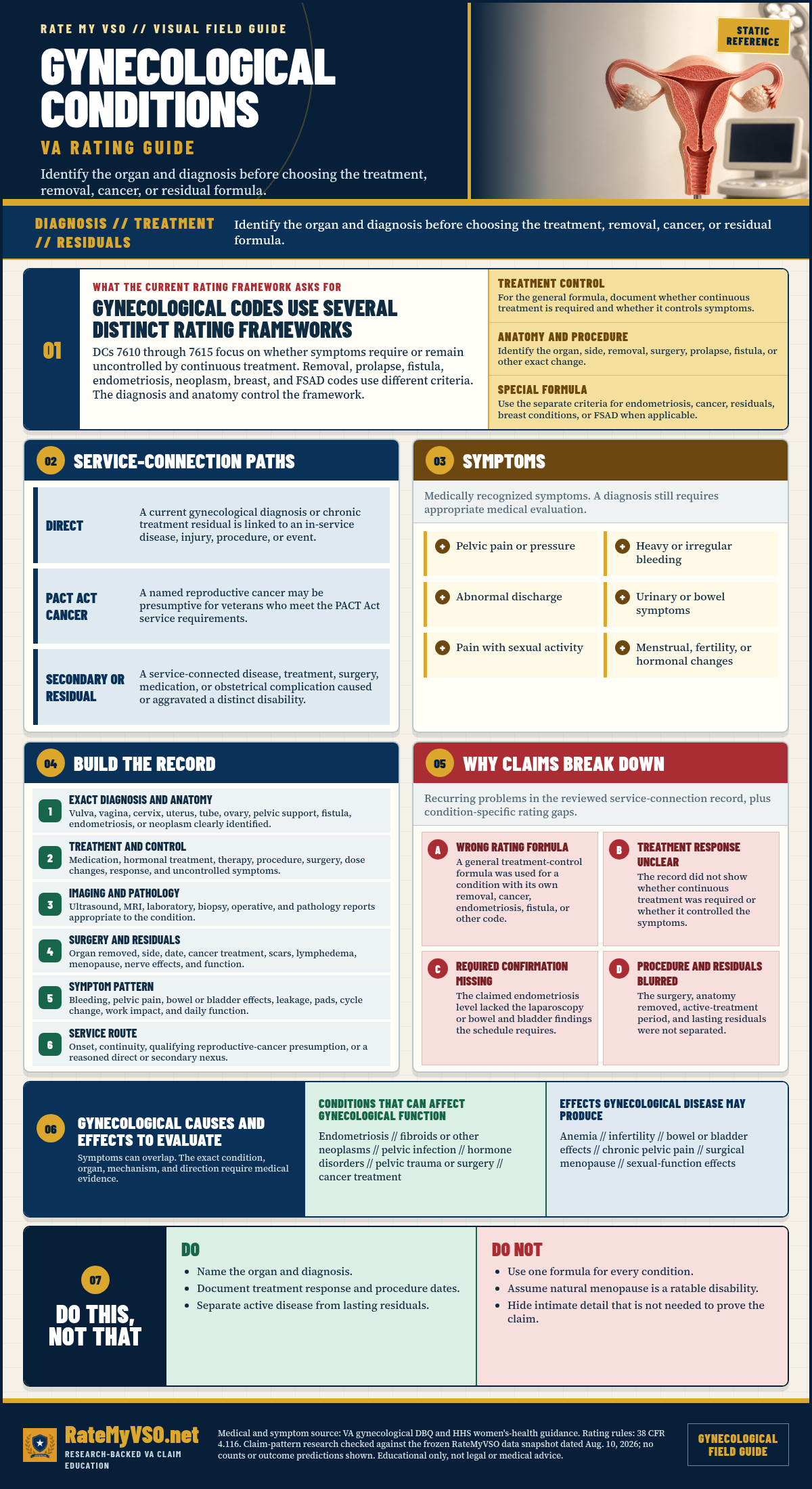 One-page guide: Gynecological Conditions Rating Guide in One Page
Gynecological-system guide separating treatment-control, removal, prolapse, fistula, endometriosis, cancer, residual, and FSAD frameworks, with symptoms, service paths, evidence, and common claim gaps. Opens the full-size chart, free to save or print.
One-page guide: Gynecological Conditions Rating Guide in One Page
Gynecological-system guide separating treatment-control, removal, prolapse, fistula, endometriosis, cancer, residual, and FSAD frameworks, with symptoms, service paths, evidence, and common claim gaps. Opens the full-size chart, free to save or print.
The Rules That Decide Every Gynecological Claim
Conditions of the female reproductive system are rated under 38 CFR § 4.116. The codes differ from one condition to the next, but a small set of shared ideas decides most claims. Learn these and the individual rating tables make sense.
1. One code family is rated on whether treatment controls the symptoms
The General Rating Formula for diagnostic codes 7610 through 7615 turns on one question: does continuous treatment control the symptoms? A condition that requires continuous treatment, or that is not controlled by continuous treatment, is rated higher than one that needs no treatment. For those codes the treatment record is the center of the claim. Removal, prolapse, fistula, endometriosis, neoplasms, breast surgery, and FSAD sit outside that formula and use their own criteria.
2. Removal or loss of a reproductive organ has set ratings and can bring extra compensation
When a reproductive organ is removed or lost, the schedule assigns set ratings for that loss. On top of the schedular rating, some organ losses qualify for special monthly compensation (SMC) for the loss of a creative organ. That extra payment is separate from and added to the regular rating, and it is easy to miss.
3. Each condition has its own code and scale within the section
Conditions like endometriosis, uterine and ovarian disorders, and pelvic conditions each have their own diagnostic code and their own rating scale inside 38 CFR § 4.116. There is no single number that covers the whole system, so the exact levels depend on the specific condition.
4. Symptoms of another condition are rated under their own codes
As with other body systems, symptoms that a mental-health or other condition produces are rated under their own codes, not folded into the gynecological rating. That separation matters, because it is what lets a related condition, such as depression tied to chronic pain, be claimed and rated on its own.
Choose the Gynecological or Breast Rating Lane
The continuous-treatment question is the General Rating Formula for diagnostic codes 7610 through 7615, not the rule for the whole section. This part of the schedule also covers disorders of the breast, and each lane below reads a different record:
| Rating lane | What controls | Records that show it |
|---|---|---|
| DCs 7610 through 7615 | What controlsWhether symptoms require continuous treatment and whether that treatment controls them | Records that show itDiagnosis, treatment duration, medication or procedure history, symptoms that persist despite treatment |
| Organ removal or anatomical loss | What controlsThe exact organ or breast procedure, the temporary period, the set residual rating, and a separate review for special monthly compensation | Records that show itOperative and pathology reports, treatment and follow-up, anatomy and residual findings |
| Prolapse or fistula | What controlsThe exact diagnosis and the code-specific digestive, urinary, skin, or structural manifestations | Records that show itPelvic examination, imaging or testing when used, bowel and bladder findings, skin residuals |
| Endometriosis | What controlsPelvic pain or heavy or irregular bleeding, treatment response, bowel or bladder involvement, and laparoscopic substantiation | Records that show itLaparoscopy or operative record, treatment history, symptom and bowel or bladder record |
| Active gynecological or breast cancer | What controlsActive disease or treatment, the treatment-end date, mandatory follow-up, and chronic residuals | Records that show itPathology, oncology and operative records, follow-up examination, residual-specific records |
| Benign breast condition or breast surgery residual | What controlsScar, lymphedema, disfigurement, arm or shoulder limitation, grip, sensation, or another distinct residual | Records that show itBreast and scar examinations, physical or occupational therapy records, range of motion, neurologic findings |
| Female sexual arousal disorder | What controlsThe noncompensable schedular code, with separate review for SMC under 38 CFR § 3.350 | Records that show itDiagnosis, examination, treatment history, the facts the SMC question turns on |
Condition detail: FSAD, SMC, and the cancer claims guide.
Treatment and Surgery Can Create More Than One Rating Question
Cancer treatment, organ removal, and breast surgery each move a claim through several states, and more than one question can be open at the same time:
- Underlying condition: identify the exact gynecological or breast diagnosis and the rating formula it uses.
- Active treatment or temporary period: cancer, organ removal, or other procedures may use a code-specific total-rating period.
- Mandatory follow-up: where the code requires an examination after treatment, that record decides whether active disease remains.
- Chronic residuals: scar, lymphedema, disfigurement, bowel or bladder impairment, arm or shoulder limitation, nerve or sensation changes, and other distinct residuals may be evaluated under their own codes.
- Special monthly compensation review: loss or loss of use of a creative organ and qualifying anatomical breast loss are separate SMC questions. SMC is not a substitute for rating distinct chronic residuals.
Find the Guide for Your Condition
The rules above apply across the board. This body system does not yet have a dedicated per-condition guide, so the directory below routes you to the closest related guide and to the condition lookup page for the exact numbers:
| Area | Guide | DC codes |
|---|---|---|
| Gynecological cancers | Cancer Claims Guide | varies |
For endometriosis, uterine, ovarian, and other conditions, open the condition lookup page for the rating levels and Board data.
Every Gynecological Diagnostic Code, With Board Outcomes
Every diagnostic code in this body system, ordered by how often it reaches the Board of Veterans' Appeals. Percentages are the share of each code's Board issues granted, denied, or remanded (sent back for more development); dismissed and other outcomes are not shown, so rows do not sum to 100%. Each code links to its full page: rating criteria, evidence notes, and secondary-condition data.
Show 4 more codes with too few Board appeals to report (expand)
| DC | Condition | Board appeals | Granted | Denied | Remanded |
|---|---|---|---|---|---|
| 7617 | Uterus and both ovaries, removal of, complete | Too few Board appeals to report | |||
| 7620 | Ovaries, atrophy of both, complete | Too few Board appeals to report | |||
| 7624 | Fistula, rectovaginal | Too few Board appeals to report | |||
| 7625 | Fistula, urethrovaginal | Too few Board appeals to report | |||
Counts from RateMyVSO's index of published BVA decisions, refreshed weekly. A remand is not a loss; it means the Board needed more evidence before deciding. Descriptive of the published record, not a prediction for any claim.
Common Secondary Conditions
Gynecological conditions rarely stand alone. Because they can flow from another disability, or drive one, several secondary claims are common:
- Conditions secondary to another disability. A gynecological condition can arise as secondary to another service-connected condition or to its treatment.
- Mental health from chronic pain or infertility. A separate mental-health condition may be considered when the record supports a diagnosis and a link to the service-connected condition, subject to the anti-pyramiding rule; it is not automatic.
- Special monthly compensation for organ loss. The loss of a reproductive organ can support special monthly compensation for the loss of a creative organ, separate from the schedular rating.
- Conditions following cancer treatment. Conditions that follow gynecological cancer treatment can be claimed in their own right. See secondary conditions.
Records That Show What the Schedule Measures
The official gynecological and breast examination forms ask for a specific set of findings. A complete record covers the same ground:
- Exact diagnosis: the specific gynecological or breast condition, since the lane it falls in decides which facts matter.
- Treatment and response: whether treatment is continuous and whether it actually controls the symptoms, the point the 7610 through 7615 family turns on.
- Laparoscopy where the code requires it: the operative or laparoscopic record substantiating endometriosis.
- Pelvic, bowel, and bladder findings: examination results plus any anemia or other condition-specific testing.
- Cancer status and dates: pathology, treatment dates, the operative report, and the required follow-up examination.
- Surgical and breast residuals: scars, lymphedema, disfigurement, arm or shoulder range of motion, grip, and sensory changes documented as distinct findings.
- Ordinary functional impact: what the condition and its treatment change about work, sleep, and daily activity.
Documentation of loss or loss of use of a creative organ, or of qualifying anatomical breast loss, supports the separate special monthly compensation question. The matching DBQ prompts an examiner to capture these findings in the schedule's own terms.
Common Mistakes
- Not documenting whether treatment is continuous. For the 7610-7615 family the rating turns on whether continuous treatment controls the symptoms, so a file that does not make the treatment picture clear can be rated too low.
- Missing special monthly compensation after an organ removal. The loss of a reproductive organ can bring SMC on top of the schedular rating, and it is easy to overlook.
- Never raising a documented mental-health condition. Where the record supports a diagnosis and a link to chronic pelvic pain or its treatment, a secondary mental-health claim can be considered; leaving it unraised means it is never evaluated.
- Assuming a gynecological cancer follows a different rule than other cancers. It uses the same active-then-residuals pattern: rated at 100 percent while active, then re-evaluated on the residuals that remain.
Frequently Asked Questions
How does the VA rate gynecological conditions?
Does the continuous-treatment formula apply to every condition in this part of the schedule?
Why are breast conditions included on this page?
Can chronic complications of pregnancy be rated?
Is special monthly compensation the same as the schedular rating?
What does "controlled by continuous treatment" mean?
Is organ removal ratable, and is there extra compensation?
How is endometriosis rated?
Are gynecological cancers rated here?
Related Tools and Guides
Sources: 38 CFR 4.116, gynecological conditions. Educational only, not legal advice, and not a prediction of any individual claim. Rating criteria and case law change; confirm current details in 38 CFR Part 4. For help with your claim, find a VA-accredited representative.