VA Female Sexual Arousal Disorder Claims Guide
Female Sexual Arousal Disorder (FSAD) is rated under diagnostic code 7632, part of the gynecological rating schedule added effective May 13, 2018. Like erectile dysfunction in men, FSAD carries a schedular rating of 0 percent, and the code's footnote directs the rater to review for Special Monthly Compensation (SMC) under 38 CFR 3.350. Unlike ED, the regulation does not spell out a specific functional-loss test for female reproductive organs, so how SMC-K applies to FSAD is decided case by case rather than by a fixed rule. FSAD is also almost always a secondary claim, most often tied to PTSD, military sexual trauma (MST), depression, or medication side effects. This guide walks the whole path: how service connection works, how FSAD gets connected to your service, what evidence helps, why these claims get denied, a checklist before you file, what the claims process looks like step by step, how to read your decision letter, and what to do whether you win or you're denied.
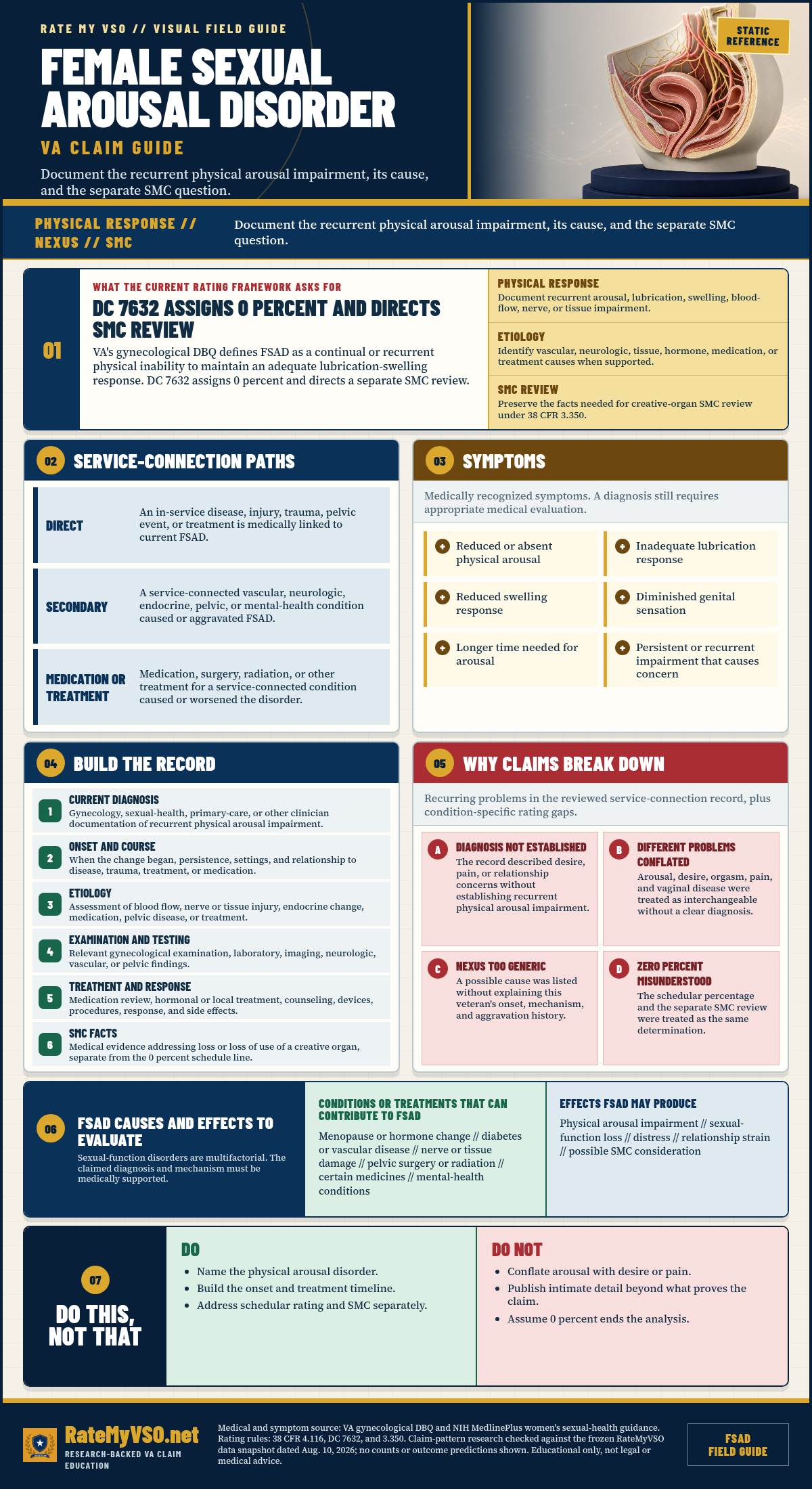 One-page guide: Female Sexual Arousal Disorder Claims in One Page
Female sexual arousal disorder guide covering DC 7632, the recurrent physical arousal impairment, the separate SMC review, service paths, possible causes, examination and treatment evidence, and common claim gaps. Opens the full-size chart, free to save or print.
One-page guide: Female Sexual Arousal Disorder Claims in One Page
Female sexual arousal disorder guide covering DC 7632, the recurrent physical arousal impairment, the separate SMC review, service paths, possible causes, examination and treatment evidence, and common claim gaps. Opens the full-size chart, free to save or print.
Start with the essentials
- 01Service Connection
The ways service connection can be established for this condition.
- 02Diagnosis and Evidence
Common symptoms and the evidence cited in published Board appeals.
- 03Your History
What you experienced, what others observed, and what treatment changed.
Understand the claim
What the VA Counts as FSAD
FSAD is rated under 38 CFR 4.116, the Schedule of Ratings for Gynecological Conditions and Disorders of the Breast, diagnostic code 7632, titled simply "Female sexual arousal disorder (FSAD)." That schedule took effect May 13, 2018, replacing an older, thinner set of gynecological codes. VA treats FSAD as a psychiatric (mental health) condition for rating purposes, so the diagnosis is expected to follow the DSM-5 manual under 38 CFR 4.125, the same rule that governs mental-disorder diagnoses generally.
The VA's clinical picture
Persistent difficulty becoming physically aroused during sexual activity despite the presence of desire, evaluated through a gynecological exam and medical history rather than a mental-status exam alone.
The clinical reality (DSM-5)
The DSM-5 recognizes this condition as Female Sexual Interest/Arousal Disorder (FSIAD), and describes it as arising from a mix of physiological, psychological, hormonal, neurochemical, and social factors together, not a purely physical or purely psychological condition.
ICD-10 Diagnosis Codes
The ICD-10 diagnosis codes most commonly used for DC 7632, Female sexual arousal disorder (FSAD) (the kind on your medical records, decision letter, or C&P exam report). VA rates the disability and its residuals, not the diagnosis itself, so coding can vary.
How Service Connection Works, At a High Level
Before getting into the specific pathways below, it helps to understand the three things every FSAD claim ultimately has to show. This is the same basic test that applies to any VA disability claim, just applied to this condition.
- A current diagnosis. A medical provider must actually diagnose FSAD. Because VA treats FSAD as a mental health condition, the diagnosis should follow the DSM-5 manual (38 CFR 4.125). A veteran's own description of the difficulty, without a provider's diagnosis behind it, is not enough on its own.
- An in-service cause, or a service-connected condition behind it. Either the FSAD started in service, or it was caused by another condition already connected to your service, such as a psychiatric disability or a medication taken for a service-connected condition (38 CFR 3.310).
- A medical link (nexus). A doctor's opinion, with reasons, tying the FSAD to service or to the service-connected condition (38 CFR 3.303).
How FSAD Gets Service Connected
Direct service connection
Direct service connection requires a current diagnosis, an in-service event, injury, or disease, and a medical nexus linking the two. This is the less common path for FSAD, since the condition typically develops from an underlying cause rather than a single discrete event.
Secondary service connection (the main route)
Secondary service connection is the more common path. Under 38 CFR 3.310, a secondary claim requires a current FSAD diagnosis and a medical nexus opinion tying it to a service-connected condition, or to a medication taken for one, by causation or aggravation. Established secondary pathways include:
Secondary to PTSD, Depression, or Military Sexual Trauma
PTSD, particularly stemming from military sexual trauma (MST), is the pathway most consistently discussed across sources on this condition. In the Board's published record, the volume is small but the pattern is visible: FSAD claimed as secondary to PTSD appears in a small number of published issues, granted at roughly half of decided issues (published BVA decisions). Treat that as a directional signal from a thin sample, not a population estimate. See the PTSD claims guide and MST claims guide.
Secondary to Medication
A medication prescribed for a service-connected condition can itself cause or worsen arousal difficulty. An antidepressant, for example, prescribed for service-connected depression or another psychiatric condition, is a recognized example of this pathway. This is a distinct theory from arguing the underlying condition caused it directly: the nexus opinion instead ties the specific medication and its documented effect on arousal function to the difficulty, rather than the condition the medication was prescribed for. Document the medication, the condition it was prescribed for, and when the arousal symptoms began relative to starting it.
Secondary to a Gynecological or Surgical Event
When an in-service gynecological surgery, injury, or event caused broader gynecological problems, FSAD can be claimed as part of that same causal chain rather than as a standalone psychiatric theory. This pathway rests on gynecological records and exam findings rather than psychiatric ones, and is best supported by treatment records connecting the arousal difficulty to the same underlying gynecological history.
Beyond PTSD, depression and anxiety, chronic pelvic pain, hormonal imbalance (including thyroid disorders and PCOS), and diabetes are recognized causal pathways in the clinical literature and are argued as secondary theories. See secondary conditions and secondary vs aggravation.
What VA Looks For: Tests, Records, and Diagnostic Codes
Records to gather for a direct or secondary claim:
- The diagnosis itself: because FSAD is treated as a mental-health condition for rating purposes, the diagnosis is expected to follow the DSM-5 framework (38 CFR 4.125), documented by a mental-health clinician, gynecologist, or other treating provider.
- The service-connected condition or medication behind it: the diagnostic code for whatever you're connecting FSAD to, for example DC 9411 (PTSD), DC 9434 (depression), or the medication list for a service-connected condition, plus DC 7632 for the FSAD itself.
- The nexus opinion: a doctor's opinion, with reasons, tying the FSAD to the in-service event or the service-connected condition, discussed further below.
- The actual form the examiner fills out: a Disability Benefits Questionnaire (DBQ) covering female reproductive and sexual health conditions, discussed in more detail later in this guide.
Symptoms and rating
Pyramiding and Rating Separately
The VA's pyramiding rules prevent paying twice for the same disability. For FSAD, this rarely becomes an issue because the schedular rating is 0 percent and contributes nothing to the combined evaluation. Any additional compensation, SMC, is layered on top of the combined rating rather than folded into it.
The underlying condition that caused the FSAD (PTSD, depression, a medical condition, or a medication reaction) is rated under its own diagnostic code. The FSAD itself is rated 0 percent under DC 7632, and SMC is considered separately. These are distinct lines, not double-counting.
The 0% Rating and SMC-K: Where This Gets Genuinely Unsettled
Under DC 7632, the schedular rating is a fixed 0 percent. As with erectile dysfunction (DC 7522), the code carries a footnote: "Review for entitlement to special monthly compensation under 3.350 of this chapter." That is the same referral language used for ED, and it is where any additional compensation would come from.
Here is the part worth understanding clearly: 38 CFR 3.350(a)(1)(i), the regulation that defines "loss of use of a creative organ" for SMC-K, writes out a specific functional-loss test only for testicles, measured by size reduction or a biopsy showing absence of spermatozoa. It defines actual loss (absence) for "ovaries or other creative organ," but it does not write out a parallel functional-loss test for ovaries, and it does not write out one for the penis either. In practice, ED reaches SMC-K through long-standing rater practice and guidance beyond the bare regulatory text. FSAD does not yet have that same well-worn path in the text, so it is genuinely evaluated case by case rather than under a codified formula.
What SMC-K is
A flat, statutory monthly dollar amount under 38 U.S.C. 1114(k), tax-free, added on top of the combined schedular rating. It does not change the underlying combined percentage; it is a separate amount layered above it.
How it is decided for FSAD
Not automatic, and not governed by one written test the way testicular loss is. The rater reviews the C&P exam findings and the medical record for documented loss of arousal function tied to a service-connected cause, then applies 38 CFR 3.350(a) by analogy.
DC 7632 Rating
The gynecological schedule lists a single rating line for FSAD. There is no percentage ladder for severity, the schedular value is fixed.
Go deeper: open the full FSAD breakdown- The 0% schedular line and the SMC cross-reference
- Evidence and exam tips
- Secondary condition map
| Rating | What it reflects |
|---|---|
| 0% | Female sexual arousal disorder (FSAD), the schedular line. Footnote directs review for SMC under 38 CFR 3.350. |
| SMC-K | Not codified with a specific test for female organs; reviewed case by case against 38 CFR 3.350(a) when documented loss of arousal function is tied to a service-connected cause. |
If a gynecological exam documents actual physical damage or injury to the reproductive organs (as opposed to a functional arousal disorder), that damage may instead be ratable under a different, organ-specific gynecological code. DC 7632 is specifically for the arousal disorder itself.
Evidence and Board research
Evidence That Helps
- A current, written diagnosis: a treating provider's FSAD diagnosis, ideally consistent with the DSM-5 framework. Without it, there is no valid claim regardless of how well-documented the rest of the file is.
- A gynecological or sexual-health specialist's evaluation: documentation from a gynecologist, urologist, or sexual-health specialist who has examined or treated the condition.
- A nexus opinion addressing both causation and aggravation: a private or treating clinician's opinion stating whether the service-connected condition or medication caused, or made worse, the arousal difficulty. An opinion that reviews the record and gives clear reasons carries real weight, particularly when VA itself never obtained a competing opinion.
- Medication history: a list of medications tried, including any prescribed for a service-connected condition with a documented effect on arousal function, and their effectiveness or side effects.
- A personal statement: describing when your symptoms began and how they have continued, and how the condition affects daily life, relationships, and well-being. Because FSAD is treated as a mental-health condition for rating purposes, a credible personal statement can help support the nexus, especially where later treatment records back it up.
- Buddy or lay statements: from a spouse or partner describing observed effects, if the veteran is comfortable including one.
- Records connecting the condition to MST or PTSD, where applicable: treatment records showing the trauma-related condition's timeline relative to the arousal difficulty.
Evidence Cited in Published Female sexual arousal disorder Decisions
We analyzed 280 published Board decisions involving female sexual arousal disorder for condition-specific evidence, counting only case-specific mentions (boilerplate recitations excluded). "Favorable" is the share of decisions citing that evidence where every issue was granted or the outcome was mixed; the baseline across all these decisions is 67.1%. Evidence appearing in a decision does not mean it decided the case. Descriptive of the published record, not a prediction.
Bar length shows decisions citing the evidence.
Detected by phrase-reading the decision text with condition-specific vocabularies. Source: Board of Veterans' Appeals decisions, RateMyVSO analysis.
Board Grants, Dissected
The FSAD grants in this set almost never rest on a straight "in-service onset" story. Instead, the Board usually finds FSAD to be secondary to another already-service-connected condition, most often a psychiatric disorder, endometriosis or another gynecological problem, or a hypothyroid or other endocrine condition. In more than one case the Board also relied on an AOJ favorable finding it was bound to accept, or on a VA examiner's own conflicting statements read in the veteran's favor. Remember, these are individual Board decisions. They are not binding precedent, and they do not predict how any other claim will turn out.
FSAD tied to service-connected endometriosis and depressive disorder Citation A26030368 (April 2026), Evidence Submission docket
The record: The AOJ had already granted service connection for endometriosis in a rating decision issued while the appeal was pending. The Board noted this grant was a favorable finding it could not disturb.
Why it won: The Board stated plainly that the AOJ "has determined that the Veteran's FSAD and urinary frequency are related to her 'service-connected disability of history of endometriosis with endometrial polyps [status post] hysterectomy.'" Because the Board could not disturb that finding, it found service connection for FSAD warranted as a straightforward secondary claim.
Board reads an examiner's own contradictory notes in the veteran's favor Citation A26023240 (March 2026), Hearing docket
The record: A VA gynecological examiner wrote two conflicting lines in the same report. One line said the examiner was "unable to confirm a current chronic diagnosis." Another line said the veteran's "subject complaints support a diagnosis of Female Arousal Disorder due to subjective complaints of lack of desire, pain during intercourse, and difficulty with lubrication and reaching a climax." The examiner separately gave a negative opinion only on whether FSAD was secondary to the veteran's PTSD.
Why it won: The Board resolved the contradiction in the veteran's favor, finding the examiner had in substance rendered a diagnosis. Because FSAD is treated as a psychiatric disorder for rating purposes, the Board presumed the examiner, as a mental health professional, applied DSM-5 criteria even without saying so. The Board then found the claim supported on a direct basis using the veteran's own credible hearing testimony that her symptoms began after an in-service sexual trauma and continued since, along with a consistent post-service treatment record.
Hysterectomy and FSAD granted together from one VA opinion Citation A26019482 (March 2026), Hearing docket
The record: The veteran had a hysterectomy in 2005 due to heavy bleeding. A VA examiner opined that conditions related to the hysterectomy were at least as likely as not incurred in or caused by the in-service hysterectomy, explaining the veteran's medical records documented the surgery and its cause. There was no opinion against the claim.
Why it won: With only one probative opinion of record, and it favorable, the Board found the evidence at least in equipoise and granted service connection for the gynecological condition, "variously diagnosed as hysterectomy and female sexual arousal disorder," as a single combined grant.
Treating specialist's letter outweighs a negative VA opinion Citation A26006576 (January 2026), Hearing docket
The record: The veteran had a complicated surgical history beginning with an in-service procedure in 1986 that was followed by a postoperative pelvic infection, then several more surgeries over the following decade. A March 2022 VA opinion found no relationship because the hysterectomy and related issues arose after service, but it did not consider whether the in-service procedure caused the later problems. A private clinician, Dr. S.F., who had a treating relationship with the veteran, wrote that the "inciting event was the post operative infection from her original surgery in 1986," which led to recurring pelvic adhesions and eventual hysterectomy.
Why it won: The Board gave Dr. S.F.'s letter great weight because the clinician reviewed the veteran's full medical history, had an ongoing treating relationship, and explained the causal chain. The VA opinion was found incomplete because it never addressed whether the original in-service procedure caused the later cascade of problems. Service connection was granted for the bladder condition, FSAD, and hysterectomy and cystectomy residuals together.
Medication prescribed for service-connected conditions causes FSAD Citation A25098993 (November 2025), Direct Review docket
The record: A VA examiner confirmed an FSAD diagnosis and stated the most likely cause was the veteran's "duloxetine dosage which can cause anorgasmia and low libido." Medical records confirmed the duloxetine was prescribed for the veteran's already service-connected depression and fibromyalgia. The same examiner gave a negative opinion on whether FSAD was directly caused by service or by the psychiatric condition itself.
Why it won: The Board found that even though the examiner's direct and psychiatric-based nexus opinions were negative, the same report established that medication prescribed for two service-connected disabilities caused the FSAD. The Board cited DeLisio v. Shinseki for the principle that VA must investigate a secondary cause when the record reasonably raises it, and granted service connection on that secondary basis.
Why These Claims Get Denied
Beyond the general "no diagnosis" and "no nexus" reasons covered above, a few specific denial patterns show up often enough to call out on their own.
- No current clinical diagnosis. A veteran's own description of the difficulty, without a treating provider's diagnosis behind it, is not enough. FSAD needs clinical testing and medical expertise a veteran cannot supply on her own.
- Secondary connection argued against a condition that was never itself service connected. If the underlying psychiatric or medical condition has not been granted service connection, secondary service connection for FSAD on that theory is not legally possible, the chain fails at the first link.
- Expecting a compensable schedular percentage. DC 7632 has one rating level, 0 percent. Appeals asking for a higher schedular rating for FSAD itself are denied as a matter of law; the SMC-K review is where any additional value comes from.
- Assuming a related psychiatric claim already covers FSAD. Filing for PTSD or another psychiatric condition does not automatically file for FSAD. Its effective date runs from when the FSAD claim itself was filed, not the earlier claim it flows from.
- A trauma-based claim where the event did not occur during qualifying active service. When FSAD is tied to a specific trauma, that event generally has to have happened during a qualifying period of active duty status.
Common Mistakes
Patterns worth knowing before you file:
- Expecting a percentage from DC 7632 itself: the schedular rating is a fixed 0 percent. Any additional compensation comes from a case-by-case SMC review, not from the diagnostic code.
- Assuming SMC is automatic: the regulation directs a review for entitlement, it does not grant SMC automatically upon service connection. Raise it explicitly rather than assuming the rater will address it on their own.
- Assuming SMC requires infertility specifically: that framing conflates loss of use of the ovaries (a fertility question) with FSAD (an arousal-function question). Document the functional loss itself.
- Skipping mental-health treatment records because "FSAD isn't a mental-health condition": the DSM-5 diagnosis spans physiological and psychological causes together. Mental-health records, especially PTSD and MST treatment history, are legitimate and often central evidence.
- Filing as a standalone direct claim with no in-service event and no nexus: the more realistic path is secondary to PTSD, MST, depression, a medical condition, or a medication side effect.
- Leaving out the medication angle: SSRIs and several other common prescriptions have documented effects on arousal function; this is a distinct theory from the underlying condition.
- Missing a scheduled VA examination. Skipping the exam that would confirm the diagnosis can lead to an initial denial; if an exam is cancelled or rescheduled, follow up right away to make sure you're seen.
- Not filing a written intent to file. An intent to file can protect an earlier effective date if a complete claim follows within the required window, don't wait to submit a complete claim without one first on record.
- Overlooking how a discharge upgrade affects the effective date. If your discharge status is later upgraded, a new effective-date window can open, but it runs from the upgrade-related dates, not your original claim date.
Do's and Don'ts
A condensed version of everything above, in the order it actually matters when you sit down to build your file.
- Get a current, written FSAD diagnosis before you file, ideally documented consistent with the DSM-5.
- Connect FSAD to a service-connected condition or medication whenever you can; secondary service connection is the stronger path for this condition.
- Get a nexus opinion that reviews your records and explains its reasoning, not a bare conclusion.
- Use your own statement about when symptoms began, especially where the condition behind it is psychiatric in nature.
- Push back if a VA opinion denies the claim only because service records are silent on the issue, silence alone is not evidence against you.
- Attend every scheduled VA examination, and follow up immediately if one is cancelled or rescheduled.
- File the FSAD claim itself as its own claim, and file as early as possible.
- Ask about special monthly compensation (SMC) for loss of use of a creative organ once FSAD is service connected.
- Don't assume your own account of the condition substitutes for a medical diagnosis, FSAD requires clinical documentation.
- Don't claim FSAD as secondary to a condition that is not itself already service connected, that theory fails at the first link.
- Don't expect a compensable percentage from DC 7632 itself, the schedular rating is fixed at 0 percent; any additional value comes from the SMC review.
- Don't assume a PTSD or other psychiatric claim automatically includes FSAD, file it separately and as early as possible.
- Don't skip a scheduled VA examination, missing it can lead to an initial denial.
- Don't overlook whether the event behind a trauma-based claim happened during a qualifying period of active service.
Secondary relationships
Common Causes and Secondary Conditions
The clinical literature on FSIAD (the DSM-5 name for this condition) identifies several categories of contributing cause, useful for understanding what a nexus opinion might point to:
- Medical conditions: diabetes, thyroid disease, cardiovascular disorders, liver disease, and neurological conditions.
- Medications: SSRIs and other antidepressants, tricyclic antidepressants, antipsychotics, and antihypertensives (beta-blockers, calcium channel blockers) are all documented causes of reduced arousal function.
- Psychological and trauma-related factors: depression, PTSD, trauma (including MST), relationship difficulty, and chronic stress.
- Neurobiological factors: declining testosterone (notably postmenopausal), and dysregulation of dopamine and serotonin pathways.
- Other contributing factors: age, menopausal status, obesity, and smoking.
Ways to Connect via Other Conditions
Put together, the pathways above give you several ways in, PTSD or MST-related psychiatric conditions, depression and anxiety, a medication prescribed for a service-connected condition, a hormonal or endocrine condition, diabetes, chronic pelvic pain, or an in-service gynecological event. This guide does not run the site's automated secondary-condition data widgets for this pairing beyond the PTSD chart above, the published record for FSAD is too thin to support broader population-level statistics. Treat the list above as documented clinical and legal pathways, and pick the one that actually matches your own medical history rather than the one that sounds strongest in the abstract.
Conditions Secondary to FSAD
FSAD is a primary condition rated 0 percent on its own; the compensation value comes from the underlying service-connected condition it flows from, plus a possible SMC-K review, not from FSAD causing other separate disabilities. There is no well-documented pattern in the published record of other conditions being claimed as secondary to FSAD itself. If you believe a separate, diagnosable condition developed because of the FSAD specifically, that would need its own medical nexus opinion tying it to the FSAD diagnosis, rather than being assumed from the arousal disorder alone.
Prepare and take the next step
Prepare: your own working pages
Optional. These are your own notes, in your own words. They are not a VA form, they are not sent to the VA, and nothing here is a medical finding or a prediction about your claim.
Three reminders while you prepare
- Record the diagnosis and history privately and precisely
Note the diagnosed condition, onset, treatment, and changes over time. Include only the personal detail needed for your own preparation. Go to this part
- Describe function and treatment effects
Organize symptoms, frequency, devices or materials, medicines, procedures, and practical effects without assigning yourself a rating. Go to this part
- Consider direct and secondary pathways separately
List the service history, other conditions, medicines, or treatment that may be relevant, then take medical-link questions to a clinician. Go to this part
Sign in or create an account to save your answers and come back to them later. You can fill these in and print them without an account.
Condition and treatment history
Symptoms and functional effects
Connection and examination questions
Records and unanswered questions
Decision-letter reading sheet
Quick Checklist Before You File
Bring these together before you submit anything.
- A current, written FSAD diagnosis from a medical provider, ideally documented consistent with the DSM-5.
- The service-connected condition or medication you believe your FSAD flows from (PTSD, depression, another psychiatric condition, a gynecological event, or a specific medication), claimed as secondary.
- A nexus opinion that reviews your records and explains its reasoning, not just a bare conclusion.
- A personal statement describing when your symptoms began and how they have continued.
- Confirmation that you attended, or will attend, every scheduled VA examination; follow up right away if one is cancelled or rescheduled.
- The FSAD claim itself, filed separately, don't assume a PTSD or other psychiatric claim automatically covers it, and file as early as possible.
- A note to ask about special monthly compensation (SMC) for loss of use of a creative organ once FSAD is service connected.
For the mechanics of actually submitting the claim, see the Standard Claim Guide and the Fully Developed Claim Guide (filing with all your evidence up front can speed up the decision).
The Claims Process, Step by Step
Once you file, your claim moves through a series of hand-offs. Understanding who does what helps you know who to contact, and what to expect, at each stage.
- You file the claim. Directly with VA, through VA.gov, or with the help of an accredited representative. File the FSAD claim itself, don't assume a related psychiatric claim covers it.
- VA acknowledges the claim and assigns it for development. A Veteran Service Representative (VSR) is assigned to gather your service treatment records, VA and private medical records, and any other evidence needed.
- The VSR orders a Compensation & Pension (C&P) exam if one is needed. Most FSAD claims require one, especially secondary claims where a nexus opinion is needed.
- The C&P exam is conducted. By a VA clinician or a contracted examiner, who completes the Gynecological Conditions DBQ documenting the diagnosis, severity, and, where relevant, a nexus opinion.
- The file goes to a Rating Veteran Service Representative (RVSR), the "rater." The rater reviews the complete file, including the exam results, and decides whether service connection is warranted, and separately, whether the record supports SMC-K.
- A senior reviewer may review the decision before it's finalized, depending on the complexity of the claim.
- VA issues the decision letter. This states whether the claim is granted or denied, whether SMC-K was awarded, and the reasons behind the decision.
- If you disagree, you choose an appeal lane. Higher-Level Review, Supplemental Claim, or a Board appeal, covered later in this guide.
Who's who: VSO vs. VSR vs. Rater vs. C&P Examiner
Your VSO
An accredited representative from a veterans service organization, or an accredited attorney or claims agent. Not a VA employee. Helps you prepare, gather evidence, and file, and can represent you through an appeal. Has no authority to decide your claim.
VSR (Veteran Service Representative)
VA staff who "develops" your claim: requests records, schedules the C&P exam, and assembles the file. Does not decide the rating.
Rater (RVSR)
VA staff who reviews the completed file and makes the actual decision, service connection or denial, the SMC-K question, and the percentage. This is the person whose judgment the decision letter reflects.
C&P Examiner
A VA clinician or a contracted medical examiner who conducts the exam and completes the DBQ. Documents findings and, where asked, a nexus opinion. Does not decide the claim.
For the full walkthrough of every stage with more detail, see Inside Your Claim and Claim Stages.
Diagnostic Evaluation and the DBQ
No lab test changes the schedular percentage for FSAD, which is fixed at 0 percent. Evaluation serves a different purpose: confirming the diagnosis, establishing etiology and nexus, and supporting an SMC review.
- The C&P examination using the Gynecological Conditions DBQ: the VA Disability Benefits Questionnaire covering female reproductive and sexual health conditions. See the DBQ guide for how these forms work, including whether a private DBQ completed by your own doctor can be submitted instead of relying solely on a VA exam.
- Gynecological history and exam: documenting onset, progression, and any physiological findings.
- Review of the primary condition workup: when claimed as secondary, this includes records for the underlying condition (PTSD treatment history, thyroid labs, diabetes labs, a medication list) that supports the causal link.
- Response to treatment attempts: counseling, medication (such as flibanserin or bremelanotide, the two FDA-approved options for this condition), and any documented effect on symptoms.
Before your C&P exam, bring a clear, specific account of your symptoms and be consistent with what's already in your medical records and prior statements. For a full walkthrough of what to expect and how to prepare, see the C&P Exam Prep Guide.
Reading Your Decision Letter, and What to Do If Denied
Your decision letter has two parts: a narrative section explaining the reasoning (often called "reasons and bases"), and a codesheet showing the actual rating percentage, whether SMC was awarded, the effective date, and the diagnostic code used. See the Reading Your Decision Letter Guide for how to find and interpret each part, or use the Letter Interpreter tool to upload your own letter and get a plain-English breakdown.
If your claim is denied, or SMC-K was not addressed the way you expected, you have three main lanes:
- Supplemental Claim: refile with new and relevant evidence, such as a new nexus opinion or updated exam findings. See Supplemental Claim Guide.
- Higher-Level Review (HLR): a senior reviewer looks at the same evidence again for a difference of opinion, no new evidence is added. See HLR Guide.
- Board Appeal: your case goes to a Veterans Law Judge at the Board of Veterans' Appeals, with options for a direct review, an evidence docket, or a hearing. See Board Appeal Guide.
Not sure which lane fits your situation? See the Appeals decision guide for a side-by-side comparison of all three.
After You Win: Maintaining Your Rating and Getting the Effective Date Right
A grant of FSAD tends to be paired with a review for SMC-K in the same decision, but if your decision letter does not address SMC, ask about it directly rather than assuming it was considered. When FSAD is granted as secondary to another condition, the effective date generally runs from when you filed the FSAD claim itself, not from the date of the earlier claim for the underlying condition, so file the FSAD claim as soon as you identify the connection rather than waiting. A written intent to file, submitted before your complete claim, can also protect an earlier effective date if the complete claim follows within the required window. If your discharge status is later upgraded, a new effective-date window can open, but it runs from the upgrade-related dates rather than your original claim date; an accredited representative can help you sort out which date controls in that situation.
Keep your treatment records current. Continued follow-up with a mental-health provider, gynecologist, or other treating clinician documenting ongoing symptoms protects you if VA schedules a future reexamination. See Protect Your Rating and Future Reexaminations for the specifics.
References and related resources
Quick Reference Tables
Secondary Connection Pathways
| Underlying Condition | Mechanism | Evidence Needed |
|---|---|---|
| PTSD / MST (DC 9411) | Trauma-related psychiatric disruption of arousal function | Diagnosis + nexus opinion linking PTSD/MST to FSAD |
| Depression (DC 9434) / anxiety | Psychiatric disruption of arousal function | Diagnosis + nexus opinion linking the psychiatric condition to FSAD |
| Prescribed medications (SSRIs, other antidepressants, antihypertensives) | Documented pharmacological effect on arousal function | Medication history + nexus opinion naming the specific medication and mechanism |
| Gynecological or surgical event | Physical or hormonal disruption from an in-service gynecological injury or surgery | Gynecological records + ENT/gynecological nexus opinion |
| Hormonal conditions (thyroid disorders, PCOS) / diabetes | Endocrine or metabolic disruption of arousal function | Lab results and treatment records + nexus opinion |
From Filing to Decision: Who Does What
| Role | Does | Decides your rating? |
|---|---|---|
| VSO / accredited representative | Helps prepare, gather evidence, and file; represents you on appeal | No |
| VSR | Develops the claim: orders records and the C&P exam | No |
| C&P Examiner | Conducts the exam, completes the DBQ, may give a nexus opinion | No / but has a strong impact |
| Rater (RVSR) | Reviews the full file and decides service connection and SMC-K | Yes |
Frequently Asked Questions
Does DC 7632 pay a percentage rating?
Is SMC automatic once FSAD is service connected?
Is FSAD a real DSM-5 diagnosis?
Why is FSAD almost always a secondary claim?
Can a medication for another service-connected condition cause FSAD?
Do I need a gynecologist, or can my mental-health provider's records count?
What happens if I miss my C&P exam?
Does my FSAD effective date go back to my original PTSD or psychiatric claim?
Related Tools and Guides
Sources
- 38 CFR 4.116, DC 7632, Schedule of Ratings for Gynecological Conditions and Disorders of the Breast
- 38 CFR 3.350, special monthly compensation (loss of use of a creative organ)
- 38 CFR 3.303, basic rules for service connection, including 3.303(d) for disease diagnosed after service
- 38 CFR 3.310, Secondary Service Connection
- 38 CFR 4.125, mental disorder diagnosis must follow the DSM-5
- 38 CFR 3.102, benefit of the doubt; 38 CFR 3.400 and 3.400(g), effective dates, including after a discharge upgrade; 38 CFR 3.155, intent to file
- 38 U.S.C. 1110 and 1131, basic service connection; 38 U.S.C. 5107(b), benefit of the doubt; 38 U.S.C. 5110, effective dates; 38 U.S.C. 1114(k), special monthly compensation
- StatPearls, Female Sexual Interest/Arousal Disorder