VA Hemorrhoids Claims Guide
Hemorrhoids are swollen veins around the anus or lower rectum, common after years of heavy lifting, poor field diet, and long stretches without proper facilities. This guide explains how to file a hemorrhoids claim and how the VA evaluates it: how service connection works, how hemorrhoids get connected to your service (directly, or secondary to another condition), what evidence you need, why these claims get denied, a checklist before you file, what the claims process looks like step by step, how to read your decision letter, and what to do whether you win or you're denied. You will also learn how hemorrhoids are rated under 38 CFR § 4.114, Diagnostic Code 7336, including the bleeding-and-anemia threshold for the higher levels and the secondary path that often matters more than the hemorrhoids themselves.
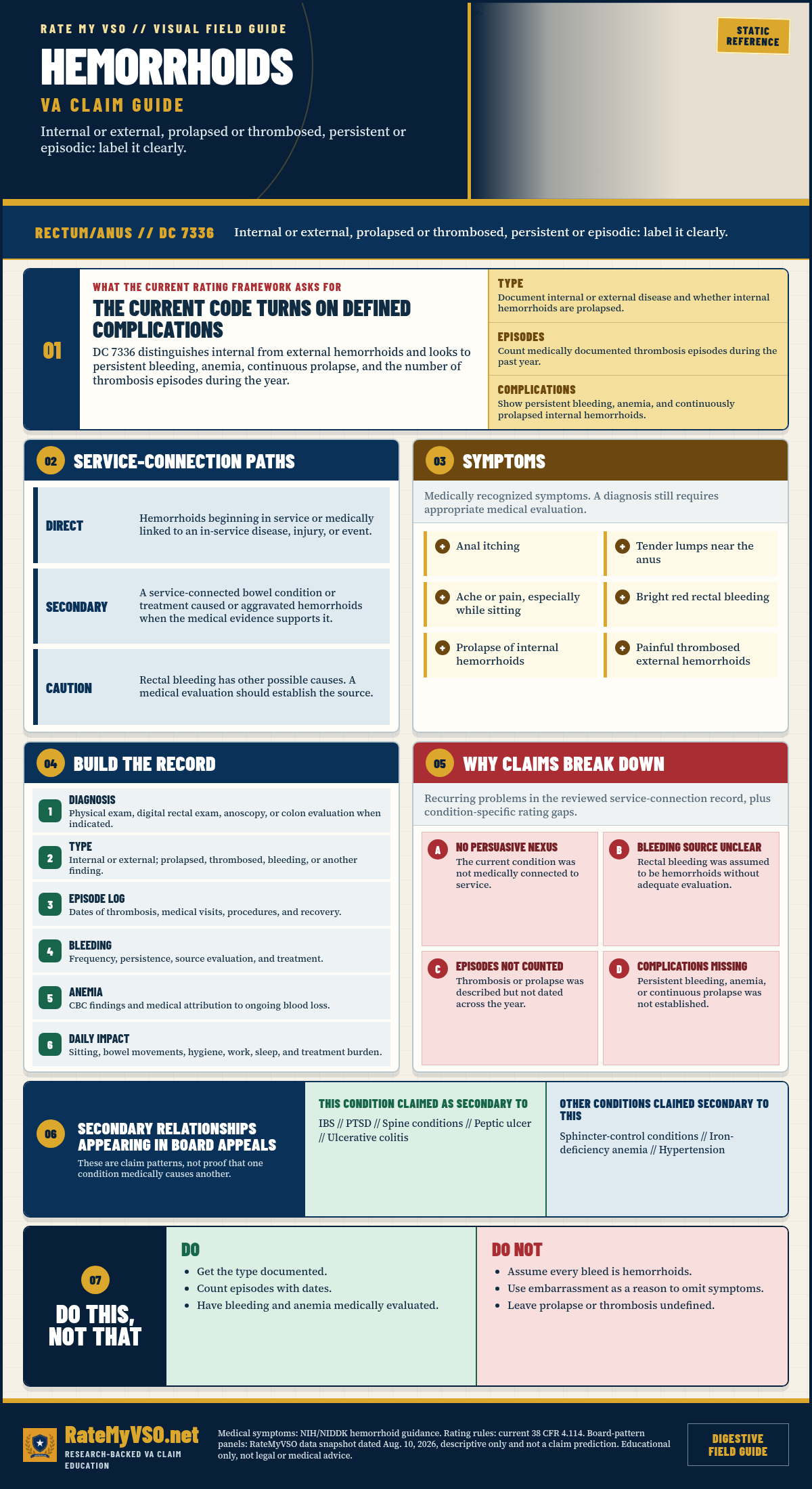 One-page guide: Hemorrhoids Claims in One Page
Hemorrhoids guide covering DC 7336, internal and external findings, thrombosis episodes, prolapse, bleeding, anemia, evidence, and common claim gaps. Opens the full-size chart, free to save or print.
One-page guide: Hemorrhoids Claims in One Page
Hemorrhoids guide covering DC 7336, internal and external findings, thrombosis episodes, prolapse, bleeding, anemia, evidence, and common claim gaps. Opens the full-size chart, free to save or print.
Start with the essentials
- 01Service Connection
The ways service connection can be established for this condition.
- 02Diagnosis and Evidence
Common symptoms and the evidence cited in published Board appeals.
- 03Your History
What you experienced, what others observed, and what treatment changed.
Understand the claim
ICD-10 Diagnosis Codes
The ICD-10 diagnosis codes most commonly used for DC 7336, Hemorrhoids, external or internal (the kind on your medical records, decision letter, or C&P exam report). VA rates the disability and its residuals, not the diagnosis itself, so coding can vary.
How Service Connection Works, At a High Level
Before getting into the specific pathways below, it helps to understand the three things every hemorrhoids claim ultimately has to show on a direct basis. This is the same basic test that applies to any VA disability claim, just applied to this condition.
- A current diagnosis. A doctor has to confirm you actually have hemorrhoids now. Claims have failed before anything else where the exam came back normal and no hemorrhoids were found.
- An in-service event or cause. Proof that hemorrhoids, or their symptoms, began during your service (38 CFR § 3.303). This can come from service treatment records, credible testimony about onset, or statements from people who served with you, or from an already service-connected condition that caused or worsened the hemorrhoids instead.
- A medical nexus. Usually a medical opinion, credible reports of symptoms that never stopped, or a link to another service-connected condition connecting your current hemorrhoids to service.
If the evidence for and against is roughly equal, the tie goes to you under the benefit-of-the-doubt rule (38 CFR § 3.102; 38 USC § 5107(b)).
Service Connection Pathways: Direct and Secondary
Hemorrhoids are not a VA presumptive condition for any exposure category. Service connection must be established through one of the following pathways.
Direct Service Connection
Hemorrhoids that began in service, documented in treatment records or shown continuous since, from the straining, lifting, and diet of military life. Supporting evidence includes service treatment records noting hemorrhoid complaints, credible testimony or buddy statements about onset, and a medical opinion or continuity of symptoms tying the current diagnosis back to service. For combat veterans, lay statements about what happened in service are given added weight under 38 USC § 1154(b). See our Service Connection Guide.
Secondary to IBS or Another Bowel Condition (38 CFR § 3.310)
Hemorrhoids caused or worsened by another service-connected condition that drives chronic straining, such as constipation or diarrhea from irritable bowel syndrome (IBS) or a chronic cough. This is often the stronger path: many veterans win not by proving hemorrhoids started in service, but by showing that a condition VA has already service-connected caused or worsened them. See our Secondary Service Connection Guide and the IBS & IBD Claims Guide.
Secondary to a Chronic Cough
A chronic, service-connected pulmonary or respiratory condition that produces frequent, forceful coughing can create the same repeated straining pattern that causes or worsens hemorrhoids. A medical opinion linking the two should explain the mechanism, not just assert the connection.
Secondary to Medications
Some medications prescribed for a service-connected condition, for example opioids or iron supplements, are constipating and can indirectly cause or worsen hemorrhoids through the same straining mechanism. Under 38 CFR § 3.310 this is an intermediate-step chain, and a nexus opinion should name the specific medication and mechanism.
Service Connection by Aggravation
When a veteran had documented pre-service hemorrhoids that were significantly worsened beyond their natural progression by military service, aggravation-based service connection under 38 CFR § 3.306 is available.
Across published DC 7336 decisions, here is how often the Board granted by the legal theory the claim was argued on:
What VA Looks For: Tests, Records, and Diagnostic Codes
Records to gather for a direct or secondary claim:
- The exam findings: whether the hemorrhoids are internal or external, their size, whether they are thrombotic or irreducible, the presence of excessive redundant tissue, how often they recur, and whether anal fissures are present.
- A blood count: a lab-confirmed anemia diagnosis paired with documented bleeding is what unlocks the highest rating level.
- Treatment records over time: showing the pattern of symptoms and any procedures performed.
- The diagnostic codes involved: DC 7336 for the hemorrhoids themselves, and where relevant DC 7332 (impairment of sphincter control) if there is associated loss of bowel control, plus whatever code applies to the condition you're connecting it to, for example DC 7319 (irritable colon syndrome).
- The actual form the examiner fills out: the Rectum and Anus Disability Benefits Questionnaire (DBQ), discussed in more detail later in this guide.
What Hemorrhoids Are
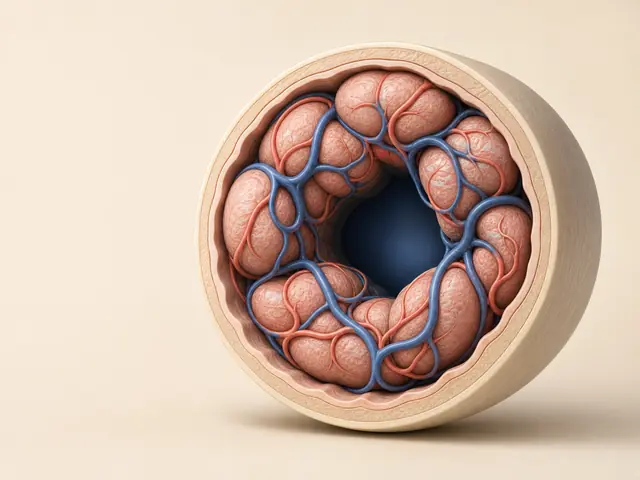
Hemorrhoids are enlarged veins in and around the anus that can bleed, itch, hurt, and sometimes prolapse or clot (thrombose). The VA rates them under diagnostic code 7336, part of the digestive schedule (see 38 CFR § 4.114).
External hemorrhoids form under the skin around the anal opening. They are the type most likely to thrombose (form a painful clot), and swelling or a hard lump is often what a veteran notices first.
Internal hemorrhoids form inside the rectum and are less often painful on their own, but are the more common source of bleeding, and can prolapse (protrude through the anus), especially with straining.
Symptoms and rating
Symptoms Recorded in Granted Hemorrhoids Decisions
We analyzed 450 granted Board decisions involving hemorrhoids for symptoms named in sentences about the condition (rating-criteria recitations excluded). Descriptive of the published record, what the Board wrote down, not a checklist of what to report.
Bar length shows decisions. Percentages remain context.
Detected by phrase-reading the decision text with condition-specific vocabularies. Source: Board of Veterans' Appeals decisions, RateMyVSO analysis.
Current Rating Criteria Under DC 7336
Hemorrhoids are rated under DC 7336, 38 CFR § 4.114. The compensable levels require specific findings, mild or moderate hemorrhoids rate 0 percent no matter how uncomfortable they are.
Evidence and Board research
Evidence That Wins
We analyzed the Board's published DC 7336 decisions: a private nexus opinion in the file goes with a much higher grant rate, shown below.
- A blood count showing anemia, paired with records of persistent rectal bleeding, this is what unlocks the 20 percent level.
- An exam documenting the findings: size, whether they are thrombotic or irreducible, redundant tissue, fissures, and how often they recur.
- Treatment records over time, showing the pattern and any procedures. Records made while you were seeking care are treated as trustworthy, because you had a reason to be honest to get good treatment; post-service treatment records documenting long-standing hemorrhoids can be called highly probative.
- A nexus opinion for a secondary claim, linking the hemorrhoids to a service-connected bowel condition or chronic straining, and explaining why, not just asserting a conclusion. See nexus letters.
- Buddy statements from people who served with you, especially where service records are silent. Statements from fellow service members describing observed in-service hemorrhoid treatment can help fill the gap. See our Buddy & Lay Statements Guide.
- Your own service records, submitted directly if VA's file is incomplete. Sometimes the records that prove your case are ones you have to send in yourself.
- The Rectum and Anus DBQ, which records the findings the rating turns on. See the DBQ guide.
Evidence Cited in Published Hemorrhoids Decisions
We analyzed 9,779 published Board decisions involving hemorrhoids for condition-specific evidence, counting only case-specific mentions (boilerplate recitations excluded). "Favorable" is the share of decisions citing that evidence where every issue was granted or the outcome was mixed; the baseline across all these decisions is 65.7%. Evidence appearing in a decision does not mean it decided the case. Descriptive of the published record, not a prediction.
Bar length shows decisions citing the evidence.
Detected by phrase-reading the decision text with condition-specific vocabularies. Source: Board of Veterans' Appeals decisions, RateMyVSO analysis.
Board Grants, Dissected
The Board decisions below show that hemorrhoid claims are decided on ordinary evidence, not on any special rule. Veterans who won these cases were not required to have hemorrhoids written down in their service medical records. Instead, the Board looked at whether the story held together: credible testimony about symptoms that began in service, a diagnosis at some point after service, and no strong evidence pointing to a different cause. These are examples only. Published Board decisions do not set binding precedent, and each case turns on its own facts.
Marine Corps Reserve status did not defeat a documented hemorrhoidectomy claim Citation A26039000 (April 27, 2026), Hearing docket
The record: The veteran had a hemorrhoidectomy in January 2009 during Marine Corps officer training, followed by continued treatment with suppositories and creams. A November 2019 VA examiner reviewed the records and wrote that the condition "had onset with treatment in service with continued treatments since discharge," finding it at least as likely as not related to service. The RO denied the claim, reasoning the injury did not happen during qualifying active duty. At his hearing, the veteran testified he was on Marine Corps Reserve orders at Officer Candidate School in Quantico when the hemorrhoid became thrombosed and infected, requiring surgery, and that Reserve service records and a treatment note from a nearby Air Force clinic confirmed his status and the timing.
Why it won: The Board found the RO's premise wrong. Service records and the hearing testimony showed the veteran was in fact serving (in the Marine Corps Reserve) when the hemorrhoid occurred, so the in-service element was satisfied. Combined with the positive VA opinion and continued treatment since, the evidence was at least in approximate balance, and the Board resolved doubt in the veteran's favor.
No nexus opinion, but consistent lay statements were enough Citation A26037752 (April 22, 2026), Direct Review docket
The record: Service treatment records did not mention hemorrhoids. At his January 2025 VA examination, the veteran reported hemorrhoids since leaving service, explaining he "just dealt with it" for years before seeking care. VA treatment records showed ongoing treatment for hemorrhoids going back to 2011. There was no medical nexus opinion for or against the claim.
Why it won: The Board found the veteran competent and credible to describe his own symptoms and their onset, citing case law that a lay person can describe observable symptoms like hemorrhoids. Because there was no negative opinion to weigh against his consistent statements, and the record showed longstanding, recurrent symptoms, the Board found the evidence at least in approximate balance and granted the claim.
Hemorrhoids linked to constipation from service-connected IBS Citation A26037507 (April 22, 2026), Direct Review docket
The record: Service treatment records did not show hemorrhoid complaints. A VA examiner in April 2024 found the veteran's hemorrhoids were "secondary to constipation, no connection to diarrhea," and in a related exam characterized his gastrointestinal condition as chronic constipation. A June 2025 rating decision later granted service connection for IBS based on that same constipation.
Why it won: The Board reasoned that although IBS was not yet service-connected when the examiner wrote the opinion, it had since been granted based on the very constipation the examiner tied to the hemorrhoids. That made the only etiology opinion of record supportive once the underlying condition became service-connected. The Board found the evidence at least in approximate balance and granted service connection for hemorrhoids as secondary to IBS.
Combat veteran's hearing testimony carried the claim with no positive nexus opinion Citation A26037030 (April 21, 2026), Hearing docket
The record: Service treatment records did not contain complaints, treatment, or diagnoses of hemorrhoids. At his January 2025 Board hearing, the veteran testified that diarrhea and constipation in service led to fissures and fistulas requiring a medical procedure, and that straining from constipation worsened his hemorrhoids, which have continued since service. There was no positive nexus opinion of record.
Why it won: The Board found the veteran competent and credible to testify to his in-service symptoms and observations, and found him competent to say his in-service hemorrhoid symptoms never resolved and remained symptomatic. With the current diagnosis conceded and credible testimony covering both the in-service event and continuity, the Board granted the claim directly under 38 C.F.R. § 3.303(a), without needing a medical opinion.
Enlistment exam findings helped corroborate onset during a Navy deployment Citation A26035610 (April 16, 2026), Hearing docket
The record: A February 2014 VA treatment record documented hemorrhoids on endoscopy, and the RO had already conceded a current disability. At his August 2024 hearing, the veteran testified that he frequently sat on metal platforms aboard ship and first noticed hemorrhoid symptoms, including pain and bleeding, in the middle of a 1999 deployment. His May 1989 enlistment exam showed a normal anus and rectum, and he denied any rectal disease history at enlistment.
Why it won: The Board found the veteran competent to describe his hemorrhoid symptoms and found his testimony about onset during service credible, partly because the enlistment exam ruled out a pre-existing condition. An April 2018 VA treatment record noting occasional bloody diarrhea supported that his symptoms had persisted. The Board found the evidence at least in approximate balance and granted the claim on a direct basis.
Why These Claims Get Denied
Beyond the general "no diagnosis" and "no nexus" reasons, a few specific denial patterns show up often enough to call out on their own.
- A bare claim with no diagnosis or evidence. If no doctor confirms current hemorrhoids and there is nothing in the record but the veteran's own account, the claim fails before anything else. Exams that come back normal, with no hemorrhoids found, sink the claim at the first element.
- A vague cause like general exposure. A short, general statement that service somehow caused the hemorrhoids is not enough, and will not even trigger a VA exam. Claims that rest on vague chemical or dietary exposure, without a medical opinion explaining a specific mechanism, are weak on their own.
- The veteran's own opinion about the medical cause, without a doctor behind it. A veteran is competent to describe symptoms, but is not treated as qualified to give the medical opinion linking hemorrhoids to service. Claims lose where the only nexus evidence is the veteran's own belief.
- Skipping a scheduled VA examination. If VA schedules an exam and the veteran does not show up without good cause, the Board decides on the existing paper record, which often means a denial.
- Assuming VA already has all your service records. Sometimes the records that prove the case are ones the veteran has to send in directly rather than relying on VA to locate them.
Pitfalls and Common Mistakes
Patterns the published DC 7336 decisions flag most often. Among the Board's classified service-connection denials for hemorrhoids, here is what claims most often fell short on.
- Expecting a compensable rating for pain alone. Mild or moderate hemorrhoids rate 0 percent. The higher levels need specific findings, so aim the evidence at them.
- Documenting bleeding but not anemia. The 20 percent level requires persistent bleeding with secondary anemia, or fissures. Get a blood count to show the anemia.
- Treating 0 percent as a denial. A 0 percent grant establishes service connection, which protects the condition and supports later increases and related secondary claims.
- Skipping the secondary angle. Hemorrhoids driven by a service-connected bowel condition or chronic straining are often the stronger claim. Do not leave that path unclaimed.
- No exam for fissures or thrombosis. These specific findings move the rating. If the exam does not look for them, the finding that earns the rating is missing.
- Leaving loss of bowel control undocumented. If there is fecal leakage or involuntary bowel movements alongside the hemorrhoids, that can be a separate rating under DC 7332; if it is never raised or documented, it goes unrated.
- Letting the onset story shift. When a veteran's account of when symptoms began changes between statements, and the record repeatedly contradicts an in-service onset, that inconsistency itself becomes a reason to discount the claim.
Do's and Don'ts
A condensed version of everything above, in the order it actually matters when you sit down to build your file.
- Get a current diagnosis of hemorrhoids from a doctor and make sure it is in the record.
- Ask VA to consider your hemorrhoids as secondary to any service-connected bowel or stomach condition, such as IBS, or to a chronic cough.
- Get a medical nexus opinion that clearly explains its reasoning, not a bare conclusion.
- Collect statements from people who served with you who knew about your condition.
- Write down when your symptoms started in service and that they have continued to today, and keep that account consistent.
- Go to every VA examination that is scheduled for you.
- Submit your own service records if you have them, in case VA's file is incomplete.
- For a higher rating, report and document any bleeding, anemia, fissures, thrombosis, or loss of bowel control.
- If you were denied before, file a Supplemental Claim with new and relevant evidence rather than starting over.
- Don't file a bare claim with no diagnosis or supporting evidence.
- Don't give only a vague cause like general exposure, it will not even trigger a VA exam.
- Don't rely only on your own opinion about what caused it, causation is treated as a medical question.
- Don't skip a scheduled VA examination without good cause.
- Don't assume VA already has every service record that supports your claim.
- Don't let your story about when symptoms began shift between statements and exams.
- Don't leave loss of bowel control undocumented if it's part of your picture.
- Don't expect a compensable rating for discomfort alone without the specific findings the rating schedule requires.
Secondary relationships
Common Secondary Conditions
Hemorrhoids sit downstream of anything that causes straining, and they connect to other bowel and anal conditions. Each bar below is the Board's grant rate for DC 7336 in that pairing, with the number of decisions under it. They describe the published record across many veterans, not a prediction about any one claim.
Conditions that can cause hemorrhoids (hemorrhoids as the secondary)
Claims where hemorrhoids were argued as secondary to an already service-connected condition, most often a bowel condition that drives chronic straining. This is the "ways to connect via another condition" list, and it's often the easier route into a grant:
Conditions hemorrhoids can cause (hemorrhoids as the primary)
Conditions veterans have claimed as caused or aggravated by service-connected hemorrhoids, most often loss of sphincter control from long-standing hemorrhoid disease:
Prepare and take the next step
Prepare: your own working pages
Optional. These are your own notes, in your own words. They are not a VA form, they are not sent to the VA, and nothing here is a medical finding or a prediction about your claim.
Three reminders while you prepare
- Start with the medical findings
Record the diagnosis, examination findings, and treatment you actually have. Keep bleeding, thrombosis, prolapse, fissures, and anemia separate rather than guessing at a rating. Go to this part
- Then organize the connection to service
Use the guide's direct and secondary pathways to identify the history and records that apply to you. Mark unknown or unavailable records honestly. Go to this part
- Prepare for the next decision point
Use your symptom history, available records, and unanswered questions for a claim, examination, or decision review without writing a medical conclusion for yourself. Go to this part
Sign in or create an account to save your answers and come back to them later. You can fill these in and print them without an account.
Bleeding, episodes, and findings
Treatment and daily impact
Service-connection timeline and questions
Records and unanswered questions
Decision-letter reading sheet
Quick Checklist Before You File
Bring these together before you submit anything.
- A current diagnosis of hemorrhoids from a doctor, confirmed and in the record.
- A request that VA consider your hemorrhoids as secondary to any service-connected bowel or stomach condition, such as IBS, if that applies to you.
- Statements from people who served with you who knew about your condition.
- A written account of when your symptoms started in service and that they have continued to today.
- A medical nexus opinion that clearly explains its reasoning.
- Plans to attend every VA examination scheduled for you.
- Documentation of any bleeding, anemia, fissures, thrombosis, or loss of bowel control, for a higher rating.
- If you were denied before: new and relevant evidence for a Supplemental Claim, not just a repeat of what was already considered.
For the mechanics of actually submitting the claim, see the Standard Claim Guide and the Fully Developed Claim Guide (filing with all your evidence up front can speed up the decision).
The Claims Process, Step by Step
Once you file, your claim moves through a series of hand-offs. Understanding who does what helps you know who to contact, and what to expect, at each stage.
- You file the claim. Directly with VA, through VA.gov, or with the help of an accredited representative.
- VA acknowledges the claim and assigns it for development. A Veteran Service Representative (VSR) is assigned to gather your service treatment records, VA and private medical records, and any other evidence needed.
- The VSR orders a Compensation & Pension (C&P) exam if one is needed. Most hemorrhoids claims involve one, especially secondary claims where a nexus opinion is required.
- The C&P exam is conducted. By a VA clinician or a contracted examiner, who completes the Rectum and Anus Disability Benefits Questionnaire (DBQ) documenting the diagnosis, severity, and, where relevant, a nexus opinion.
- The file goes to a Rating Veteran Service Representative (RVSR), the "rater." The rater reviews the complete file, including the exam results, and decides whether service connection is warranted and at what percentage.
- A senior reviewer may review the decision before it's finalized, depending on the complexity of the claim.
- VA issues the decision letter. This states whether the claim is granted or denied, the rating percentage if granted, and the reasons behind the decision.
- If you disagree, you choose an appeal lane. Higher-Level Review, Supplemental Claim, or a Board appeal, covered later in this guide.
Who's who: VSO vs. VSR vs. Rater vs. C&P Examiner
Your VSO
An accredited representative from a veterans service organization, or an accredited attorney or claims agent. Not a VA employee. Helps you prepare, gather evidence, and file, and can represent you through an appeal. Has no authority to decide your claim.
VSR (Veteran Service Representative)
VA staff who "develops" your claim: requests records, schedules the C&P exam, and assembles the file. Does not decide the rating.
Rater (RVSR)
VA staff who reviews the completed file and makes the actual decision, service connection or denial, and the percentage. This is the person whose judgment the decision letter reflects.
C&P Examiner
A VA clinician or a contracted medical examiner who conducts the exam and completes the DBQ. Documents findings and, where asked, a nexus opinion. Does not decide the claim.
For the full walkthrough of every stage with more detail, see Inside Your Claim and Claim Stages.
DBQs and Your C&P Exam
The Rectum and Anus Disability Benefits Questionnaire (DBQ) is the standardized form an examiner completes for your condition, it structures the exam findings into the specific data points VA's rating schedule requires (size, whether the hemorrhoids are thrombotic or irreducible, redundant tissue, fissures, recurrence, and any sphincter impairment). See the DBQ Guide for how these forms work, including whether a private DBQ completed by your own doctor can be submitted instead of relying solely on a VA exam.
Before your C&P exam, bring a clear, specific account of your symptoms, focus on your worst flare-ups and how the condition affects daily function, not just how you feel on an average day. Report bleeding, anemia symptoms, fissures, and any bowel-control issues directly, since an exam that never asks about them will not document them. Be consistent with what's already in your medical records and prior statements. For a full walkthrough of what to expect and how to prepare, see the C&P Exam Prep Guide and the C&P Exam Guide.
Reading Your Decision Letter, and What to Do If Denied
Your decision letter has two parts: a narrative section explaining the reasoning (often called "reasons and bases"), and a codesheet showing the actual rating percentage, the effective date, and the diagnostic code used. See the Reading Your Decision Letter Guide for how to find and interpret each part, or use the Letter Interpreter tool to upload your own letter and get a plain-English breakdown.
If your claim is denied, or the rating is lower than you expected, you have three main lanes:
- Supplemental Claim: refile with new and relevant evidence, such as a new nexus opinion or updated exam findings. See Supplemental Claim Guide.
- Higher-Level Review (HLR): a senior reviewer looks at the same evidence again for a difference of opinion, no new evidence is added. See HLR Guide.
- Board Appeal: your case goes to a Veterans Law Judge at the Board of Veterans' Appeals, with options for a direct review, an evidence docket, or a hearing. See Board Appeal Guide.
Not sure which lane fits your situation? See the Appeals decision guide for a side-by-side comparison of all three.
After You Win: Rating, Effective Date, and Maintaining It
A grant is not always the end of the story. Keep your treatment consistent, continued follow-up documenting bleeding, anemia, fissures, thrombosis, or bowel-control symptoms protects you if the condition worsens and you need to file for an increase. Not every rating gets reexamined; understand when a rating becomes protected from future review and what to do if VA proposes to reduce it. See Protect Your Rating and Future Reexaminations for the specifics.
On effective dates: if you keep appealing without a gap in your filings, an earlier effective date tied to your original claim can be protected (38 USC § 5110; 38 CFR § 3.400). A condition rated as secondary to hemorrhoids, such as sphincter impairment under DC 7332, cannot be given an effective date earlier than the hemorrhoids themselves.
If your hemorrhoids worsen after the initial grant, for example progressing to frequent thrombosis or new bleeding with anemia, you can file for an increased rating. See the Rating Increase Guide.
References and related resources
Quick Reference Tables
Rating Levels (DC 7336)
| Rating | Finding |
|---|---|
| 20% | Persistent bleeding with secondary anemia, or with anal fissures |
| 10% | Large or thrombotic, irreducible, with excessive redundant tissue, showing frequent recurrences |
| 0% | Mild or moderate |
Secondary Connection Pathways
| Primary Condition | Mechanism | Evidence Needed |
|---|---|---|
| IBS or other bowel condition (DC 7319) | Chronic constipation or diarrhea causing straining | Exam findings + nexus opinion linking bowel condition to hemorrhoids |
| Chronic cough / pulmonary condition | Repeated forceful straining from coughing | Exam findings + nexus opinion naming the mechanism |
| Prescribed medications (opioids, iron supplements) | Constipation causing straining as an intermediate step | Nexus opinion naming the specific medication and mechanism |
From Filing to Decision: Who Does What
| Role | Does | Decides your rating? |
|---|---|---|
| VSO / accredited representative | Helps prepare, gather evidence, and file; represents you on appeal | No |
| VSR | Develops the claim: orders records and the C&P exam | No |
| C&P Examiner | Conducts the exam, completes the DBQ, may give a nexus opinion | No / but has a strong impact |
| Rater (RVSR) | Reviews the full file and decides service connection and percentage | Yes |
Frequently Asked Questions
Why are my hemorrhoids only rated 0 percent?
What does it take to get 20 percent?
Is a 0 percent hemorrhoid rating worthless?
Can I connect hemorrhoids to my IBS?
Do I need a colonoscopy?
Can loss of bowel control be rated separately from hemorrhoids?
What if I miss my scheduled C&P exam?
Related Tools and Guides
Sources
- 38 CFR § 4.114, DC 7336, Schedule of Ratings, Digestive System (Hemorrhoids)
- 38 CFR § 4.114, DC 7332, impairment of sphincter control
- 38 CFR § 3.303, direct service connection, chronic disease and continuity of symptoms
- 38 CFR § 3.310, Secondary Service Connection
- 38 CFR § 3.306, Aggravation of Pre-Service Disability
- 38 CFR § 3.307 and 3.309, presumptive and chronic disease rules
- 38 CFR § 3.304, soundness at entry to service
- 38 CFR § 3.102, reasonable doubt in the veteran's favor
- 38 CFR § 3.400, effective dates
- 38 CFR § 4.3 and 4.7, reasonable doubt and applying the higher of two ratings
- 38 USC § 1110 and 1131, basic service connection
- 38 USC § 1154(b), combat veterans' lay evidence
- 38 USC § 5107(b), benefit of the doubt
- 38 USC § 5110, effective dates
- 38 USC § 1155, rating schedule
- CCK Law, "Hemorrhoids VA Disability Ratings"
- Hill & Ponton, "Hemorrhoids VA Disability Rating"