Hepatitis C Claims Guide
Hepatitis C is a blood-borne virus that can quietly damage the liver for decades before symptoms appear, which is exactly why so many veterans are diagnosed long after service. For a VA claim, the hard part is usually not the rating, it is connecting the infection to an in-service risk factor. This guide explains how service connection works, the risk-factor analysis that wins it, how DC 7354 is rated, the evidence that wins, why these claims get denied, a filing checklist, the claims process step by step, how to read your decision letter, and what to do whether you win or you're denied.
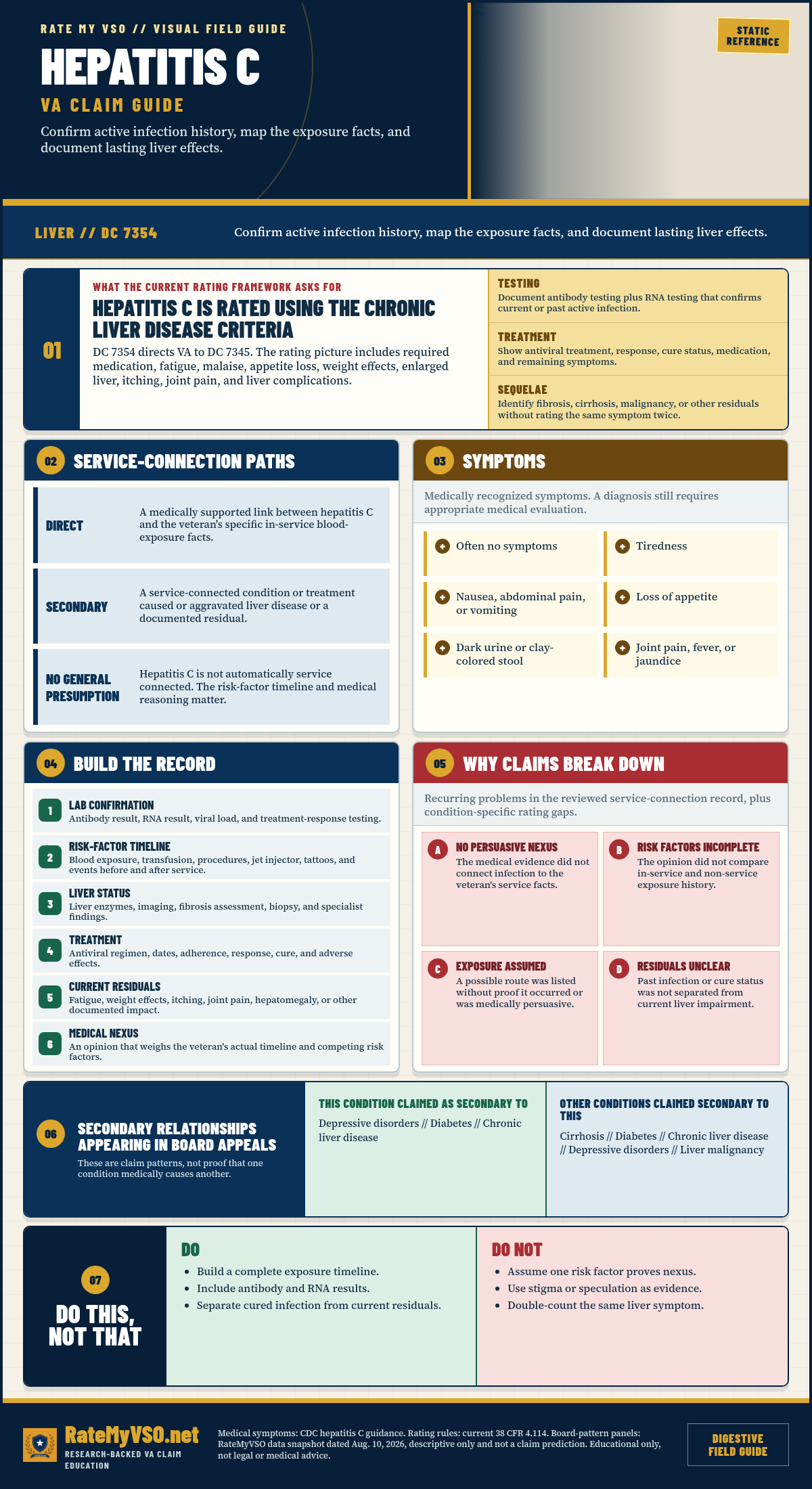 One-page guide: Hepatitis C Claims in One Page
Hepatitis C guide covering DC 7354 and 7345, test confirmation, exposure history, treatment, liver residuals, evidence, and common claim gaps. Opens the full-size chart, free to save or print.
One-page guide: Hepatitis C Claims in One Page
Hepatitis C guide covering DC 7354 and 7345, test confirmation, exposure history, treatment, liver residuals, evidence, and common claim gaps. Opens the full-size chart, free to save or print.
Start with the essentials
- 01Service Connection
The ways service connection can be established for this condition.
- 02Diagnosis and Evidence
Common symptoms and the evidence cited in published Board appeals.
- 03Your History
What you experienced, what others observed, and what treatment changed.
Understand the claim
ICD-10 Diagnosis Codes
The ICD-10 diagnosis codes most commonly used for DC 7354, Hepatitis C (or non-A, non-B hepatitis) (the kind on your medical records, decision letter, or C&P exam report). These ICD-10 codes describe hepatitis C diagnoses in medical records. They are different from the VA's rating codes. The VA identifies hepatitis C under DC 7354 and evaluates it using DC 7345's rating criteria. An ICD-10 code alone does not determine your disability percentage.
How Service Connection Works, At a High Level
Before getting into the risk-factor analysis below, it helps to understand the three things every hepatitis C claim ultimately has to show. This is the same basic test that applies to any VA disability claim (Shedden v. Principi, 381 F.3d 1163 (Fed. Cir. 2004)), just applied to this condition.
- A current diagnosis. Medical evidence that you had hepatitis C when you filed or at some point during the claim. This matters more for hepatitis C than for most conditions because it is now often cured, and VA can deny a claim where the virus was already cleared and caused no symptoms during the review period. The good news is that a diagnosis at any point from filing through the review counts, even if the virus later resolved (McClain v. Nicholson, 21 Vet. App. 319 (2007)).
- An in-service cause. Something in service that could have infected you with this blood-borne virus, such as jet injector ("air gun") vaccinations, a needle stick, or a documented in-service hepatitis infection.
- A medical nexus. A medical opinion connecting your hepatitis C to that in-service cause, and the opinion has to explain its reasoning, not just state a conclusion.
How It Gets Service Connected
Sleep apnea aside, hepatitis C has three established pathways to service connection.
Direct, through a risk factor
The standard path: a current hepatitis C diagnosis, a documented in-service risk factor, and a medical opinion linking the two. The opinion should weigh the in-service risk factor against any post-service ones, since VA will look for and use other risk factors if the medical opinion does not address them. A treating clinician's opinion tying a documented in-service blood test to the infection, or a private opinion that discusses the veteran's specific risk factors and cites supporting medical literature, carries real weight. An opinion that is only data and a conclusion, with no reasoning, is given little weight.
Secondary, through a service-connected condition
If a service-connected condition led to your hepatitis C, you can win on a secondary basis (38 CFR § 3.310), which needs a current disability caused or aggravated by a service-connected disability. One documented pathway is a multi-step causal chain: a veteran's service-connected PTSD led to intravenous drug use, which in turn caused the hepatitis C. This is a real, but-for causal chain, distinct from arguing that drug use itself is the in-service event (which is not service-connectable on its own). See our Secondary Service Connection Guide and PTSD Claims Guide.
Related liver conditions, once hepatitis C is service connected
Once hepatitis C is service connected, the damage it causes can be added on. Cirrhosis of the liver (DC 7312) and esophageal varices have been granted as secondary to service-connected hepatitis C. But-for causation covers multi-causal links, so other contributing factors, such as alcohol use, do not automatically defeat a secondary liver-disease claim on their own.
Across published DC 7354 decisions, here is how often the Board granted by the legal theory the claim was argued on:
What VA Looks For: Tests, Records, and Diagnostic Codes
Records to gather for a direct or secondary claim:
- Lab confirmation: a positive HCV antibody test followed by a confirmatory HCV RNA (viral load) test, and, where relevant, the genotype.
- Liver function and imaging: liver enzyme panels, imaging (ultrasound, FibroScan, or biopsy) showing whether fibrosis or cirrhosis has developed, and any weight-loss or malnutrition documentation.
- Treatment records: antiviral treatment history (including whether the virus was cleared), and ongoing follow-up for any residual liver damage.
- The diagnostic codes involved: DC 7354 for hepatitis C itself (rated under the same criteria as DC 7345, chronic liver disease without cirrhosis), DC 7312 if cirrhosis has developed, and whatever code applies to a secondary condition you're connecting it to, for example PTSD if you are pursuing the drug-use causal chain described below.
- The actual form the examiner fills out: the Liver Conditions Disability Benefits Questionnaire (DBQ), discussed in more detail later in this guide.
What Hepatitis C Is
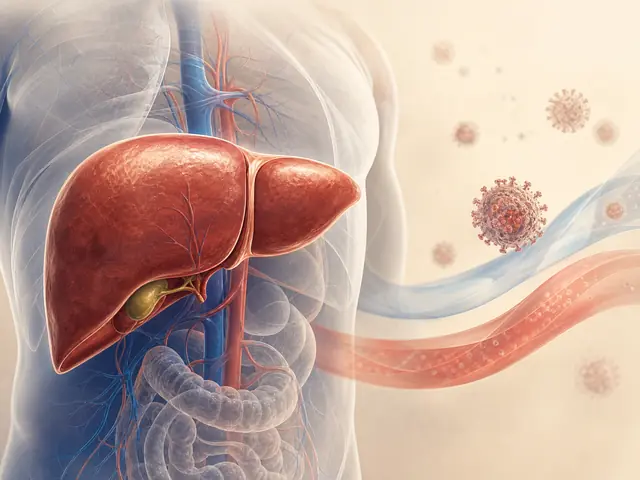
Hepatitis C is a virus spread through blood-to-blood contact that infects the liver. Many people have no symptoms for years, then develop fatigue, nausea, joint pain, and, if it progresses, liver scarring (cirrhosis) or liver cancer. The VA rates it under diagnostic code 7354, part of the digestive schedule (see 38 CFR § 4.114).
In-Service Risk Factors (This Is the Whole Claim)
Because hepatitis C usually is not diagnosed until years after service, winning service connection means identifying a blood-exposure risk factor that happened during service and linking the infection to it. The recognized in-service risk factors include:
- Air-gun (jet injector) immunizations. The reused, high-pressure injectors that vaccinated whole units, especially before the late 1990s, could carry blood between recipients. This is the most-cited in-service risk factor.
- Blood transfusions, particularly before reliable hepatitis C screening existed.
- Combat or medic blood exposure, treating wounded, handling blood, or being wounded.
- Shared razors, and unregulated tattoos or piercings received in service.
- Occupational exposure for medical and dental personnel (needlesticks), including needle sticks while handling bloody hospital laundry, and documented in-service hospitalization for hepatitis.
Symptoms and rating
Symptoms Recorded in Granted Hepatitis C and chronic liver disease Decisions
We analyzed 1,037 granted Board decisions involving hepatitis c and chronic liver disease for symptoms named in sentences about the condition (rating-criteria recitations excluded). Descriptive of the published record, what the Board wrote down, not a checklist of what to report.
Bar length shows decisions. Percentages remain context.
Detected by phrase-reading the decision text with condition-specific vocabularies. Source: Board of Veterans' Appeals decisions, RateMyVSO analysis.
How the VA Rates Hepatitis C (DC 7354)
The VA identifies hepatitis C under DC 7354 and uses DC 7345 to determine the percentage. The current criteria consider the liver disease, treatment, weight loss, and listed symptoms. They took effect on May 19, 2024. The rules are in 38 CFR § 4.114.
These are the current criteria. Earlier rating periods may be evaluated under different rules, so an older decision or an existing 10 percent rating is not automatically wrong.
Evidence and Board research
Evidence That Wins
We analyzed the Board's published DC 7354 decisions: a private nexus opinion in the file goes with a much higher grant rate, shown below.
- Proof of an in-service risk factor: immunization records showing air-gun shots, transfusion records, a combat or medic role, or a documented needlestick. A signed statement about how the exposure happened helps.
- A nexus opinion that names the in-service risk factor and explains why it is at least as likely as post-service factors to be the source. This is the heart of the claim. Opinions that discuss the veteran's specific risk factors and cite supporting medical literature, applied to the veteran's own facts, are given significant weight; an opinion built on inaccurate history (for example, weight loss the records don't actually show) carries no weight. See nexus letters.
- Current medical records confirming the diagnosis, your symptoms, lab results, any weight loss, liver imaging, and treatment history, including whether the virus was later cleared.
- A treatment, weight and symptom record, since the rating turns on the treatment you require, your weight change against baseline, the listed symptoms, and any remaining liver disease.
- Buddy and family statements that rule out other causes. Because VA looks for non-service risk factors, statements from people who know you can help establish the in-service event and confirm you had no other recognized risk factor (no drug use, no tattoos, no transfusions outside service). A spouse's or family member's firsthand account of an in-service diagnosis or symptom onset is competent, credible evidence.
- The Liver Conditions DBQ, which records the symptoms, weight loss, treatment, and liver findings an examiner documents. See the DBQ guide.
Evidence Cited in Published Hepatitis C and chronic liver disease Decisions
We analyzed 15,320 published Board decisions involving hepatitis c and chronic liver disease for condition-specific evidence, counting only case-specific mentions (boilerplate recitations excluded). "Favorable" is the share of decisions citing that evidence where every issue was granted or the outcome was mixed; the baseline across all these decisions is 49.5%, combining every diagnostic code below. Evidence appearing in a decision does not mean it decided the case. Descriptive of the published record, not a prediction.
Bar length shows decisions citing the evidence.
By diagnostic code
These codes are grouped together above. They do not perform the same, so find your own code here rather than reading the combined figure. A code retired in the schedule rewrites appears without a link, because its decisions were judged under criteria that no longer apply.
Bar length shows published decisions reviewed.
Detected by phrase-reading the decision text with condition-specific vocabularies. Source: Board of Veterans' Appeals decisions, RateMyVSO analysis.
Board Grants, Dissected
The Board has granted direct service connection for hepatitis C in a number of published decisions. Board decisions are not binding precedent and each case turns on its own record, but these cases show a consistent pattern: veterans who lacked common risk factors for hepatitis C, who could point to a specific in-service exposure such as air gun (jet injector) inoculations or an in-service hepatitis diagnosis, and who supported the claim with a detailed medical opinion, fared well when the opposing VA opinion was thin or based on an inaccurate history.
Air gun inoculations linked to hepatitis C and resulting cirrhosis Citation A26038279 (April 23, 2026), Hearing docket
The record: The veteran testified that he received inoculations from a "jet air gun" during basic training and had none of the usual risk factors for hepatitis C. A May 2019 VA examiner gave a negative opinion, citing VBA Fast Letter 04-13 for the claim that air gun transmission is not supported. The Board found that the examiner "fundamentally mischaracterized" the letter, which actually states that such transmission is "biologically plausible." A July 2025 private clinician gave a detailed positive opinion, explaining how jet injector guns could retain blood residue, ruling out other risk factors, and matching the veteran's 37-year interval to cirrhosis with the known natural history of untreated hepatitis C.
Why it won: The Board found the May 2019 VA exam inadequate because it misread its own cited authority and did not address the veteran's lack of other risk factors. The private opinion was found to have "at least as much probative value" because it was based on an accurate history with clear supporting data. The Board resolved doubt in the veteran's favor.
Conceded air gun exposure outweighs one negative opinion, several conditions follow secondarily Citation A26034159 (April 14, 2026), Hearing docket
The record: VA had already conceded that the veteran received air gun inoculations at enlistment. A VA physician, a VA gastroenterologist, and a VA nurse practitioner all wrote letters over several years supporting a link between the air gun inoculations and hepatitis C. One VA examiner in December 2019 wrote a negative opinion citing a history of intravenous heroin use recorded in two mental health notes. The veteran had otherwise consistently denied intravenous drug use.
Why it won: The Board weighed multiple favorable VA treatment notes and opinions against a single negative opinion resting on two isolated notations that the veteran had otherwise contradicted. With only one opinion against the claim, the Board resolved reasonable doubt in the veteran's favor. Cirrhosis, diabetes, esophageal varices, hepatic encephalopathy, and splenomegaly were then granted as secondary to the now-service-connected hepatitis C.
Private doctor's rationale beats VA's "no other risk factors" gap Citation A26033594 (April 10, 2026), Hearing docket
The record: The veteran's claim was readjudicated after a private physician, Dr. R.P., submitted a report tying hepatitis C (along with lung nodules, calluses, and flat feet) to service. Dr. R.P. explained that hepatitis C testing did not exist until the late 1980s, so the absence of an earlier diagnosis was not evidence against the claim. She linked the veteran's report of mass immunizations by jet injector to a recognized transmission risk, citing medical literature.
Why it won: The Board called Dr. R.P.'s report "highly probative" because of its thorough rationale, citations, and attention to the veteran's specific history. Even though negative VA opinions existed in the file, the Board resolved doubt in the veteran's favor based on the private report.
In-service hepatitis diagnosis, decades of consistent lay statements, and two private opinions outweigh three inadequate VA opinions Citation A26027639 (March 26, 2026), Hearing docket
The record: The veteran was hospitalized for 44 days in service and discharged with a diagnosis of "infectious Hepatitis, Au+." He testified consistently across decades that he was stuck by needles handling contaminated hospital linens. Three VA opinions (May 2002, September 2016, February 2019) found against the claim, with the September 2016 and February 2019 opinions relying on a mischaracterization of "Au+" as hepatitis A rather than hepatitis B antigen testing. Two private physicians, in September and December 2019, reviewed the records and opined the hepatitis C was related to the in-service hepatitis diagnosis.
Why it won: The Board found the VA opinions inadequate because they mischaracterized the record and discounted the veteran's competent, credible, and consistent lay statements about continuity of symptoms. The Board noted that hepatitis C could not even be diagnosed at the time of the veteran's 1971 hospitalization, so the absence of that specific diagnosis in the service records was not negative evidence. The two private opinions were found adequate and persuasive, and the Board resolved doubt in the veteran's favor. Cirrhosis of the liver was granted secondary to the newly service-connected hepatitis C.
Conflicting VA opinions on jet injector inoculations, tie goes to the veteran Citation A26023449 (March 16, 2026), Hearing docket
The record: An August 2019 VA examiner opined that the veteran's hepatitis C was at least as likely as not related to jet injector inoculations in service, explaining that hepatitis C could not even be tested for until 1990 and that policy changes were later made because of the risk of transmission through this inoculation method. A December 2019 addendum by a different VA examiner reached the opposite conclusion, citing years of gaps in care and no documented liver complaints at separation.
Why it won: The Board found both opinions competent and probative, creating an approximate balance of evidence. Quoting the "tie goes to the runner" language from Gilbert v. Derwinski, the Board resolved the doubt in the veteran's favor.
Why These Claims Get Denied
Beyond the general "no nexus" and "no diagnosis" reasons, a few specific denial patterns show up often enough in published DC 7354 decisions to call out on their own.
- A cleared infection with no symptoms during the claim. Hepatitis C can now be cured. Where the virus was already cleared and caused no symptoms during the review window, the claim can fail for lack of a current disability, even though a diagnosis at any point during the claim would have been enough.
- The veteran's own opinion standing in for a medical link. A veteran can describe symptoms and what happened to them, but the cause of hepatitis C is treated as a medical question. A personal belief that service caused the infection, without a supporting medical opinion, does not carry the claim.
- An unexplained theory with a documented alternative cause in the record. A claim resting only on the air-gun theory, with no supporting medical opinion, has been denied where the record separately documented a post-service risk factor.
- Post-service risk factors left unaddressed. VA will identify and weigh other risk factors on its own, including a long post-service gap combined with high-risk activity. A nexus opinion silent on those factors is vulnerable.
- A private opinion built on facts the record doesn't support. An opinion that relies on symptoms or history, such as weight loss, that the actual records do not show during the period at issue carries no weight.
Pitfalls and Common Mistakes
The same handful of missteps account for most lost or under-rated hepatitis C claims. Among the Board's classified service-connection denials for hepatitis C, here is what claims most often fell short on:
- Not identifying a specific in-service risk factor. "I must have caught it in the military" does not win. Name the risk factor, air-gun shots, a transfusion, a combat exposure, and support it.
- A nexus that ignores post-service risk factors. A strong opinion weighs the in-service exposure against any later ones and explains why service is at least as likely the source.
- Assuming a cure means no rating. Even after the virus is cleared, remaining symptoms and liver damage, including cirrhosis, are still rated, as long as a diagnosis or symptoms existed at some point during the claim.
- Letting drug-use history frame the claim. Hepatitis C from in-service IV or intranasal drug use is generally not service-connected as a direct claim. Build the claim on a recognized, non-misconduct risk factor, or on the PTSD-to-drug-use secondary chain if the facts support it.
- Not documenting the treatment, weight and symptoms. The rating turns on the treatment your liver disease requires, weight loss measured against your baseline, and the listed symptoms. Dated records of all three support a higher level.
- Expecting extra pay for symptoms already counted. Fatigue and weakness already compensated under a separate cirrhosis rating cannot also increase the hepatitis C rating (no pyramiding, 38 CFR § 4.14).
Do's and Don'ts
A condensed version of everything above, in the order it actually matters when you sit down to build your file.
- Document that you were diagnosed with hepatitis C when you filed or at some point during the review, even if it was later cured.
- Get a nexus opinion that explains its reasoning, not just a bare conclusion, and cites your specific risk factors.
- Name a specific in-service blood exposure: air-gun shots, a transfusion, a combat or medic exposure, a needle stick.
- Gather buddy or family statements confirming the in-service event and that you had no other risk factors.
- Give an honest account of any post-service risk factors, with your own explanation.
- If a service-connected condition (like PTSD) led to your hepatitis C through drug use, raise it as a secondary claim.
- Claim the related liver conditions, cirrhosis or esophageal varices, once hepatitis C is service connected.
- Keep a dated record of your symptoms, prescribed treatment, and weight changes.
- Don't assume a cured infection with no symptoms during the claim wins on its own.
- Don't rely only on your own opinion about how you got infected, causation is treated as a medical question.
- Don't lean on the air-gun theory alone with no supporting medical opinion behind it.
- Don't ignore your post-service risk factors, VA will find and weigh them even if you don't address them.
- Don't let a nexus opinion rest on facts the records don't actually support.
- Don't let in-service drug use frame a direct claim, it's generally treated as willful misconduct.
- Don't expect a higher hepatitis C rating for symptoms already compensated under a separate cirrhosis rating.
Secondary relationships
Secondary Conditions
Chronic liver disease reaches into the rest of the body, so hepatitis C connects to other claims in both directions. Each bar below is the Board's grant rate for DC 7354 in that pairing, with the number of decisions under it. They describe the published record across many veterans, not a prediction about any one claim.
Conditions linked as causing hepatitis C (hepatitis C as the secondary)
Claims where hepatitis C was argued as secondary to an already service-connected condition. Beyond the PTSD-to-drug-use chain described above, this is the "ways to connect via another condition" list:
Conditions hepatitis C is linked to causing (hepatitis C as the primary)
Conditions veterans have claimed as caused or aggravated by service-connected hepatitis C, as the liver disease progresses, including cirrhosis and esophageal varices:
Note: this page discusses DC 7354 and its DC 7312/7345 rating relationship in prose above rather than as a separate live data widget; a dedicated widget was not added because those two codes don't otherwise appear as their own tracked condition on this page.
Prepare and take the next step
Prepare: your own working pages
Optional. These are your own notes, in your own words. They are not a VA form, they are not sent to the VA, and nothing here is a medical finding or a prediction about your claim.
Three reminders while you prepare
- Build one complete risk-factor timeline
List possible in-service and post-service risk factors with dates and records. Do not omit a factor because it appears unfavorable; the medical reviewer needs the full history. Go to this part
- Keep diagnosis, current residuals, and treatment distinct
Organize testing, treatment response, current symptoms, and residual conditions as the record describes them. Go to this part
- Use evidence without writing the nexus yourself
A timeline helps a clinician evaluate the history. The cause and medical connection remain medical questions, and the Board figures describe published decisions rather than your odds. Go to this part
Sign in or create an account to save your answers and come back to them later. You can fill these in and print them without an account.
Risk-factor and exposure timeline
Diagnosis, testing, and treatment
Symptoms, functional effects, and medical questions
Records and unanswered questions
Decision-letter reading sheet
Quick Checklist Before You File
Bring these together before you submit anything.
- Records showing you were diagnosed with hepatitis C when you filed or during the review, even if it was later cured.
- A written statement describing the exact in-service blood exposure (jet injector shots, a needle stick, or similar) and when it happened.
- A medical nexus opinion that explains, with reasons, why service caused your hepatitis C, and that addresses any post-service risk factors.
- Buddy or family statements confirming the in-service event and that you had no other risk factors.
- An honest account of any post-service risk factors, along with your explanation.
- If a service-connected condition (like PTSD) led to your hepatitis C, evidence of that connection for a secondary claim.
- Records of related liver conditions (cirrhosis, varices) and your current symptoms for the rating.
- If you were denied before: new and relevant evidence for a Supplemental Claim, not just a repeat of what was already considered.
For the mechanics of actually submitting the claim, see the Standard Claim Guide and the Fully Developed Claim Guide.
The Claims Process, Step by Step
Once you file, your claim moves through a series of hand-offs. Understanding who does what helps you know who to contact, and what to expect, at each stage.
- You file the claim. Directly with VA, through VA.gov, or with the help of an accredited representative.
- VA acknowledges the claim and assigns it for development. A Veteran Service Representative (VSR) is assigned to gather your service treatment records, VA and private medical records, and any other evidence needed.
- The VSR orders a Compensation & Pension (C&P) exam if one is needed. Most hepatitis C claims do, especially where a nexus opinion addressing risk factors is required.
- The C&P exam is conducted. By a VA clinician or a contracted examiner, who completes the Liver Conditions Disability Benefits Questionnaire (DBQ) documenting the diagnosis, severity, and, where relevant, a nexus opinion.
- The file goes to a Rating Veteran Service Representative (RVSR), the "rater." The rater reviews the complete file, including the exam results, and decides whether service connection is warranted and at what percentage.
- A senior reviewer may review the decision before it's finalized, depending on the complexity of the claim.
- VA issues the decision letter. This states whether the claim is granted or denied, the rating percentage if granted, the effective date, and the reasons behind the decision.
- If you disagree, you choose an appeal lane. Higher-Level Review, Supplemental Claim, or a Board appeal, covered later in this guide.
Who's who: VSO vs. VSR vs. Rater vs. C&P Examiner
Your VSO
An accredited representative from a veterans service organization, or an accredited attorney or claims agent. Not a VA employee. Helps you prepare, gather evidence, and file, and can represent you through an appeal. Has no authority to decide your claim.
VSR (Veteran Service Representative)
VA staff who "develops" your claim: requests records, schedules the C&P exam, and assembles the file. Does not decide the rating.
Rater (RVSR)
VA staff who reviews the completed file and makes the actual decision, service connection or denial, and the percentage. This is the person whose judgment the decision letter reflects.
C&P Examiner
A VA clinician or a contracted medical examiner who conducts the exam and completes the DBQ. Documents findings and, where asked, a nexus opinion. Does not decide the claim.
For the full walkthrough of every stage with more detail, see Inside Your Claim and Claim Stages.
DBQs and Your C&P Exam
The Liver Conditions Disability Benefits Questionnaire (DBQ) is the standardized form an examiner completes for your condition. It records your diagnosis, treatment, symptoms, weight, and liver findings. A DBQ may still carry questions left over from older versions of the rating schedule, so what the form records is not the same as what the current criteria require. See the DBQ Guide for how these forms work, including whether a private DBQ completed by your own doctor can be submitted instead of relying solely on a VA exam.
Before your C&P exam, bring a clear, specific account of your symptoms, the treatment you have been prescribed, and any weight change, and be consistent with what's already in your medical records and prior statements. For a full walkthrough of what to expect and how to prepare, see the C&P Exam Prep Guide.
Reading Your Decision Letter, and What to Do If Denied
Your decision letter has two parts: a narrative section explaining the reasoning (often called "reasons and bases"), and a codesheet showing the actual rating percentage, the effective date, and the diagnostic code used. See the Reading Your Decision Letter Guide for how to find and interpret each part, or use the Letter Interpreter tool to upload your own letter and get a plain-English breakdown.
Effective dates generally run from the date you filed, and the earliest possible date has been upheld where no earlier claim existed. Where a confusing VA letter misled a veteran about a deadline, an earlier effective date has been granted through equitable tolling. See 38 CFR § 3.400.
If your claim is denied, or the rating is lower than you expected, you have three main lanes:
- Supplemental Claim: refile with new and relevant evidence, such as a new nexus opinion, updated lab work, or newly identified risk-factor documentation. See Supplemental Claim Guide.
- Higher-Level Review (HLR): a senior reviewer looks at the same evidence again for a difference of opinion, no new evidence is added. See HLR Guide.
- Board Appeal: your case goes to a Veterans Law Judge at the Board of Veterans' Appeals, with options for a direct review, an evidence docket, or a hearing. See Appeals Guide.
Not sure which lane fits your situation? See the Appeals decision guide for a side-by-side comparison of all three.
After You Win: Maintaining Your Rating
A grant is not always the end of the story, and for hepatitis C, several claims that reach the Board are actually about the rating percentage or the effective date after service connection was already established, not the service-connection fight itself. Keeping consistent follow-up records, including any liver imaging and lab work, protects both your current rating and any future request for an increase.
Not every rating gets reexamined; understand when a rating becomes protected from future review (including Permanent and Total status) and what to do if VA proposes to reduce it. See Protect Your Rating and Future Reexaminations for the specifics.
If your liver disease worsens after the initial grant, for example progressing toward cirrhosis, you can file for an increased rating or claim the related liver condition as secondary. See the Rating Increase Guide.
References and related resources
Quick Reference
Rating Levels (DC 7354, per DC 7345 criteria)
| Rating | What it takes |
|---|---|
| 100% | Progressive chronic liver disease requiring both parenteral antiviral therapy and parenteral immunomodulatory therapy, and for six months after treatment stops |
| 60% | Progressive chronic liver disease requiring continuous medication and causing substantial weight loss and at least two of: daily fatigue, malaise, anorexia, hepatomegaly, pruritus, arthralgia |
| 40% | Progressive chronic liver disease requiring continuous medication and causing minor weight loss and at least two of that same six-symptom list |
| 20% | Chronic liver disease with at least one of: intermittent fatigue, malaise, anorexia, hepatomegaly, pruritus |
| 0% | Nonsymptomatic |
Service Connection Pathways
| Pathway | Mechanism | Evidence Needed |
|---|---|---|
| Direct, via risk factor | In-service blood exposure (air gun, transfusion, combat/medic exposure, needlestick) | Documented exposure + nexus opinion weighing it against post-service factors |
| Secondary, via PTSD | Service-connected PTSD leads to IV drug use, which causes the infection | Nexus opinion establishing the full causal chain |
| Related liver conditions | Cirrhosis (DC 7312) or esophageal varices develop from service-connected hepatitis C | Medical records documenting the liver disease progression |
From Filing to Decision: Who Does What
| Role | Does | Decides your rating? |
|---|---|---|
| VSO / accredited representative | Helps prepare, gather evidence, and file; represents you on appeal | No |
| VSR | Develops the claim: orders records and the C&P exam | No |
| C&P Examiner | Conducts the exam, completes the DBQ, may give a nexus opinion | No / but has a strong impact |
| Rater (RVSR) | Reviews the full file and decides service connection and percentage | Yes |
Frequently Asked Questions
How do I connect hepatitis C to my service?
Is the air-gun immunization theory real?
My hepatitis C was cured. Can I still get a rating?
What if drug use is in my records?
Can I get service connection for the liver damage hepatitis C causes?
What is the highest hepatitis C rating?
Related Tools and Guides
Sources
- 38 CFR § 4.114, Diagnostic Codes 7354 and 7345 (rating hepatitis C using the chronic-liver-disease criteria), including Notes 1 through 4
- 89 FR 19735, Schedule for Rating Disabilities: The Digestive System, final rule published March 20, 2024, effective May 19, 2024 (the amendment that replaced the earlier incapacitating-episode criteria)
- 38 CFR § 4.112, definitions of substantial and minor weight loss
- 38 CFR § 3.105(e), notice and reduction procedure applied after the mandatory post-treatment examination
- 38 CFR § 4.114, Diagnostic Code 7312, rating cirrhosis of the liver
- 38 CFR § 3.303, direct service connection: a current disability, an in-service event, and a link between them
- 38 CFR § 3.310, secondary service connection, caused or aggravated by a service-connected disability
- 38 CFR § 3.102 and 38 U.S.C. § 5107(b), benefit of the doubt when the evidence is nearly equal
- 38 CFR § 4.14, no pyramiding, the same symptoms cannot be rated twice
- 38 CFR § 3.400, effective dates
- 38 CFR § 3.156 and 3.2501, new and relevant evidence to reopen a claim
- Shedden v. Principi, 381 F.3d 1163 (Fed. Cir. 2004), the three elements of service connection
- McClain v. Nicholson, 21 Vet. App. 319 (2007), a current disability counts if present at any time during the pendency of the claim
- Spicer v. McDonough, 61 F.4th 1360 (Fed. Cir. 2023), but-for causation standard for secondary service connection
- CCK Law, hepatitis C
- Hill & Ponton, hepatitis C
Educational only, not legal advice, and not a prediction of any individual claim. Rating criteria change; confirm current details in 38 CFR § 4.114. For help with your claim, find a VA-accredited representative.