Scars and Burns Claims Guide
Scars, including burn scars and surgical scars, are one of the most common VA disabilities, and they are rated under a flexible set of codes (38 CFR 4.118, DC 7800 to 7805) that often let you collect more than one rating at once. This guide walks the whole path: how service connection works, how a scar gets connected to your service (directly, secondary to another condition, or by aggravation), how the five scar codes are rated and how they stack, the evidence that wins, why these claims get denied, a checklist before you file, what the claims process looks like step by step, how to read your decision letter, and what to do whether you win or you're denied.

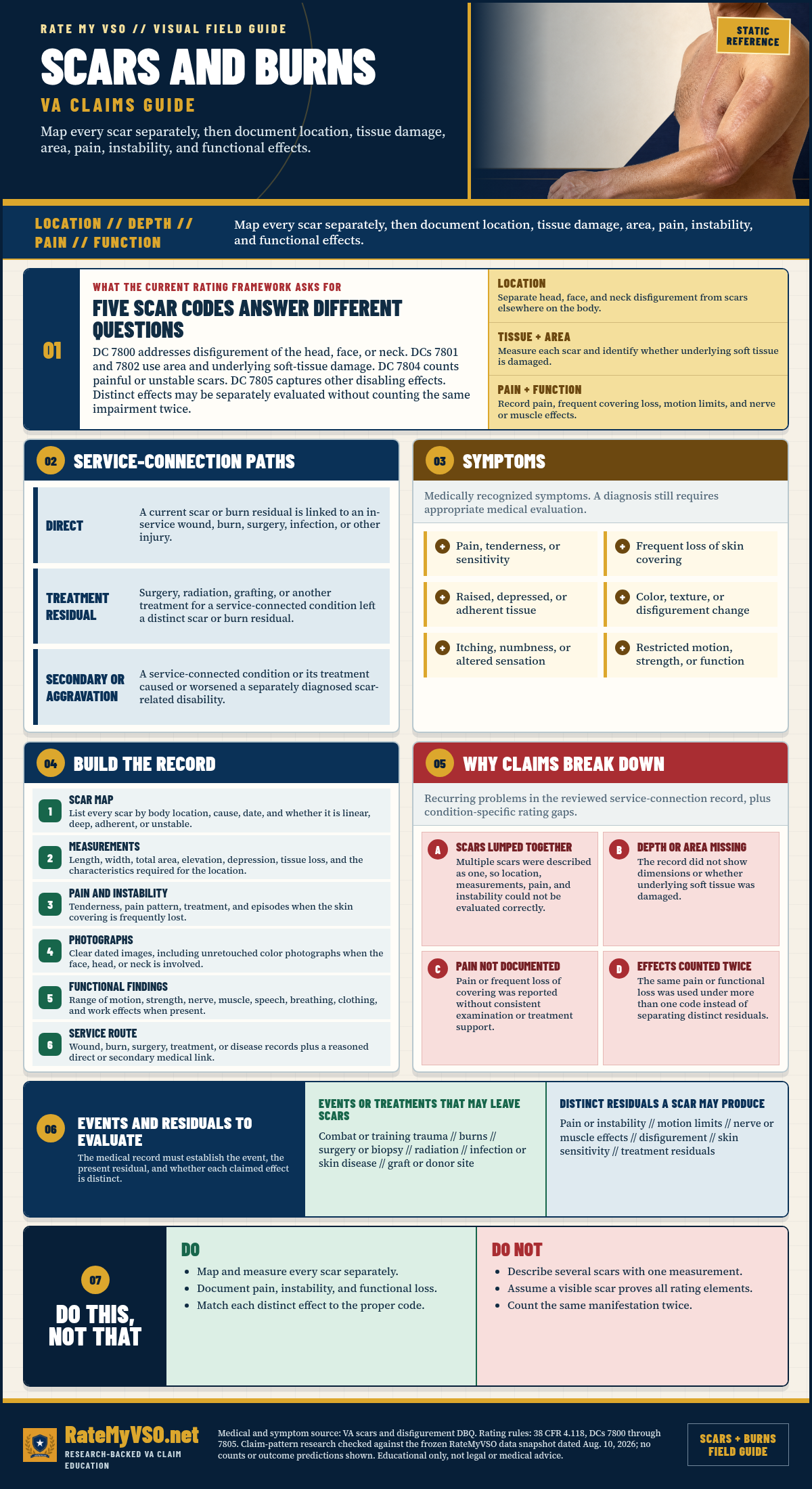 One-page guide: Scars and Burns Claims in One Page
Scars and burns guide covering the five scar codes, location, tissue damage, area, pain, instability, disfigurement, function, service paths, evidence, and common claim gaps. Opens the full-size chart, free to save or print.
One-page guide: Scars and Burns Claims in One Page
Scars and burns guide covering the five scar codes, location, tissue damage, area, pain, instability, disfigurement, function, service paths, evidence, and common claim gaps. Opens the full-size chart, free to save or print.
Start with the essentials
- 01Service Connection
The ways service connection can be established for this condition.
- 02Diagnosis and Evidence
Common symptoms and the evidence cited in published Board appeals.
- 03Your History
What you experienced, what others observed, and what treatment changed.
Understand the claim
Types of Scars This Guide Covers
Whatever caused it, a scar is rated the same way once it's in the file. The three most common origins:
- Surgical scars. Left behind by a surgery, biopsy, or other procedure. If the surgery was to treat a service-connected condition, the scar is a residual of that condition and is service connectable on a secondary basis.
- Burn scars. From a burn injury in service. Burns are rated through their residuals, meaning the scarring and any lasting functional loss they left behind, using the same five scar codes described in this guide.
- Scars from other causes. Lacerations, shrapnel, blast injury, or any other wound sustained during service.
All three origins are evaluated under the identical rating schedule at 38 CFR § 4.118. What matters for the rating is the scar's characteristics (pain, stability, area, location, and any functional effect), not how it was caused.
ICD-10 Diagnosis Codes
The ICD-10 diagnosis codes most commonly used for DC 7804, Scar(s), unstable or painful (the kind on your medical records, decision letter, or C&P exam report). VA rates the disability and its residuals, not the diagnosis itself, so coding can vary.
How Service Connection Works, At a High Level
Before getting into the specific pathways below, it helps to understand the three things every scar claim ultimately has to show, if the scar is not already service connected. This is the same basic test that applies to any VA disability claim, just applied to scars.
- A current scar. A scar that exists now. This is usually the easiest element, a VA examiner can see and measure it directly.
- An in-service cause, or a service-connected condition behind it. The injury, burn, surgery, or in-service event that left the scar, or a disability VA has already service-connected whose treatment (for example, a surgery or biopsy) caused it.
- A link (nexus) connecting the scar to that cause. For a scar left by treatment of an already service-connected condition, this is the "secondary" pathway, and the link is often straightforward once the surgery or treatment records are in the file.
Getting Scars and Burns Service Connected
Most scar and burn claims are established through one of the following pathways.
Direct Service Connection
A burn, laceration, shrapnel or blast injury, or other wound during service, with the scar as the current residual. Supporting evidence includes service treatment records documenting the injury, and a current exam confirming the scar and its characteristics. See our Service Connection Guide.
Secondary Service Connection, Surgical Scars (38 CFR § 3.310)
If you had surgery, a biopsy, or other treatment for a service-connected condition, the surgical scar left behind is itself service connected as a residual of that treatment. This is a frequently used and well-supported pathway, and the link is often obvious once the surgery or treatment records are in the file, no separate combat or in-service-injury story is required. A painful surgical scar is an easy, commonly-missed add-on to an existing service-connected condition.
Secondary service connection generally needs three things: a current disability (the scar, or a functional problem it causes), an already service-connected disability, and evidence the first was caused or aggravated by treatment for the second. Notably, a pain or motion problem caused by a surgical scar can itself be service connected even without a separate formal diagnosis, because pain that limits function counts as a disability in its own right.
Secondary Psychological Conditions From Disfigurement
Visible scarring or disfigurement, especially of the head, face, or neck, can cause or aggravate a diagnosed mental health condition such as depression, an adjustment disorder, or, in some cases, PTSD-spectrum symptoms tied to the disfiguring event itself. Where a mental health provider documents a causal link between the disfigurement (or the traumatic event that caused it) and a diagnosed psychiatric condition, that condition can be service connected secondary to the scar. See our Secondary Service Connection Guide and PTSD Claims Guide for how a mental-health nexus opinion should be built.
Aggravation of a Pre-Existing Scar or Skin Condition
When service worsened a pre-existing scar or skin condition beyond its natural progression, aggravation-based service connection under 38 CFR § 3.306 is available. The claim should document the scar's condition before service and the specific in-service event or exposure that made it worse.
What VA Looks For: Tests, Records, and Diagnostic Codes
Records to gather for a direct or secondary claim:
- Measurements of each scar. Length, width, and total area in square inches or square centimeters, the area-based codes (7801, 7802) are measured precisely against fixed thresholds.
- Whether each scar is painful and/or unstable, and exactly how many qualify, since DC 7804 is driven entirely by the count.
- Whether there is underlying soft-tissue damage. A scar with documented soft-tissue damage is rated under DC 7801, which starts at a much smaller area than the surface-scar code, DC 7802. Make sure the examiner records tissue damage if it exists.
- Color photographs, especially for head, face, or neck disfigurement claims under DC 7800.
- Any functional limitation a scar causes, such as restricted joint motion, so DC 7805 and the relevant body-system code can both apply.
- The diagnostic codes involved: DC 7800 through 7805 for the scar itself, plus DC 7806 if the burn left ongoing active skin disease rather than, or in addition to, a scar.
- The actual form the examiner fills out: the scars/disfigurement Disability Benefits Questionnaire (DBQ), which captures count, location, size, stability, pain, and characteristics of disfigurement. Discussed in more detail later in this guide.
Symptoms and rating
Symptoms Recorded in Granted Scars and burn scars Decisions
We analyzed 2,549 granted Board decisions involving scars and burn scars for symptoms named in sentences about the condition (rating-criteria recitations excluded). Descriptive of the published record, what the Board wrote down, not a checklist of what to report.
Bar length shows decisions. Percentages remain context.
Detected by phrase-reading the decision text with condition-specific vocabularies. Source: Board of Veterans' Appeals decisions, RateMyVSO analysis.
How Scars Are Rated, and Why You Can Get Several Ratings
Scars are rated by five codes that each capture a different problem: whether the scar is painful or unstable, how much area it covers, whether it causes facial disfigurement, and any other functional effect. Because each code compensates a different thing, a single scar (or set of scars) can earn more than one rating at the same time, that is not pyramiding.
One pattern worth knowing before you file: for scars, the fight over whether the scar is connected to service is comparatively rare. In practice, the disputed question in most scar cases is the rating (how many painful scars, how much area, how much disfigurement) and the effective date (how far back the money goes), not whether the scar itself is service connected. Once a scar is on the books, the mistakes that cost veterans money tend to happen at the rating and effective-date stage, covered later in this guide.
Painful or Unstable Scars, DC 7804
This is the most-used code, and it does not care where the scar is or how big it is. "Unstable" means the skin covering breaks down repeatedly.
If one or more scars are both unstable and painful, add 10% to the rating based on the count (DC 7804, Note 2). Thirty percent is the schedule maximum under this code, once you're there, look to the disfigurement code (7800) or the area-based codes (7801/7802) for any additional rating a different scar or effect might support.
Go deeper: open the full painful/unstable scars breakdown- What the VA measures at your C&P exam
- Evidence that has won at the Board
- Inside the rater's playbook: grant, denial, and remand rates
- Secondary condition map
Scars Rated by Area (Not Head, Face, or Neck)
Deep or nonlinear scars, DC 7801 (with underlying soft-tissue damage)
Go deeper: open the full deep/nonlinear scars breakdown- What the VA measures at your C&P exam
- Evidence that has won at the Board
- Inside the rater's playbook: grant, denial, and remand rates
- Secondary condition map
Superficial nonlinear scars, DC 7802 (no soft-tissue damage)
- What the VA measures at your C&P exam
- Evidence that has won at the Board
- Inside the rater's playbook: grant, denial, and remand rates
- Secondary condition map
Head, Face, or Neck Scars, DC 7800
Scars and burns of the head, face, or neck are rated on disfigurement, using the "8 characteristics of disfigurement" (things like a scar 5 inches or longer, at least one-quarter inch wide, raised or depressed surface, stuck to underlying tissue, abnormal color or texture or missing tissue over an area larger than 6 square inches). In general terms:
- What the VA measures at your C&P exam
- Evidence that has won at the Board
- Inside the rater's playbook: grant, denial, and remand rates
- Secondary condition map
Other Effects, DC 7805
If a scar limits function, for example a scar across a joint that restricts motion, or one that causes another disabling effect not already counted, DC 7805 says to also rate that effect under the appropriate body-system code. So a scar near the elbow that limits arm motion can earn a scar rating and a separate limitation-of-motion rating. See the range-of-motion guide.
Go deeper: open the full other scar effects breakdown- What the VA measures at your C&P exam
- Evidence that has won at the Board
- Inside the rater's playbook: grant, denial, and remand rates
- Secondary condition map
How Burns Are Handled
Burns are rated through their residuals, the scarring and any functional loss they leave behind, using the same scar codes above. A second-degree burn that healed into a painful scar is rated under 7804. A large deep burn scar is rated by area under 7801. A burn to the face is rated for disfigurement under 7800. If the burn left active skin disease (such as ongoing dermatitis over a body-surface area), that can be rated under the skin-disease code DC 7806 instead. The key is to capture every distinct residual, scars, disfigurement, painful areas, and lost function, since they can be rated together.
Evidence and Board research
Evidence That Wins
We analyzed the Board's published decisions and found a private medical opinion is the highest-yield evidence for these claims:
- Measurements. Length, width, and area in square inches or square centimeters for each scar, the area codes are measured precisely. Documenting each qualifying scar separately, rather than describing them as a group, is what lets a veteran reach the higher DC 7804 tiers, several painful scars documented and counted individually can support a 20% or 30% rating, where a single undifferentiated description would not.
- Whether each scar is painful and/or unstable, and how many there are, this drives DC 7804. If a scar is both unstable and painful, note both, that combination adds 10% on top of the count-based rating.
- Your own report of pain, even if the exam disagrees. You are competent to describe your own pain, and VA resolves reasonable doubt in your favor when the evidence is close. A credible personal statement about scar pain, describing what triggers it (clothing, weather, pressure), has supported a rating even where the examiner's own notes did not flag the scar as painful.
- Color photographs, especially for head/face/neck disfigurement claims.
- Any functional limitation a scar causes (restricted motion, etc.) so DC 7805 and the body-system code can both apply.
- Underlying soft-tissue damage, documented at the exam, so a deep scar is rated under the larger-payout DC 7801 rather than the surface-scar DC 7802.
- The scars/disfigurement DBQ, which captures count, location, size, stability, pain, and characteristics. See the DBQ guide.
- A nexus for secondary claims. A medical opinion connecting a surgical scar to the surgery for a service-connected condition, or connecting a psychological condition to disfiguring scarring, explaining the reasoning rather than stating a bare conclusion. See our Nexus Letters Guide.
Evidence Cited in Published Scars and burn scars Decisions
We analyzed 48,297 published Board decisions involving scars and burn scars for condition-specific evidence, counting only case-specific mentions (boilerplate recitations excluded). "Favorable" is the share of decisions citing that evidence where every issue was granted or the outcome was mixed; the baseline across all these decisions is 60.1%, combining every diagnostic code below. Evidence appearing in a decision does not mean it decided the case. Descriptive of the published record, not a prediction.
Bar length shows decisions citing the evidence.
By diagnostic code
These codes are grouped together above. They do not perform the same, so find your own code here rather than reading the combined figure. A code retired in the schedule rewrites appears without a link, because its decisions were judged under criteria that no longer apply.
Bar length shows published decisions reviewed.
Detected by phrase-reading the decision text with condition-specific vocabularies. Source: Board of Veterans' Appeals decisions, RateMyVSO analysis.
Board Grants, Dissected
Painful or unstable scar claims rarely succeed as simple, stand-alone direct service-connection cases in this set of decisions. Most of the scar cases that veterans win involve a scar tied to another already-service-connected condition (a secondary claim) or a fight over whether an earlier scar rating was properly reduced or severed. Only one case in this set is a true direct grant of service connection for a painful scarring condition, and it shows what the Board looks for: years of matching, repeated in-service treatment records for the identical condition.
Repeated in-service treatment records carried a painful scarring claim to a direct grant Citation A25104153 (December 3, 2025), Evidence Submission docket
The record: Service treatment records showed the veteran was diagnosed with acne keloidalis nuchae (with painful, keloid scarring on the neck) starting during a period of active duty for training in May 1984, with a dermatology consult confirming the diagnosis at that time. Records over the following years, from December 1988 through June 1991, documented repeated visits and the same diagnosis, describing painful papules, keloids, and scarring on the neck. A February 2024 VA examination confirmed the same diagnosis and the veteran's report that the condition began in boot camp and had continued. The VA examiner addressed only whether the condition was due to toxic exposure (finding it was not) but did not address direct service connection. The veteran also submitted an April 2025 opinion from a chiropractor linking the scarring to service, but the Board found this opinion entitled to no weight because a chiropractor is not shown to have training in diagnosing or explaining skin conditions.
Why it won: The Board found "no basis upon which the Board can dissociate the current disability from the identical manifestations and diagnosis that began during ADT, persisted throughout active duty, and continued after service." Because the VA examiner never actually addressed direct service connection, the Board relied on the veteran's competent lay statements of continuity plus the matching, repeated in-service diagnoses to grant the claim without needing a favorable nexus opinion.
Why These Claims Get Denied
Scar and burn claims are unusual, published Board decisions on these claims are rarely about whether the scar is connected to service at all. Almost all of the disputed cases turn on the rating percentage, the effective date, a proposed reduction, or a clear-and-unmistakable-error motion for a scar that was already service connected. Within that pattern, a few specific issues show up often enough to call out on their own.
- Assuming one painful scar is worth more than 10%. One or two painful or unstable scars is only 10% under DC 7804, you need three or more to reach 20%, and five or more for the 30% maximum. A single painful scar, however genuinely painful, does not on its own reach the higher tiers.
- Expecting a size-based rating for a small scar. The area threshold under DC 7802 is 929 square centimeters (about 144 square inches), a very large area. Scars measured in a handful of square centimeters, well under that threshold, are rated 0% under the area code, even though the same scar may still qualify under DC 7804 if it is painful.
- Trying to get paid twice for the same scar or symptom (pyramiding). VA will not rate the same scar, or the same symptom, under two codes. A scar already counted as disfigurement under DC 7800 cannot also be counted a second time under a different scar code for the identical effect, and a symptom already compensated under an unrelated body-system rating (for example, a heart condition) cannot be added again for a nearby scar.
- Filing a standalone "earlier effective date" claim after a decision is already final. Once a rating decision becomes final because it was not appealed, a fresh, freestanding claim asking only for an earlier effective date is dismissed as a matter of law (Rudd v. Nicholson, 20 Vet. App. 296 (2006)). The proper routes are a timely appeal of that decision, a clear-and-unmistakable-error motion, or a new claim to reopen with new and material evidence, not a bare request to move the date.
- Treating a CUE motion as a chance to re-argue how the evidence was weighed. Clear-and-unmistakable error is reserved for undebatable mistakes, not disagreement about how the facts were weighed or which diagnostic code should have applied. A CUE motion that amounts to "I think the scar should have been rated as painful instead of as disfigurement" is not the kind of error CUE reaches.
- Expecting benefits to start before you left service. Service connection cannot begin earlier than the day after separation from active duty. An effective-date argument that reaches back to a date during service is denied as a matter of law regardless of the medical facts.
Common Mistakes
Where scar and burn claims most often lose points, drawn from the rating rules under DC 7800 to 7805 on this page. These are procedural and documentation gaps, distinct from the denial patterns above.
- Treating a painful scar as too small to count. DC 7804 rates one or two painful or unstable scars at 10% regardless of size or location. Many veterans never claim a painful surgical or shrapnel scar because they assume a scar has to be large or disfiguring to qualify.
- Not counting every qualifying scar. DC 7804 is driven by the number of painful or unstable scars (one or two, three or four, five or more). When scars are described in a lump rather than counted individually, the rating can land lower than the count supports.
- Missing the separate ratings. The scar codes compensate different things, pain or instability, area, facial disfigurement, and other functional effect, so more than one can apply at once. Folding everything into a single scar rating, instead of rating each distinct effect, leaves percentage on the table and is not pyramiding.
- Skipping precise area measurements. DC 7801 and DC 7802 are rated by area in square inches, with the rating set by which threshold the scar meets. Without length, width, and area documented for each scar, the rater cannot place the scar in the correct tier.
- No nexus tying the scar to service. A missing link to an in-service injury, surgery for a service-connected condition, or aggravation is a common denial reason. The scar has to be connected to service, not just present today.
- Letting a proposed rating reduction go unanswered. VA cannot cut a scar rating unless the evidence shows real improvement in how the scar affects daily life and work. If your rating is proposed for reduction, respond within the deadline and point out that the scar has not actually improved, rather than letting the reduction go through by default.
- Missing an appeal deadline and losing the earlier effective date. Appealing on time preserves your effective date back to your original claim. Letting a decision go final, then trying to reopen the effective-date question later, is a much harder path than a timely appeal in the first place.
Do's and Don'ts
A condensed version of everything above, in the order it actually matters when you sit down to build your file.
- Report every scar that hurts, and make sure each separate scar is counted, DC 7804 pays by the count.
- Tell the examiner if a scar breaks open or keeps losing its skin covering, "unstable" counts and can add to the rating.
- Speak up about scar pain in your own words even if the exam report calls it "not painful," you are competent to report your own symptoms.
- Tie the scar to a service-connected condition or its surgery whenever that's the origin, and cite 38 CFR § 3.310 for the secondary link.
- Ask for pain and disfigurement to be rated together on a face or neck scar, both DC 7800 and DC 7804 can apply.
- Ask the examiner to measure each scar and note any underlying soft-tissue damage.
- Appeal on time to protect an early effective date, continuous pursuit within the deadlines preserves your original filing date.
- If VA proposes to cut your scar rating, respond and point out that the scar has not actually improved.
- Don't assume one painful scar is worth more than 10%, you need three or more for the next tier.
- Don't expect a size-based rating for a small scar, the area threshold is very large (929 sq cm).
- Don't try to get paid twice for the same scar or the same symptom under two different codes.
- Don't file a standalone "earlier effective date" claim once a decision is already final, appeal on time instead.
- Don't count on a CUE motion to re-argue how the evidence was weighed or which code applies.
- Don't expect benefits to start before the day after you left service.
- Don't let a scar's DC 7805 functional effect (like restricted motion) go unclaimed just because the scar itself is already rated.
Secondary relationships
Other Conditions Linked to Scars
Unlike many conditions on this site, scars don't have a small, repeatable set of "other conditions" that reliably cause or are caused by them in the Board's published data. A scar's origin varies by veteran, a knee surgery, a shrapnel wound, a burn, a mastectomy, so there is no single condition-pair pattern to chart the way there is for, say, sleep apnea and PTSD. The bidirectional condition-pair widget used elsewhere on this site is skipped here for that reason, the only paired data available for the scar codes reflects how the five scar codes (7800 to 7805) interact with each other on the same scar, not a distinct secondary condition.
The real "other condition" pathways for scars are the ones already covered above: a scar as a residual of surgery for an already service-connected condition, and a psychological condition secondary to disfiguring scarring. See Service Connection Pathways above.
Prepare and take the next step
Prepare: your own working pages
Optional. These are your own notes, in your own words. They are not a VA form, they are not sent to the VA, and nothing here is a medical finding or a prediction about your claim.
Three reminders while you prepare
- Map each scar or burn separately
Record location, size, cause, treatment, and whether it is painful, unstable, deep, or function-limiting as documented. Go to this part
- Use measurements and photographs carefully
Organize clinical measurements and dated photographs without replacing the examination or guessing at a rating. Go to this part
- Identify functional and cosmetic effects
Note motion limits, pain, skin breakdown, treatment, and effects on work or ordinary activities. Go to this part
Sign in or create an account to save your answers and come back to them later. You can fill these in and print them without an account.
Scar and burn location map
Function, symptoms, and treatment
Connection and examination questions
Records and unanswered questions
Decision-letter reading sheet
Quick Checklist Before You File
Bring these together before you submit anything.
- Count your scars, and note which ones are painful or keep losing their skin covering (unstable).
- At the exam, describe scar pain in your own words even if the examiner does not find it, and mention what makes it worse (clothing, weather, pressure).
- If a scar came from surgery or treatment for a service-connected condition, say so and ask for secondary service connection under 38 CFR § 3.310.
- For a face or neck scar, ask that both disfigurement and pain be rated.
- Ask the examiner to measure each scar precisely and note any underlying soft-tissue damage.
- Gather any color photographs, especially for facial or neck scars.
- After any decision, appeal within the deadline (Supplemental Claim, Higher-Level Review, or Board appeal) to protect your effective date.
- If VA proposes to cut your scar rating, respond and point out that the scar has not actually improved.
- If you were denied before, file a Supplemental Claim with new and relevant evidence rather than a standalone request for an earlier date.
For the mechanics of actually submitting the claim, see the Standard Claim Guide and the Fully Developed Claim Guide (filing with all your evidence up front can speed up the decision).
The Claims Process, Step by Step
Once you file, your claim moves through a series of hand-offs. Understanding who does what helps you know who to contact, and what to expect, at each stage.
- You file the claim. Directly with VA, through VA.gov, or with the help of an accredited representative.
- VA acknowledges the claim and assigns it for development. A Veteran Service Representative (VSR) is assigned to gather your service treatment records, VA and private medical records, and any other evidence needed.
- The VSR orders a Compensation & Pension (C&P) exam if one is needed. Most scar claims involve one, since the rating depends on measurements and characteristics an examiner has to document firsthand.
- The C&P exam is conducted. By a VA clinician or a contracted examiner, who completes a scars/disfigurement Disability Benefits Questionnaire (DBQ) documenting count, size, stability, pain, and, where relevant, a nexus opinion.
- The file goes to a Rating Veteran Service Representative (RVSR), the "rater." The rater reviews the complete file, including the exam results, and decides whether service connection is warranted and at what percentage, or percentages, since more than one scar code can apply.
- A senior reviewer may review the decision before it's finalized, depending on the complexity of the claim.
- VA issues the decision letter. This states whether the claim is granted or denied, the rating percentage (or percentages) if granted, and the reasons behind the decision.
- If you disagree, you choose an appeal lane. Higher-Level Review, Supplemental Claim, or a Board appeal, covered later in this guide.
Who's who: VSO vs. VSR vs. Rater vs. C&P Examiner
Your VSO
An accredited representative from a veterans service organization, or an accredited attorney or claims agent. Not a VA employee. Helps you prepare, gather evidence, and file, and can represent you through an appeal. Has no authority to decide your claim.
VSR (Veteran Service Representative)
VA staff who "develops" your claim: requests records, schedules the C&P exam, and assembles the file. Does not decide the rating.
Rater (RVSR)
VA staff who reviews the completed file and makes the actual decision, service connection or denial, and the percentage. This is the person whose judgment the decision letter reflects.
C&P Examiner
A VA clinician or a contracted medical examiner who conducts the exam and completes the DBQ. Measures and documents the scar's characteristics and, where asked, a nexus opinion. Does not decide the claim.
For the full walkthrough of every stage with more detail, see Inside Your Claim and Claim Stages.
DBQs and Your C&P Exam
A Disability Benefits Questionnaire (DBQ) is the standardized form an examiner completes for your condition, it structures the exam findings into the specific data points VA's rating schedule requires. For scars, the DBQ captures the count, precise measurements, whether each scar is painful and/or unstable, characteristics of disfigurement for head/face/neck scars, whether there is underlying soft-tissue damage, and any functional effect. See the DBQ Guide for how these forms work, including whether a private DBQ completed by your own doctor can be submitted instead of relying solely on a VA exam.
Before your C&P exam, be ready to point out every scar individually, describe pain in your own words even if it isn't visibly obvious, and mention anything that makes the pain worse (clothing, weather, pressure). Be consistent with what's already in your medical records and prior statements. For a full walkthrough of what to expect and how to prepare, see the C&P Exam Prep Guide.
Reading Your Decision Letter, and What to Do If Denied
Your decision letter has two parts: a narrative section explaining the reasoning (often called "reasons and bases"), and a codesheet showing the actual rating percentage or percentages, the effective date, and the diagnostic code(s) used. See the Reading Your Decision Letter Guide for how to find and interpret each part, or use the Letter Interpreter tool to upload your own letter and get a plain-English breakdown.
If your claim is denied, or the rating is lower than you expected, you have three main lanes:
- Supplemental Claim: refile with new and relevant evidence, such as updated measurements, photographs, or a new nexus opinion. See Supplemental Claim Guide.
- Higher-Level Review (HLR): a senior reviewer looks at the same evidence again for a difference of opinion, no new evidence is added. See HLR Guide.
- Board Appeal: your case goes to a Veterans Law Judge at the Board of Veterans' Appeals, with options for a direct review, an evidence docket, or a hearing. See Board Appeal Guide.
Not sure which lane fits your situation? See the Appeals decision guide for a side-by-side comparison of all three. Remember: a standalone claim asking only for an earlier effective date after a decision is final will be dismissed, use one of the three lanes above, or a CUE motion if the error is truly undebatable, instead.
After You Win: Maintaining and Protecting Your Rating
A grant is not always the end of the story. VA cannot cut a scar rating unless the evidence actually shows improvement in how the scar affects daily life and work, if it doesn't, a proposed reduction should be challenged and the existing rating restored. Keep follow-up records that document your scars honestly over time, since that record is what protects you if VA proposes a future reduction or schedules a reexamination. Not every rating gets reexamined; understand when a rating becomes protected from future review (including Permanent and Total status) and what to do if VA proposes to reduce it. See Protect Your Rating and Future Reexaminations for the specifics.
If your scars worsen after the initial grant, for example a scar becomes newly painful, unstable, or larger, you can file for an increased rating. VA can generally look back up to one year before that claim if the records show the scar had already worsened in that window. See the Rating Increase Guide.
References and related resources
Quick Reference Tables
The Five Scar Codes at a Glance
| Code | What It Rates | Range |
|---|---|---|
| DC 7800 | Head/face/neck disfigurement (8 characteristics of disfigurement) | 10% to 80% |
| DC 7801 | Deep or nonlinear scars, not head/face/neck, with underlying soft-tissue damage, rated by area | 10% to 40% |
| DC 7802 | Superficial nonlinear scars, not head/face/neck, no soft-tissue damage, rated by area | 10% (max) |
| DC 7804 | Painful and/or unstable scars, rated by count, anywhere on the body | 10% to 30% |
| DC 7805 | Other disabling effects of a scar, rated under the applicable body-system code | Varies by effect |
| DC 7806 | Active skin disease residual of a burn (instead of, or alongside, a scar rating) | Varies |
Service Connection Pathways
| Pathway | Mechanism | Evidence Needed |
|---|---|---|
| Direct | Burn, laceration, shrapnel, blast, or other wound in service | Service treatment records + current exam confirming the scar |
| Secondary, surgical scar | Surgery or biopsy for an already service-connected condition | Surgery/treatment records tying the scar to the procedure |
| Secondary, psychological | Diagnosed mental health condition caused or aggravated by disfigurement | Mental-health nexus opinion connecting the diagnosis to the scarring or the event that caused it |
| Aggravation | Service worsened a pre-existing scar or skin condition beyond natural progression | Pre-service baseline + evidence of the in-service worsening event |
From Filing to Decision: Who Does What
| Role | Does | Decides your rating? |
|---|---|---|
| VSO / accredited representative | Helps prepare, gather evidence, and file; represents you on appeal | No |
| VSR | Develops the claim: orders records and the C&P exam | No |
| C&P Examiner | Conducts the exam, completes the DBQ, may give a nexus opinion | No / but has a strong impact |
| Rater (RVSR) | Reviews the full file and decides service connection and percentage(s) | Yes |
Frequently Asked Questions
My scar is small but it hurts. Is that worth claiming?
Can I get more than one rating for my scars?
How are burns rated?
What is the difference between 7801 and 7802?
Is my surgery scar service-connected?
Is service connection usually the hard part of a scar claim?
Can VA reduce my scar rating?
Can I just ask for an earlier effective date after my decision is final?
Related Tools and Guides
Sources
- 38 CFR § 4.118, Schedule of Ratings, Skin (Scars, DC 7800-7806)
- 38 CFR § 3.303, basic rules for service connection
- 38 CFR § 3.310, Secondary Service Connection
- 38 CFR § 3.306, Aggravation of Pre-Service Disability
- 38 CFR § 3.102 and 38 U.S.C. § 5107(b), benefit of the doubt
- 38 CFR § 3.400 and 38 U.S.C. § 5110, effective dates
- 38 CFR § 3.2500, continuous pursuit of a claim to preserve the effective date
- 38 CFR § 3.105, clear and unmistakable error, severance, and rating reductions
- 38 CFR § 3.344, stability of disability ratings before a reduction
- 38 CFR § 4.14, no pyramiding (no double payment for the same disability or symptom)
- 38 U.S.C. §§ 1110, 1131, basic entitlement to service connection
- Rudd v. Nicholson, 20 Vet. App. 296 (2006), a freestanding claim for an earlier effective date is not a valid way to attack a final rating decision
- CCK Law, scars and VA compensation