More severe paired losses. Two rates.
SMC-N: Higher Loss-Combination Rate
SMC at the (n) rate is the second-highest statutory rate before reaching the SMC-O cap. It applies to more severe bilateral losses than SMC-M: total anatomical loss of paired limbs with factors preventing prosthetic use, total loss of both eyes, or absolute bilateral blindness without light perception. Authority: 38 USC § 1114(n).
Find the part that matters to you
Three topics. Start with yours.
Shortcuts into the guide, not an eligibility decision. The full criteria are in each chapter.
Who qualifies
The more severe paired losses and blindness the statute lists.
Read who qualifies
The N½ half step
When an additional disability lifts SMC-N to the intermediate rate.
Read the half step
What grants cite
Evidence types the Board cited when it granted SMC-N.
Read the evidenceThe complete reference
The details behind each topic.
All of the guidance is here. Open a section when you need it.
01What SMC-N Is
Where SMC-N sits on the ladder.
SMC-N, defined at 38 USC § 1114(n), is the fourth statutory rate above schedular 100% (after SMC-K, SMC-L, SMC-M). It applies when service-connected disabilities produce more severe bilateral losses than SMC-M, the key differences are: prosthetic use is precluded (not merely impaired), or the eye loss is total rather than light-perception only. The 2026 monthly rate is $6,152.64 for a veteran alone (effective December 1, 2025).
02Who Qualifies for SMC-N
The statutory text and the combinations it lists.
Any one of the following is sufficient. The statutory text reads:
"if the veteran, as the result of service-connected disability, has suffered the anatomical loss or loss of use of both arms with factors preventing natural elbow action with prostheses in place, has suffered the anatomical loss of both legs with factors that prevent the use of prosthetic appliances, or has suffered the anatomical loss of one arm and one leg with factors that prevent the use of prosthetic appliances, or has suffered the anatomical loss of both eyes, or has suffered blindness without light perception in both eyes…"
Translated:
- Anatomical loss or loss of use of both arms with factors preventing natural elbow action with prostheses in place
- Anatomical loss of both legs with factors preventing prosthetic appliance use
- Anatomical loss of one arm and one leg with factors preventing prosthetic appliance use
- Anatomical loss of both eyes
- Blindness without light perception in both eyes (more severe than the SMC-M light-perception path)
03Illustrative Example
A fictional scenario to illustrate the guidance.
Fictional example, not a real claimant. Names and facts are invented to show how the criteria above could apply in a single case.
Robert S. is a Vietnam-era Army veteran who suffered a high spinal cord injury in a 1969 vehicle accident, granted service connection in 2010. He is paralyzed from the neck down with no functional use of his arms or legs. Because the level of his paralysis approximates anatomical loss of both legs at the hip joint and both arms at the elbow, Robert qualifies for SMC-N at $6,152.64 per month under 38 CFR § 3.350(d).
04SMC-N½ Half-Step
The intermediate rate between SMC-N and SMC-O.
SMC-N½ is not a separate statutory rate. It is the arithmetic mean between SMC-N and SMC-O, authorized by 38 USC § 1114(p) and implemented at 38 CFR § 3.350(f). It is paid when a veteran qualifies for SMC-N and additionally has either:
- Service-connected disability independently ratable at 50% or more (per 38 CFR § 3.350(f)(3)), bumping the rate to the next intermediate or statutory step (SMC-N½ or SMC-O), OR
- A single permanent disability independently ratable at 100% (per 38 CFR § 3.350(f)(4)), capped at the SMC-O amount.
For the full intermediate-rate mechanism see the SMC-P explainer.
052026 Monthly Rates
SMC-N and SMC-N½, with dependents.
Effective December 1, 2025. Source: VA.gov SMC rate table.
| Rate | Veteran alone | + Spouse | + Spouse + 1 child |
|---|---|---|---|
| SMC-N | $6,152.64 | $6,372.23 | $6,533.05 |
| SMC-N½ | $6,514.00 | $6,733.59 | $6,894.41 |
06Evidence in BVA Grants
Evidence types cited in Board grants, and a sample case.
Across 442 Board of Veterans' Appeals decisions in our corpus that address SMC-N (a phrase search of the decision text, May 2026), the evidence types cited in grants:
| Evidence type | Cited in grants |
|---|---|
| VA C&P examination | 195 (~74%) |
| Private medical records | 89 (~34%) |
| Buddy / lay statement | 62 (~24%) |
| DBQ | 32 (~12%) |
| Service treatment records | 38 (~14%) |
| SSA records | 13 (~5%) |
| Nexus letter | 7 (~3%) |
| IMO | 2 (~1%) |
In a separate AI-extracted count of SMC-N issues decided by the Board, the issue-level grant rate is approximately 37%, modestly above the BVA-wide grant rate (~31%). SMC-N is a low-volume, high-bar tier; the small confirmed sample makes the rate noisier than the higher-volume levels.
Sample case: SMC-N granted
07Why BVA Denies (recurring patterns)
Recurring reasons the Board denies SMC-N.
Denial themes in SMC-N cases mirror the SMC-M pattern, with two additions specific to SMC-N:
- Anatomical loss not established; loss of use only. SMC-N generally requires anatomical loss for the leg and arm-and-leg paths, not loss of use. Cases where the appellant argues SMC-N on loss-of-use grounds for legs typically lose unless the SMC-N elbow-factor path for arms is met.
- Light perception remains. SMC-N blindness requires no light perception in both eyes. Cases where the C&P examiner documents any light perception, even minimal, do not qualify for SMC-N on the blindness path; the appellant is redirected to SMC-M.
- Crossover to SMC-R1 / R-2 without SMC-O predicate. Appellants who reach SMC-N and additionally need higher-level aid and attendance often appeal directly to SMC-R1 / R-2. The Board denies because SMC-R1 / R-2 require SMC-O as the predicate, not SMC-N.
A different way to take it in
Two guides to keep close.
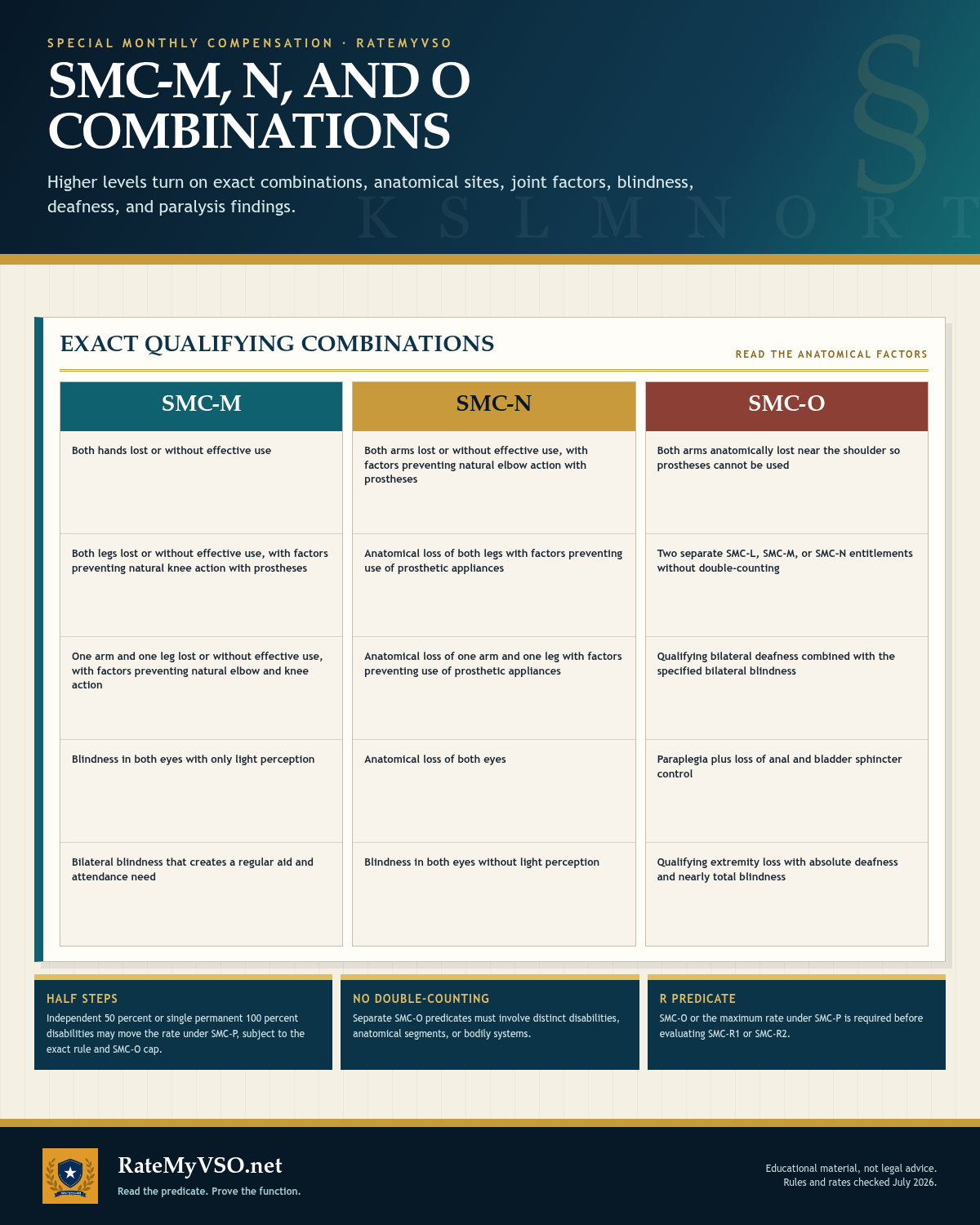
Visual guide: SMC-M, N, and O Combinations
The paired-loss and functional combinations for each level.
View full size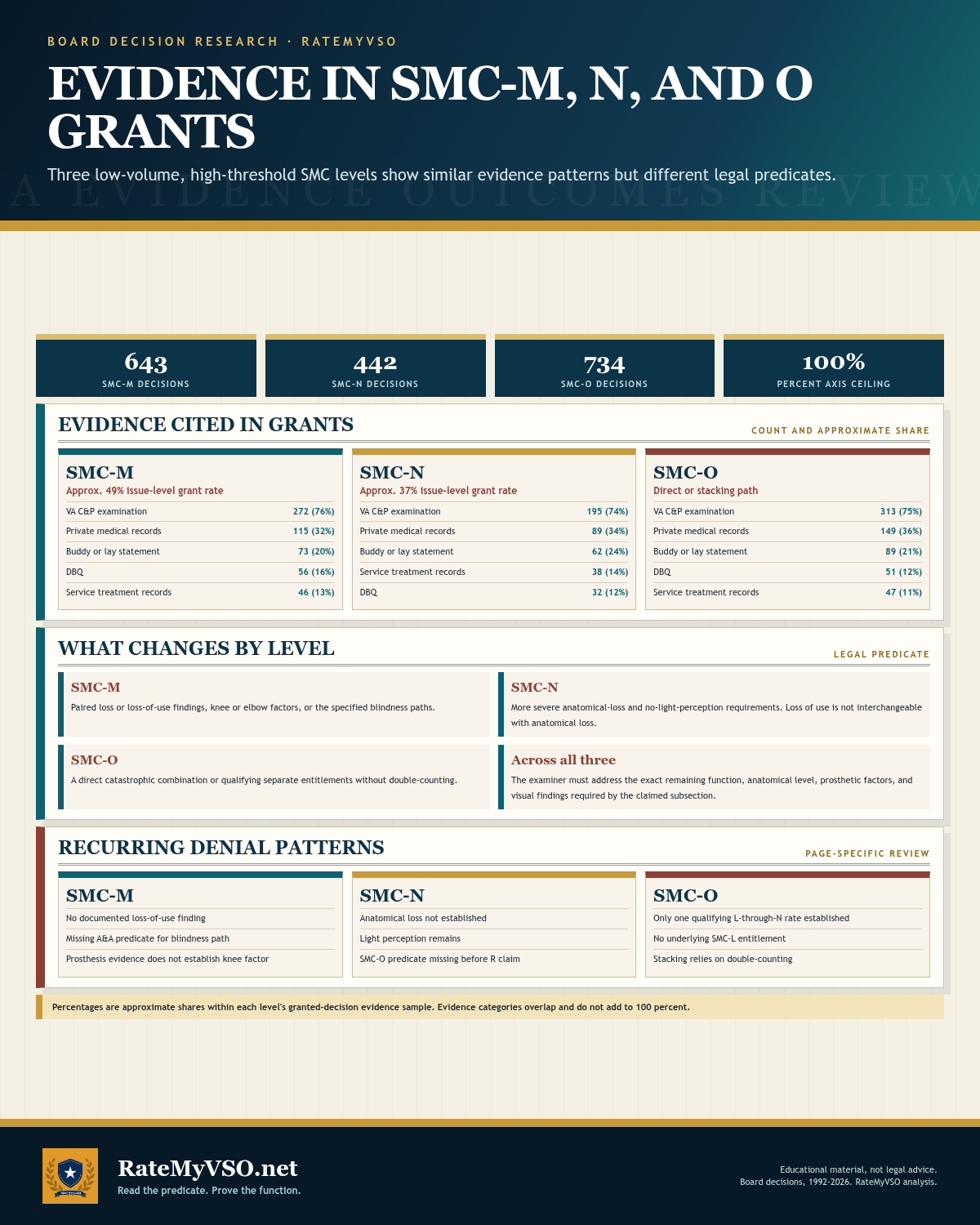
Visual guide: Evidence in SMC-M, N, and O Grants
Evidence cited in grants, each level's predicate and denial patterns.
View full sizeAuthority & Sources
- 38 USC § 1114(n), (p)
- 38 CFR § 3.350, qualifying conditions and § 3.350(f) stacking math
- VA.gov SMC rate table
BVA decisions are non-precedential under 38 CFR § 20.1303. Volume and pattern data above are from our internal index of BVA decisions and are reported as observed patterns, not as predictions of outcomes for any individual claim.