Vertigo and Meniere's Claims Guide
Vertigo, dizziness, and the balance problems that come from inner-ear damage are common after acoustic trauma, blasts, head injuries, and ear infections, yet they are among the most under-claimed conditions veterans carry. The VA rates them in two places: peripheral vestibular disorders under DC 6204, and Meniere's syndrome under DC 6205. Both turn on one thing most veterans miss: objective test findings, not just how you feel. This guide walks the whole path: how service connection works, how vertigo gets connected to your service directly or secondary to another condition, the either-or rule that decides Meniere's, the evidence that wins, why these claims get denied, a checklist before you file, what the claims process looks like step by step, how to read your decision letter, and what to do whether you win or you're denied.
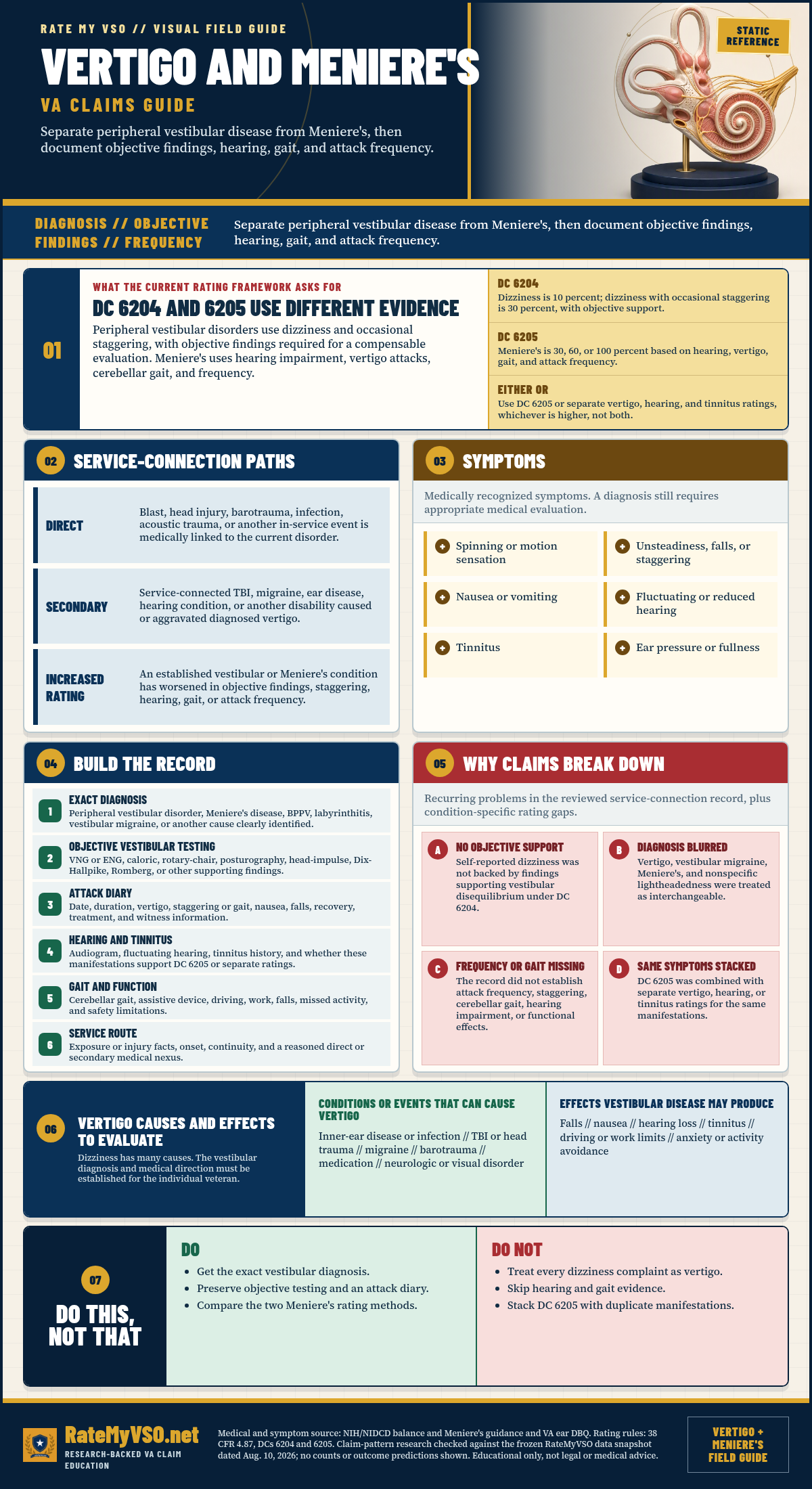 One-page guide: Vertigo and Meniere's Claims in One Page
Vertigo and Meniere's guide covering DCs 6204 and 6205, objective vestibular findings, hearing, gait, attack frequency, service paths, testing, the either-or rule, and common claim gaps. Opens the full-size chart, free to save or print.
One-page guide: Vertigo and Meniere's Claims in One Page
Vertigo and Meniere's guide covering DCs 6204 and 6205, objective vestibular findings, hearing, gait, attack frequency, service paths, testing, the either-or rule, and common claim gaps. Opens the full-size chart, free to save or print.
Start with the essentials
- 01Service Connection
The ways service connection can be established for this condition.
- 02Diagnosis and Evidence
Common symptoms and the evidence cited in published Board appeals.
- 03Your History
What you experienced, what others observed, and what treatment changed.
Understand the claim
Overview
If you're a veteran trying to understand how to actually file a vertigo or Meniere's claim, not just how the VA rates it once approved, it helps to know which fight you're actually in. We analyzed a recent set of published Board decisions on these conditions and found roughly four in ten were true service-connection grants, roughly four in ten were true service-connection denials, and the remainder involved veterans who were already service connected and were instead disputing the rating percentage or the effective date. The path that matters for you depends on which of those three situations you're in: proving the condition is connected to service in the first place, defending against a denial, or arguing for a higher rating or an earlier start date once you've already won.
ICD-10 Diagnosis Codes
The ICD-10 diagnosis codes most commonly used for DC 6204, Peripheral vestibular disorders (the kind on your medical records, decision letter, or C&P exam report). VA rates the disability and its residuals, not the diagnosis itself, so coding can vary.
How Service Connection Works, At a High Level
Before getting into the specific pathways below, it helps to understand the three things every vertigo or Meniere's claim ultimately has to show, at least on a direct basis. This is the same basic test that applies to any VA disability claim, just applied to this condition.
- A current diagnosis. A doctor must diagnose an actual vestibular condition, such as vertigo, Meniere's disease, BPPV, or peripheral vestibular disorder. Feeling dizzy by itself is not a diagnosis.
- An in-service event, or a service-connected condition behind it. Something in service that caused or started the problem, such as noise or acoustic trauma, a head injury, or the first onset of dizziness during active duty, or a disability VA has already service-connected that caused or worsened the vertigo.
- A medical nexus. A qualified medical professional connecting the current diagnosis to service, or to the service-connected condition, ideally with a clear explanation and supporting medical literature rather than a bare conclusion.
Service Connection Pathways: Direct and Secondary
Vertigo is not a presumptive condition for any exposure category as of this writing. Service connection must be established through one of the following pathways.
Direct Service Connection
An inner-ear injury or illness that began in service: acoustic trauma or blast exposure, a head injury, barotrauma from diving or flight, an ototoxic medication, or labyrinthitis and ear infections documented at the time, with a current diagnosis and a nexus. A diagnosis made during a period of active duty for training also counts as an in-service event, the same as one made during regular active duty. See our Service Connection Guide.
Secondary to Tinnitus or Hearing Loss
If you are already service connected for tinnitus or hearing loss from noise exposure, vertigo can be argued as caused by that same inner-ear damage. Winning claims on this theory rest on a medical opinion that explains the mechanism, not just the fact that the two conditions often occur together, hearing and balance share a common space in the inner ear, and an opinion has to say so and connect it to your facts. See our Secondary Service Connection Guide.
Secondary to TBI (Traumatic Brain Injury)
Traumatic brain injury and head trauma affect the inner ear and the brain's balance-processing pathways directly. Vertigo, dizziness, and disequilibrium are recognized residuals of TBI, and the effective date for a vertigo rating tied to TBI generally follows the effective date of the underlying TBI grant.
Secondary to Migraine (Vestibular Migraine)
Dizziness is a recognized symptom of migraine, sometimes called vestibular migraine. Know how your doctors have characterized the cause of your dizziness before you file: if the record already frames it as a migraine symptom, the VA may rate it as part of the migraine (DC 8100) rather than as a separate vestibular disability, and you cannot be paid for both the same symptom under the anti-pyramiding rule (38 CFR § 4.14).
Secondary to Other Service-Connected Nerve or Neurological Conditions
Dizziness has also been connected as secondary to other service-connected nerve conditions, for example a nerve condition affecting the head such as trigeminal neuralgia, and to cervicogenic dizziness driven by a service-connected neck injury. As with any secondary theory, the medical opinion has to explain the specific mechanism connecting the nerve condition to the dizziness, not just assert that a link exists.
Increased rating. An already service-connected vestibular condition that has gotten worse, more frequent attacks or new staggering, can be re-rated higher. See the Rating Increase Guide.
Across published DC 6204 decisions, here is how often the Board granted by the legal theory the claim was argued on:
What VA Looks For: Tests, Records, and Diagnostic Codes
Records to gather for a direct or secondary claim:
- Objective balance testing: electronystagmography or videonystagmography (ENG or VNG), rotary-chair testing, caloric testing, posturography, or a documented positive Romberg or Dix-Hallpike finding on exam. This is the finding a compensable DC 6204 rating is built on.
- An audiogram: especially one showing fluctuating low-frequency hearing loss, which supports a Meniere's diagnosis and feeds the either-or election described below.
- An attack diary: dated entries showing the frequency and duration of each vertigo spell, whether you staggered or fell, and any hearing change or tinnitus at the time. Frequency drives both the 6204 staggering row and every Meniere's row.
- The diagnostic codes involved: DC 6204 for peripheral vestibular disorders, DC 6205 for Meniere's syndrome, plus whatever code applies to the condition you're connecting it to, for example tinnitus and hearing loss, TBI, or migraine under DC 8100.
- The Ear Conditions DBQ: the form an examiner completes documenting the vestibular findings, attack frequency, and gait the ratings depend on. See the DBQ Guide.
What Peripheral Vestibular Disorders and Meniere's Are
Peripheral vestibular disorders are problems in the inner-ear balance system that cause vertigo (a spinning sensation), dizziness, and disequilibrium (a feeling of being off balance, sometimes with staggering). This bucket includes labyrinthitis, vestibular neuritis, benign paroxysmal positional vertigo (BPPV), and the lasting residuals of positional vertigo. They are rated under diagnostic code 6204. Meniere's syndrome (endolymphatic hydrops) is a specific inner-ear disorder that brings attacks of vertigo together with fluctuating hearing loss, tinnitus, and a feeling of fullness in the ear. It is rated under diagnostic code 6205. Both sit in the ear schedule (see 38 CFR § 4.87).
The single biggest lesson from the Board's published decisions on these conditions: a real diagnosis from a doctor is the foundation of the whole claim. Feeling dizzy, on its own, without a doctor putting a name to it, is not a valid claim.
Symptoms and rating
Symptoms Recorded in Granted Vertigo and vestibular disorders Decisions
We analyzed 957 granted Board decisions involving vertigo and vestibular disorders for symptoms named in sentences about the condition (rating-criteria recitations excluded). Descriptive of the published record, what the Board wrote down, not a checklist of what to report.
Bar length shows decisions. Percentages remain context.
Detected by phrase-reading the decision text with condition-specific vocabularies. Source: Board of Veterans' Appeals decisions, RateMyVSO analysis.
Current Rating Criteria Under DC 6204 and DC 6205
Peripheral vestibular disorders and Meniere's syndrome sit in the same part of the ear schedule (38 CFR § 4.87) but are rated on different findings.
DC 6204: Peripheral Vestibular Disorders
Rated on two findings: how often you are dizzy, and whether the dizziness is bad enough to make you stagger.
Two rules in the Note to DC 6204 decide most of these claims. First, objective findings supporting a diagnosis of vestibular disequilibrium are required before any compensable rating can be assigned, self-reported dizziness alone is not enough. Second, hearing impairment and ear suppuration are rated separately and combined, so a vestibular rating does not absorb your hearing loss.
DC 6205: Meniere's Syndrome
Rated on how often the vertigo attacks strike and whether they come with cerebellar gait (a wide, unsteady, staggering walk), plus hearing impairment.
Evidence and Board research
Evidence That Wins
- Objective balance testing, ENG or VNG, rotary-chair, caloric, or posturography results. This is the finding the compensable rating is built on, and its absence is the single most common reason these claims fail.
- An attack diary, dated, with the frequency and duration of each vertigo spell, whether you staggered or fell, and any hearing change or tinnitus at the time. Frequency is what drives both the 6204 staggering row and every Meniere's row.
- An audiogram, especially one showing fluctuating low-frequency hearing loss, which supports a Meniere's diagnosis and feeds the separate-and-combine election.
- A nexus opinion. The bars above show the lift: files with a private medical opinion, or both a private and VA opinion, granted at roughly twice the rate of files with no opinion at all. A medical opinion that includes only a conclusion with no supporting reasoning is entitled to little weight, even one written by a VA examiner; the opinions that carry the most weight explain the mechanism and cite supporting medical literature applied to the veteran's own facts.
- Buddy and family statements, from people who directly observed dizziness, staggering, or balance problems, in service or since. Lay witnesses are competent to describe what they personally observed. See our Buddy & Lay Statements Guide. (Jandreau v. Nicholson, 492 F.3d 1372 (Fed. Cir. 2007); Layno v. Brown, 6 Vet. App. 465 (1994).)
- A consistent history, describing when the dizziness began and that it continued since, told the same way across every form, exam, and statement. A lack of old service treatment records, by itself, cannot be used to reject a veteran's account of continuous symptoms (Buchanan v. Nicholson, 451 F.3d 1331 (Fed. Cir. 2006)).
- The Ear Conditions DBQ, which captures the vestibular findings, attack frequency, and gait the ratings depend on. See the DBQ guide.
Evidence Cited in Published Vertigo and vestibular disorders Decisions
We analyzed 10,778 published Board decisions involving vertigo and vestibular disorders for condition-specific evidence, counting only case-specific mentions (boilerplate recitations excluded). "Favorable" is the share of decisions citing that evidence where every issue was granted or the outcome was mixed; the baseline across all these decisions is 56.9%, combining every diagnostic code below. Evidence appearing in a decision does not mean it decided the case. Descriptive of the published record, not a prediction.
Bar length shows decisions citing the evidence.
By diagnostic code
These codes are grouped together above. They do not perform the same, so find your own code here rather than reading the combined figure. A code retired in the schedule rewrites appears without a link, because its decisions were judged under criteria that no longer apply.
Bar length shows published decisions reviewed.
Detected by phrase-reading the decision text with condition-specific vocabularies. Source: Board of Veterans' Appeals decisions, RateMyVSO analysis.
Board Grants, Dissected
The decisions below show a consistent pattern in cases that succeeded on vertigo claims. Nearly every grant came through a secondary theory, most often tying vertigo to service-connected migraines or tinnitus, rather than a purely direct theory. Boards repeatedly found VA opinions inadequate when examiners leaned only on missing treatment records or failed to address a veteran's reported symptoms. Keep in mind that Board decisions are not binding precedent on other veterans' claims. They are useful only to see how the Board has reasoned through similar facts.
Vertigo linked to service-connected migraines wins on equipoise Citation A26037644 (April 22, 2026), Hearing docket
The record: The veteran's treating VA neurologist wrote in a 2023 record that he had "chronic vertigo, likely migraine-related vertigo," with imaging that did not point to any other structural cause. A private provider, Dr. J.C., submitted an April 2025 opinion finding it at least as likely as not that the vertigo resulted from a "synergistic effect" between PTSD and migraines, relying in part on the VA neurologist's findings. The only VA opinion in the file addressed vertigo and PTSD, not vertigo and migraines.
Why it won: The Board gave high weight to the treating neurologist's long-term assessment and found the private opinion consistent with it. Because there was no competing VA opinion actually addressing the migraine-vertigo relationship, the Board found the evidence at least in equipoise and granted on a secondary, direct-causation basis.
AOJ's failure to expand claim scope leads to grant tied to migraines Citation A26037302 (April 21, 2026), Direct Review docket
The record: The veteran filed a claim for Meniere's disease, but a VA examination confirmed only benign paroxysmal positional vertigo (BPPV). The AOJ denied the claim because the veteran did not have Meniere's disease, without ever developing whether the vertigo itself was related to any service-connected condition. Separately, the veteran had already been granted service connection for vertigo secondary to migraines in a later rating decision.
Why it won: The Board recharacterized the claim under Clemons v. Shinseki because a lay person cannot self-diagnose which inner ear condition he has. Since the AOJ never developed the vertigo-migraine relationship in connection with the earlier claim, and that relationship had since been established, the Board found the earlier claim was also entitled to the grant.
In-service vestibular migraine notation outweighs unrelated negative opinions Citation A26036151 (April 17, 2026), Direct Review docket
The record: Service treatment records documented a diagnosis of "vestibular headache" treated during active duty with associated vertigo, and later "vestibular migraine" was again noted on a 2020 exam. An August 2023 VA examiner found this history supported a nexus for vertigo as a symptom of migraine headaches during service. Other unfavorable opinions in the file addressed toxin exposure and a secondary theory, not the direct link to vestibular migraine.
Why it won: The Board found the August 2023 opinion was the only competent opinion addressing direct service connection for vertigo, and the record showed a documented chronicity of vestibular migraine with associated vertigo from service forward. The Board found the evidence persuasively favored the claim.
Inadequate VA addendum opinion opens the door to a direct grant Citation A26036105 (April 17, 2026), Hearing docket
The record: The veteran was diagnosed in service with benign positional vertigo in November 2000, a favorable finding the AOJ made and the Board was bound by. A December 2017 VA examiner found no link to tinnitus. An October 2018 VA addendum opinion found the in-service vertigo episodes were "acute, transient, and resolved without residuals," but gave no further explanation and did not address the current diagnosis's etiology.
Why it won: The Board found the October 2018 addendum opinion conclusory and unsupported by rationale, making it inadequate. With no other competent opinion addressing the etiology of the current BPPV, and an in-service diagnosis of record, the Board resolved reasonable doubt in the veteran's favor.
Severance of vertigo reversed for failing to meet the higher CUE standard Citation A26034076 (April 14, 2026), Hearing docket
The record: The RO originally granted service connection for vertigo in 2021 based on a positive nexus opinion tying vertigo to an in-service head injury. The RO later tried to sever that grant, relying on an addendum opinion stating no head injury could be confirmed in the service treatment records. The veteran maintained a consistent lay history of an in-service fall and head injury.
Why it won: The Board explained that a severance claim requires a much higher showing than an ordinary service connection denial. It found this was, at most, a disagreement over how to weigh the lack of objective documentation against the veteran's lay statements, not clear and unmistakable error. Because the higher CUE standard was not met, the severance was improper.
Why These Claims Get Denied
Beyond the general "no diagnosis" and "no nexus" reasons touched on above, a few specific denial patterns show up often enough in the Board's published decisions to call out on their own.
- Reported dizziness with no diagnosed disability behind it. Without a doctor putting a name to the problem, there is no valid claim. VA examiners routinely describe undiagnosed dizziness as "subjective only," and that framing alone is enough to sink a claim (Brammer v. Derwinski, 3 Vet. App. 223 (1992)).
- Assuming tinnitus automatically causes vertigo. The two conditions often occur together, but that link is not automatic. An examiner can reasonably conclude that tinnitus by itself does not cause vertigo, and a claim resting on the assumption alone, without an opinion that explains the connection for the veteran's own facts, is denied.
- The veteran's own belief about the diagnosis or cause, without a doctor's opinion behind it. Diagnosing a complex inner-ear condition, and explaining what caused it, are medical questions a non-doctor is not assumed competent to answer on their own (Jandreau v. Nicholson).
- Dizziness that is really a migraine symptom, filed as a separate claim. When the record already characterizes the dizziness as vestibular migraine, filing it again as a standalone vestibular disability does not add a second rating, it folds into the migraine evaluation.
- A VA exam that finds "no diagnosis," left unanswered. Many denials rest on a VA examiner concluding the symptoms did not warrant a diagnosis. When that opinion is inadequate, bare, or ignores the veteran's own statements, a well-reasoned private opinion can outweigh it (Nieves-Rodriguez v. Peake, 22 Vet. App. 295 (2008)).
- Evidence submitted outside the appeal's review window. Under the modern appeals system, the Board can only consider evidence from certain time periods depending on the review lane chosen. New testimony or records that arrive outside the allowed window do not get counted, and the fix is either timing it correctly or filing a Supplemental Claim (38 CFR § 20.303).
Common Mistakes
The same handful of missteps, distinct from the denial patterns above, account for most lost or under-rated vertigo claims. Among the Board's classified service-connection denials for DC 6204, here is what claims most often fell short on:
- No objective testing. A compensable vestibular rating requires objective findings. Self-reported dizziness with nothing in the file to support it, no ENG or VNG, no documented positive exam, usually rates at zero.
- Filing vertigo as a presumptive. Dizziness is not on any exposure list. Claims argued on a presumptive theory grant at the lowest rate; the direct or secondary path with a nexus is the one that works.
- Double-dipping Meniere's. You cannot carry a 6205 rating and separate vertigo, hearing, and tinnitus ratings at the same time. Pick the method that combines higher, not both.
- No attack diary. Meniere's rows and the 6204 staggering row all turn on frequency. A vague "I get dizzy sometimes" undercounts what a dated log of weekly attacks would have shown.
- Missing the secondary link. Dizziness that started after a head injury, or that travels with migraine, tinnitus, or hearing loss, is often ratable as secondary. Filing it as an unconnected new problem throws that link away.
Do's and Don'ts
A condensed version of everything above, in the order it actually matters when you sit down to build your file.
- See an ENT or neurologist and get a named diagnosis, vertigo, Meniere's, BPPV, or peripheral vestibular disorder, before you expect to win.
- Get a nexus opinion that explains its reasoning and cites medical literature, not a bare conclusion.
- If you have service-connected tinnitus or hearing loss, argue vertigo as secondary inner-ear damage.
- Gather buddy and family statements describing dizziness or staggering they personally observed, in service and since.
- Describe a continuous history of symptoms since service, told the same way every time.
- Search your service treatment records for any mention of dizziness, balance, or ear trouble, even a single entry can satisfy the in-service element.
- Ask about the presumption of soundness if your entrance exam did not note a vestibular problem.
- Submit evidence within your appeal's evidence window, or file a Supplemental Claim if it's late.
- If denied for "no diagnosis," get diagnosed and file a Supplemental Claim with the new evidence.
- Don't assume that reporting dizziness alone will win, without a diagnosed disability there is no valid claim.
- Don't assume tinnitus automatically causes vertigo, that link is not automatic and needs its own opinion.
- Don't rely on your own opinion about what you have or what caused it, causation and diagnosis here are medical questions.
- Don't overlook that your dizziness may really be a migraine symptom, filing it separately can just fold it into the same evaluation.
- Don't let a VA exam that finds "no diagnosis" go unanswered, a strong private opinion can outweigh an inadequate one.
- Don't submit key evidence outside your appeal's review window, ask which lane you're in first.
- Don't stack a 6205 rating on top of separate vertigo, hearing, and tinnitus ratings, it's one method or the other.
- Don't file vertigo on a presumptive or exposure theory alone, it's not on any presumptive list.
Secondary relationships
Common Secondary Conditions
Inner-ear balance problems connect to other claims in both directions, usually through a shared injury or the ear itself. Each bar below is the Board's grant rate for DC 6204 in that pairing, with the number of decisions under it. They describe the published record across many veterans, not a prediction about any one claim.
Conditions linked as causing vertigo (vertigo as the secondary)
Claims where a vestibular disorder was argued as secondary to an already service-connected condition, hearing loss, tinnitus, TBI, migraine, ear disease, and more, in other words, the ways to connect vertigo via another condition:
Conditions vertigo is linked to causing (vertigo as the primary)
Conditions veterans have claimed as caused or aggravated by a service-connected vestibular disorder:
Prepare and take the next step
Prepare: your own working pages
Optional. These are your own notes, in your own words. They are not a VA form, they are not sent to the VA, and nothing here is a medical finding or a prediction about your claim.
Three reminders while you prepare
- Start with the diagnosis and test results
Vertigo is a symptom as well as part of several diagnoses. Record what the clinician diagnosed and the hearing, vestibular, imaging, or other testing used. Go to this part
- Track attacks and associated findings
Note frequency, duration, dizziness, staggering or gait effects, hearing changes, tinnitus, nausea, and recovery in your own words. Go to this part
- Document function and safety
Record falls, driving limits, work effects, treatment, and accommodations, then organize the records and questions needed for the next step. Go to this part
Sign in or create an account to save your answers and come back to them later. You can fill these in and print them without an account.
Vertigo and Meniere's attack log
Diagnosis and testing
Treatment, function, and connection questions
Records and unanswered questions
Decision-letter reading sheet
Quick Checklist Before You File
Bring these together before you submit anything.
- See an ENT or neurologist and get a named diagnosis (vertigo, Meniere's, BPPV, or vestibular disorder).
- A nexus opinion that explains its reasoning and cites medical literature.
- If you have service-connected tinnitus or hearing loss, argue vertigo as secondary inner-ear damage.
- Buddy and family statements describing your dizziness in and since service.
- Your service treatment records, searched for any mention of dizziness, balance, or ear trouble.
- A plan to submit evidence within your appeal's evidence window, or file a Supplemental Claim if it's late.
- If you were denied before for "no diagnosis," get diagnosed and file a Supplemental Claim with the new evidence rather than starting over.
For the mechanics of actually submitting the claim, see the Standard Claim Guide and the Fully Developed Claim Guide (filing with all your evidence up front can speed up the decision).
The Claims Process, Step by Step
Once you file, your claim moves through a series of hand-offs. Understanding who does what helps you know who to contact, and what to expect, at each stage.
- You file the claim. Directly with VA, through VA.gov, or with the help of an accredited representative.
- VA acknowledges the claim and assigns it for development. A Veteran Service Representative (VSR) is assigned to gather your service treatment records, VA and private medical records, and any other evidence needed.
- The VSR orders a Compensation & Pension (C&P) exam if one is needed. Not every claim requires one, but most vertigo and Meniere's claims do, since balance testing and a nexus opinion are usually central to the decision.
- The C&P exam is conducted. By a VA clinician or a contracted examiner, who completes the Ear Conditions Disability Benefits Questionnaire (DBQ) documenting the diagnosis, balance testing, attack frequency, gait, and, where relevant, a nexus opinion.
- The file goes to a Rating Veteran Service Representative (RVSR), the "rater." The rater reviews the complete file, including the exam results, and decides whether service connection is warranted and at what percentage.
- A senior reviewer may review the decision before it's finalized, depending on the complexity of the claim.
- VA issues the decision letter. This states whether the claim is granted or denied, the rating percentage if granted, and the reasons behind the decision.
- If you disagree, you choose an appeal lane. Higher-Level Review, Supplemental Claim, or a Board appeal, covered later in this guide.
Who's who: VSO vs. VSR vs. Rater vs. C&P Examiner
Your VSO
An accredited representative from a veterans service organization, or an accredited attorney or claims agent. Not a VA employee. Helps you prepare, gather evidence, and file, and can represent you through an appeal. Has no authority to decide your claim.
VSR (Veteran Service Representative)
VA staff who "develops" your claim: requests records, schedules the C&P exam, and assembles the file. Does not decide the rating.
Rater (RVSR)
VA staff who reviews the completed file and makes the actual decision, service connection or denial, and the percentage. This is the person whose judgment the decision letter reflects.
C&P Examiner
A VA clinician or a contracted medical examiner who conducts the exam and completes the DBQ. Documents findings and, where asked, a nexus opinion. Does not decide the claim.
For the full walkthrough of every stage with more detail, see Inside Your Claim and Claim Stages.
DBQs and Your C&P Exam
The Ear Conditions Disability Benefits Questionnaire (DBQ) is the standardized form an examiner completes for a vertigo or Meniere's claim, it structures the exam findings into the specific data points VA's rating schedule requires: the balance-testing results, attack frequency, gait, and hearing impairment. See the DBQ Guide for how these forms work, including whether a private DBQ completed by your own doctor can be submitted instead of relying solely on a VA exam.
Before your C&P exam, bring your attack diary and be ready to describe frequency and severity precisely, how often the attacks strike, whether you staggered or fell, and what else came with them. Be consistent with what's already in your medical records and prior statements. For a full walkthrough of what to expect and how to prepare, see the C&P Exam Prep Guide.
Reading Your Decision Letter, and What to Do If Denied
Your decision letter has two parts: a narrative section explaining the reasoning (often called "reasons and bases"), and a codesheet showing the actual rating percentage, the effective date, and the diagnostic code used. See the Reading Your Decision Letter Guide for how to find and interpret each part, or use the Letter Interpreter tool to upload your own letter and get a plain-English breakdown.
If your claim is denied, or the rating is lower than you expected, you have three main lanes:
- Supplemental Claim: refile with new and relevant evidence, such as a new nexus opinion, a new balance-testing result, or an attack diary. See Supplemental Claim Guide.
- Higher-Level Review (HLR): a senior reviewer looks at the same evidence again for a difference of opinion, no new evidence is added. See HLR Guide.
- Board Appeal: your case goes to a Veterans Law Judge at the Board of Veterans' Appeals, with options for a direct review, an evidence docket, or a hearing. See Board Appeal Guide.
Whichever lane you pick, know its evidence window: each lane has its own rules about what evidence the Board or reviewer can actually consider, and evidence submitted outside that window does not count toward the decision (38 CFR § 20.303). Not sure which lane fits your situation? See the Appeals decision guide for a side-by-side comparison of all three.
After You Win: Maintaining Your Rating
A grant is not always the end of the story. Keep your treatment consistent, continued follow-up with an ENT or neurologist, and updated balance testing and audiograms as your condition is monitored, protects you if VA schedules a future reexamination. Not every rating gets reexamined; understand when a rating becomes protected from future review (including Permanent and Total status) and what to do if VA proposes to reduce it. See Protect Your Rating and Future Reexaminations for the specifics.
Two things to watch once you've won: if your vertigo is rated as a residual of a TBI, its effective date generally follows the effective date of the underlying TBI grant, not a later filing date. And if your dizziness worsens after the initial grant, for example more frequent or more severe attacks, you can file for an increased rating. See the Rating Increase Guide.
References and related resources
Quick Reference Tables
DC 6204 and DC 6205 Ratings at a Glance
| Code | Rating | What it takes |
|---|---|---|
| 6204 | 30% | Dizziness and occasional staggering |
| 6204 | 10% | Occasional dizziness |
| 6205 | 100% | Hearing impairment with vertigo and cerebellar gait more than once a week |
| 6205 | 60% | Hearing impairment with vertigo and cerebellar gait 1 to 4 times a month |
| 6205 | 30% | Hearing impairment with vertigo less than once a month |
Secondary Connection Pathways
| Primary Condition | Mechanism | Evidence Needed |
|---|---|---|
| Tinnitus / hearing loss | Shared inner-ear damage from noise exposure | Balance testing + nexus opinion explaining the shared mechanism |
| TBI (traumatic brain injury) | Injury to the inner ear or brain balance-processing pathways | Balance testing + neurological nexus opinion |
| Migraine (vestibular migraine) | Dizziness as a migraine symptom | Records characterizing the dizziness; be aware it may fold into the migraine rating |
| Nerve conditions (e.g. trigeminal neuralgia) | Nerve dysfunction driving dizziness | Nexus opinion explaining the specific nerve-to-dizziness mechanism |
| Neck injury | Cervicogenic dizziness | Balance testing + nexus opinion tying the neck injury to the dizziness |
From Filing to Decision: Who Does What
| Role | Does | Decides your rating? |
|---|---|---|
| VSO / accredited representative | Helps prepare, gather evidence, and file; represents you on appeal | No |
| VSR | Develops the claim: orders records and the C&P exam | No |
| C&P Examiner | Conducts the exam, completes the DBQ, may give a nexus opinion | No / but has a strong impact |
| Rater (RVSR) | Reviews the full file and decides service connection and percentage | Yes |
Frequently Asked Questions
How does the VA rate vertigo and dizziness?
What is the difference between DC 6204 and DC 6205?
Can I get 100 percent for Meniere's syndrome?
Should Meniere's be rated under 6205 or as separate conditions?
Is vertigo covered by the PACT Act or any presumptive?
What testing proves a vestibular disorder?
What if my dizziness is really a symptom of my migraines?
What happens if VA says I have no diagnosis?
Related Tools and Guides
Sources
- 38 CFR § 4.87, Diagnostic Code 6204 (peripheral vestibular disorders) and Diagnostic Code 6205 (Meniere's syndrome)
- 38 CFR § 3.303, basic rules for direct service connection, and § 3.303(b), continuity of symptoms
- 38 CFR § 3.310, Secondary Service Connection
- 38 CFR § 3.304(b), Presumption of Soundness; 38 U.S.C. § 1111, same
- 38 CFR § 3.307, 3.309, presumptive and chronic diseases
- 38 CFR § 3.102, Benefit of the Doubt; 38 U.S.C. § 5107(b), same
- 38 CFR § 4.124a, Diagnostic Code 8100 (migraines)
- 38 CFR § 4.14, avoiding pyramiding (duplicate compensation for the same symptom)
- 38 CFR § 3.400, effective dates
- 38 CFR § 20.303, evidence submission windows in the modern (AMA) appeals system
- 38 U.S.C. § 1110 and 1131, basic service connection
- Nieves-Rodriguez v. Peake, 22 Vet. App. 295 (2008), the probative value of a medical opinion depends on factually accurate, fully articulated, sound reasoning, not a bare conclusion
- Brammer v. Derwinski, 3 Vet. App. 223 (1992), absent proof of a current disability, there is no valid claim
- Wilson v. McDonough, 35 Vet. App. 103 (2022), VA's obligation to identify and adjudicate a claim for a secondary condition, including peripheral vestibular disorders, that is reasonably raised while processing a related claim
- Jandreau v. Nicholson, 492 F.3d 1372 (Fed. Cir. 2007), competency of lay testimony regarding observable symptoms, and the limits on lay competency to diagnose complex conditions
- Layno v. Brown, 6 Vet. App. 465 (1994), competency of lay evidence describing personally observed symptoms
- Buchanan v. Nicholson, 451 F.3d 1331 (Fed. Cir. 2006), VA cannot rely solely on the absence of records to deny a claim
- VA, disability eligibility