VA Migraine Claims Guide
This guide explains how to file a migraine claim and how the VA evaluates it: how service connection works, how migraines get connected to your service (directly, or secondary to another condition), what "prostrating" and "severe economic inadaptability" mean under case law, what evidence you need, why these claims get denied, a checklist before you file, what the claims process looks like step by step, how to read your decision letter, and what to do whether you win or you're denied. Migraines are rated under DC 8100, 38 CFR § 4.124a, with secondary pathways from TBI, PTSD, cervical spine, and sleep apnea, and extra-schedular consideration when the 50% schedular ceiling does not capture the disability picture.
Start with the essentials
- 01Service Connection
The ways service connection can be established for this condition.
- 02Diagnosis and Evidence
Common symptoms and the evidence cited in published Board appeals.
- 03Your History
What you experienced, what others observed, and what treatment changed.
Understand the claim
ICD-10 Diagnosis Codes
The ICD-10 diagnosis codes most commonly used for DC 8100, Migraine (the kind on your medical records, decision letter, or C&P exam report). VA rates the disability and its residuals, not the diagnosis itself, so coding can vary.
How Service Connection Works, At a High Level
Before getting into the specific pathways below, it helps to understand the three things every migraine claim ultimately has to show. This is the same basic test that applies to any VA disability claim, just applied to this condition.
- A current diagnosis. A diagnosis of migraine specifically, confirmed by a medical provider, must be in the file. VA treats headaches and migraines as distinct diagnoses, so a record documenting sinus headaches or generic "headache" complaints, without a migraine diagnosis by name, does not establish this element.
- An in-service event, or a service-connected condition behind it. The record must show headaches, a head injury, or a qualifying exposure documented during service, or a disability VA has already service-connected that caused or worsened the migraines.
- A medical nexus. A doctor's opinion connecting the current migraines to service, or to the service-connected condition, and explaining the reasoning, not just stating a conclusion.
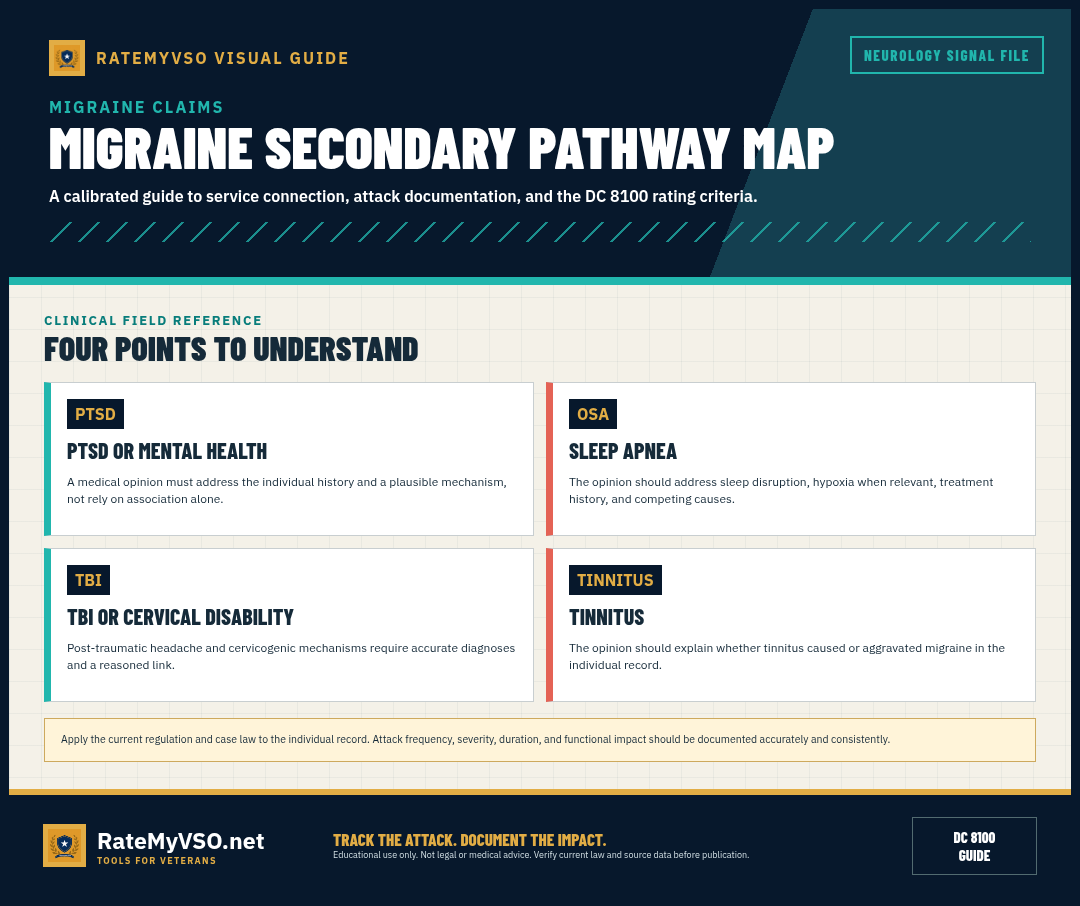 One-page guide: Migraine Secondary Pathway Map
PTSD, sleep apnea, TBI or cervical disability, and tinnitus pathways. Opens the full-size chart, free to save or print.
One-page guide: Migraine Secondary Pathway Map
PTSD, sleep apnea, TBI or cervical disability, and tinnitus pathways. Opens the full-size chart, free to save or print.
Section 8: Service Connection Pathways: Direct and Secondary
Direct Service Connection
Migraines that began during or were caused by military service. Supporting evidence includes documentation of headaches in service treatment records, onset of migraines during deployment, or documentation of in-service trauma, blast exposure, or head injury preceding migraine onset.
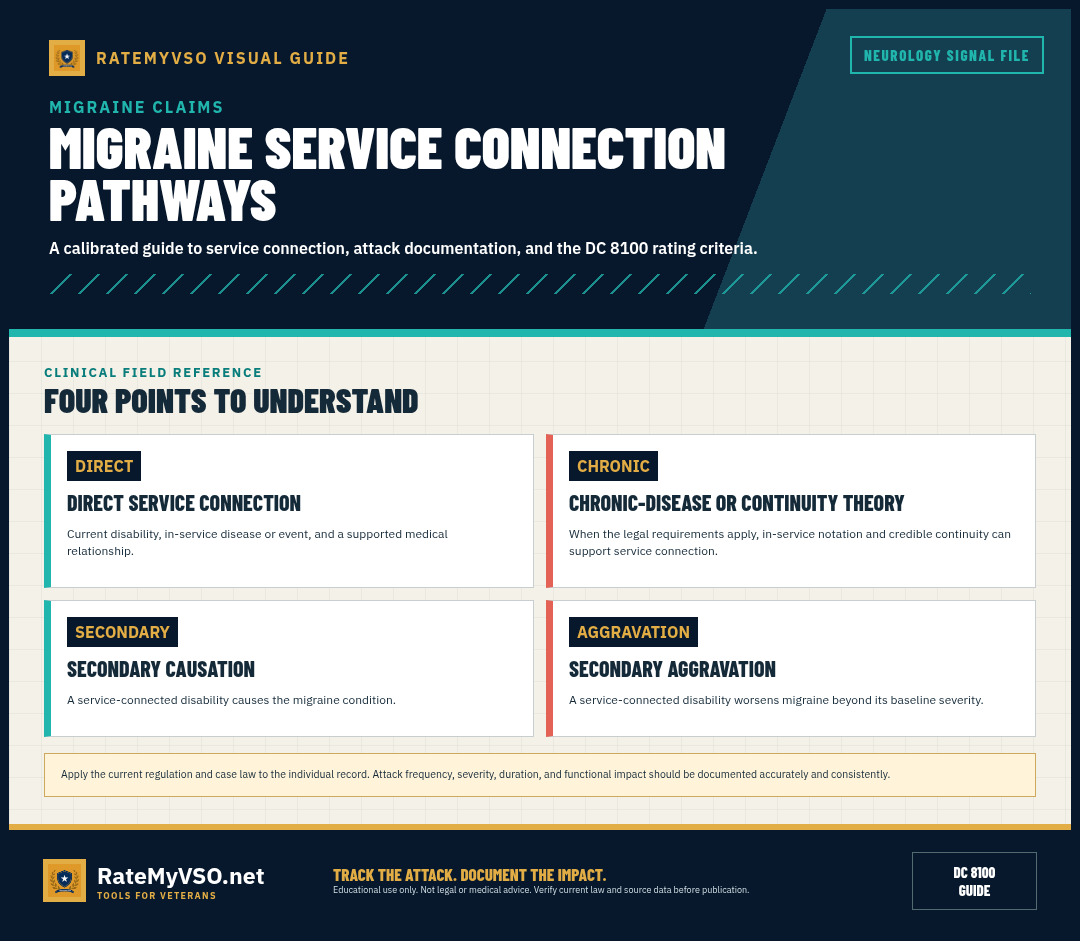
Because migraine is treated as a chronic organic disease of the nervous system, direct service connection can also be shown through continuity of symptoms since service, described above, when service records document headaches and a credible history connects them to the present, even without a favorable nexus opinion addressing causation directly.
Secondary Service Connection (38 CFR § 3.310)
Migraines caused or aggravated by another service-connected condition. Common primary conditions with recognized associations to migraine include TBI, PTSD, cervical spine disability, and sleep apnea, each described below. See our Secondary Service Connection Guide.
Secondary to TBI (DC 8045)
Traumatic brain injury is among the most common causes of post-traumatic headaches. Post-traumatic headaches are frequently rated under DC 8100 when they meet the migraine pattern criteria, a direct neurological sequela of the brain injury.
Secondary to PTSD (DC 9411)
Chronic stress, sleep disruption, and autonomic dysregulation associated with PTSD are recognized migraine triggers. Published Board decisions have granted migraines as secondary to a service-connected mental health condition on this theory. See our PTSD Claims Guide.
Secondary to Cervical Spine Disability
Tension and referred pain from cervical degenerative disc disease or cervical instability can trigger or aggravate migraine, sometimes described clinically as cervicogenic headache. When a service-connected cervical spine disability causes or contributes to the headache pattern, the headaches may be rated as secondary.
Secondary to Sleep Apnea (DC 6847)
Nocturnal oxygen desaturation and disrupted sleep architecture are recognized triggers for morning headaches with migraine characteristics. Migraines and sleep apnea also show a documented bidirectional relationship, meaning sleep apnea has separately been linked back to a service-connected migraine condition, though that direction is less common. See our Sleep Apnea Claims Guide.
Aggravation
Pre-existing migraines demonstrably worsened beyond natural progression by in-service exposure or another service-connected condition are ratable under 38 CFR § 3.306.
What VA Looks For: Tests, Records, and Diagnostic Codes
Whether you are filing directly or secondary to another condition, the record VA actually reviews centers on a small set of documents and data points, and for migraines the single biggest gap is usually attack-frequency documentation.
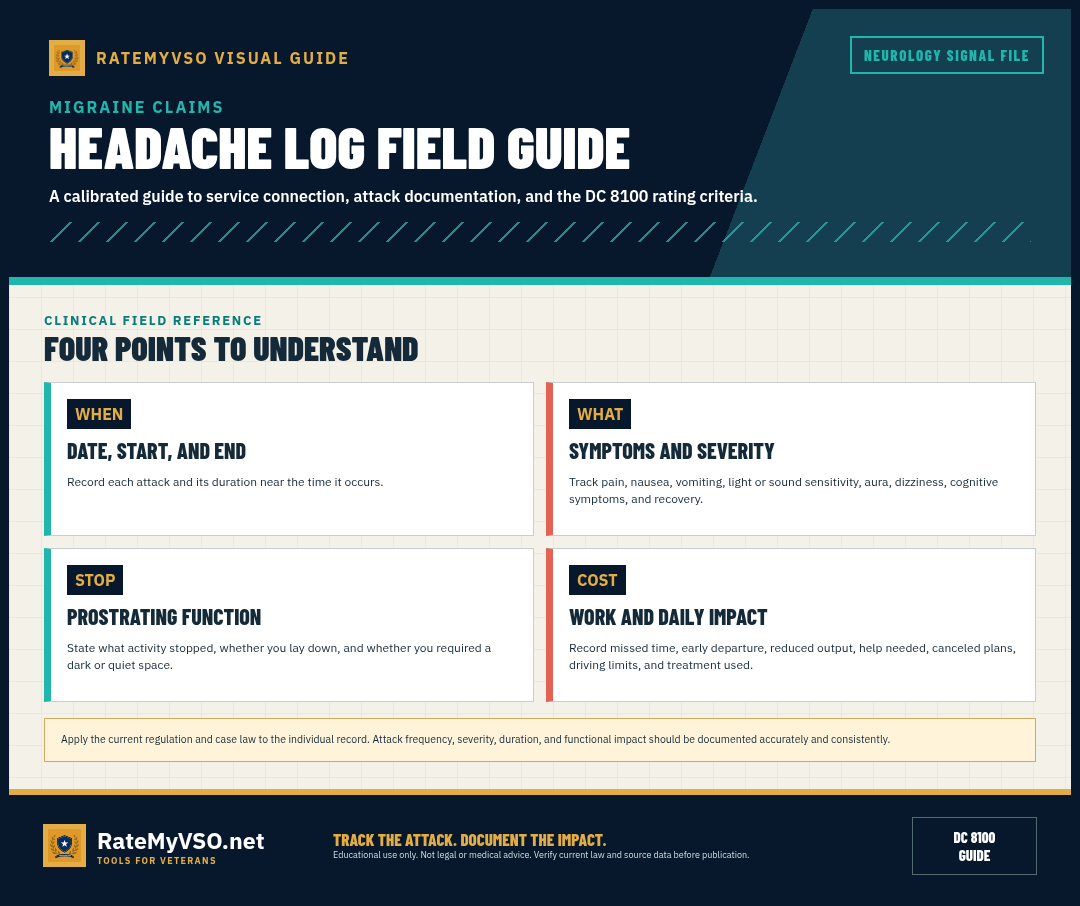
- A headache log or diary: a contemporaneous record of the date, duration, severity, symptoms, and functional impact of each attack. Because the rating levels turn on how often attacks reach the "prostrating" threshold, an ongoing log is the clearest way to document frequency, rather than relying on memory at a single C&P exam.
- Treatment and prescription records: treating-provider notes describing frequency, character, and functional impact, plus prescription records for migraine-specific treatments (triptans, CGRP inhibitors, preventive medications), which help document chronicity.
- Work-impact records: sick leave usage, HR accommodation requests, or attendance records that tie missed or disrupted work time to migraine attacks, relevant to the "severe economic inadaptability" standard at the 50% level.
- The diagnostic codes involved: DC 8100 for the migraines themselves, plus whatever code applies to the condition you're connecting it to, for example DC 8045 (TBI), DC 9411 (PTSD), a cervical spine code, or DC 6847 (sleep apnea).
- The actual form the examiner fills out: a Disability Benefits Questionnaire (DBQ) specific to headaches, discussed in more detail later in this guide.
Section 1: Overview
Migraine headaches are among the most commonly underrated VA disabilities. The rating ceiling is 50%, which is lower than many veterans expect, but reaching that ceiling requires specific documentation that is frequently absent from VA records. The rating turns almost entirely on two legally defined terms: "prostrating" and "economic inadaptability." Both have specific meanings established through case law that differ from their everyday interpretations.
Migraines are rated under DC 8100, 38 CFR § 4.124a (Schedule of Ratings, Neurological Conditions and Convulsive Disorders).
A review of a sample of recently published Board of Veterans' Appeals decisions on migraines found that most of these files were not actually about winning service connection from scratch. The large majority involved veterans who were already service connected for migraines and were instead fighting over the rating percentage, the effective date, education benefits, unemployability (TDIU), or housebound special monthly compensation (SMC). Only a small minority were true grants or true denials of service connection itself. That pattern is worth keeping in mind: for many veterans, the harder fight isn't getting migraines service connected at all, it's proving the attacks are frequent and severe enough to reach the higher rating levels, and documenting the correct effective date.
Symptoms and rating
Symptoms Recorded in Granted Migraines Decisions
We analyzed 6,219 granted Board decisions involving migraines for symptoms named in sentences about the condition (rating-criteria recitations excluded). Descriptive of the published record, what the Board wrote down, not a checklist of what to report.
Bar length shows decisions. Percentages remain context.
Detected by phrase-reading the decision text with condition-specific vocabularies. Source: Board of Veterans' Appeals decisions, RateMyVSO analysis.
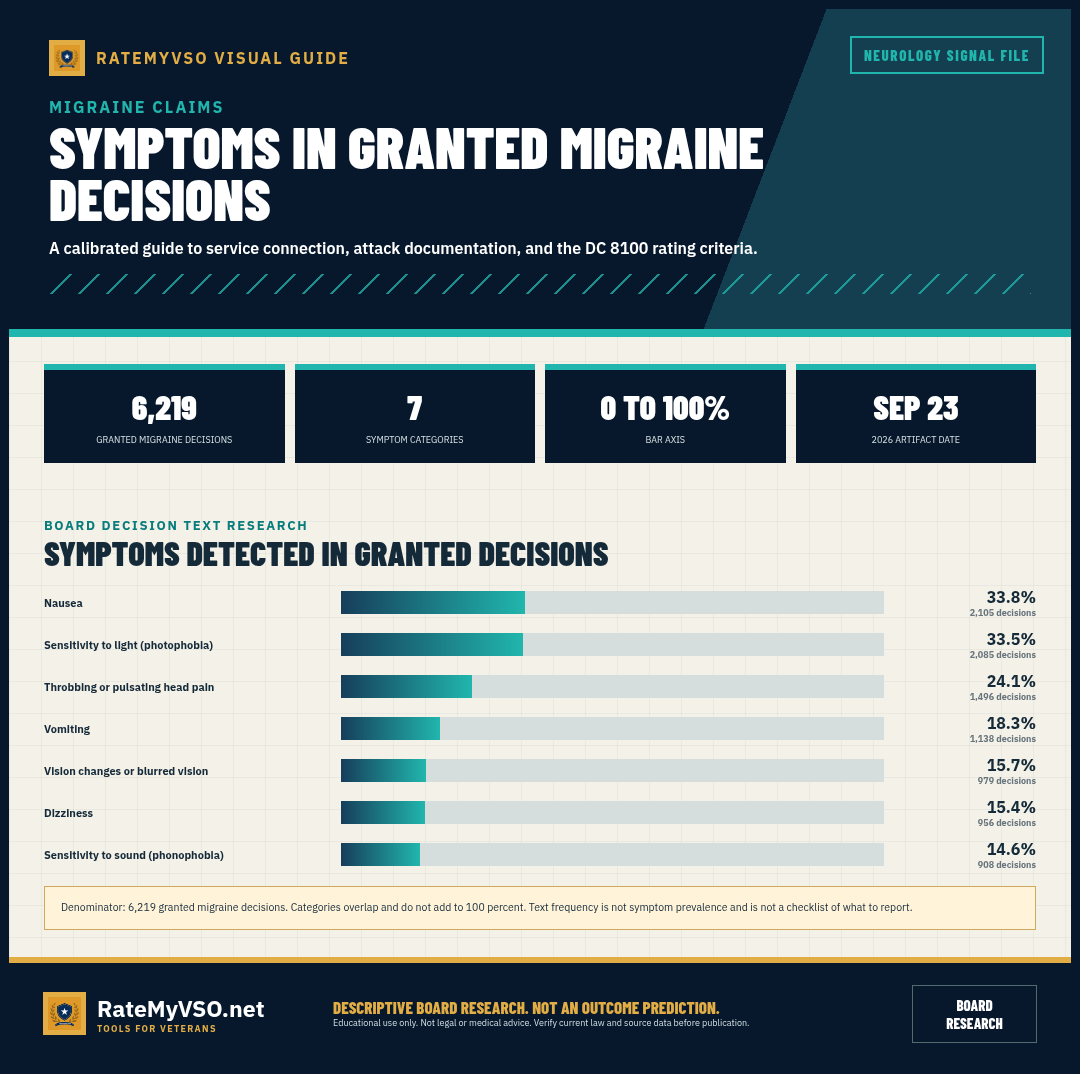 One-page guide: Symptoms in Granted Migraine Decisions
Symptom frequencies detected across 6,219 granted migraine Board decisions. Opens the full-size chart, free to save or print.
One-page guide: Symptoms in Granted Migraine Decisions
Symptom frequencies detected across 6,219 granted migraine Board decisions. Opens the full-size chart, free to save or print.
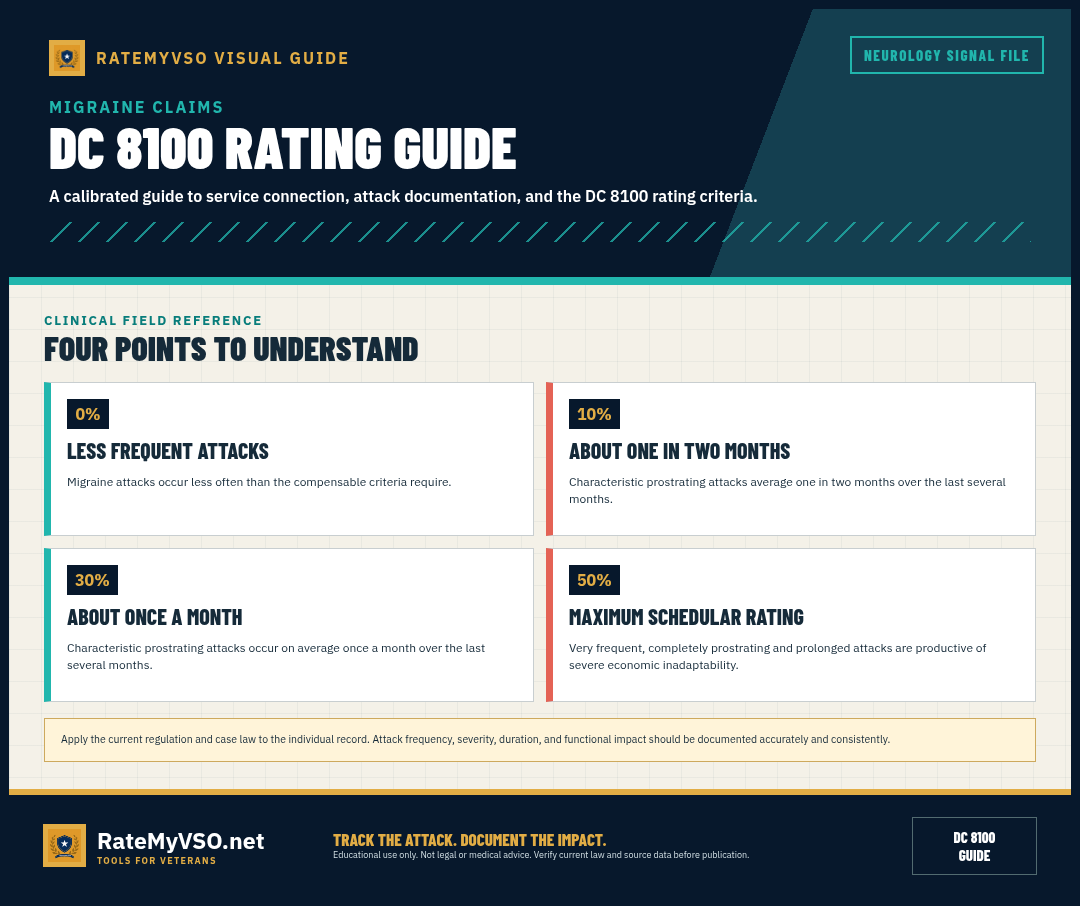
Section 6: The Four Rating Levels Under DC 8100
0%Noncompensable
Migraine diagnosis is documented but attacks occur with less frequency than the criteria for a 10% rating, or attacks are not demonstrated to be prostrating. Service connection is established. No monthly compensation is paid. A 0% rating preserves the record for future claims for increase.
- What the VA measures at your C&P exam
- Evidence that has won at the Board
- Inside the rater's playbook: grant, denial, and remand rates
- Secondary condition map
Section 2: What "Prostrating" Means Under VA Law
The term "characteristic prostrating attacks" appears at the 10% and 30% rating levels and "completely prostrating and prolonged attacks" appears at the 50% level. Neither phrase is defined in the regulation itself, but the Court of Appeals for Veterans Claims addressed the meaning in case law.
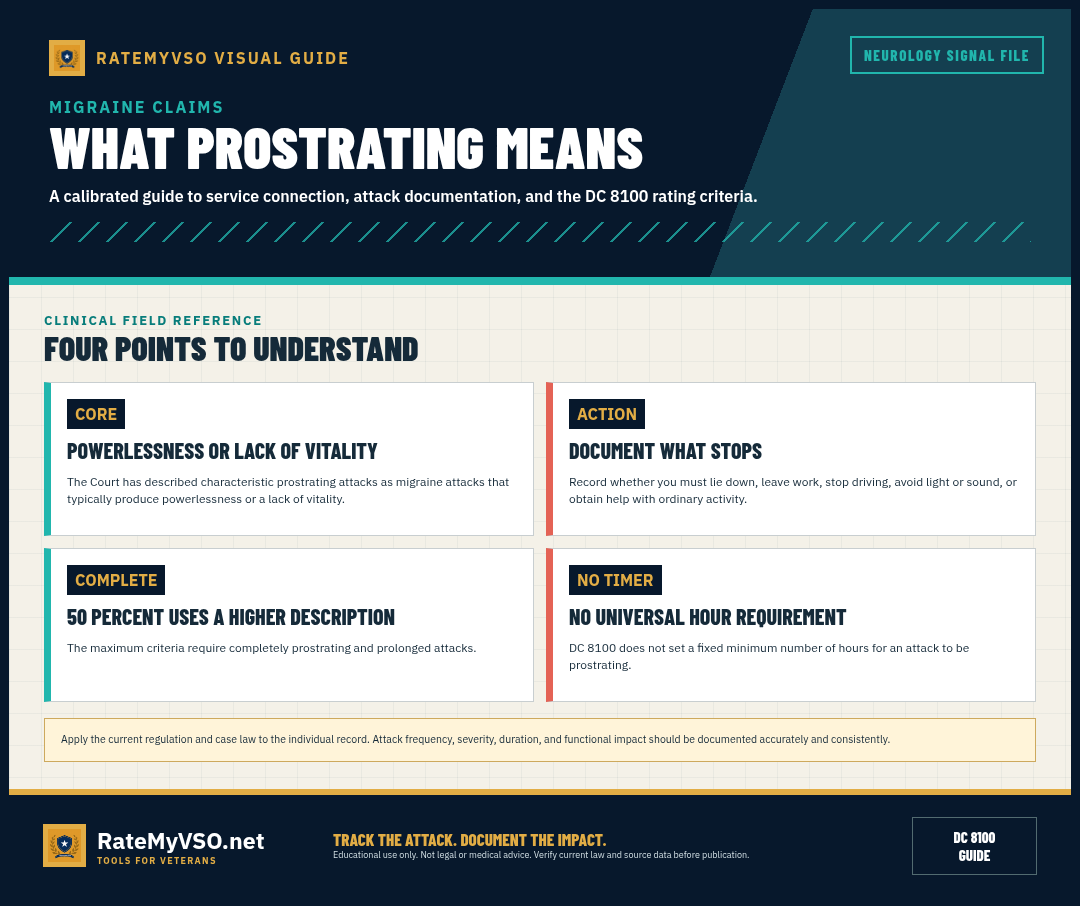
Citing Dorland's Illustrated Medical Dictionary, the Court defined prostration as "extreme exhaustion or powerlessness." A characteristic prostrating attack is therefore a migraine that typically produces extreme exhaustion or powerlessness, not merely pain or discomfort.
For the 50% level, the regulation requires "completely prostrating and prolonged attacks." The current VA Headaches DBQ describes a prostrating attack, for VA purposes, as one that causes extreme exhaustion, powerlessness, debilitation, or incapacitation with substantial inability to engage in ordinary activities. DC 8100 does not state a fixed minimum number of hours. At 50 percent, duration still matters because the attacks must also be prolonged.
Key implication
A painful migraine is not automatically a prostrating attack. The evidence should describe whether the attack caused extreme exhaustion or powerlessness and a substantial inability to engage in ordinary activities. Document the actual duration, but do not apply a universal three-hour cutoff.
 One-page guide: Severe Economic Inadaptability
Work-impact guide explaining that total unemployability is not required. Opens the full-size chart, free to save or print.
One-page guide: Severe Economic Inadaptability
Work-impact guide explaining that total unemployability is not required. Opens the full-size chart, free to save or print.
Section 3: What "Economic Inadaptability" Means Under VA Law
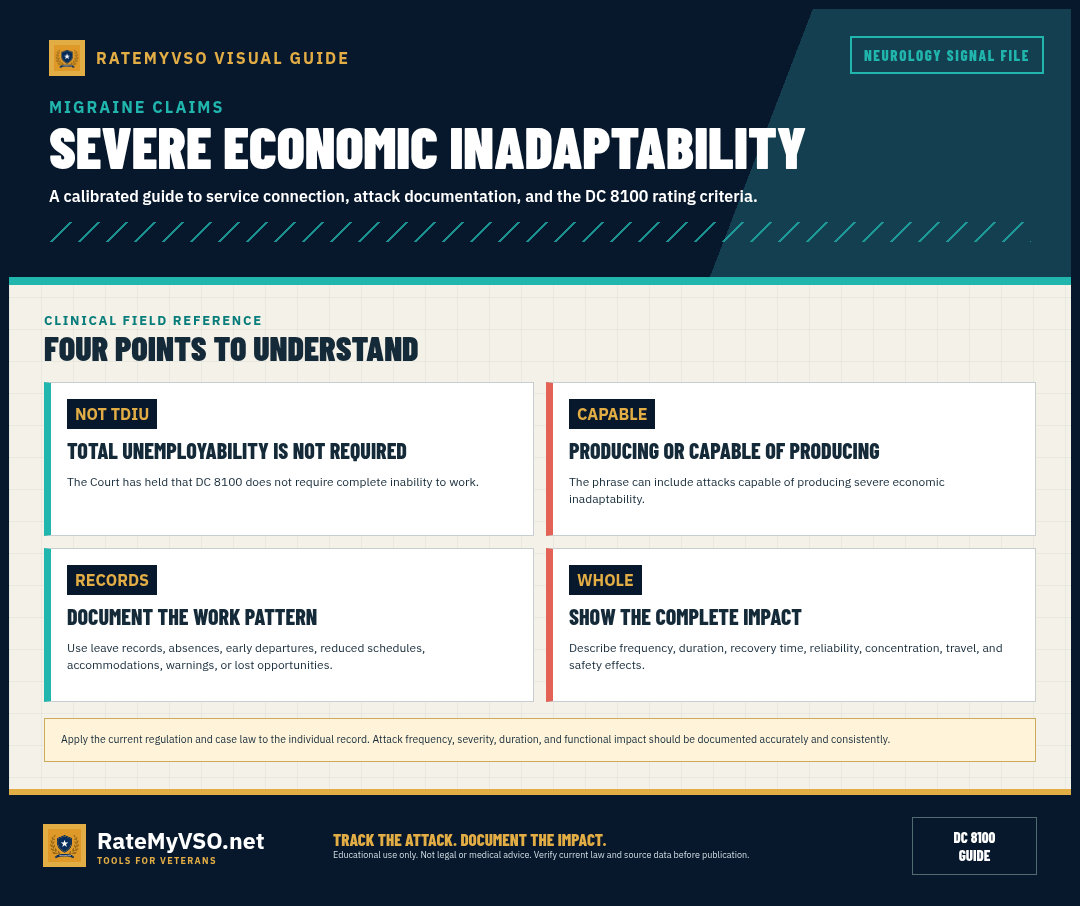
The 50% rating level requires attacks "productive of severe economic inadaptability." This phrase was interpreted by the Court in Pierce v. Principi, 18 Vet. App. 440, 445-46 (2004).
The Court held that "severe economic inadaptability" denotes a degree of substantial work impairment. It does not require that the veteran be completely unable to work. A veteran who is employed but frequently misses work, requires accommodations, uses sick leave or unpaid absence due to migraine attacks, or has their work performance materially affected qualifies for the 50% standard. In published Board decisions, this standard has been read to mean that "productive" covers attacks that either actually produce lost work time, or are capable of producing it, and a documented pattern of missed or disrupted work has been enough to support the initial 50% rating.
Evidence of work impairment includes the use of sick leave or unpaid absence attributable to migraines, accommodation requests related to migraine attacks, documentation of missed workdays in employment records, and treating provider statements describing the impact of attacks on work attendance and performance.
Section 4: What "Characteristic" Means
The word "characteristic" in the 10% and 30% criteria means typical or representative of the veteran's migraine attacks. The rating is based on the veteran's usual or representative attack pattern, not on an isolated worst-day episode. Medical records documenting frequent, recurring attacks consistent with the described pattern support that the attacks are characteristic.
Section 5: All Migraine Symptoms Count
VA must consider all symptoms experienced during migraine attacks, not only head pain, when rating DC 8100 (Holmes v. Wilkie, 33 Vet. App. 67 (2020)). The Court compared this requirement to the whole-symptom evaluation standard for mental health conditions (see 38 CFR § 4.126).
Symptoms evaluated under DC 8100 include but are not limited to:
- Head pain (location, intensity, character)
- Nausea and vomiting
- Photophobia (sensitivity to light)
- Phonophobia (sensitivity to sound)
- Visual aura (scotoma, visual disturbance preceding headache)
- Cognitive impairment during attacks
- Vestibular symptoms (dizziness, vertigo)
- Duration of the attack including post-migraine fatigue (migraine hangover or postdrome)
Documenting all of these symptoms in medical records and personal statements strengthens the evidence record for rating purposes.
Section 7: Extra-Schedular Consideration
50% is the maximum schedular rating under DC 8100. When a veteran's migraine disability results in impairment not adequately captured by the 50% criteria, VA must consider extra-schedular rating under 38 CFR § 3.321(b)(1). Extra-schedular consideration is appropriate when the average impairment in earning capacity is exceptional or unusual and the schedular criteria are inadequate for the disability picture presented.
When migraine attacks cause complete unemployability and the 50% schedular maximum does not reflect the actual functional level, the case may be referred for extra-schedular consideration or evaluated under the TDIU provisions at 38 CFR § 4.16. Even at the 50% schedular maximum, migraines that keep a veteran from working can support a total unemployability rating, and in some cases extra housebound special monthly compensation, based on the migraines alone.
Evidence and Board research
 One-page guide: Migraine Evidence Guide
Medical, diary, lay, and employment evidence. Opens the full-size chart, free to save or print.
One-page guide: Migraine Evidence Guide
Medical, diary, lay, and employment evidence. Opens the full-size chart, free to save or print.
Section 9: Evidence That Matters
We analyzed the Board's published DC 8100 decisions: a private nexus opinion in the file goes with a much higher grant rate, shown below.
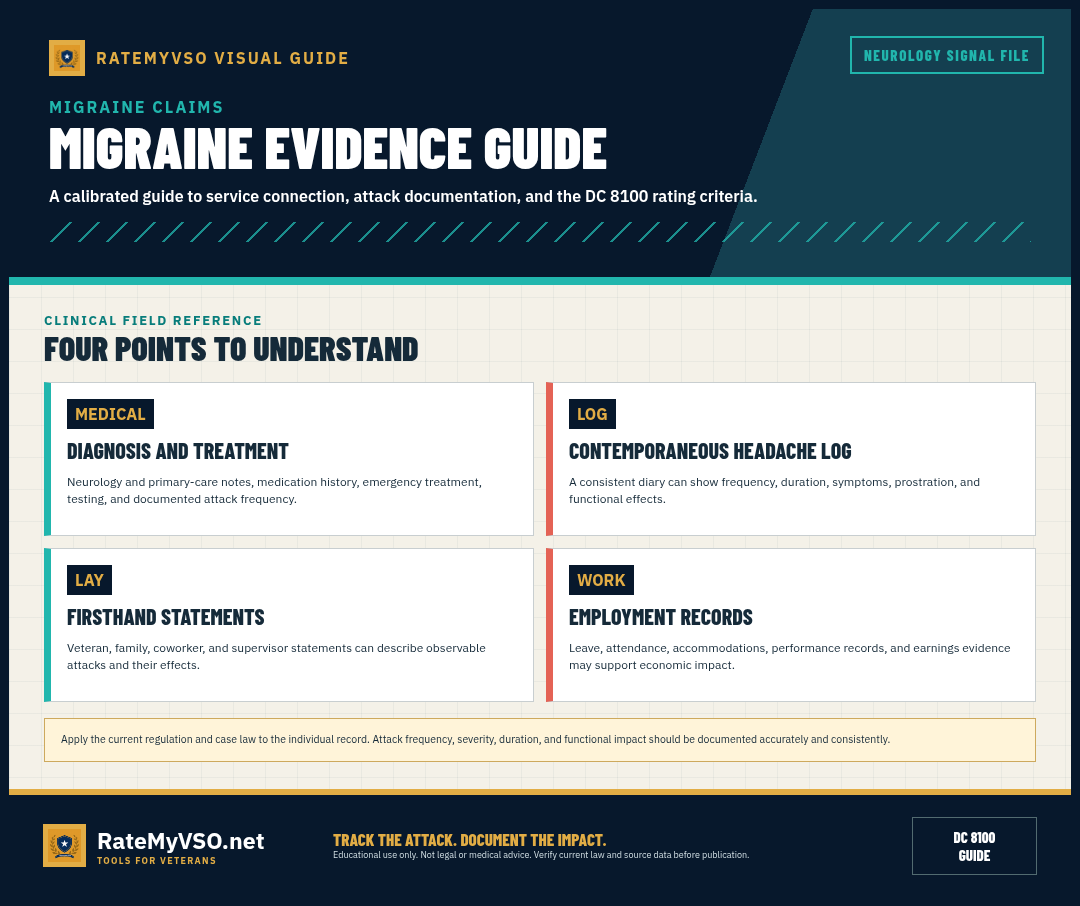
Frequency logs. A contemporaneous headache diary recording the date, duration, severity, symptoms, and functional impact of each attack provides objective frequency evidence. Medical practitioners and C&P examiners place significant weight on documented attack frequency.
Medical records. Treating provider notes documenting the frequency, character, and functional impact of migraines are primary evidence. Prescription records for migraine-specific treatments (triptans, CGRP inhibitors, preventive medications) also document chronicity.
Work records. Documentation of sick leave usage, HR accommodation requests, or attendance records noting migraine-related absences supports the economic inadaptability component of the 50% criteria.
Lay statements. Personal statements describing typical attack characteristics (onset, duration, symptoms, inability to function), along with statements from family members or co-workers who directly observe the impact of attacks, constitute admissible evidence. (Buchanan v. Nicholson, 451 F.3d 1331 (Fed. Cir. 2006)). Family and personal statements describing how attacks force the veteran to stop and lie down in a dark room have been enough, on their own, to support a 50% rating in published decisions even where a VA examiner's own report characterized the attacks as not prostrating. See our Buddy & Lay Statements Guide.
DBQ for headaches. The C&P examination for migraines uses a Disability Benefits Questionnaire designed to capture the frequency, severity, and occupational impact of headache attacks. The examiner assesses whether attacks are prostrating and whether the frequency meets the rating criteria. See our DBQ Library.
Evidence Cited in Published Migraines Decisions
We analyzed 70,852 published Board decisions involving migraines for condition-specific evidence, counting only case-specific mentions (boilerplate recitations excluded). "Favorable" is the share of decisions citing that evidence where every issue was granted or the outcome was mixed; the baseline across all these decisions is 60%. Evidence appearing in a decision does not mean it decided the case. Descriptive of the published record, not a prediction.
Bar length shows decisions citing the evidence.
Detected by phrase-reading the decision text with condition-specific vocabularies. Source: Board of Veterans' Appeals decisions, RateMyVSO analysis.
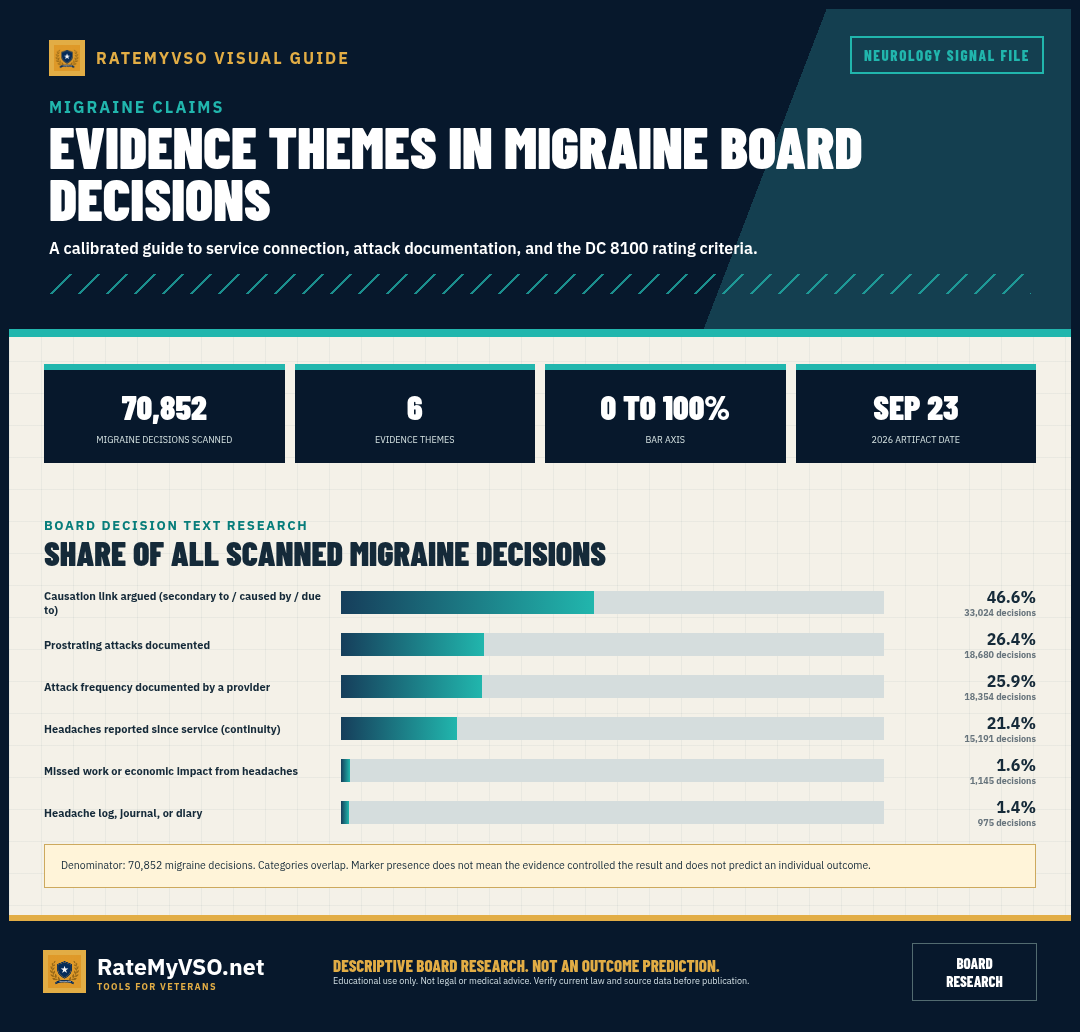 One-page guide: Evidence Themes in Migraine Board Decisions
Overlapping evidence-theme frequencies across 70,852 scanned migraine Board decisions. Opens the full-size chart, free to save or print.
One-page guide: Evidence Themes in Migraine Board Decisions
Overlapping evidence-theme frequencies across 70,852 scanned migraine Board decisions. Opens the full-size chart, free to save or print.
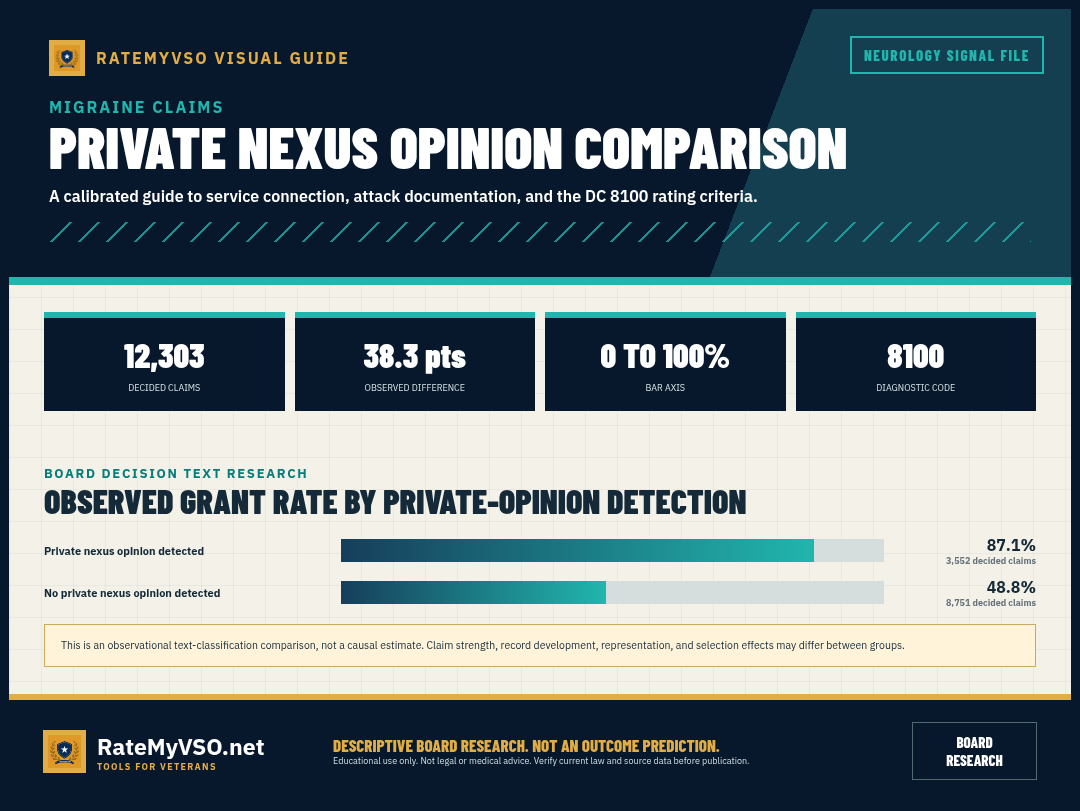 One-page guide: Private Nexus Opinion Comparison
Observed grant rates across 12,303 decided migraine claims, with and without a detected private nexus opinion. Opens the full-size chart, free to save or print.
One-page guide: Private Nexus Opinion Comparison
Observed grant rates across 12,303 decided migraine claims, with and without a detected private nexus opinion. Opens the full-size chart, free to save or print.
Why These Claims Get Denied
Beyond the general "no nexus" reasons covered above, a few specific denial patterns show up often enough in published migraine decisions to call out on their own.
- No current diagnosis in the file. A claim form or a veteran's own description of headaches is not the same as a documented migraine diagnosis. Claims have been denied where the only support was the claim itself, with no confirming diagnosis from a medical provider.
- No in-service event, and service records that contradict the claim. Where a veteran repeatedly answered "no" to headache questions on in-service and post-service medical history forms, or told VA directly that they had no headache history, the later claim of an in-service onset has been found not credible. A history of denying headaches for years before filing works against the claim.
- The veteran's own belief about the cause, without a doctor's opinion behind it. A veteran can describe symptoms, but is not competent to give the medical opinion that migraines were caused by service, that determination requires specialized medical training. A personal opinion about causation, without a supporting nexus opinion, does not carry the claim.
- Treating "headache" and "migraine" as interchangeable. VA treats headaches and migraines as distinct diagnoses. A record noting sinus headaches or generic headache complaints, without a migraine diagnosis specifically, has not been enough to open a migraine claim on its own.
- An injury from willful misconduct, not in the line of duty. Where migraines or an underlying TBI trace back to an injury from the veteran's own willful misconduct during service, service connection is barred by law regardless of how clearly the current condition connects to that injury.
- No new and relevant evidence to reopen a previously denied claim. A repeat filing that does not bring new and relevant evidence beyond what was already considered does not succeed on reopening; see the checklist and Supplemental Claim guidance later in this guide.
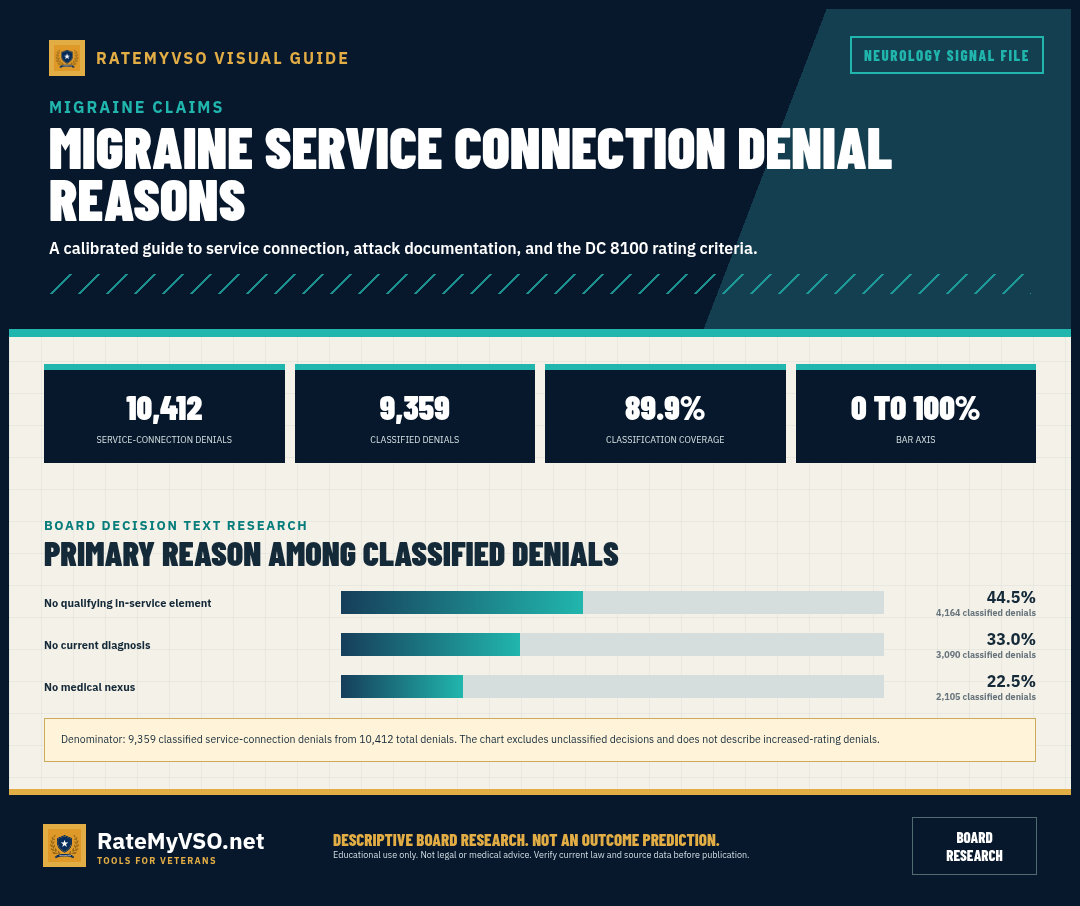 One-page guide: Migraine Service Connection Denial Reasons
Classified service-connection denial reasons for migraine: 9,359 of 10,412 denials carried a classified reason. Opens the full-size chart, free to save or print.
One-page guide: Migraine Service Connection Denial Reasons
Classified service-connection denial reasons for migraine: 9,359 of 10,412 denials carried a classified reason. Opens the full-size chart, free to save or print.
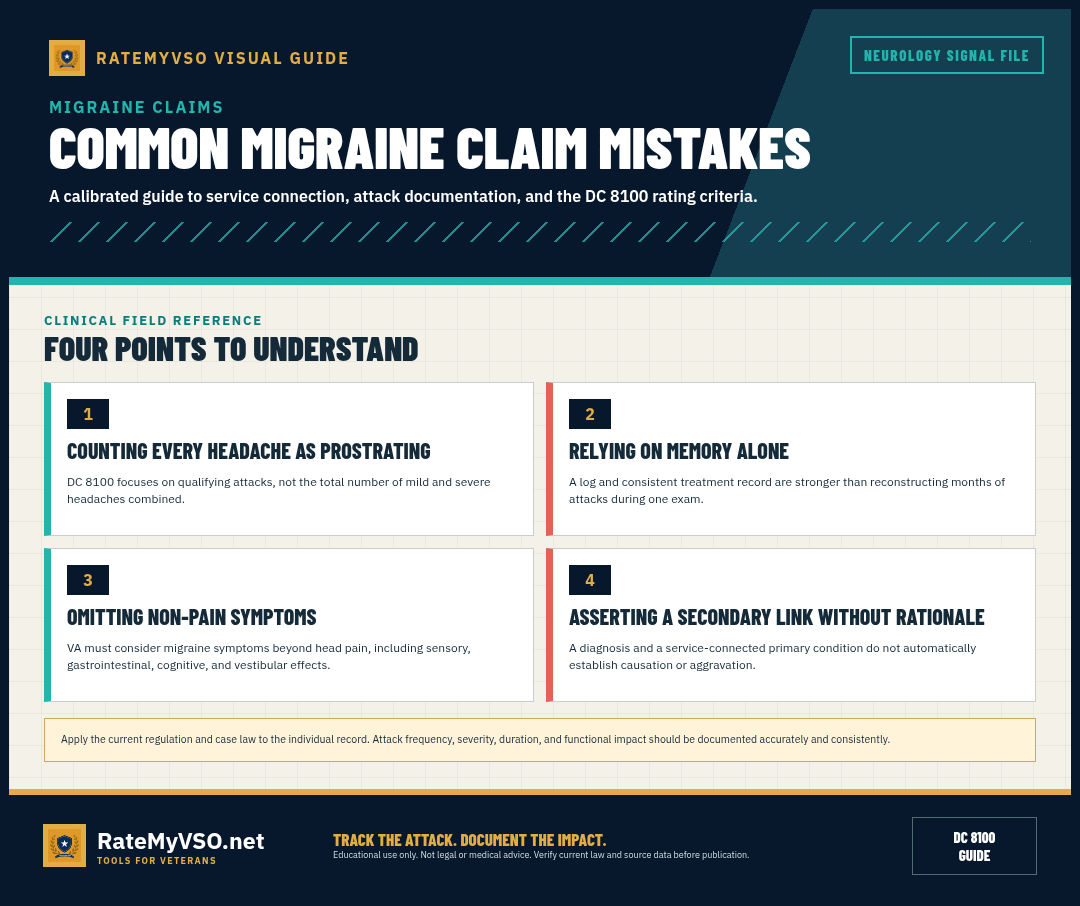 One-page guide: Common Migraine Claim Mistakes
Four common documentation and nexus mistakes. Opens the full-size chart, free to save or print.
One-page guide: Common Migraine Claim Mistakes
Four common documentation and nexus mistakes. Opens the full-size chart, free to save or print.
Common Mistakes
Patterns the published DC 8100 decisions and the rating rule flag most often.
- No nexus opinion in the file. No in-service event is the leading service-connection denial reason for DC 8100, at 44.5% of classified denials, ahead of no current diagnosis (33.0%) and a missing nexus (22.5%). In the published decisions, cases with a private nexus opinion were granted at a higher rate than cases with no medical opinion at all; the current figures are in the medical-opinion chart above, which updates weekly from the Board record. A useful opinion names the in-service event or the service-connected primary and explains the link, rather than stating a bare conclusion.
- Treating a painful migraine as a prostrating one. A migraine that lets the veteran keep working at reduced capacity is not "prostrating" under VA law. Prostration means extreme exhaustion or powerlessness with a substantial inability to engage in ordinary activities. Duration still matters and should be documented, but DC 8100 does not establish a universal minimum number of hours. Records that do not describe that level of incapacity can fall short of the 10% and 30% criteria.
- Documenting only head pain. Under Holmes v. Wilkie, DC 8100 requires VA to weigh all attack symptoms, nausea, photophobia, phonophobia, aura, cognitive and vestibular symptoms, and postdrome, not head pain alone. A record limited to pain understates the disability picture.
- Leaving out work-impact evidence for the 50% level. The 50% rating turns on "severe economic inadaptability." Without sick-leave records, accommodation requests, or documented missed workdays tied to attacks, the file often does not support the maximum schedular rating.
- Missing extra-schedular or TDIU referral. 50% is the schedular ceiling under DC 8100. When attacks cause impairment beyond what 50% captures, the case can be referred for extra-schedular consideration under 38 CFR 3.321(b)(1) or evaluated for TDIU under 38 CFR 4.16, a path that is frequently overlooked.
- Not raising a housebound SMC claim when attacks are severe enough. Some veterans whose migraines alone support TDIU may also qualify for special monthly compensation at the housebound rate; this is worth raising alongside a TDIU claim rather than assuming the two are the same thing.
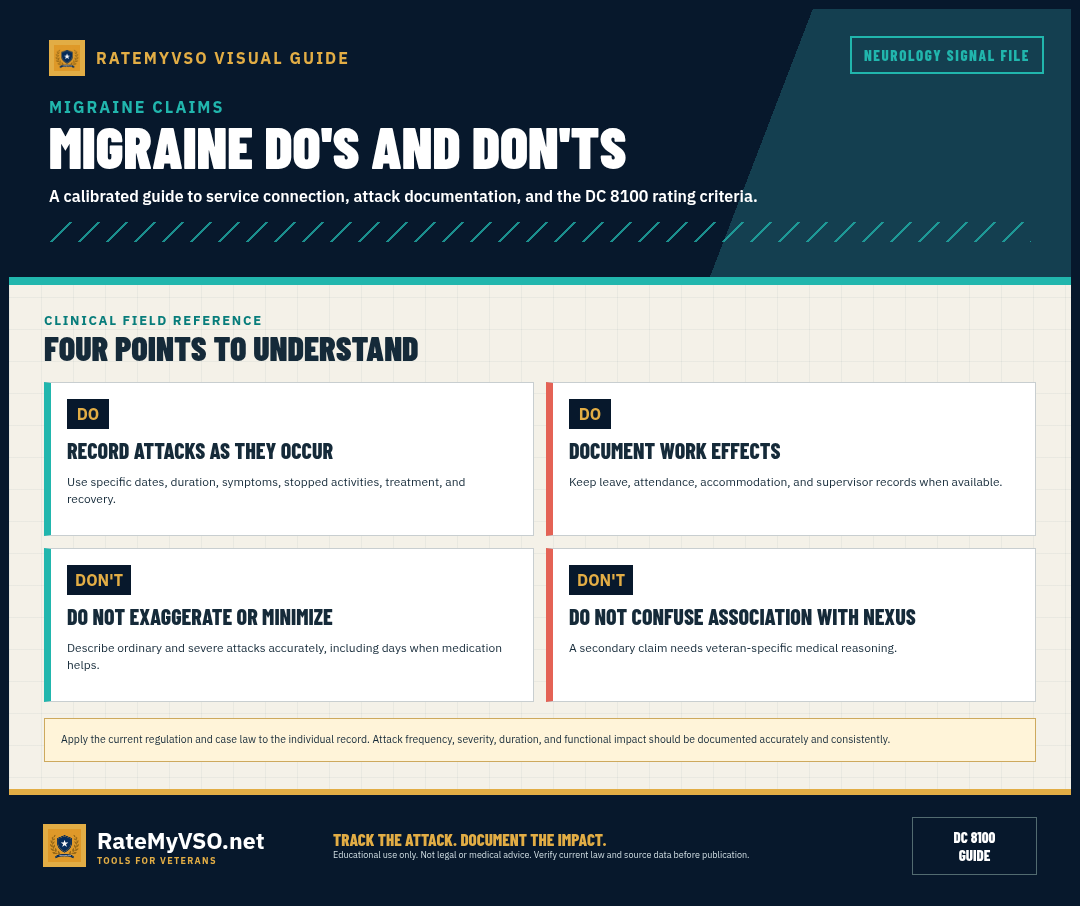 One-page guide: Migraine Do's and Don'ts
Four practical rules for logs, work records, accuracy, and medical nexus. Opens the full-size chart, free to save or print.
One-page guide: Migraine Do's and Don'ts
Four practical rules for logs, work records, accuracy, and medical nexus. Opens the full-size chart, free to save or print.
Do's and Don'ts
A condensed version of everything above, in the order it actually matters when you sit down to build your file.
- Get a migraine diagnosis confirmed by a medical provider before you rely on the claim, not just a symptom description.
- Get a private nexus opinion that explains its reasoning, lists the in-service headache records, and weighs your own account, not a bare conclusion.
- Point to headaches documented in service and describe, consistently, that they never stopped, migraine's chronic-disease status makes this continuity route available.
- Raise a toxic-exposure theory if your military job exposed you to fumes, fuels, or solvents, with a medical opinion explaining the mechanism.
- Identify every service-connected condition that could plausibly have caused or worsened your migraines (TBI, PTSD, cervical spine disability, sleep apnea).
- Keep a headache log documenting frequency, duration, and how attacks force you to stop and lie down, ideally in a dark room.
- Gather statements from family or co-workers who have witnessed your attacks and their impact.
- Document sick leave, accommodation requests, and missed workdays tied to attacks if you're aiming at the 50% level.
- Ask about TDIU and housebound SMC if migraines alone keep you from working, even at the 50% schedular maximum.
- File on time and respond to each VA decision within a year to protect your effective date.
- Don't assume a diagnosis alone proves the claim, you still need the in-service event and the medical link.
- Don't rely only on your own opinion about what caused your migraines, causation is treated as a medical question a non-doctor cannot answer alone.
- Don't deny headaches on medical history forms and then claim an in-service onset years later, inconsistency in your own record undermines credibility.
- Don't treat "headache" and "migraine" as the same diagnosis, claim migraines by name and get them diagnosed by name.
- Don't expect service connection for an injury caused by your own willful misconduct, the law bars it regardless of the medical connection.
- Don't let a C&P exam undercount your attacks just because medication provides partial relief, DC 8100 doesn't turn on medication response.
- Don't skip work-impact documentation if you're aiming for the 50% level, "severe economic inadaptability" needs a paper trail.
- Don't refile without new and relevant evidence if you were denied before, a repeat of what VA already considered will not reopen the claim.
Secondary relationships
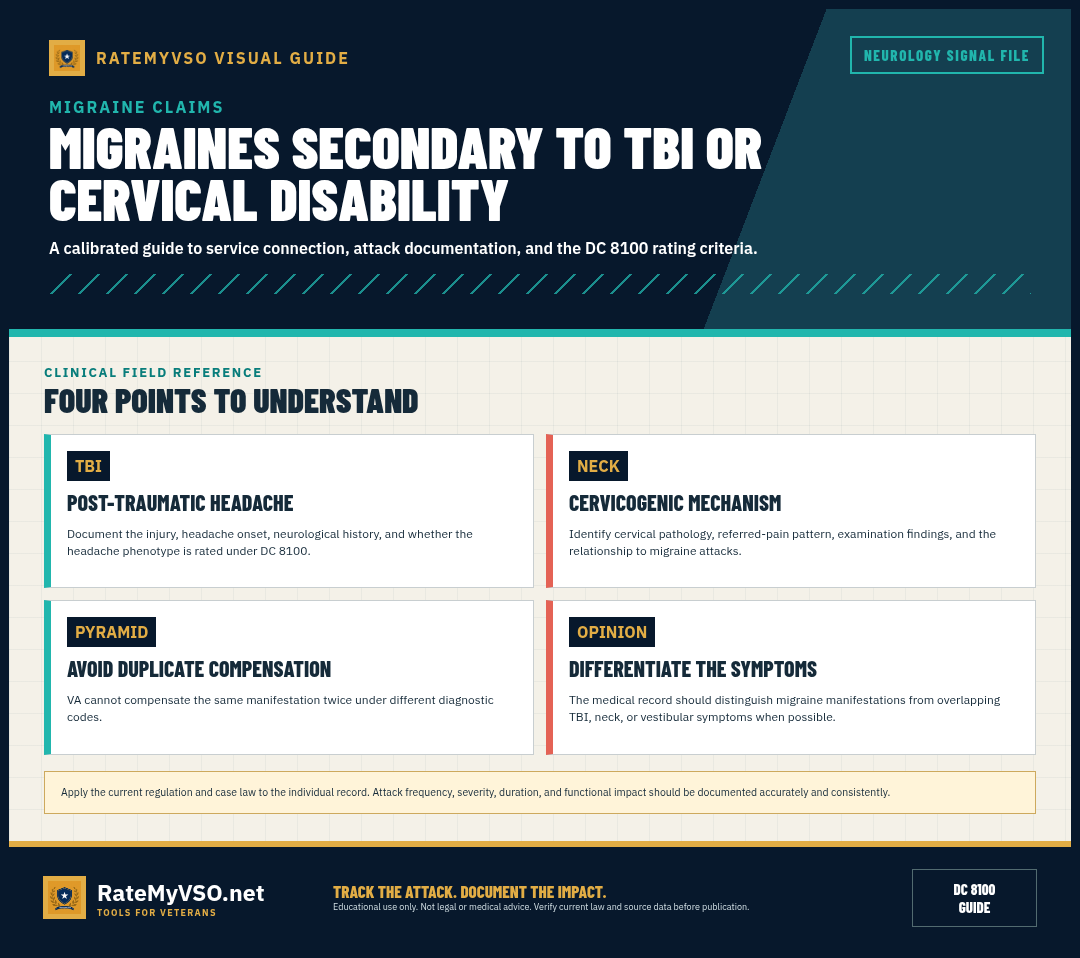 One-page guide: Migraines Secondary to TBI or Cervical Disability
Post-traumatic headache, cervicogenic mechanism, duplicate-compensation, and symptom-differentiation guide. Opens the full-size chart, free to save or print.
One-page guide: Migraines Secondary to TBI or Cervical Disability
Post-traumatic headache, cervicogenic mechanism, duplicate-compensation, and symptom-differentiation guide. Opens the full-size chart, free to save or print.
Section 10: Secondary Conditions Associated with Migraines
Migraines produce or co-occur with conditions that may be separately ratable when a causal link is documented.
Depression and anxiety (DC 9434, DC 9400). Chronic pain and the unpredictable, disabling nature of migraine attacks are associated with depressive and anxiety disorders. Secondary service connection is available when the causal link to service-connected migraines is documented. See the Mental Health Rating Formula Guide.
Sleep disorders. Migraines frequently disrupt sleep, and sleep disruption triggers migraines, creating a documented bidirectional cycle. Sleep apnea secondary to migraine-related sleep disruption is less common as a secondary chain than the reverse, but is not excluded, and has been recognized in published Board decisions.
Cervicogenic headache. Cervical spine degeneration can trigger headaches with migraine characteristics. When a service-connected cervical spine disability causes or contributes to the headache pattern, the headaches may be rated as secondary.
Medication overuse headache. Chronic use of pain medications to manage migraines can produce rebound headaches. This complicates both the clinical and rating picture and may be relevant in claims where treatment records show escalating medication use.
Common Secondary Conditions
We found these are the conditions most often linked with migraine in the Board's published decisions. Each bar is the BVA grant rate for DC 8100, with the number of decisions below it. They describe what the Board's record shows across many veterans, not a prediction about any one claim.
Conditions that can cause migraine (migraine as the secondary)
Claims where migraine was argued as secondary to an already service-connected condition. This is the "ways to connect via another condition" list, and it's usually the easier route into a grant. See the case-dissection guides on migraines secondary to PTSD, migraines secondary to sleep apnea, and migraines secondary to tinnitus for a deeper look at three of the pairings below.
Conditions migraine can cause (migraine as the primary)
Conditions veterans have claimed as caused or aggravated by a service-connected migraine:
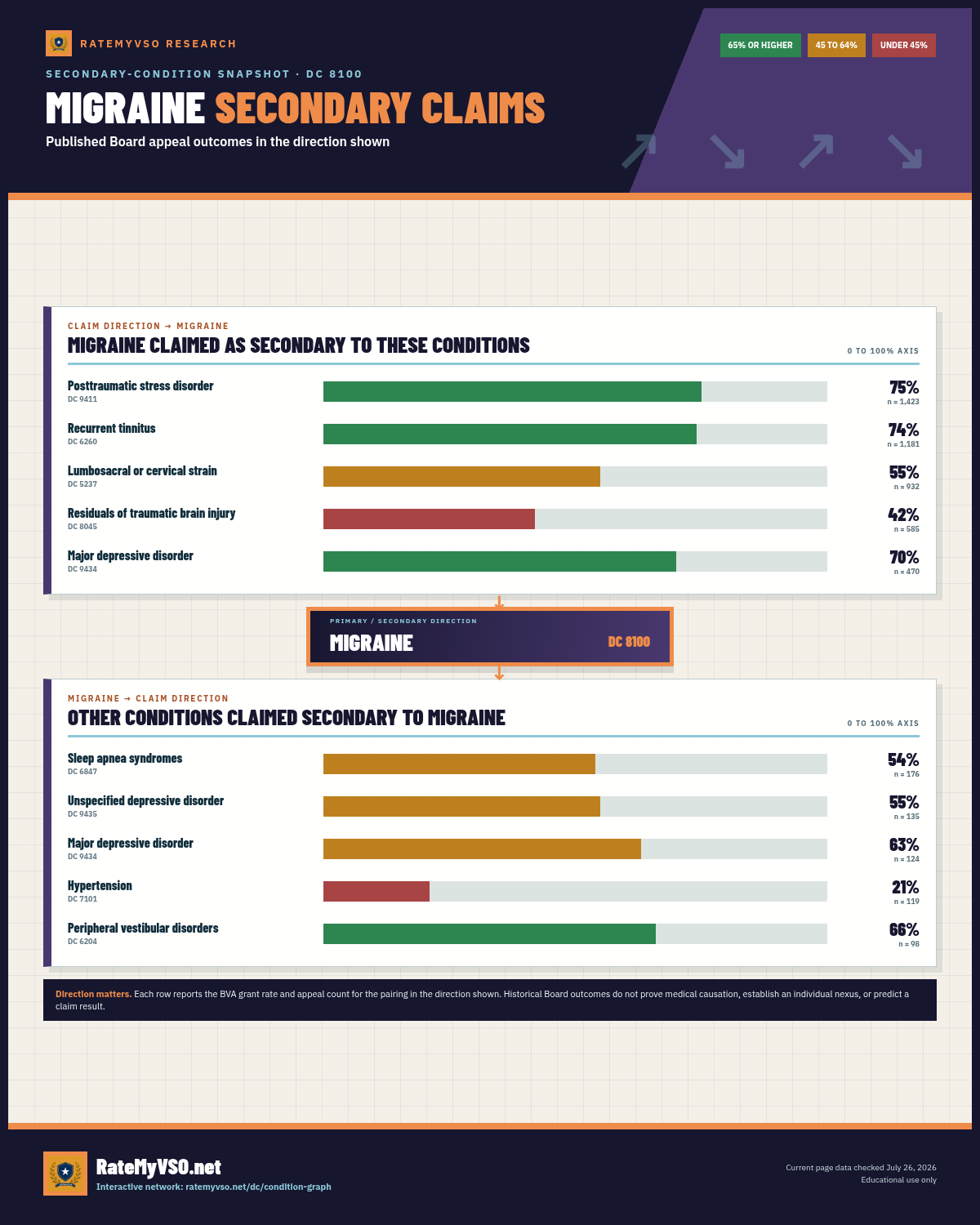 One-page guide: Migraine Secondary-Claim Snapshot
Two-direction secondary-claim snapshot for MIGRAINE, showing BVA grant rates and appeal counts for conditions claimed toward and away from MIGRAINE. Opens the full-size chart, free to save or print.
One-page guide: Migraine Secondary-Claim Snapshot
Two-direction secondary-claim snapshot for MIGRAINE, showing BVA grant rates and appeal counts for conditions claimed toward and away from MIGRAINE. Opens the full-size chart, free to save or print.
Prepare and take the next step
Prepare: your own working pages
Optional. These are your own notes, in your own words. They are not a VA form, they are not sent to the VA, and nothing here is a medical finding or a prediction about your claim.
Three reminders while you prepare
- Connection and severity are different questions
Understand how the migraines relate to service, then how the attacks affect your functioning. This guide explains the connection pathways and the rating criteria separately. Go to this part
- Describe the attacks in practical terms
Track symptoms, frequency, duration, recovery, and the activities you have to stop. Record treatment and the real effects on work or daily life, in your own words. Go to this part
- Match your account with available records
Start with the documents you already have. Mark missing or unverified records honestly, then use the claim, exam or decision tools for your next step. Go to this part
Sign in or create an account to save your answers and come back to them later. You can fill these in and print them without an account.
Attack and daily-life log
Records and unanswered questions
Personal and witness notes
Exam notes and provider conversation
Decision-letter reading sheet
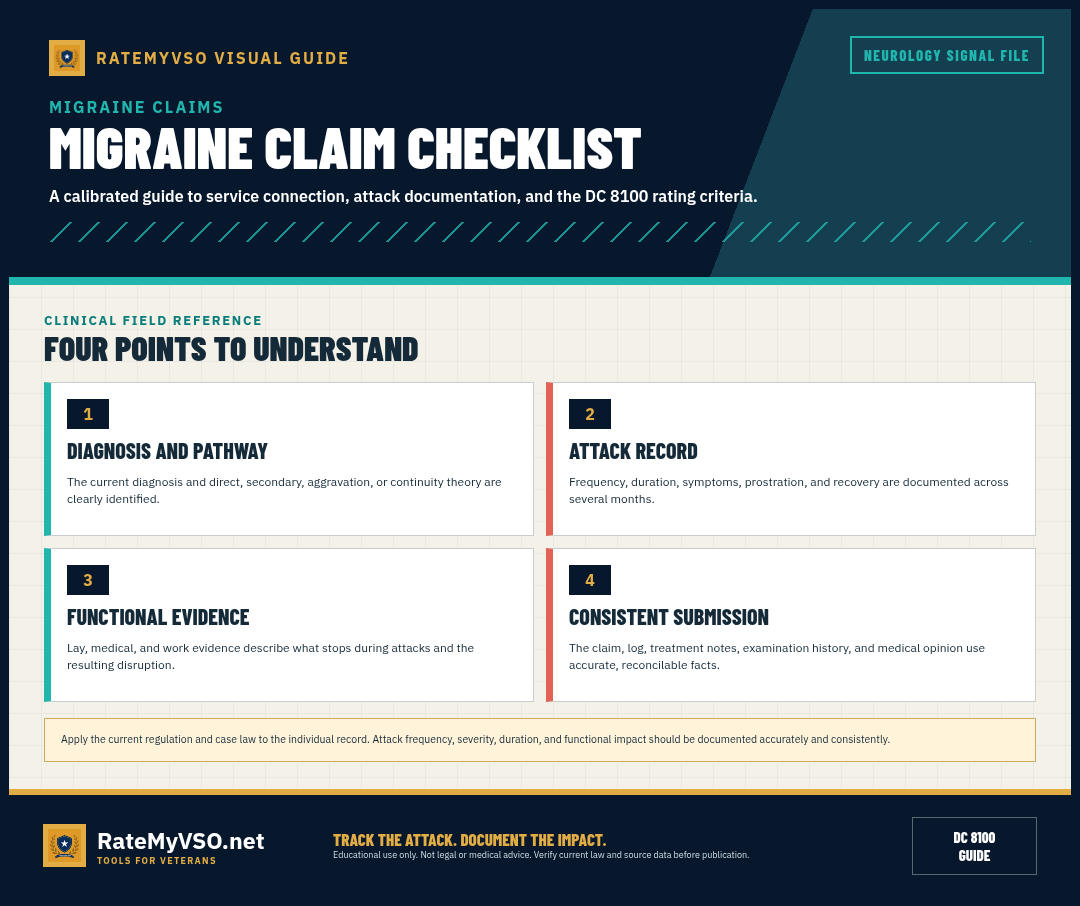 One-page guide: Migraine Claim Checklist
Diagnosis, attack record, functional evidence, and consistency checklist. Opens the full-size chart, free to save or print.
One-page guide: Migraine Claim Checklist
Diagnosis, attack record, functional evidence, and consistency checklist. Opens the full-size chart, free to save or print.
Quick Checklist Before You File
Bring these together before you submit anything.
- A confirmed migraine diagnosis, by name, actually in your VA file.
- Service records showing headaches or a head injury documented during service.
- A written nexus opinion from a doctor that explains the reasons for the link, not just a conclusion.
- A headache log, kept by you and where possible your family, describing how often attacks hit and how they force you to stop.
- A list of every service-connected condition that could plausibly connect (TBI, PTSD, cervical spine disability, sleep apnea), or a documented toxic-exposure history.
- Work records if you're aiming for the 50% level: sick leave, accommodation requests, or missed workdays tied to attacks.
- If you were denied before: new and relevant evidence for a Supplemental Claim, not just a repeat of what was already considered.
- Filed and responded to on time, within a year of each VA decision, to protect your effective date.
For the mechanics of actually submitting the claim, see the Standard Claim Guide and the Fully Developed Claim Guide (filing with all your evidence up front can speed up the decision).
The Claims Process, Step by Step
Once you file, your claim moves through a series of hand-offs. Understanding who does what helps you know who to contact, and what to expect, at each stage.
- You file the claim. Directly with VA, through VA.gov, or with the help of an accredited representative.
- VA acknowledges the claim and assigns it for development. A Veteran Service Representative (VSR) is assigned to gather your service treatment records, VA and private medical records, and any other evidence needed.
- The VSR orders a Compensation & Pension (C&P) exam if one is needed. Not every claim requires one, but most migraine claims do, especially secondary claims where a nexus opinion is required.
- The C&P exam is conducted. By a VA clinician or a contracted examiner, who completes a Disability Benefits Questionnaire (DBQ) documenting attack frequency, prostration, and, where relevant, a nexus opinion.
- The file goes to a Rating Veteran Service Representative (RVSR), the "rater." The rater reviews the complete file, including the exam results and any headache log, and decides whether service connection is warranted and at what percentage.
- A senior reviewer may review the decision before it's finalized, depending on the complexity of the claim.
- VA issues the decision letter. This states whether the claim is granted or denied, the rating percentage if granted, and the reasons behind the decision.
- If you disagree, you choose an appeal lane. Higher-Level Review, Supplemental Claim, or a Board appeal, covered later in this guide.
Who's who: VSO vs. VSR vs. Rater vs. C&P Examiner
Your VSO
An accredited representative from a veterans service organization, or an accredited attorney or claims agent. Not a VA employee. Helps you prepare, gather evidence, and file, and can represent you through an appeal. Has no authority to decide your claim.
VSR (Veteran Service Representative)
VA staff who "develops" your claim: requests records, schedules the C&P exam, and assembles the file. Does not decide the rating.
Rater (RVSR)
VA staff who reviews the completed file and makes the actual decision, service connection or denial, and the percentage. This is the person whose judgment the decision letter reflects.
C&P Examiner
A VA clinician or a contracted medical examiner who conducts the exam and completes the DBQ. Documents findings and, where asked, a nexus opinion. Does not decide the claim.
For the full walkthrough of every stage with more detail, see Inside Your Claim and Claim Stages.
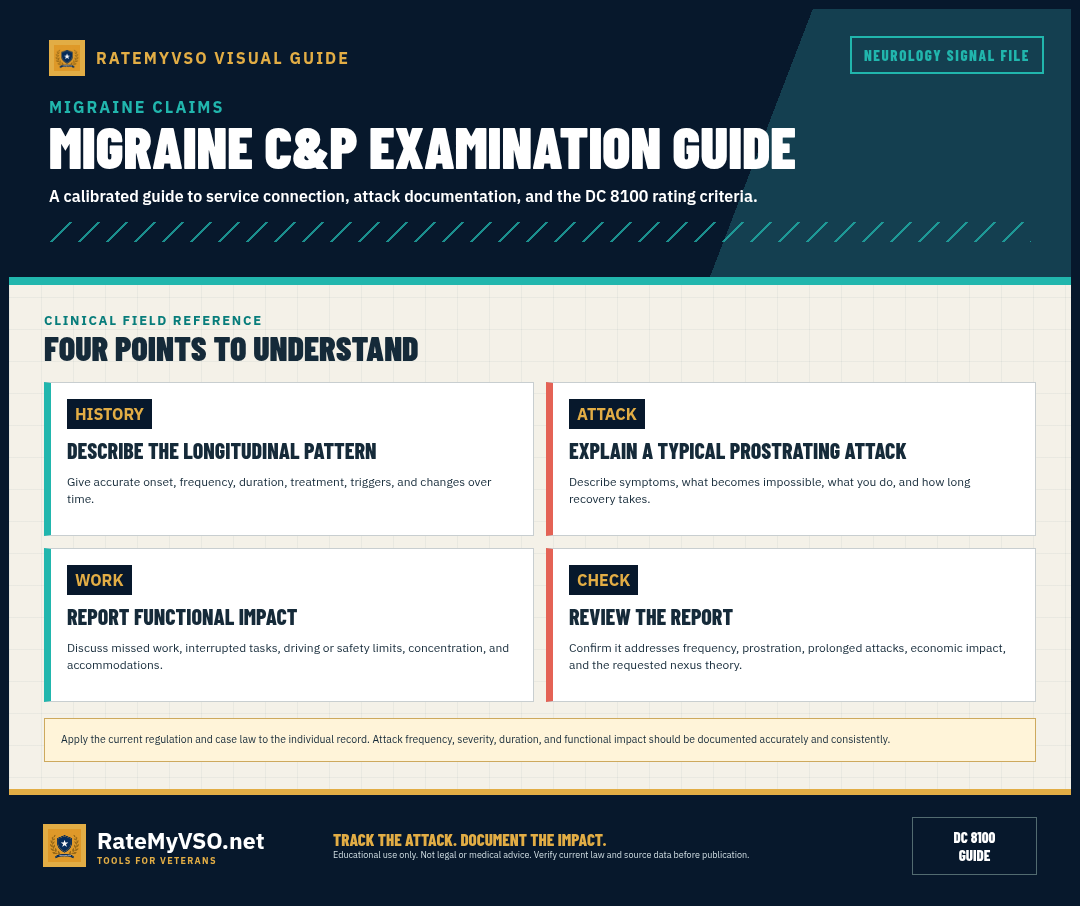 One-page guide: Migraine C&P Examination Guide
History, typical prostrating attack, work impact, and report review. Opens the full-size chart, free to save or print.
One-page guide: Migraine C&P Examination Guide
History, typical prostrating attack, work impact, and report review. Opens the full-size chart, free to save or print.
DBQs and Your C&P Exam
A Disability Benefits Questionnaire (DBQ) is the standardized form an examiner completes for your condition. For migraines, the DBQ structures the exam findings into the specific data points VA's rating schedule requires: attack frequency, whether attacks are prostrating, duration, and whether the pattern is productive of severe economic inadaptability. See the DBQ Guide for how these forms work generally, including whether a private DBQ completed by your own doctor can be submitted instead of relying solely on a VA exam.
Before your C&P exam, bring a clear, specific account of your attacks, focus on your worst attacks and how the condition affects daily function and work, not just how you feel on an average day. Be consistent with what's already in your medical records, headache log, and prior statements. For a full walkthrough of what to expect and how to prepare, see the C&P Exam Prep Guide and the C&P Exam Reference.
Reading Your Decision Letter, and What to Do If Denied
Your decision letter has two parts: a narrative section explaining the reasoning (often called "reasons and bases"), and a codesheet showing the actual rating percentage, the effective date, and the diagnostic code used. See the Reading Your Decision Letter Guide for how to find and interpret each part, or use the Letter Interpreter tool to upload your own letter and get a plain-English breakdown.
If your claim is denied, or the rating is lower than you expected, you have three main lanes:
- Supplemental Claim: refile with new and relevant evidence, such as a new nexus opinion, a headache log, or updated work-impact records. See Supplemental Claim Guide.
- Higher-Level Review (HLR): a senior reviewer looks at the same evidence again for a difference of opinion, no new evidence is added. See HLR Guide.
- Board Appeal: your case goes to a Veterans Law Judge at the Board of Veterans' Appeals, with options for a direct review, an evidence docket, or a hearing. See Board Appeal Guide.
Not sure which lane fits your situation? See the Appeals decision guide for a side-by-side comparison of all three.
After You Win: Maintaining Your Rating and Getting the Effective Date Right
A grant is not always the end of the story. In practice, a large share of published migraine decisions are not about the initial grant at all, they're about whether the rating is high enough or whether the effective date is correct.
Keep your headache log current and continue regular follow-up with a treating provider; ongoing documentation of attack frequency and severity protects you if you later file for an increased rating, and helps if VA proposes any future reduction. Remember that a medication that provides partial relief does not, on its own, justify a lower rating under DC 8100. Not every rating gets reexamined; understand when a rating becomes protected from future review and what to do if VA proposes to reduce it. See Protect Your Rating and Future Reexaminations for the specifics.
For the effective date, file promptly and respond to every VA request or decision within the applicable deadline, continuous pursuit of a claim can help lock in an earlier effective date, but the date generally cannot reach back before VA received the claim. If your migraines worsen after the initial grant, or if attacks alone are keeping you from working even at the 50% schedular maximum, see the Rating Increase Guide and consider raising TDIU and housebound special monthly compensation.
References and related resources
Section 11: Quick Reference Tables
Secondary Connection Pathways for Migraines
| Primary Condition | Recognized Mechanism | Evidence Needed |
|---|---|---|
| TBI (DC 8045) | Post-traumatic headache; direct neurological sequela | Diagnosis of migraine + neurological nexus opinion |
| PTSD (DC 9411) | Chronic stress, cortisol dysregulation, sleep disruption | Headache log + nexus opinion linking PTSD to migraine |
| Cervical spine disability | Referred pain, muscular tension, cervicogenic trigger | Cervical spine records + nexus opinion |
| Sleep apnea (DC 6847) | Oxygen desaturation, disrupted sleep architecture | Sleep study + nexus opinion linking OSA to migraine |
| Toxic exposure (direct, PACT Act) | Documented occupational exposure to fumes, fuels, or solvents | Exposure history + medical opinion naming the mechanism |
From Filing to Decision: Who Does What
| Role | Does | Decides your rating? |
|---|---|---|
| VSO / accredited representative | Helps prepare, gather evidence, and file; represents you on appeal | No |
| VSR | Develops the claim: orders records and the C&P exam | No |
| C&P Examiner | Conducts the exam, completes the DBQ, may give a nexus opinion | No / but has a strong impact |
| Rater (RVSR) | Reviews the full file and decides service connection and percentage | Yes |
Related Tools and Guides
Sources
- 38 CFR § 4.124a, DC 8100, Schedule of Ratings, Neurological Conditions (Migraine)
- 38 CFR § 3.303, service connection and the three-element test; § 3.303(b), continuity of symptomatology for chronic diseases
- 38 CFR § 3.307 and § 3.309, presumptive service connection; migraine as an organic disease of the nervous system
- 38 CFR § 3.310, Secondary Service Connection
- 38 CFR § 3.306, Aggravation of Pre-Service Disability
- 38 CFR § 3.321(b)(1), Extra-Schedular Ratings
- 38 CFR § 4.16, TDIU
- 38 U.S.C. § 1114(s) and 38 CFR § 3.350(i), special monthly compensation at the housebound rate
- 38 CFR § 3.102 and 38 U.S.C. § 5107(b), benefit of the doubt
- 38 U.S.C. §§ 1110 and 1131, basic service connection
- 38 CFR § 3.400 and 38 U.S.C. § 5110, effective dates
- 38 CFR § 3.156(c), reconsideration based on newly found service records; § 3.156(d) and § 3.2501, new and relevant evidence to readjudicate
- 38 CFR § 3.301 and 38 U.S.C. § 105(a), willful misconduct and line of duty
- 38 U.S.C. § 1168, medical exam duty for toxic exposure risk activity under the PACT Act
- Pierce v. Principi, 18 Vet. App. 440, 445-46 (2004), Definition of "severe economic inadaptability" under DC 8100
- Holmes v. Wilkie, 33 Vet. App. 67 (2020), All migraine symptoms evaluated under DC 8100, not just head pain
- Buchanan v. Nicholson, 451 F.3d 1331 (Fed. Cir. 2006), lay testimony evidentiary weight
- Dorland's Illustrated Medical Dictionary (32d ed. 2012), Definition of "prostration" as extreme exhaustion or powerlessness
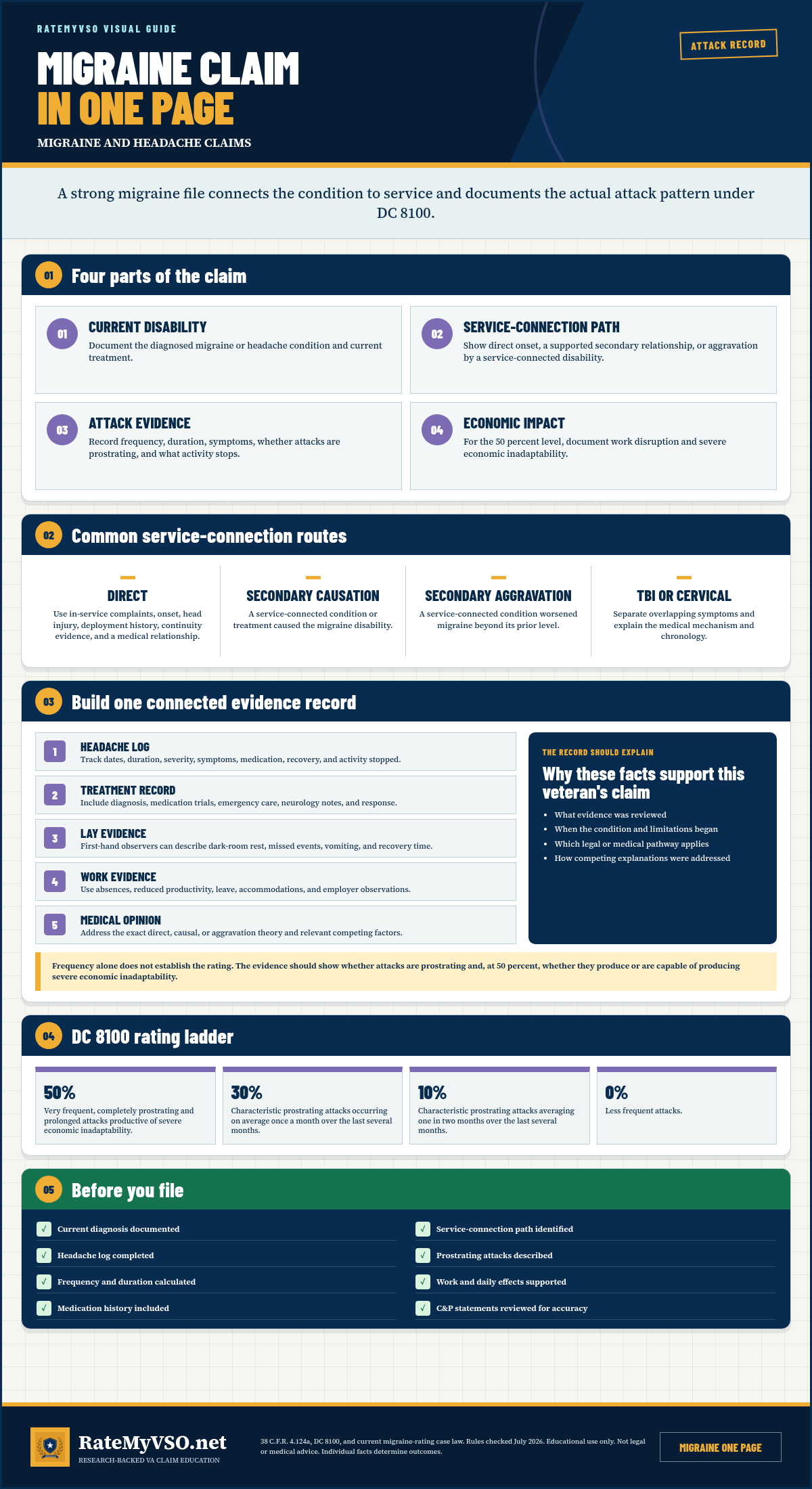 One-page guide: Migraine Claim in One Page
Five-part visual guide to migraine claims covering service-connection routes, attack logs, prostrating attacks, economic impact, the DC 8100 rating ladder, and a filing checklist. Opens the full-size chart, free to save or print.
One-page guide: Migraine Claim in One Page
Five-part visual guide to migraine claims covering service-connection routes, attack logs, prostrating attacks, economic impact, the DC 8100 rating ladder, and a filing checklist. Opens the full-size chart, free to save or print.