Original research
The Private-Opinion Edge
A private medical opinion has always helped a service-connection claim at the Board. But across the highest-volume conditions, its edge has nearly tripled in thirty years, from a 20.6-point advantage in the 1990s to 37 points today.
How this research is built: every Board of Veterans' Appeals decision published by VA is public, and anyone can read one at a time. RateMyVSO downloads and analyzes the complete published record, identifying who wrote the medical opinion in each decision, private doctor, VA examiner, both, or none, and tracking the grant-rate difference over three decades. The result is one of the largest structured research datasets built from the published Board record. It updates automatically every week as new decisions publish.
The gap has widened decade by decade
Grouping decisions on the 30 most-appealed conditions by decade, and comparing those where the file held a private medical opinion against those with only a VA opinion or none, both grant rates rose over time, but the ones with a private opinion rose far faster:
| Decade | With private opinion | Without | Edge (points) |
|---|---|---|---|
| 1992-1999 | 41.2% (6,576) | 20.6% (43,352) | +20.6 |
| 2000-2009 | 42.9% (17,977) | 22.1% (83,074) | +20.8 |
| 2010-2018 | 68.6% (35,440) | 38.6% (137,339) | +30 |
| 2019-2026 | 81% (81,270) | 44% (238,704) | +37 |
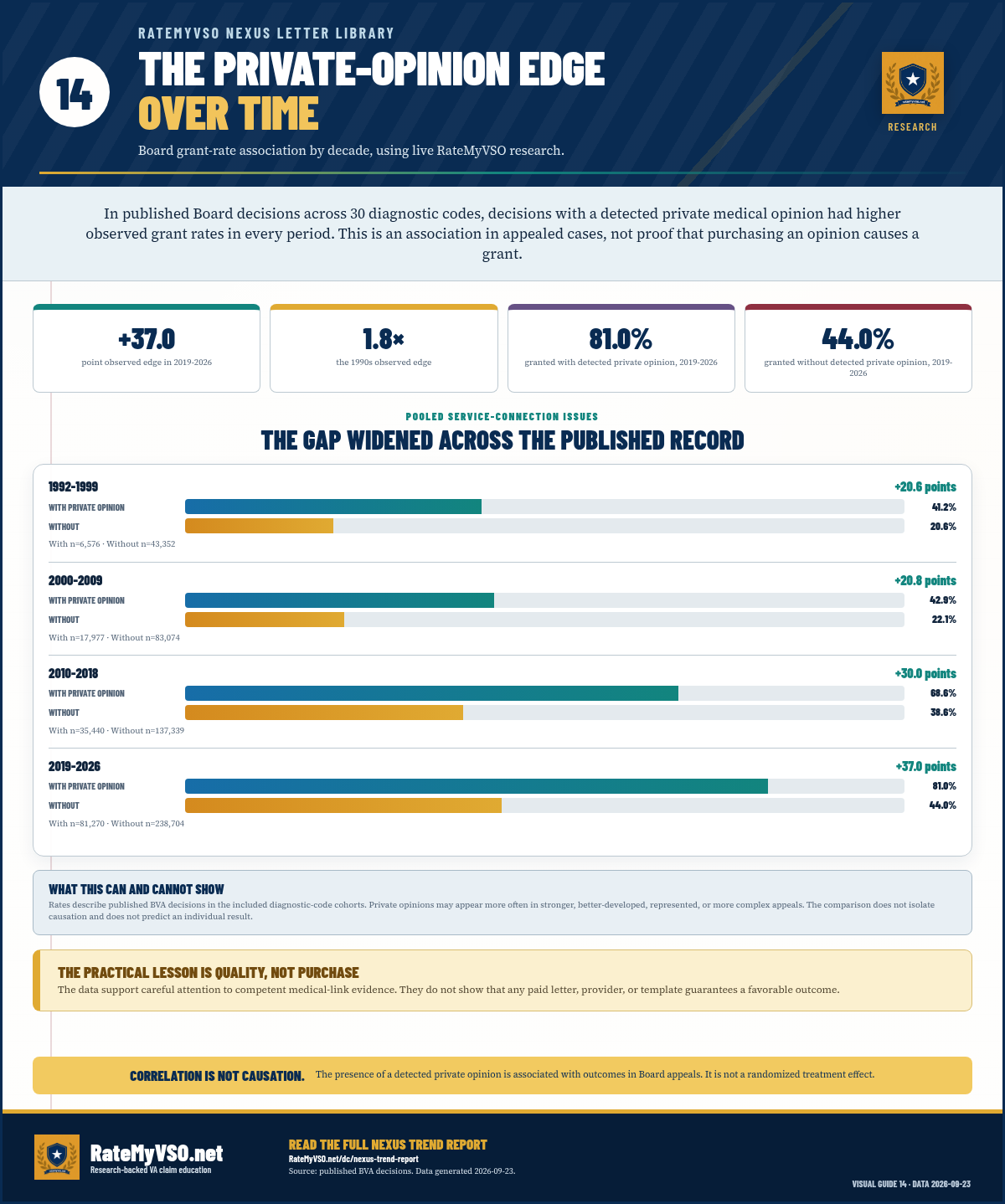 Visual guide: The Private-Opinion Edge Over Time
Board grant-rate comparison with and without a detected private medical opinion, current edge 37.0 percentage points, 81.0 percent granted with versus 44.0 percent without. Opens the full-size chart, free to save or print.
Visual guide: The Private-Opinion Edge Over Time
Board grant-rate comparison with and without a detected private medical opinion, current edge 37.0 percentage points, 81.0 percent granted with versus 44.0 percent without. Opens the full-size chart, free to save or print.
Source: RateMyVSO analysis of published BVA decisions, 1992-2026. Data generated July 2026; refreshes weekly. · All 16 visual guides
The trend holds across conditions
It is not one condition driving the pattern. Here is the grant rate with a private opinion, by decade, for the twelve most-appealed conditions, each climbs:
| Condition | 1992-1999 | 2000-2009 | 2010-2018 | 2019-2026 |
|---|---|---|---|---|
| Hearing loss | 48.6% | 48.7% | 71% | 79.2% |
| Posttraumatic stress disorder | 42.2% | 44.7% | 72% | 84.5% |
| Tinnitus, recurrent | 56% | 52.7% | 78.7% | 85.1% |
| Hypertensive vascular disease | 28.7% | 36% | 49.6% | 75.8% |
| Sleep Apnea Syndromes | 33.3% | 44.8% | 76.5% | 87.1% |
| Diabetes mellitus | 35.3% | 30.7% | 47.1% | 69.8% |
| Lumbosacral or cervical strain | 34.6% | 44.6% | 68.3% | 76.3% |
| Migraine | 35% | 42.3% | 74.7% | 88.1% |
| Paralysis of sciatic nerve | 35.4% | 38.5% | 67.9% | 78.9% |
| Degenerative arthritis, other than post-traumatic | 45.1% | 46.9% | 73.4% | 83.2% |
| Other specified anxiety disorder | 35% | 42.1% | 73% | 80.1% |
| Arteriosclerotic heart disease | 32.1% | 37.8% | 56.1% | 70.6% |
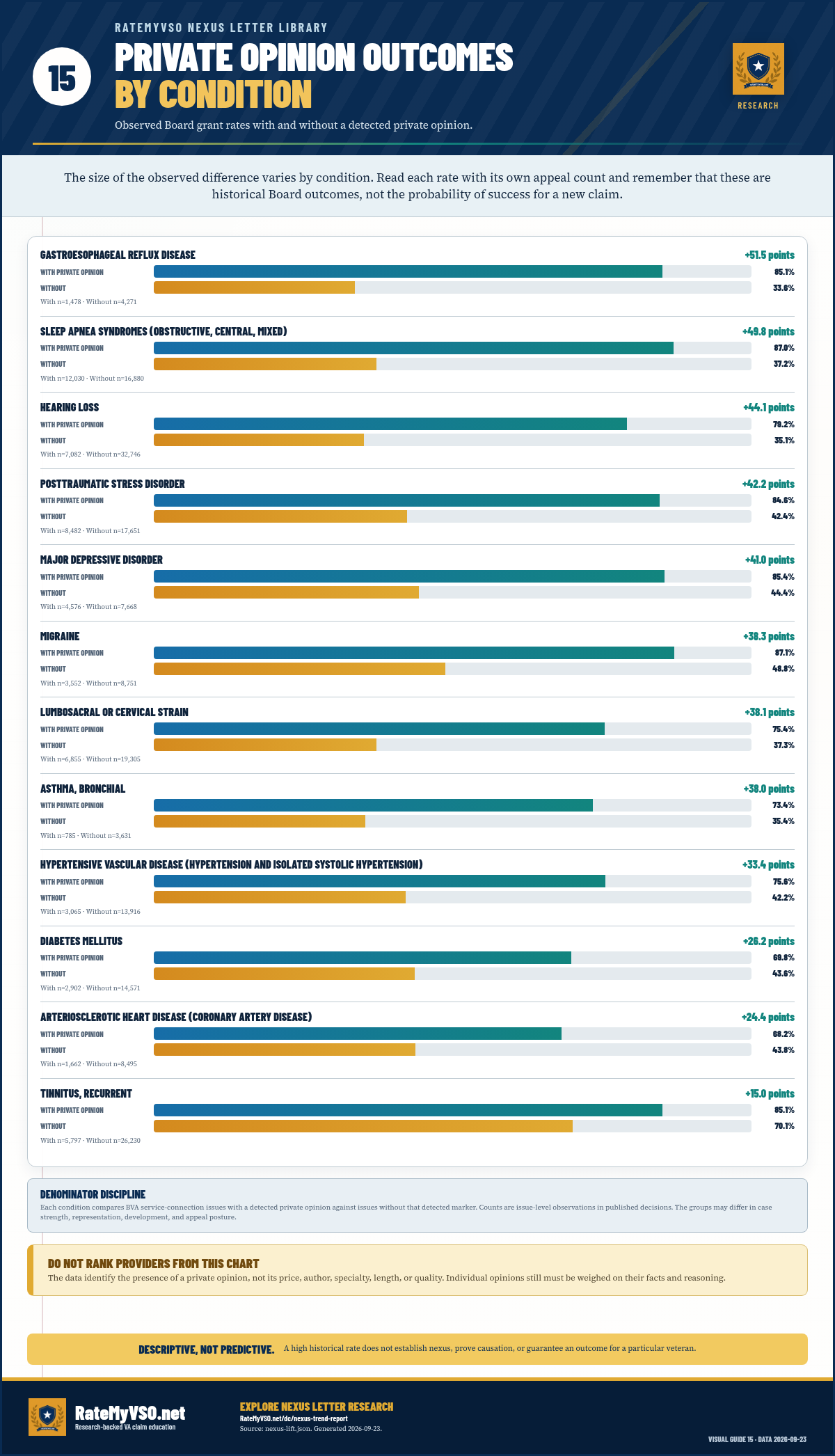 Visual guide: Private Opinion Outcomes by Condition
Board grant-rate comparison by condition with and without a detected private medical opinion, Gastroesophageal reflux disease shows the highest edge at 51.5 percentage points. Opens the full-size chart, free to save or print.
Visual guide: Private Opinion Outcomes by Condition
Board grant-rate comparison by condition with and without a detected private medical opinion, Gastroesophageal reflux disease shows the highest edge at 51.5 percentage points. Opens the full-size chart, free to save or print.
Source: RateMyVSO analysis of published BVA decisions, 1992-2026. Data generated July 2026; refreshes weekly. · All 16 visual guides
Methodology
This report aggregates published decisions of the Board of Veterans' Appeals at the issue level, limited to service-connection issues on the 30 highest-volume diagnostic codes. A decision is counted as "with a private opinion" when the record identifies a private or non-VA medical opinion on the nexus question, and "without" when the only medical opinion was a VA examiner's or there was none. Grant rate is granted divided by granted-plus-denied. The private/no-private classification comes from the language of each decision. These figures describe the published record; they are not legal advice and do not predict the outcome of any individual claim. Data as of September 2026; figures refresh weekly.
Cite this research
RateMyVSO. (September 2026). The Private-Opinion Edge: How the Value of a Private Nexus Opinion at the Board of Veterans' Appeals Has Widened Over Three Decades. https://ratemyvso.net/dc/nexus-trend-report
Free to cite and link with attribution. Figures derived from published Board of Veterans' Appeals decisions.
Educational and encyclopedic only, not legal advice, and not a prediction of any individual claim. Figures describe patterns in published Board decisions. For help with a claim, find a VA-accredited representative.