An add-on payment. Not a replacement rate.
SMC-K: Loss or Loss of Use of an Anatomical Part
SMC-K is an add-on payment, on top of your regular monthly compensation, for the anatomical loss or loss of use of specific body parts. Authority: 38 USC § 1114(k), implemented at 38 CFR § 3.350(a).
Find the part that matters to you
Three topics. Start with yours.
Shortcuts into the guide, not an eligibility decision. The full list of qualifying losses is in its chapter.

What the regulation lists
Organs, a hand or a foot, sight, hearing, voice and breast tissue.
Read the qualifying losses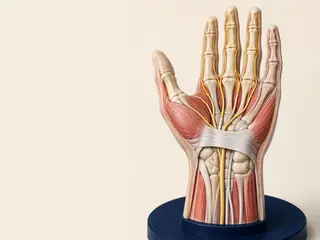
A functional test
When a part is still present but no effective function remains.
Read the standard
One award per loss
How separate losses stack, and the cap on the total.
Read the stacking rules
Make the loss
visible in the record.
From the category to the record
The evidence depends
on the loss claimed.
Operative reports, test results and treatment records each document a different kind of loss. The evidence chapter lists what fits each category.
The complete reference
The details behind each topic.
All of the guidance is here. Open a section when you need it.
01What Is SMC-K?
An add-on payment, and how it differs from the higher levels.
SMC-K is an additional monthly payment, currently $139.87/month, paid on top of your regular schedular compensation when you have suffered the anatomical loss or loss of use of a specific body part listed in 38 CFR § 3.350(a).
Unlike SMC-L through SMC-T (which replace your schedular rate with a higher monthly amount), SMC-K stacks on top of your existing pay. Veterans at any rating from 0% to 100% can receive SMC-K if they qualify.
02The Qualifying Losses
The anatomical losses and losses of use the regulation lists.
The regulation lists the qualifying anatomical losses or losses of use (see 38 CFR § 3.350(a)):
| # | Category | Notes |
|---|---|---|
| 1 | Creative organ (testicle / ovary) | Loss or loss of use of either, or sterility from service-connected condition. |
| 2 | One foot | Loss or loss of use. Both feet = qualifies for SMC-L instead. |
| 3 | One hand | Loss or loss of use. One hand + one foot = qualifies for SMC-L. |
| 4 | Both buttocks | Loss of use due to severe gluteal injury. |
| 5 | Blindness in one eye having only light perception | The regulatory test: cannot recognize test letters at 1 foot, and cannot make out objects, hand movements, or count fingers at 3 feet (§ 3.350(a)(4)). Not the 5/200 standard, which is the bilateral test for SMC-L. |
| 6 | Deafness in both ears (with absence of air and bone conduction) | Total deafness, not partial. |
| 7 | Complete organic aphonia | Loss of voice, no functional speech possible. |
| 8 | One or both breasts | From mastectomy or wide local excision (radical or modified radical). Treated as loss of one breast. |
| 9 | Loss of erectile function | Counted as loss of use of a creative organ. SMC-K does not require penile deformity; that is the separate requirement for a compensable rating under DC 7522, which is a different question from SMC-K. |
The list above shows the most common categories. The full regulation also covers loss of use of mastectomy on the female anatomy, and a handful of less-common scenarios. Read 38 CFR § 3.350(a) directly for the full list.
03"Loss of Use" Standard
A functional test, not an anatomical one.
"Loss of use" of a hand or foot is defined in 38 CFR § 3.350(a)(2):
"Loss of use of a hand or a foot will be held to exist when no effective function remains other than that which would be equally well served by an amputation stump at the site of election below elbow or knee with use of a suitable prosthetic appliance."
The legal test is functional, not anatomical. A foot that is technically intact but completely unable to bear weight or perform any locomotor function may satisfy "loss of use." Severe peripheral neuropathy, end-stage drop foot, or complete tarsal-tunnel syndrome commonly meet this standard.
For a creative organ, "loss of use" means the organ cannot perform its reproductive function. Sterility from service-connected radiation exposure, chemotherapy, or surgical removal qualifies even when the organ is anatomically present.
04Stacking Multiple SMC-K Awards
Separate losses, separate awards, and what they do not trigger.
SMC-K awards stack: each separate qualifying loss adds another $139.87/month. Two losses = $279.74. Three = $419.61.
Example: a veteran with service-connected diabetes who has lost erectile function (SMC-K #1) and has loss of use of one foot from peripheral neuropathy (SMC-K #2) and is sterile from chemotherapy for service-connected cancer (SMC-K #3) receives 3 × SMC-K, an additional $419.61/month on top of their schedular rate.
05Illustrative Example
A fictional scenario to illustrate the guidance.
Fictional example, not a real claimant. Names and facts are invented to show how the criteria above could apply in a single case.
Marcus T. served in the Army from 2003 to 2007. During his second tour in Iraq, an IED blast cost him his left foot below the ankle. The VA rated his amputation at 40% under diagnostic code 5165, but because losing a foot is a "loss of use" event under the SMC rules at 38 CFR § 3.350(a), Marcus also receives the SMC-K special monthly payment of $139.87 on top of his regular compensation. He walks with a prosthesis and lives independently.
062026 Rate
The monthly add-on and the cap on the total.
SMC-K's 2026 monthly add-on is $139.87, set by VA each December 1 alongside COLA-adjusted compensation rates. The rate has no dependent supplements, it's a flat add-on regardless of family composition.
Per loss, the rate stacks linearly: two qualifying losses = $279.74, three = $419.61. It is not unlimited. 38 CFR § 3.350(a) caps the total by rate rather than by a headcount: added to the ordinary rates or to SMC-S, the combined amount cannot exceed the SMC-L rate; added to SMC-L through N or to an intermediate SMC-P rate, it cannot exceed the SMC-O rate. VA's published rate tables reflect that ceiling by showing K added one, two, or three times, and K is not added on top of SMC-O, Q, or R.
Use the VA Math Calculator to model SMC-K stacking against your underlying schedular rate.
07Evidence That Wins
The records that fit each category.
SMC-K evidence depends on the category claimed:
- Anatomical loss (amputation, surgical removal): operative reports, post-op imaging, surgical pathology. Usually undisputed.
- Loss of use of foot/hand: EMG/nerve conduction studies, orthopedic exam findings of "no effective function," videotape evidence of weight-bearing or grip limitations.
- Creative organ / loss of erectile function: urology workup, hormone panels, treatment records (PDE-5 inhibitors documented as ineffective). The bar is lower than commonly assumed, treatment failure on standard medications often suffices.
- Sterility: semen analysis (azoospermia / severely abnormal counts), gynecologic exam findings of premature ovarian failure, oncology records linking sterility to service-connected treatment.
- Blindness in one eye: an ophthalmology report addressing the regulatory test, whether you can recognize test letters at 1 foot and whether you can perceive objects, hand movements, or count fingers at 3 feet. Ask the examiner to answer those two questions directly; a bare Snellen figure often does not.
- Deafness: audiologic testing showing absence of both air and bone conduction.
- Aphonia: ENT/laryngology records, speech-pathology evaluation, video evidence of attempted phonation.
08SMC-K vs SMC-L and Higher
An add-on compared with a replacement rate.
SMC-K (Add-On)
How it pays: $139.87 ON TOP of your schedular rate.
Stacks: yes, each qualifying loss adds another $139.87.
Triggers: single anatomical loss/loss of use from the § 3.350(a) list.
SMC-L+ (Replacement)
How it pays: replaces schedular rate with higher SMC monthly amount.
Stacks: with SMC-K only (different mechanism).
Triggers: A&A need, bedridden, both feet/hand+foot/blindness, or higher combined losses.
The two coexist. A veteran with regular A&A need (SMC-L) plus loss of erectile function (SMC-K) receives the SMC-L rate plus the SMC-K add-on.
09How to File
The form, the records, and claiming every loss.
- File VA Form 21-526EZ. SMC-K can be claimed on the same disability claim that establishes the underlying condition (e.g., file diabetes + claim SMC-K for loss of erectile function as secondary).
- Document the qualifying loss. Operative reports, EMG/NCS, audiology, ophthalmology, urology workup, depending on category.
- Establish service connection of the underlying cause. SMC-K only pays for losses caused by service-connected conditions. The cancer, the diabetes, the trauma, must itself be service-connected.
- Identify all SMC-K losses on the claim. If multiple categories apply, list each one. VA does not infer additional SMC-K losses, claim them explicitly.
10Common Mistakes
Gaps that cost back pay or a separate award.
- Not claiming SMC-K with the underlying condition. File the disability claim and the SMC-K claim together. Claiming SMC-K years later loses back pay.
- Missing erectile-dysfunction SMC-K secondary to diabetes / PTSD / SSRI medication. Treatment failure on standard meds satisfies "loss of use" and the claim is widely under-filed.
- Stopping at one SMC-K when multiple categories apply. Each separate loss adds another $139.87. Audit the full § 3.350(a) list against your conditions.
- Confusing SMC-K with SMC-L. SMC-K is the add-on. SMC-L is the replacement rate. Different rules, different amounts.
- Reading the ladder only through SMC-K. A loss that earns a K award can also be a predicate for a higher tier, so check both. What does not work is treating the number of K awards as the trigger: the intermediate-rate rules turn on specific paired losses, blindness combinations, an independently ratable 50 or 100 percent disability in a different body system, or loss of three extremities.
A different way to take it in
Five guides to keep close.
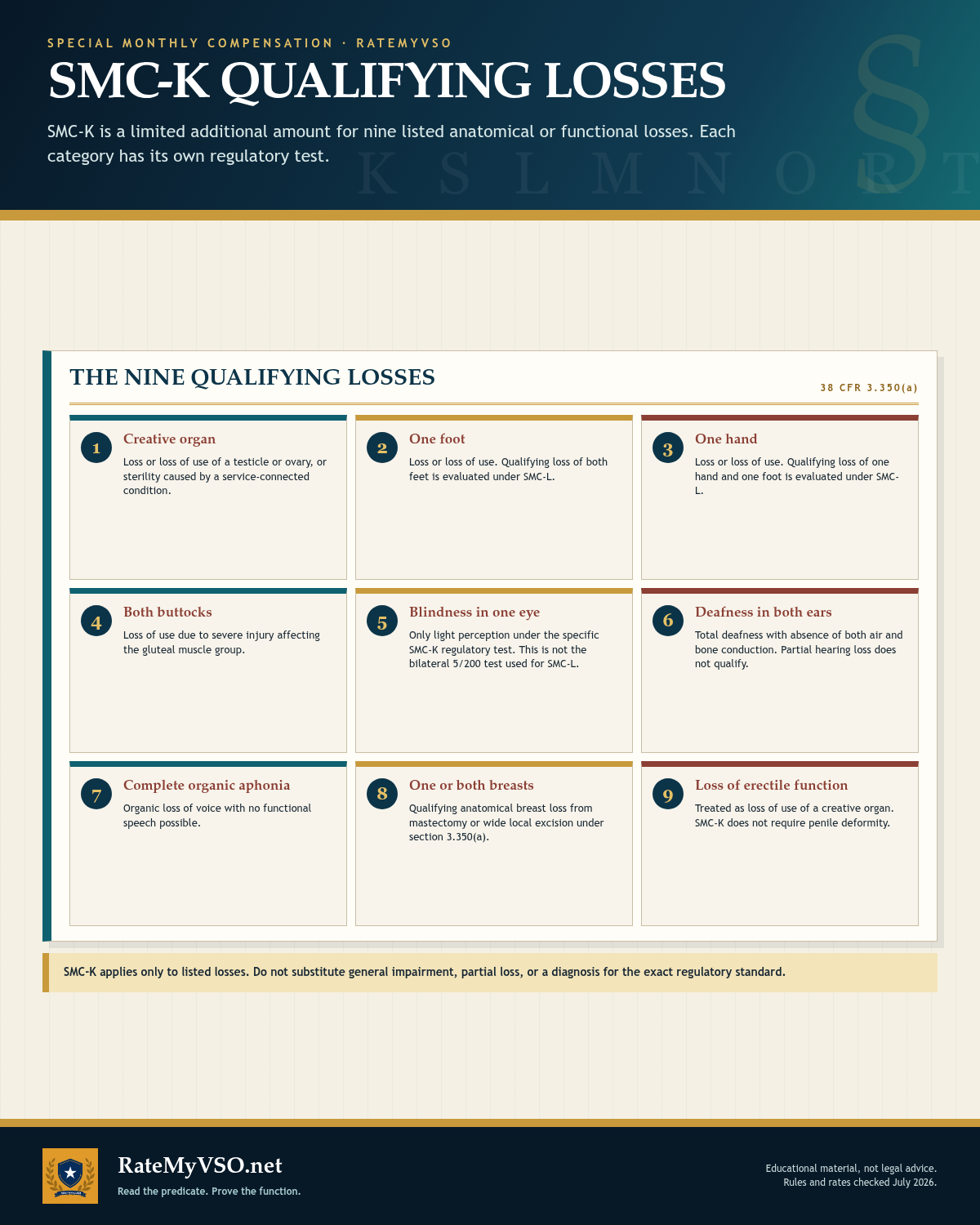
Visual guide: SMC-K Loss and Loss of Use
The qualifying losses of organs, hands, feet, senses and breast tissue.
View full size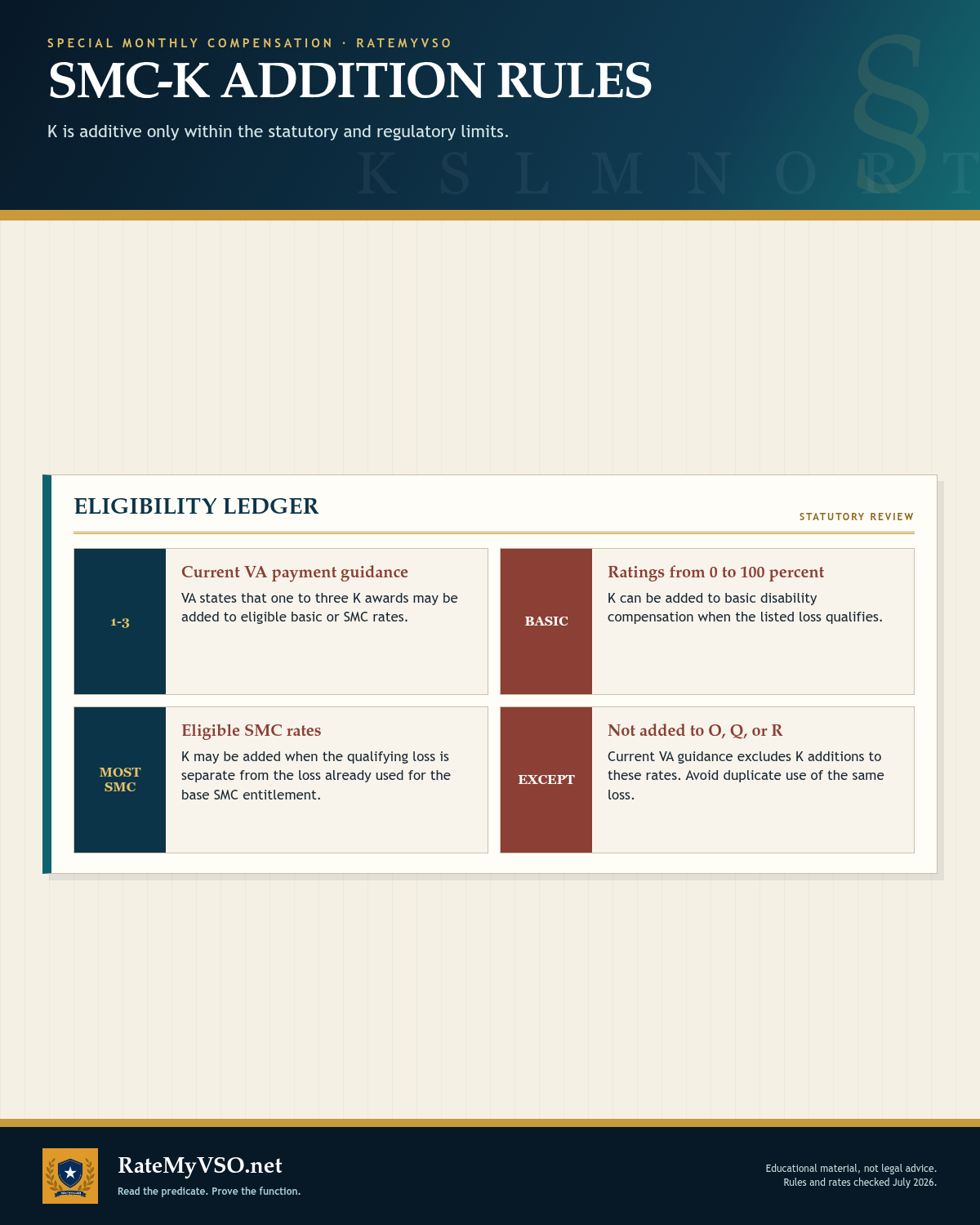
Visual guide: SMC-K Addition Rules
Adding one to three SMC-K awards, and the exclusions for SMC-O, Q and R.
View full size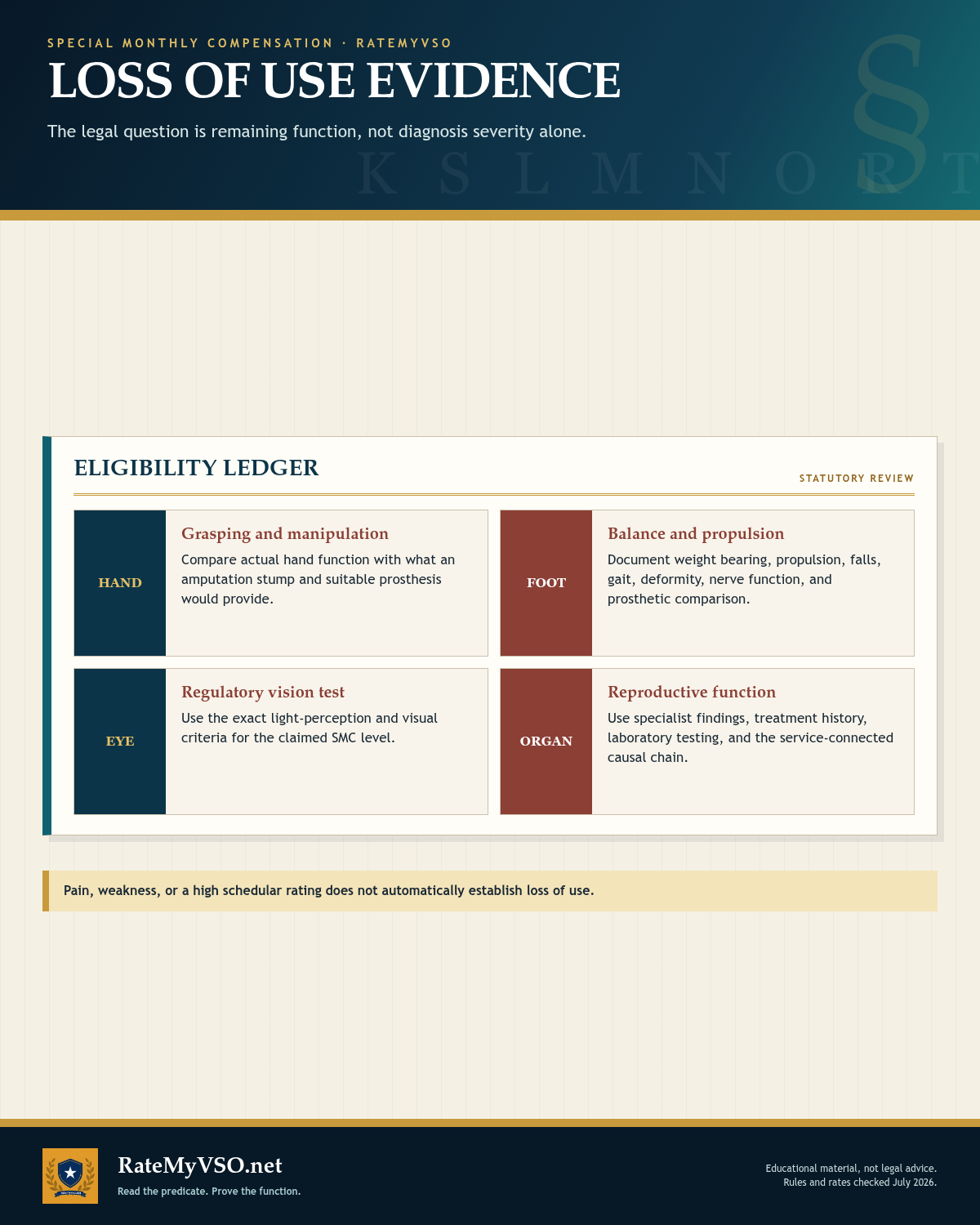
Visual guide: Loss of Use Evidence
An evidence framework for a hand, foot, eye or reproductive organ.
View full size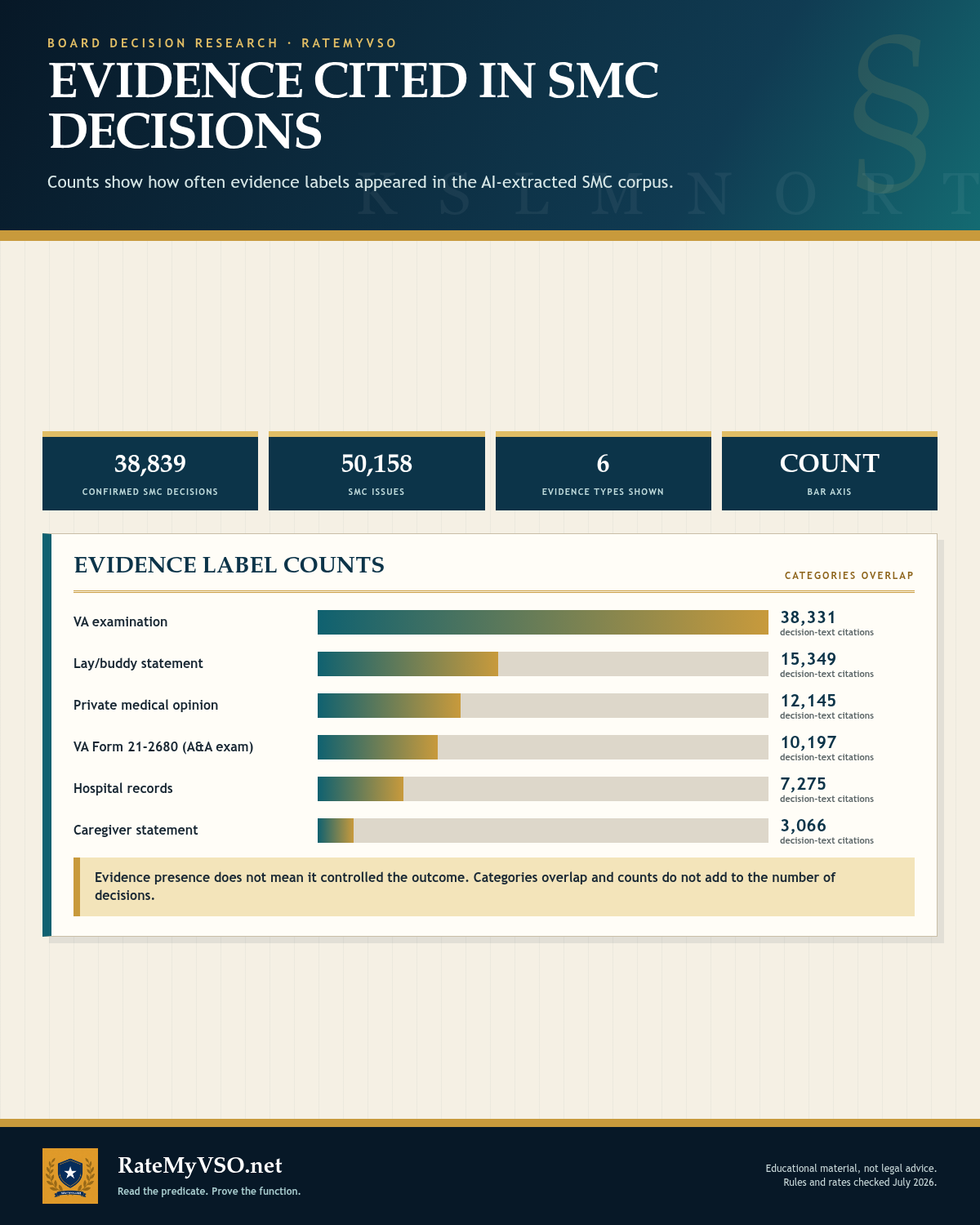
Visual guide: Evidence Cited in SMC Decisions
Evidence labels cited in the extracted SMC Board corpus.
View full size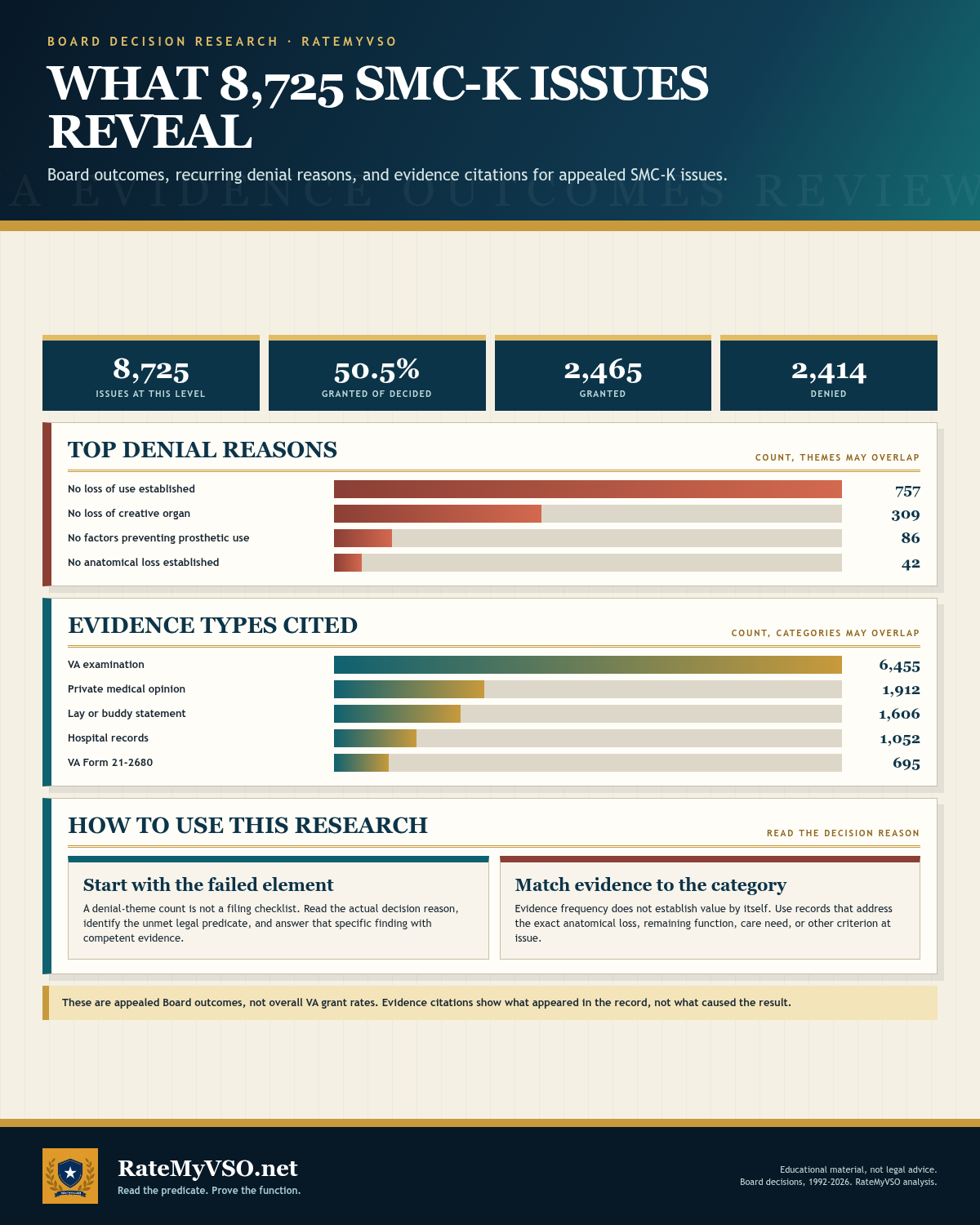
Visual guide: SMC-K Board Outcomes
The appealed record, named denial reasons and cited evidence.
View full sizeThe published Board record
What the appealed cases show.
Patterns to understand, not odds for your own claim.

The live Board outcome figures for SMC-K appear here when they are available. They are also published on SMC Appeals Data.
This page is educational and is not legal advice. For help with an SMC-K claim, work with a VA-accredited representative.