A replacement rate. Two ways to qualify.
SMC-S: Housebound Compensation
SMC-S, often called "Housebound benefits," is a Special Monthly Compensation tier paid to veterans who are substantially confined to home, or who have one 100%-rated disability plus additional 60%+ from separate disabilities. Authority: 38 USC § 1114(s), implemented at 38 CFR § 3.350(i).
Find the part that matters to you
Two paths. Start with yours.
Shortcuts into the guide, not an eligibility decision. Both paths start from one service-connected disability rated 100%.



Your codesheet
lists the ratings.
A tool on this page
Run the Codesheet Check.
Choose the path that matches your record and follow its steps on your own rating documents. Nothing is saved or sent.
The complete reference
The details behind each path.
All of the guidance is here. Open a section when you need it.
01What Is SMC-S?
A replacement rate, and where it sits on the ladder.
SMC-S is the lowest-tier "replacement" SMC rate, it pays more than schedular 100% but less than SMC-L. It targets veterans whose service-connected disabilities have either (a) substantially confined them to their home, or (b) compounded across multiple body systems to a degree that warrants extra compensation despite not requiring daily aid and attendance.
Unlike SMC-K (an add-on), SMC-S replaces the schedular rate with a higher monthly amount.
02The Two Pathways
Two alternative routes that share one prerequisite.
A veteran qualifies for SMC-S by meeting either:
- Path A, Substantial confinement. A single service-connected disability rated 100% (schedular OR via TDIU on a single disability) AND substantial confinement to home or its immediate premises due to permanent disability.
- Path B, Statutory 60% rule. A single service-connected disability rated 100% AND additional service-connected disabilities, separately rated, with a combined rating of 60% or more independent of the 100% disability.
The two paths are alternative, meet either, qualify for SMC-S. Both share the same prerequisite: a single service-connected disability rated 100%. Confinement or a separate 60% never qualifies on its own without that single 100% rating. Most veterans qualify under Path B because the math is mechanical (no clinical confinement evidence required).
03Path A: Substantially Confined
Confinement to home from a permanent disability.
"Substantially confined" under 38 CFR § 3.350(i)(2) means the veteran is unable to leave home except for medical appointments. Occasional trips outside the home (grocery store, family events) do not automatically disqualify, but the pattern must be confinement, not occasional outings with primary residence at home.
Confinement must be due to permanent disability. Temporary post-surgical confinement, even if severe, does not qualify.
04Path B: 100% Disability + Separate 60%
One 100% disability plus separate ratings of 60% or more.
The mechanical pathway. Requirements under 38 CFR § 3.350(i)(1):
- One service-connected disability rated 100% (schedular).
- Additional service-connected disabilities separately rated, with a combined rating of 60% or more, separate and distinct from the 100% disability and involving different anatomical segments or bodily systems.
Example: a veteran has PTSD rated 100%, plus tinnitus 10%, hearing loss 30%, lumbar strain 20%, and right-knee strain 10%. Combined-without-PTSD rating = 10+30+20+10 combined under § 4.25 = roughly 56%. Does not meet 60%. Adds left-knee strain at 10%. New combined-without-PTSD = 60+. Now qualifies for SMC-S Path B.
Use the VA Math Calculator to model the combined "without 100% disability" calculation.
05How TDIU Can Satisfy the 100% Rating for SMC-S
When TDIU based on one disability fills the 100% side.
For Path B, the "100% rating" can come from TDIU based on a single disability, per the U.S. Court of Appeals for Veterans Claims (CAVC) holding in Bradley v. Peake, 22 Vet. App. 280 (2008). If TDIU is granted because one service-connected disability prevents employment, that single disability is treated as 100% schedular for SMC-S purposes.
This is a major doctrine. Many TDIU veterans qualify for SMC-S without realizing it because they assume "TDIU = combined-100%" and don't see how it interacts with SMC.
06Run the SMC-S Codesheet Check
Choose your path, then follow its steps on your own record.
Your codesheet lists the ratings. The TDIU rating decision explains why the VA granted unemployability. Use both documents for this check.
Which path matches your record?
Choose one. You will only see the instructions for that situation.
Not sure? The codesheet shows the ratings. The narrative rating decision explains why the VA granted TDIU.
-
Confirm one disability is rated 100%.
Find one individual service-connected disability rated 100%. A combined 100% rating assembled from several disabilities does not fill this side of the statutory SMC-S test.
-
Identify the disabilities that can make up the additional 60%.
Count only other service-connected disabilities that are separate from the 100% disability and involve a different anatomical segment or bodily system.
-
Combine the remaining service-connected ratings.
Use the VA's combined-ratings method on the other qualifying disabilities to see whether they combine to at least 60%.
Open the VA Math Calculator -
Compare dates and read the VA's decision.
Check the effective dates. There must be at least one period when the single disability was rated 100% and the qualifying additional disabilities combined to at least 60%.
How the dates work: a short example
If the 100% rating began January 1, 2025, and the qualifying additional 60% began June 1, 2025, the first possible SMC-S date is June 1, 2025. If the rating periods never overlap, there is no qualifying statutory SMC-S period. Neither rating has to be permanent; the qualifying periods must overlap.
Then search the VA's decision for these terms:
- special monthly compensation
- SMC-S
- housebound
- Bradley
- Buie
If the VA did not discuss SMC-S, that identifies a question to review, not automatic proof of an error.
One disability rated 100%, plus other separate qualifying disabilities that combine to at least 60%, during the same period.
This path does not use TDIU. It starts with one disability actually rated 100%.
-
Read why the VA granted TDIU.
Open the TDIU rating decision and find the conditions the VA relied on when it granted unemployability.
-
Determine whether one disability caused TDIU.
One conditionIf one service-connected condition, by itself, caused unemployability, TDIU may fill the total-disability side of SMC-S.
Several conditionsIf the VA relied on several conditions together, TDIU does not supply the single total disability required for this route.
Grouping ruleThe VA may group related disabilities to meet TDIU's percentage threshold. That grouping does not turn them into one disability for SMC-S.
If one disability did not cause TDIU by itself, this TDIU-based statutory path does not match the record.
-
Identify the disabilities that can make up the additional 60%.
Leave out the disability that caused TDIU. Count only other service-connected disabilities that are separate from it and involve a different anatomical segment or bodily system.
-
Combine the remaining service-connected ratings.
Leave out non-service-connected conditions, deferred issues, and proposed ratings. Use the VA's combined-ratings method on the remaining qualifying disabilities to see whether they combine to at least 60%.
Open the VA Math Calculator -
Compare dates and check the VA's decision.
Check the effective dates. There must be at least one period when TDIU based on one disability was in effect and the qualifying additional disabilities combined to at least 60%.
How the dates work: a short example
If TDIU based on one disability began January 1, 2025, and the qualifying additional 60% began June 1, 2025, the first possible SMC-S date is June 1, 2025. If the rating periods never overlap, there is no qualifying statutory SMC-S period. Neither rating has to be permanent; the qualifying periods must overlap.
Then search the VA's decision for these terms:
- special monthly compensation
- SMC-S
- housebound
- Bradley
- Buie
If the VA did not discuss SMC-S, that identifies a question to review, not automatic proof of an error.
TDIU caused by one disability alone, plus other separate qualifying disabilities that combine to at least 60%, during the same period.
The codesheet lists the ratings. The narrative rating decision usually explains why the VA granted TDIU.
07Illustrative Example
A fictional scenario to illustrate the guidance.
Fictional example, not a real claimant. Names and facts are invented to show how the criteria above could apply in a single case.
Frank D. is a Vietnam Navy veteran. He has service-connected PTSD rated 100% and a separately rated service-connected diabetes mellitus condition rated 60%. Frank can still drive himself to a doctor's appointment, so he does not need aid and attendance, but the combination of his single 100% rating plus an additional separately-rated 60% disability qualifies him for SMC-S, "statutory housebound" status, at approximately $4,409 per month under 38 CFR § 3.350(i)(1) (the 60%-rule provision; (i)(2) covers housebound-in-fact).
082026 Monthly Rate
The monthly amount compared with 100% and SMC-L.
SMC-S's 2026 monthly rate (single veteran, no dependents) is approximately $4,409/month, set by VA each December 1 alongside the COLA-adjusted compensation rates. About $470/month above schedular 100% ($3,938.58). Dependent supplements add modestly.
Comparison:
- Schedular 100% (single, no dependents): $3,938.58
- SMC-S (this level): ~$4,409
- SMC-L: $4,900.83
09Evidence That Wins
What each pathway needs in the record.
Evidence varies by pathway:
For Path A (Substantially Confined):
- Treating physician statement explicitly addressing confinement-to-home due to permanent service-connected disability.
- VA Form 21-2680 ("Examination for Housebound Status") completed by a physician.
- Records of home-health services, home-based primary care visits.
- Caregiver statements describing the confinement pattern.
For Path B (Statutory 60%):
- VA's own rating decisions, the math is mechanical. A rating-codesheet review showing 100% + 60% combined separately is the entire evidence.
- If TDIU is the basis under Bradley, the rating decision granting TDIU should specify the disability that prevents employment.
10SMC-S vs SMC-L
Different triggers. Different rates.
SMC-S (Housebound)
Reg: § 3.350(i)
Trigger: 100%+confinement OR 100%+separate 60%.
Rate: ~$4,409/mo (single)
No A&A need required. Lower bar, lower rate.
SMC-L (Aid & Attendance)
Reg: § 3.350(b)
Trigger: regular A&A need, bedridden, both feet/hand+foot/blindness.
Rate: $4,900.83/mo (single)
Requires daily care need. Higher bar, higher rate.
If a veteran qualifies for both, SMC-L pays. VA awards the higher tier.
11How to File
The form and what to attach for each path.
- File VA Form 21-526EZ identifying the SMC-S claim.
- Path A claims: attach a treating physician statement and/or VA Form 21-2680 documenting permanent confinement.
- Path B claims: reference your existing rating decisions. The math is mechanical, no new evidence needed unless your codesheet is unclear.
- TDIU-based claims: explicitly cite Bradley if you have TDIU + 60% separate. VA adjudicators often miss this without a citation (Bradley v. Peake, 2008).
12Common Mistakes
Gaps that cost a veteran this benefit.
- Combining ratings to get to 100%. Path B requires a 100% rating from a SINGLE disability, plus separate 60%+ from others. A combined 100% rating doesn't qualify.
- Missing the Bradley application of TDIU. TDIU based on one disability counts as 100% schedular for SMC-S purposes. Many TDIU veterans qualify and don't know it.
- Confusing SMC-S with SMC-L. Different rules, different rates. SMC-L is about aid and attendance. SMC-S is about confinement OR statutory math.
- Conflating SMC-S "substantially confined" with bedridden status. SMC-S Path A doesn't require being in bed, just being substantially confined to home/premises.
- Not adding SMC-K when also eligible. SMC-S replaces the rate. SMC-K stacks on top. If you qualify for both, claim both.
A different way to take it in
Four guides to keep close.
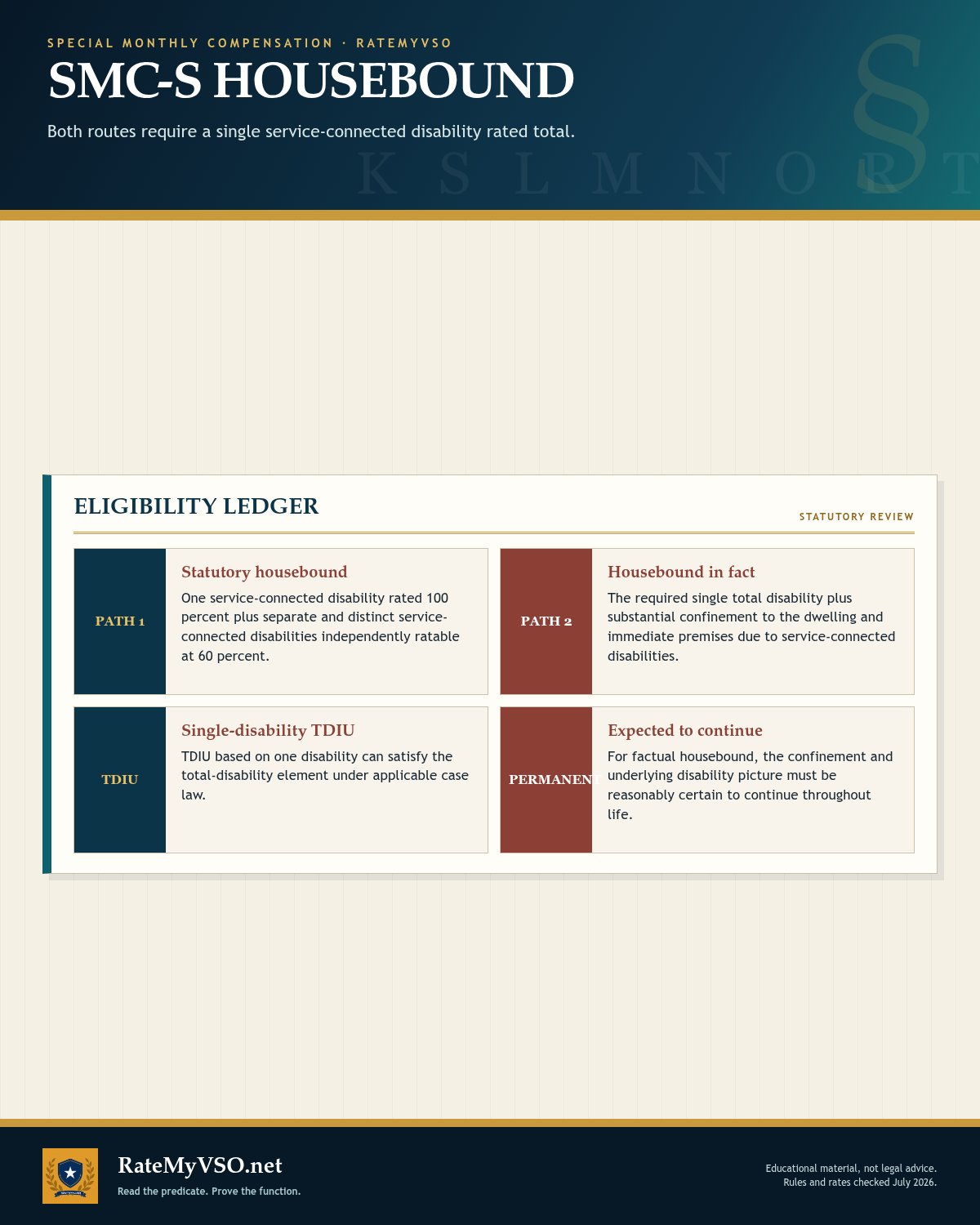
Visual guide: SMC-S Housebound
The statutory and housebound-in-fact routes, side by side.
View full size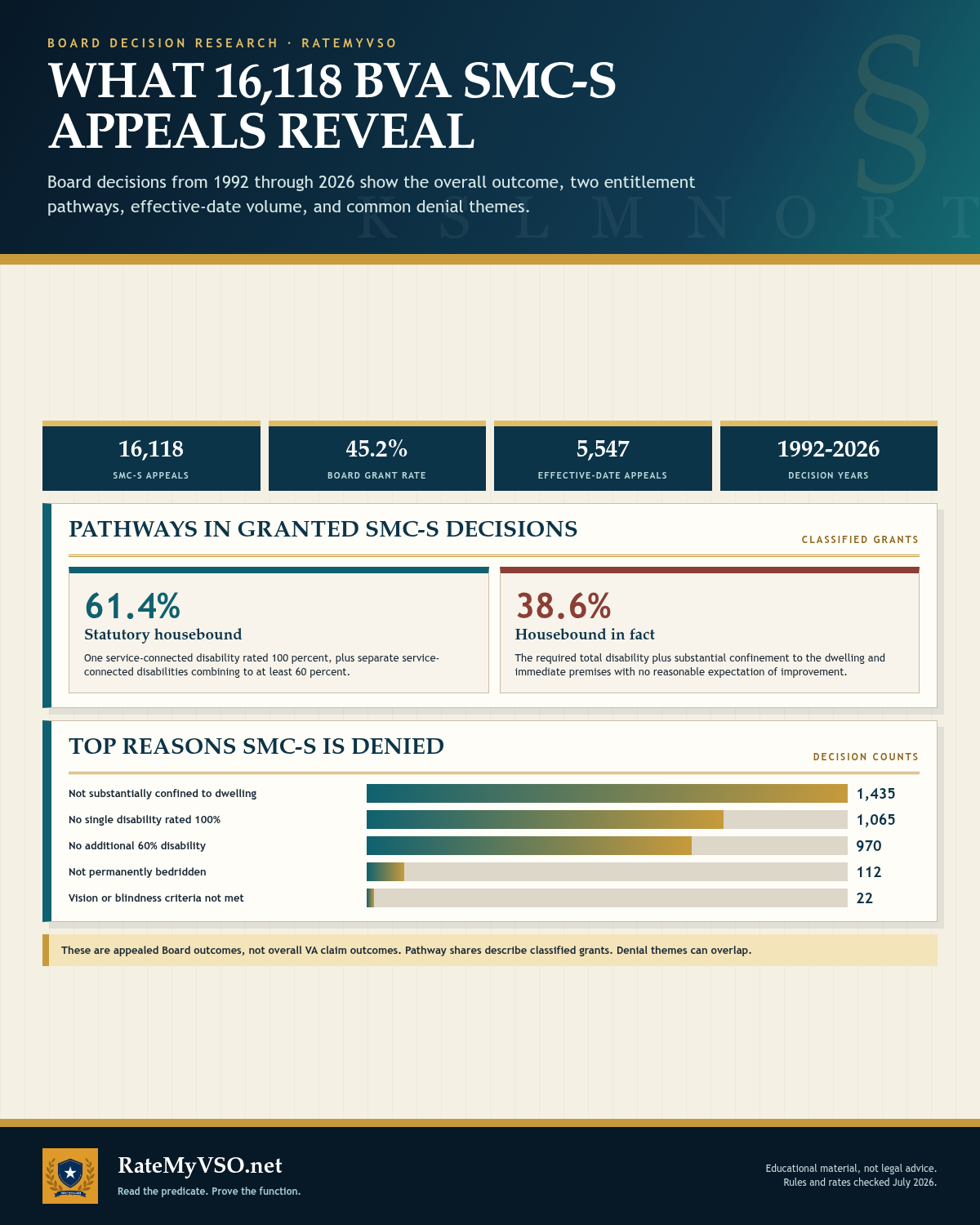
Visual guide: SMC-S Board Pathway Comparison
The appealed record by pathway, with common denial themes.
View full size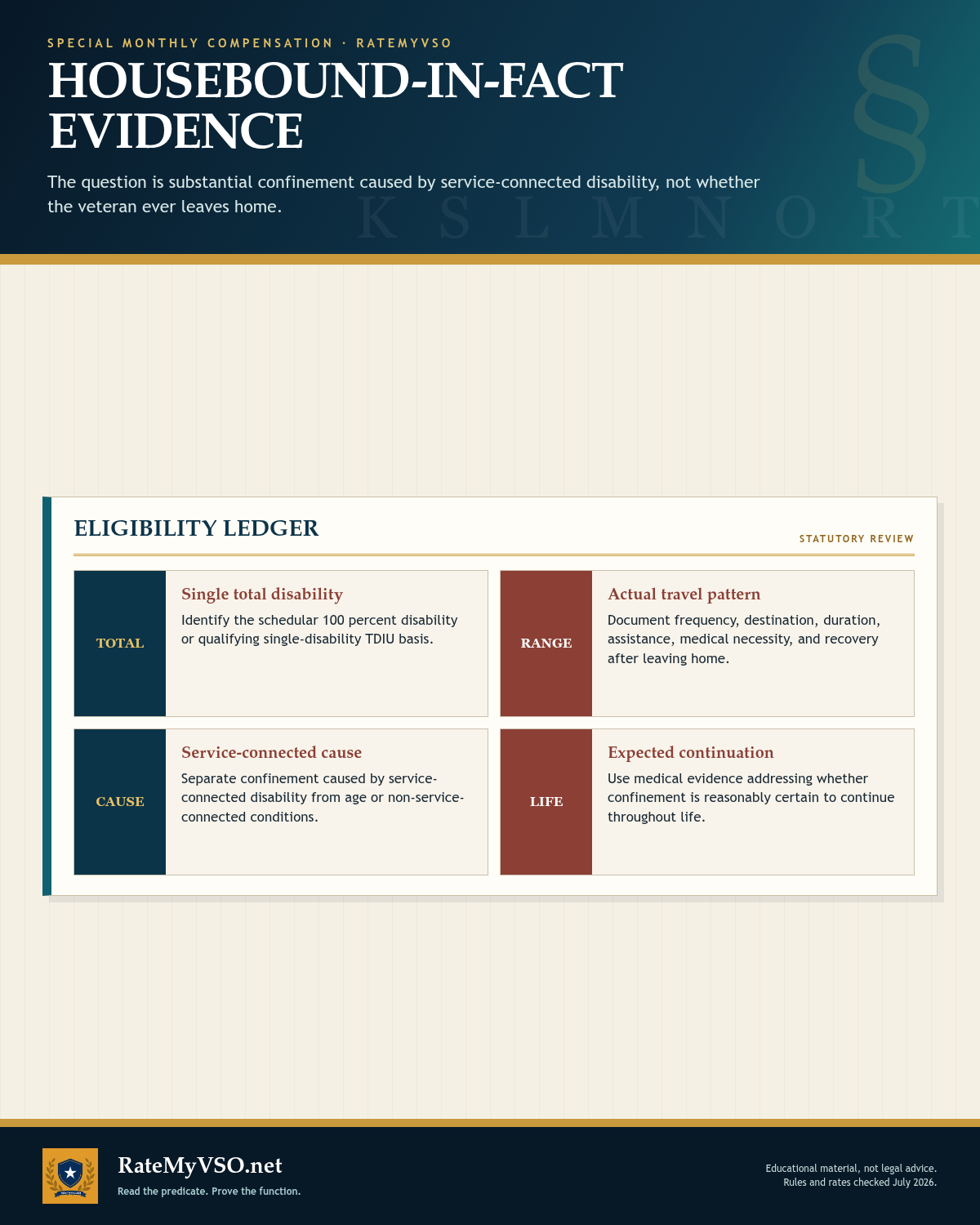
Visual guide: Housebound-in-Fact Evidence
Single-total disability, travel pattern, causation and permanence.
View full size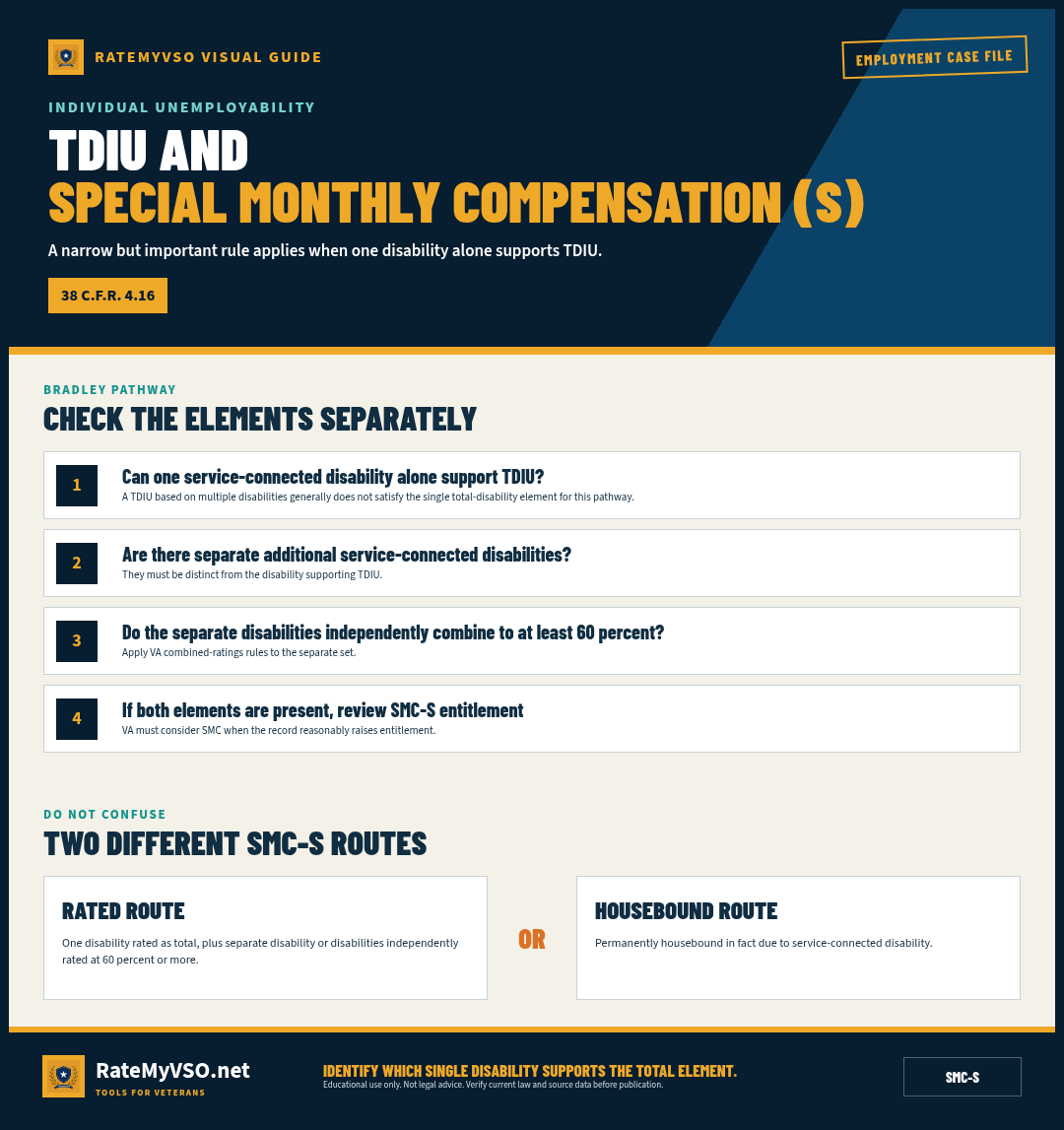
Visual guide: TDIU and SMC-S
TDIU based on one disability and the housebound rate.
View full size All 18 visual guidesThe published Board record
What the appealed cases show.
Patterns to understand, not odds for your own claim.

The live Board outcome figures for SMC-S appear here when they are available. They are also published on SMC Appeals Data, linked in the related guides below.
This page is educational and is not legal advice. For help applying SMC-S rules to a specific claim, work with a VA-accredited representative.