Musculoskeletal Conditions Rating Guide
Joint, spine, and bone conditions are the largest single category of VA disability claims, and every one of them is rated under the same schedule: 38 CFR § 4.71a. A knee, a lower back, a shoulder, and an ankle are scored by the same handful of rules. Learn those rules once and you understand your whole claim. This guide explains the rules that decide every musculoskeletal rating, then points you to the detailed guide for your specific condition.
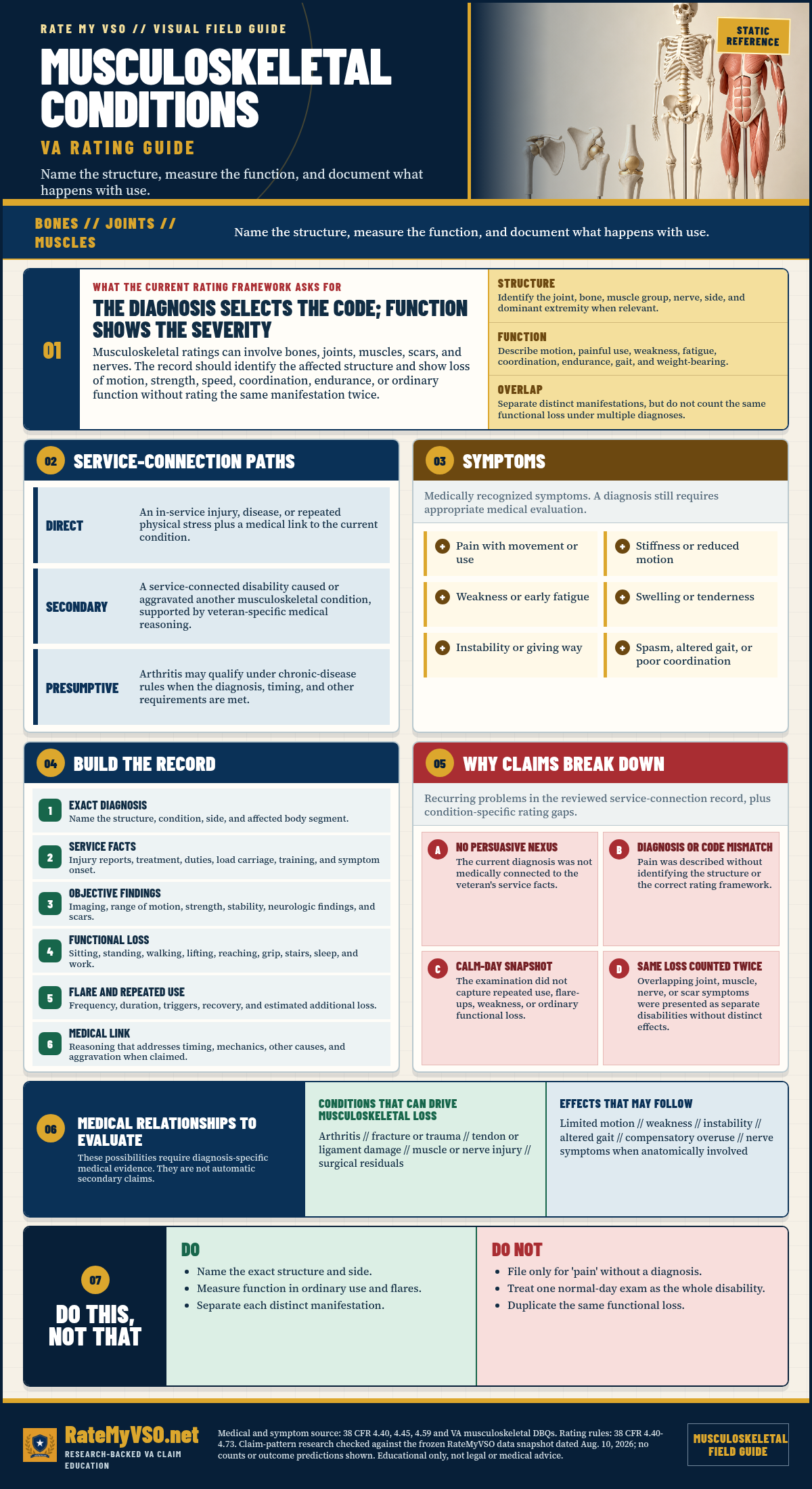 One-page guide: Musculoskeletal Conditions Rating Guide in One Page
Musculoskeletal system overview covering diagnosis and code selection, functional loss, service-connection paths, symptoms, record building, claim gaps, and medical relationships to evaluate. Opens the full-size chart, free to save or print.
One-page guide: Musculoskeletal Conditions Rating Guide in One Page
Musculoskeletal system overview covering diagnosis and code selection, functional loss, service-connection paths, symptoms, record building, claim gaps, and medical relationships to evaluate. Opens the full-size chart, free to save or print.
The Rules That Decide Every Musculoskeletal Claim
Most joint and spine codes are rated on limitation of motion: the examiner measures how far the joint bends and straightens with a goniometer, then compares it to the normal range in 38 CFR § 4.71 (Plate I and II). Less motion means a higher rating. But a string of rules sitting on top of that measurement decide far more claims than the raw degrees do.
1. Painful motion earns the minimum (38 CFR 4.59)
A joint that hurts when it moves is entitled to at least the minimum compensable rating for the joint (usually 10 percent) even if the range of motion is close to normal, where the joint's code provides a compensable level. Pain that limits function is a disability in itself. If the exam records painful motion and the rating still came back at 0 percent, that is a reason to compare the decision and examination with the applicable criteria.
2. Functional loss and flare-ups (38 CFR 4.40 and 4.45, the DeLuca rules)
The rating is not just your range of motion on a calm day in the exam room. Under DeLuca v. Brown and Mitchell v. Shinseki, the VA must account for additional loss from pain, weakness, fatigability, and incoordination, including during flare-ups and after repeated use. The examiner is supposed to measure your motion again after repetitions and estimate how much more you lose during a flare.
3. The exam must test all four ways (Correia v. McDonald)
Since Correia v. McDonald (2016), a joint exam must record range of motion in active and passive motion, and in weight-bearing and non-weight-bearing, and test the opposite undamaged joint for comparison where relevant. An exam that skips these is legally inadequate and is grounds to ask for a new one. Under Sharp v. Shulkin, if the exam was not during a flare, the examiner must still estimate the extra loss a flare causes or explain why they cannot.
4. Ankylosis is rated higher than stiffness
Ankylosis is a joint frozen in one position, from disease, injury, or surgical fusion. Because a fused joint has no usable motion, it is rated higher than mere limitation of motion, and an unfavorable position (fixed at a bad angle) rates higher than a favorable one.
5. The bilateral factor (38 CFR 4.26)
When you have compensable disabilities of both arms, both legs, or paired skeletal muscles, for example a right knee and a left knee, the VA adds an extra 10 percent of the combined value of those bilateral disabilities before combining with the rest. It is easy to miss, and it quietly raises many two-sided claims.
6. Instability and limited motion can stack (no pyramiding)
The anti-pyramiding rule (38 CFR § 4.14) says you cannot rate the same symptom twice. But distinct manifestations of one joint can carry separate ratings. Under VA General Counsel opinions, a knee with both instability (DC 5257) and limitation of motion or arthritis (DC 5003, 5260, 5261) can carry a rating for each when the record shows both problems, because giving way and losing bend are different manifestations. The separate ratings are not automatic; they depend on distinct findings that do not overlap.
7. The amputation rule is a ceiling (38 CFR 4.68)
The combined rating for one limb cannot exceed what an amputation at the elective level of that limb would pay. It is a cap, not a floor, and it rarely bites unless a single extremity carries several high ratings.
Choose the Musculoskeletal Rating Lane and Measure Function
Musculoskeletal claims run in several distinct lanes, and the lane decides which measurements matter. Identify it first, then measure function inside it.
| Rating lane | What controls | Records that show it |
|---|---|---|
| Joint motion | What controlsMeasured motion, painful motion, repeated use, flare loss, and ankylosis when present | Records that show itGoniometer findings, active and passive testing, weight-bearing and non-weight-bearing testing where possible, flare estimate, treatment notes |
| Instability or joint structure | What controlsThe distinct instability, meniscus, dislocation, or other code-specific finding | Records that show itStability testing, imaging when relevant, braces, falls or giving-way history, operative reports |
| Spine | What controlsThoracolumbar or cervical motion, ankylosis, qualifying incapacitating episodes when the intervertebral disc formula applies, and distinct neurologic residuals | Records that show itSpine examination, treatment and imaging, prescribed bed-rest record when applicable, nerve findings, bowel or bladder findings |
| Muscle injury | What controlsMuscle group, wound or injury history, cardinal signs and symptoms, strength, endurance, scarring, tissue loss, and functional impairment | Records that show itService and operative records, examination of the muscle group, strength and endurance testing, scar findings |
| Prosthetic replacement or resurfacing | What controlsThe exact joint code, surgery date, code-specific temporary period, and later chronic residuals | Records that show itOperative report, hospital discharge, post-operative examinations, pain, weakness, motion, and functional findings |
| Scar or amputation residual | What controlsScar criteria, painful or unstable scar, loss of part, loss of use, and the amputation rule | Records that show itScar examination, measurements, pain or instability, prosthetic or assistive-device records, functional examination |
The rating rules above only work if the record captures function, not just degrees. Sections 4.40 and 4.45 require evaluating normal working movement, strength, speed, coordination, and endurance, along with weakness, fatigability, incoordination, pain, swelling, instability, and interference with sitting, standing, and weight-bearing. Section 4.59 calls for pain testing on active and passive motion, and in weight-bearing and non-weight-bearing, where possible. Under Sharp v. Shulkin, the examiner must elicit enough information about your flares to estimate the functional loss they cause when feasible; the absence of a flare on exam day is not by itself a complete explanation. Six records make that estimate possible:
| Record | What makes it usable |
|---|---|
| Baseline motion | Where pain begins, not only the farthest point reached |
| Repeated use | What changes after repetitions or sustained activity |
| Flare frequency | How often, how long, and what triggers the flare |
| Flare function | The specific movement or task lost, such as standing, lifting, gripping, reaching, or walking |
| Weakness and stability | Giving way, reduced strength, poor coordination, swelling, or atrophy when present |
| Assistive devices | Brace, cane, crutches, or other device, including how often it is used and why |
A complete joint report records baseline motion, where pain begins, repeated-use findings, the frequency and duration of flares, and a medically supportable estimate of additional functional loss when feasible. If an estimate cannot be given, the report should explain why the available facts do not permit one.
The joint-specific guides show how these records meet each code: joint motion, arthritis, sciatica and radiculopathy, knee, and lumbar spine.
Build the Timeline That Connects the Current Disability to Service
A musculoskeletal claim may begin with one documented injury, but many conditions develop through repeated lifting, running, vibration, load carriage, awkward positions, or cumulative wear. The evidence question is still the same: what happened in service, what disability exists now, and what competent evidence connects the two.
| Timeline element | Examples of useful records |
|---|---|
| In-service event or duty pattern | Examples of useful recordsTreatment record, line-of-duty record, accident report, deployment record, military occupational specialty or duty description, training and equipment history |
| Symptoms during or after service | Examples of useful recordsContemporaneous complaints, physical profiles, competent lay observations, dated personal history |
| Current diagnosis and exact body part | Examples of useful recordsImaging, orthopedic or rehabilitation assessment, operative history, examination |
| Continuity and other injuries | Examples of useful recordsTreatment timeline, work and recreation history, later accidents or intercurrent injuries addressed honestly |
| Medical connection | Examples of useful recordsA reasoned medical explanation that accounts for the in-service history, current diagnosis, time course, and other plausible causes |
A Surgery Can Change the Rating Path More Than Once
Joint surgery does not produce one permanent rating. It moves the claim through separate states, and the record for each one is different.
- Convalescence: a temporary total rating may apply when the regulatory surgery, immobilization, or severe post-operative residual criteria are met (see 38 CFR § 4.30).
- Code-specific prosthetic period: some joint-replacement codes provide a separate total-rating period after the initial convalescent month. The exact duration depends on the joint and the procedure, so the current diagnostic code controls.
- Chronic residuals: after the temporary period, VA evaluates the remaining pain, weakness, motion loss, instability, or other code-specific residuals.
The operative report, the discharge date, and the post-operative examinations are what move a claim between these states, so the dates matter as much as the diagnosis.
Find the Guide for Your Condition
The rules above apply across the board. For the exact rating table, the C&P exam, and the Board data for your specific joint, open the dedicated guide:
| Area | Guide | DC codes |
|---|---|---|
| Knee | Knee Claims Guide | 5055, 5256-5263 |
| Lower back | Lumbar Spine Guide | 5235-5243 |
| Neck | Cervical Spine Guide | 5237, 5241, 5242 |
| Shoulder, elbow, wrist, hip, ankle | Joint Motion Guide | 5200-5274 |
| Flatfoot (pes planus) | Flatfoot Guide | 5276 |
| Bunion, hammertoe, foot injuries | Foot Conditions Guide | 5279-5284 |
| Arthritis (degenerative, traumatic) | Arthritis Guide | 5003, 5010 |
| Widespread pain (fibromyalgia) | Fibromyalgia Guide | 5025 |
| Radiating nerve pain (sciatica) | Sciatica & Radiculopathy Guide | 8520 |
Radiating pain down a leg or arm is rated under the neurological schedule, not 4.71a, but it is so often paired with a back or neck claim that it belongs on this map. For any code not listed, open its condition lookup page for the rating levels and Board data.
Common Secondary Conditions
Musculoskeletal injuries rarely stay in one place. Because the body compensates for a bad joint, one service-connected condition often opens the door to several secondary claims:
- The opposite joint. Favoring an injured knee, hip, or ankle overloads the other side. A service-connected right knee that causes a left-knee condition is a classic secondary claim.
- Up and down the chain. An altered gait travels: a bad ankle strains the knee, a bad knee strains the hip and back, and a fused or painful joint changes how you walk.
- Radiculopathy from the spine. A back or neck disability that pinches a nerve root produces radiating leg or arm pain, rated separately under the nerve codes. See the sciatica guide.
- Mental health from chronic pain. Long-term pain and lost mobility drive depression and anxiety, which can be claimed as secondary to the physical condition. See secondary conditions.
Each dedicated guide above shows the live Board grant rates for that joint's most common secondary pairings.
Records That Show What the Schedule Measures
The official joint and muscle examination forms ask for a specific set of fields. A complete record covers the same ground:
- Exact joint or muscle group: the specific body part, and the side plus dominant hand where the code distinguishes them.
- Motion and pain: range of motion in degrees taken with a goniometer, active and passive, weight-bearing and non-weight-bearing where possible, and the point where pain begins.
- Repeated use and flares: what changes after repetitions or sustained activity, how often flares occur, how long they last, and a medically supportable estimate of the additional loss when feasible.
- Strength and stability: muscle strength, endurance, giving way, stability testing, atrophy, and swelling when present.
- Neurologic residuals: numbness, radiating pain, reflex or sensation changes, and any bowel or bladder findings tied to a spine condition.
- Devices, surgery, and scars: braces, canes, or other assistive devices, operative reports and dates, prosthetic implants, and any painful or unstable scar.
- Ordinary functional effects: standing, walking, lifting, gripping, reaching, climbing, sleeping, and work or household limits.
The matching DBQ prompts an examiner to record most of these fields in the schedule's own terms.
Evidence Cited in Published Back and neck (spine) Decisions
We analyzed 295,592 published Board decisions involving back and neck (spine) for condition-specific evidence, counting only case-specific mentions (boilerplate recitations excluded). "Favorable" is the share of decisions citing that evidence where every issue was granted or the outcome was mixed; the baseline across all these decisions is 45.1%, combining every diagnostic code below. Evidence appearing in a decision does not mean it decided the case. Descriptive of the published record, not a prediction.
Bar length shows decisions citing the evidence.
By diagnostic code
These codes are grouped together above. They do not perform the same, so find your own code here rather than reading the combined figure. A code retired in the schedule rewrites appears without a link, because its decisions were judged under criteria that no longer apply.
Bar length shows published decisions reviewed.
Evidence Cited in Published Knee and lower-leg conditions Decisions
We analyzed 162,513 published Board decisions involving knee and lower-leg conditions for condition-specific evidence, counting only case-specific mentions (boilerplate recitations excluded). "Favorable" is the share of decisions citing that evidence where every issue was granted or the outcome was mixed; the baseline across all these decisions is 45%, combining every diagnostic code below. Evidence appearing in a decision does not mean it decided the case. Descriptive of the published record, not a prediction.
Bar length shows decisions citing the evidence.
By diagnostic code
These codes are grouped together above. They do not perform the same, so find your own code here rather than reading the combined figure. A code retired in the schedule rewrites appears without a link, because its decisions were judged under criteria that no longer apply.
Bar length shows published decisions reviewed.
Evidence Cited in Published Arthritis Decisions
We analyzed 138,613 published Board decisions involving arthritis for condition-specific evidence, counting only case-specific mentions (boilerplate recitations excluded). "Favorable" is the share of decisions citing that evidence where every issue was granted or the outcome was mixed; the baseline across all these decisions is 57%, combining every diagnostic code below. Evidence appearing in a decision does not mean it decided the case. Descriptive of the published record, not a prediction.
Bar length shows decisions citing the evidence.
By diagnostic code
These codes are grouped together above. They do not perform the same, so find your own code here rather than reading the combined figure. A code retired in the schedule rewrites appears without a link, because its decisions were judged under criteria that no longer apply.
Bar length shows published decisions reviewed.
Evidence Cited in Published Shoulder and arm conditions Decisions
We analyzed 47,727 published Board decisions involving shoulder and arm conditions for condition-specific evidence, counting only case-specific mentions (boilerplate recitations excluded). "Favorable" is the share of decisions citing that evidence where every issue was granted or the outcome was mixed; the baseline across all these decisions is 57.6%, combining every diagnostic code below. Evidence appearing in a decision does not mean it decided the case. Descriptive of the published record, not a prediction.
Bar length shows decisions citing the evidence.
By diagnostic code
These codes are grouped together above. They do not perform the same, so find your own code here rather than reading the combined figure. A code retired in the schedule rewrites appears without a link, because its decisions were judged under criteria that no longer apply.
Bar length shows published decisions reviewed.
Evidence Cited in Published Ankle conditions Decisions
We analyzed 54,095 published Board decisions involving ankle conditions for condition-specific evidence, counting only case-specific mentions (boilerplate recitations excluded). "Favorable" is the share of decisions citing that evidence where every issue was granted or the outcome was mixed; the baseline across all these decisions is 49.4%. Evidence appearing in a decision does not mean it decided the case. Descriptive of the published record, not a prediction.
Bar length shows decisions citing the evidence.
Evidence Cited in Published Hip and thigh conditions Decisions
We analyzed 27,248 published Board decisions involving hip and thigh conditions for condition-specific evidence, counting only case-specific mentions (boilerplate recitations excluded). "Favorable" is the share of decisions citing that evidence where every issue was granted or the outcome was mixed; the baseline across all these decisions is 63.8%, combining every diagnostic code below. Evidence appearing in a decision does not mean it decided the case. Descriptive of the published record, not a prediction.
Bar length shows decisions citing the evidence.
By diagnostic code
These codes are grouped together above. They do not perform the same, so find your own code here rather than reading the combined figure. A code retired in the schedule rewrites appears without a link, because its decisions were judged under criteria that no longer apply.
Bar length shows published decisions reviewed.
Detected by phrase-reading the decision text with condition-specific vocabularies. Source: Board of Veterans' Appeals decisions, RateMyVSO analysis.
Symptoms Recorded in Granted Back and neck (spine) Decisions
We analyzed 20,010 granted Board decisions involving back and neck (spine) for symptoms named in sentences about the condition (rating-criteria recitations excluded). Descriptive of the published record, what the Board wrote down, not a checklist of what to report.
Bar length shows decisions. Percentages remain context.
Symptoms Recorded in Granted Knee and lower-leg conditions Decisions
We analyzed 8,481 granted Board decisions involving knee and lower-leg conditions for symptoms named in sentences about the condition (rating-criteria recitations excluded). Descriptive of the published record, what the Board wrote down, not a checklist of what to report.
Bar length shows decisions. Percentages remain context.
Symptoms Recorded in Granted Arthritis Decisions
We analyzed 11,232 granted Board decisions involving arthritis for symptoms named in sentences about the condition (rating-criteria recitations excluded). Descriptive of the published record, what the Board wrote down, not a checklist of what to report.
Bar length shows decisions. Percentages remain context.
Symptoms Recorded in Granted Shoulder and arm conditions Decisions
We analyzed 2,944 granted Board decisions involving shoulder and arm conditions for symptoms named in sentences about the condition (rating-criteria recitations excluded). Descriptive of the published record, what the Board wrote down, not a checklist of what to report.
Bar length shows decisions. Percentages remain context.
Symptoms Recorded in Granted Ankle conditions Decisions
We analyzed 2,741 granted Board decisions involving ankle conditions for symptoms named in sentences about the condition (rating-criteria recitations excluded). Descriptive of the published record, what the Board wrote down, not a checklist of what to report.
Bar length shows decisions. Percentages remain context.
Symptoms Recorded in Granted Hip and thigh conditions Decisions
We analyzed 1,605 granted Board decisions involving hip and thigh conditions for symptoms named in sentences about the condition (rating-criteria recitations excluded). Descriptive of the published record, what the Board wrote down, not a checklist of what to report.
Bar length shows decisions. Percentages remain context.
Detected by phrase-reading the decision text with condition-specific vocabularies. Source: Board of Veterans' Appeals decisions, RateMyVSO analysis.
Common Mistakes
- Accepting a 0 percent for a painful joint without checking. Painful motion generally supports at least the joint's minimum compensable rating under 4.59. A 0 percent on a joint the exam recorded as painful is a reason to compare the decision and examination with the applicable criteria.
- Not noticing what the examination left out. When a report does not record active and passive motion, weight-bearing and non-weight-bearing testing, or an estimate of flare-up loss, the file is missing measurements the criteria use. That gap is a reason to compare the report against the applicable criteria.
- Not checking for distinct knee manifestations. Instability and limitation of motion are distinct manifestations that can carry separate ratings on the same knee when the record shows both. Anyone whose exam documents both problems but whose decision rates only one has a reason to compare the decision with the criteria.
- Forgetting the bilateral factor. Two-sided claims (both knees, both shoulders) get an extra 10 percent under 4.26 that is easy to overlook.
- Only claiming the first joint. The gait chain and the opposite joint can be secondary claims when a competent medical link is established. Stopping at the original injury leaves those conditions unevaluated.
- Treating a surgery as one permanent rating. A convalescent period, a code-specific prosthetic period, and the later chronic residuals are separate states with separate records, so the operative and discharge dates matter.
Frequently Asked Questions
How does the VA rate joint and spine conditions?
Does every painful joint receive a separate rating?
Why did I get 0 percent when my joint clearly hurts?
What is the bilateral factor?
Does a normal exam day erase flare-up loss?
What changes after joint replacement?
Related Tools and Guides
Sources: 38 CFR 4.71a, musculoskeletal ratings · 4.59, painful motion · 4.40 and 4.45, functional loss · 4.26, bilateral factor. Educational only, not legal advice, and not a prediction of any individual claim. Rating criteria and case law change; confirm current details in 38 CFR Part 4. For help with your claim, find a VA-accredited representative.