Respiratory Conditions Rating Guide
Breathing problems are one of the fastest-growing categories of VA disability claims after burn-pit and airborne-hazard exposure. Almost every lung and airway condition is rated under the same schedule: 38 CFR § 4.97. A case of COPD, asthma, emphysema, or interstitial lung disease is scored by the same handful of rules, and most of them turn on a breathing test called the pulmonary function test, or PFT. Learn that shared pattern once and you understand your whole claim. This guide explains the rules that decide most respiratory ratings, then points you to the detailed guide for your specific condition.
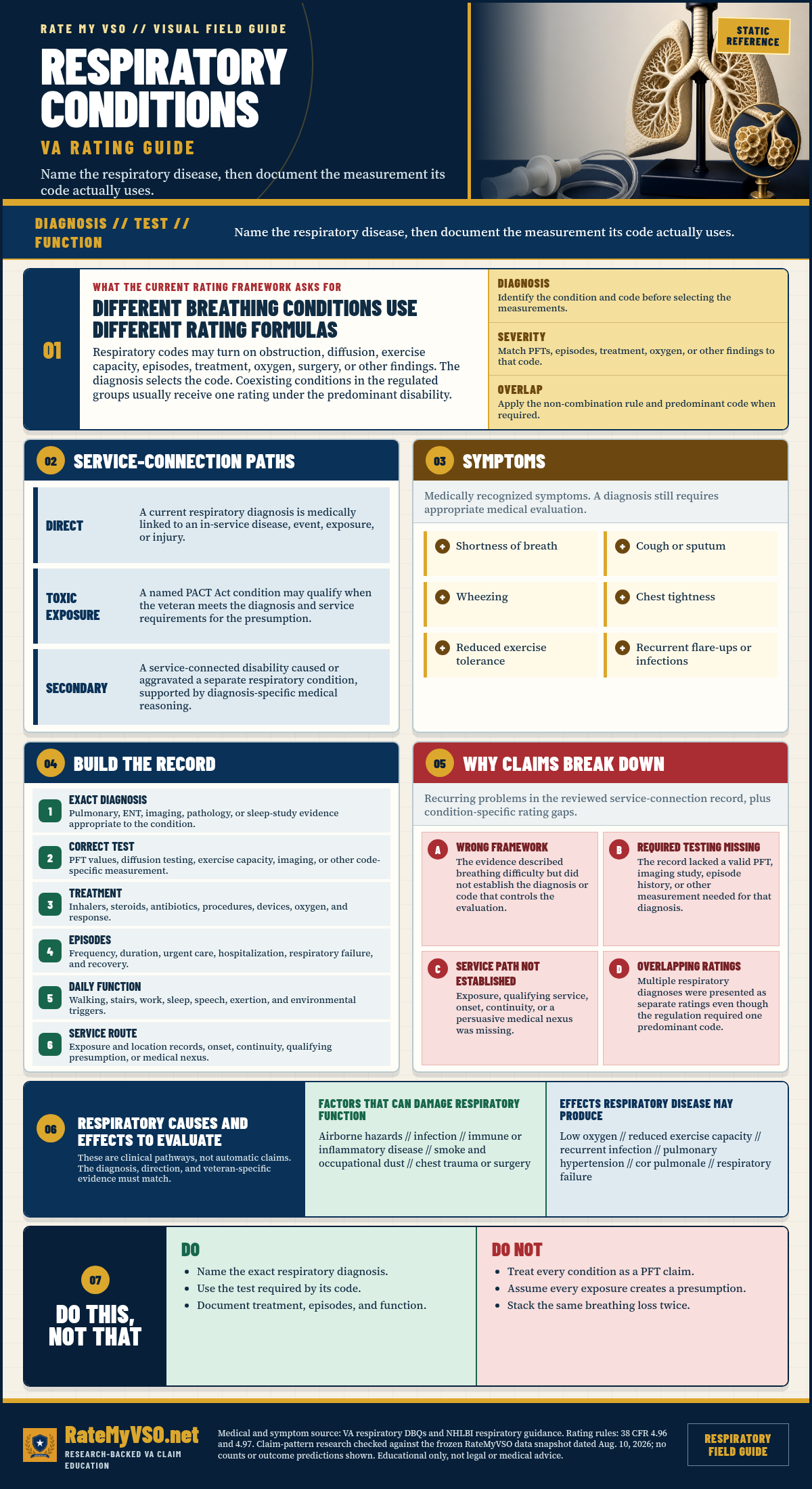 One-page guide: Respiratory Conditions Rating Guide in One Page
Respiratory-system guide covering diagnosis-specific rating methods, service-connection paths, symptoms, required testing, treatment and episode evidence, claim gaps, and medical relationships to evaluate. Opens the full-size chart, free to save or print.
One-page guide: Respiratory Conditions Rating Guide in One Page
Respiratory-system guide covering diagnosis-specific rating methods, service-connection paths, symptoms, required testing, treatment and episode evidence, claim gaps, and medical relationships to evaluate. Opens the full-size chart, free to save or print.
The Rules That Decide Most Respiratory Claims
Most lung and airway conditions are rated on a single test: the pulmonary function test (PFT), a breathing test that measures how much air you can move and how fast. A few conditions, sinusitis, rhinitis, and sleep apnea, are the exceptions and are counted a different way. Here is the shared pattern.
1. The breathing test (PFT) drives most lung ratings
Most obstructive and restrictive lung diseases, including COPD, asthma, emphysema, chronic bronchitis, and interstitial lung disease, are rated on the numbers from a PFT. The three key readings are FEV-1 (the percent of predicted air you can force out in one second), the FEV-1/FVC ratio (how much of your total breath comes out in that first second), and DLCO (the percent of predicted for how well oxygen crosses from your lungs into your blood). The post-bronchodilator values (the readings taken after an inhaler) are generally the ones used; pre-bronchodilator values are used only when the post-bronchodilator result is poorer. When different measures point to different levels, the value that controls is the one the examiner states most accurately reflects the disability (38 CFR § 4.96(d)).
2. Maximum exercise capacity is a specific criterion, not a general substitute
Some respiratory codes name maximum exercise capacity at certain rating levels. Under the respiratory schedule it is measured in ml/kg/min of oxygen consumption, not in the cardiac METs used for heart ratings, and it applies where a code lists it, for example at 20 ml/kg/min or less for the highest levels of several codes. It is not a fallback the rater reaches for whenever the PFT "does not fit"; 38 CFR § 4.96 lists the specific PFT exceptions and alternative criteria instead.
3. Sinusitis and rhinitis are the exception (episodes, not breathing tests)
Chronic sinusitis and rhinitis are not rated on PFTs. Instead the VA counts incapacitating and non-incapacitating episodes over a year, along with findings like nasal polyps and blockage of the nasal passages. Because the method is completely different, a lung PFT does nothing for a sinus or nasal claim. See the sinusitis and rhinitis guide.
4. Sleep apnea turns on a breathing-assistance device
Sleep apnea is also not rated on a PFT. What matters is whether the condition requires a breathing-assistance device such as a CPAP machine. A sleep study documents the apnea, and the prescription for the device is what supports the rating. A CPAP is the common example, but VA's manual also counts other qualifying devices, including oral appliances such as mandibular advancement devices (MAD). See the sleep apnea guide.
5. Many respiratory conditions are PACT Act presumptives
A large share of lung and airway conditions are PACT Act burn-pit and airborne-hazard presumptives. The presumption removes the need to prove the medical link between service and the condition, but eligibility still requires a covered condition, qualifying service in a covered location and period, and a current diagnosis; asthma on the PACT list is asthma diagnosed after service. A presumption is not an automatic rating or an automatic approval of every respiratory diagnosis. See the PACT Act guide and the burn-pit presumptive list.
Choose the Respiratory Rating Lane Before Reading the Test
A breathing test is not the whole answer, and for several conditions it is not the answer at all. The lane decides which record the schedule reads.
| Rating lane | What controls | Records that show it |
|---|---|---|
| Obstructive or restrictive lung disease | What controlsThe pulmonary function measures named by the code, valid test interpretation, and specified cardiopulmonary findings | Records that show itPre- and post-bronchodilator testing, DLCO when the code uses it (asthma's DC 6602 does not), examiner validity statement, oxygen or exercise testing when the code uses it |
| Asthma | What controlsFEV-1 or FEV-1/FVC plus the separate medication, exacerbation, physician-visit, and systemic-steroid paths | Records that show itPulmonary function testing, inhaler and anti-inflammatory history, systemic-steroid courses, exacerbation treatment and visit history |
| Sinusitis or rhinitis | What controlsEpisodes, antibiotics when the code requires them, obstruction, polyps, and surgery or residuals | Records that show itEar, nose, and throat examination, imaging or endoscopy when performed, antibiotic history, procedure records, obstruction and polyp findings |
| Sleep apnea | What controlsConfirmed diagnosis, sleep-study findings, prescribed breathing-assistance device, and specified complications | Records that show itSleep study, sleep-medicine assessment, device prescription and follow-up, cardiopulmonary findings when present |
| Oxygen, exercise, or cardiopulmonary path | What controlsOxygen requirement, maximum exercise capacity in ml/kg/min, pulmonary hypertension, cor pulmonale, or respiratory failure when named by the code | Records that show itOxygen order, exercise test, echocardiogram or catheterization when used, hospitalization and specialist records |
| Active cancer or post-treatment residual | What controlsTreatment status, dates, required examination, and later respiratory or other residuals | Records that show itPathology, oncology treatment record, treatment-end date, follow-up examination, residual-specific testing |
Inside the test-driven lanes, exact rules decide which value a rating uses. This is where respiratory ratings are most often argued:
| Situation | Current rule |
|---|---|
| PFT performed | Usually use post-bronchodilator results |
| Post-bronchodilator poorer than pre-bronchodilator | Use the pre-bronchodilator values |
| Different PFT measures produce different levels | Use the measure the examiner says most accurately reflects disability |
| DLCO absent | Alternative criteria may be used if the examiner explains why DLCO would not be useful or valid |
| PFT conflicts with clinical findings | PFT controls unless the examiner explains why it is not a valid measure in that case |
| Maximum exercise capacity used | It is oxygen consumption in ml/kg/min, not cardiac METs |
One more rule shapes multi-condition claims: under 38 CFR § 4.96(a), ratings within the specified respiratory code groups generally are not combined. VA assigns one rating under the code reflecting the predominant respiratory disability and may elevate it when the overall severity warrants. Do not count on separate ratings for overlapping asthma, COPD, bronchitis, emphysema, or sleep-apnea manifestations without checking the exact codes and symptoms; see the COPD guide, asthma guide, sinusitis and rhinitis guide, and sleep apnea guide.
A Respiratory Diagnosis Can Follow Several Different Service-Connection Routes
Exposure claims dominate this body system, and each route carries its own requirements. A route that fits one diagnosis will not carry another.
| Route | What it covers | Limit to state plainly |
|---|---|---|
| PACT Act or fine-particulate presumption | What it coversOnly the listed respiratory diseases or cancers plus the required service, location, time, and diagnosis facts | Limit to state plainlyIt is not a presumption for every breathing complaint. Asthma on the PACT list is asthma diagnosed after service |
| Direct toxic exposure | What it coversA current diagnosis, documented or conceded exposure, and competent evidence connecting the diagnosis to that exposure | Limit to state plainlyExposure alone is not a diagnosis or a nexus |
| Mustard gas or Lewisite | What it coversThe listed diseases after qualifying full-body exposure, including chronic laryngitis, bronchitis, emphysema, asthma, and chronic obstructive pulmonary disease (see 38 CFR § 3.316) | Limit to state plainlyThe exact exposure and disease requirements control, and willful misconduct or a supervening cause defeats the provision |
| Gulf War undiagnosed illness or chronic multisymptom illness | What it coversQualifying chronic disability patterns and respiratory signs or symptoms (see 38 CFR § 3.317) | Limit to state plainlyA diagnosed structural lung disease is not relabeled as presumptive without the applicable rule |
| Secondary or aggravated | What it coversA respiratory disability caused or aggravated by a service-connected disability or its treatment | Limit to state plainlyTwo diagnoses or a temporal sequence alone do not establish the medical link |
Find the Guide for Your Condition
The rules above apply across the board. For the exact rating table, the C&P exam, and the Board data for your specific condition, open the dedicated guide:
| Area | Guide | DC codes |
|---|---|---|
| Chronic sinusitis and rhinitis | Sinusitis & Rhinitis Guide | 6510-6514, 6522 |
| COPD, bronchitis, emphysema | COPD Guide | 6600, 6603, 6604 |
| Asthma | Asthma Guide | 6602 |
| Sleep apnea | Sleep Apnea Guide | 6847 |
For any code not listed, for example the interstitial lung diseases and respiratory cancers, open its condition lookup page for the rating levels and Board data.
Every Respiratory Diagnostic Code, With Board Outcomes
Every diagnostic code in this body system, ordered by how often it reaches the Board of Veterans' Appeals. Percentages are the share of each code's Board issues granted, denied, or remanded (sent back for more development); dismissed and other outcomes are not shown, so rows do not sum to 100%. Each code links to its full page: rating criteria, evidence notes, and secondary-condition data.
Show 31 more codes with too few Board appeals to report (expand)
| DC | Condition | Board appeals | Granted | Denied | Remanded |
|---|---|---|---|---|---|
| 6511 | Sinusitis, ethmoid, chronic | Too few Board appeals to report | |||
| 6512 | Sinusitis, frontal, chronic | Too few Board appeals to report | |||
| 6514 | Sinusitis, sphenoid, chronic | Too few Board appeals to report | |||
| 6515 | Laryngitis, tuberculous, active or inactive | Too few Board appeals to report | |||
| 6518 | Laryngectomy, total | Too few Board appeals to report | |||
| 6521 | Pharynx, injuries to | Too few Board appeals to report | |||
| 6523 | Bacterial rhinitis | Too few Board appeals to report | |||
| 6524 | Granulomatous rhinitis | Too few Board appeals to report | |||
| 6702 | Tuberculosis, pulmonary, chronic, moderately advanced, active | Too few Board appeals to report | |||
| 6703 | Tuberculosis, pulmonary, chronic, minimal, active | Too few Board appeals to report | |||
| 6704 | Tuberculosis, pulmonary, chronic, active, advancement unspecified | Too few Board appeals to report | |||
| 6721 | Tuberculosis, pulmonary, chronic, far advanced, inactive | Too few Board appeals to report | |||
| 6722 | Tuberculosis, pulmonary, chronic, moderately advanced, inactive | Too few Board appeals to report | |||
| 6723 | Tuberculosis, pulmonary, chronic, minimal, inactive | Too few Board appeals to report | |||
| 6724 | Tuberculosis, pulmonary, chronic, inactive, advancement unspecified | Too few Board appeals to report | |||
| 6731 | Tuberculosis, pulmonary, chronic, inactive | Too few Board appeals to report | |||
| 6732 | Pleurisy, tuberculous, active or inactive | Too few Board appeals to report | |||
| 6822 | Actinomycosis | Too few Board appeals to report | |||
| 6824 | Chronic lung abscess | Too few Board appeals to report | |||
| 6826 | Desquamative interstitial pneumonitis | Too few Board appeals to report | |||
| 6827 | Pulmonary alveolar proteinosis | Too few Board appeals to report | |||
| 6828 | Eosinophilic granuloma of lung | Too few Board appeals to report | |||
| 6829 | Drug-induced pulmonary pneumonitis and fibrosis | Too few Board appeals to report | |||
| 6830 | Radiation-induced pulmonary pneumonitis and fibrosis | Too few Board appeals to report | |||
| 6831 | Hypersensitivity pneumonitis (extrinsic allergic alveolitis) | Too few Board appeals to report | |||
| 6836 | Blastomycosis | Too few Board appeals to report | |||
| 6837 | Cryptococcosis | Too few Board appeals to report | |||
| 6838 | Aspergillosis | Too few Board appeals to report | |||
| 6839 | Mucormycosis | Too few Board appeals to report | |||
| 6840 | Diaphragm paralysis or paresis | Too few Board appeals to report | |||
| 6841 | Spinal cord injury with respiratory insufficiency | Too few Board appeals to report | |||
Counts from RateMyVSO's index of published BVA decisions, refreshed weekly. A remand is not a loss; it means the Board needed more evidence before deciding. Descriptive of the published record, not a prediction for any claim.
Common Secondary Conditions
Respiratory conditions rarely stay in one place. Because breathing touches sleep, the heart, and mood, one service-connected condition often opens the door to several secondary claims:
- Sleep apnea from a blocked airway or weight gain. Sleep apnea can be claimed as secondary to chronic sinus or nasal obstruction, or to weight gain caused by another service-connected condition that limits activity.
- Cor pulmonale (right-heart strain). Severe, long-standing lung disease can strain the right side of the heart. Cor pulmonale is not a separate secondary heart claim: 38 CFR § 4.104 directs VA to evaluate it as part of the pulmonary condition that causes it, and several lung codes count it at their highest levels.
- Depression and anxiety from chronic breathlessness. Long-term shortness of breath and lost activity drive depression and anxiety, which can be claimed as secondary to the physical condition. See secondary conditions.
- GERD and asthma often travel together. Acid reflux and asthma frequently occur together and can aggravate each other, so one may support a secondary claim tied to the other.
Each dedicated guide above shows the live Board grant rates for that condition's most common secondary pairings.
Records That Show What the Schedule Measures
What belongs in the file depends on the lane. Five record groups cover the respiratory schedule:
- Exact respiratory diagnosis: the specific diagnosis, and which condition is predominant when several coexist, because the codes in the affected groups are not combined.
- Complete pulmonary function report: pre- and post-bronchodilator values, DLCO when applicable, and the examiner's statement about which measure most accurately reflects the disability.
- Treatment path: inhalers, anti-inflammatory medicine, courses of systemic steroids, oxygen, antibiotics, and the physician visits the applicable code counts.
- Episode and event timeline: exacerbations, hospitalizations, respiratory failure, cancer treatment dates, or procedures, whichever the code names.
- Condition-specific records outside the breathing test: a sleep study and device prescription for sleep apnea, ear, nose, and throat findings for sinus disease, or the examination the diagnosis calls for when the code is not test-driven.
Proof of qualifying service for a presumptive route belongs in the file too, and the matching DBQ prompts an examiner to capture most of these fields.
Evidence Cited in Published Asthma Decisions
We analyzed 20,558 published Board decisions involving asthma for condition-specific evidence, counting only case-specific mentions (boilerplate recitations excluded). "Favorable" is the share of decisions citing that evidence where every issue was granted or the outcome was mixed; the baseline across all these decisions is 52.6%. Evidence appearing in a decision does not mean it decided the case. Descriptive of the published record, not a prediction.
Bar length shows decisions citing the evidence.
Evidence Cited in Published COPD and chronic lung disease Decisions
We analyzed 36,233 published Board decisions involving copd and chronic lung disease for condition-specific evidence, counting only case-specific mentions (boilerplate recitations excluded). "Favorable" is the share of decisions citing that evidence where every issue was granted or the outcome was mixed; the baseline across all these decisions is 43.9%, combining every diagnostic code below. Evidence appearing in a decision does not mean it decided the case. Descriptive of the published record, not a prediction.
Bar length shows decisions citing the evidence.
By diagnostic code
These codes are grouped together above. They do not perform the same, so find your own code here rather than reading the combined figure. A code retired in the schedule rewrites appears without a link, because its decisions were judged under criteria that no longer apply.
Bar length shows published decisions reviewed.
Detected by phrase-reading the decision text with condition-specific vocabularies. Source: Board of Veterans' Appeals decisions, RateMyVSO analysis.
Symptoms Recorded in Granted Asthma Decisions
We analyzed 1,431 granted Board decisions involving asthma for symptoms named in sentences about the condition (rating-criteria recitations excluded). Descriptive of the published record, what the Board wrote down, not a checklist of what to report.
Bar length shows decisions. Percentages remain context.
Symptoms Recorded in Granted COPD and chronic lung disease Decisions
We analyzed 2,069 granted Board decisions involving copd and chronic lung disease for symptoms named in sentences about the condition (rating-criteria recitations excluded). Descriptive of the published record, what the Board wrote down, not a checklist of what to report.
Bar length shows decisions. Percentages remain context.
Detected by phrase-reading the decision text with condition-specific vocabularies. Source: Board of Veterans' Appeals decisions, RateMyVSO analysis.
Common Mistakes
- Filing a lung claim with no PFT. If there is no breathing test in the file, there is often nothing for the rater to score the condition on. A complete PFT report is usually the backbone of the claim.
- Using pre-bronchodilator numbers. Readings taken before the inhaler can overstate how well the lungs work. The post-bronchodilator values are generally the ones that control.
- Skipping the presumptive path. If a qualifying burn-pit or airborne-hazard exposure already covers the condition under the PACT Act, do not overlook that route, it can remove the need to prove the medical link.
- Not tying sleep apnea to its cause. Sleep apnea can be a secondary condition (for example, to sinus or nasal obstruction, or to weight gain from another condition). Claiming it in isolation can miss that link.
- Forgetting that sinus and nasal conditions are rated separately. Sinusitis and rhinitis are counted by episodes, not by a PFT, so a lung claim does not cover them. Claim them on their own.
Frequently Asked Questions
How does the VA rate lung conditions?
What does a PFT (breathing test) measure?
How is sleep apnea rated?
Does the worst PFT number automatically control?
Does PACT Act service make every respiratory condition presumptive?
Can asthma, COPD, and sleep apnea always receive separate ratings?
Is sinusitis rated the same way as COPD?
Related Tools and Guides
Sources: 38 CFR 4.97, respiratory ratings · VA airborne hazards and burn-pit exposures. Educational only, not legal advice, and not a prediction of any individual claim. Rating criteria and the presumptive lists change; confirm current details in 38 CFR Part 4 and on VA.gov. For help with your claim, find a VA-accredited representative.