Endocrine Conditions Rating Guide
Hormone and gland conditions share one framework: 38 CFR § 4.119. Diabetes is by far the largest of them, and the single most valuable thing to understand about it is this: the compensable complications of diabetes, the nerve damage, the eye disease, the kidney disease, and the rest, are rated separately from the diabetes itself unless they are part of the criteria supporting a 100-percent diabetes level, while noncompensable complications stay part of the diabetes rating. This guide explains the shared rules first, then points you to the detailed guide for your specific condition. Learn the ladder, then open the guide you need.
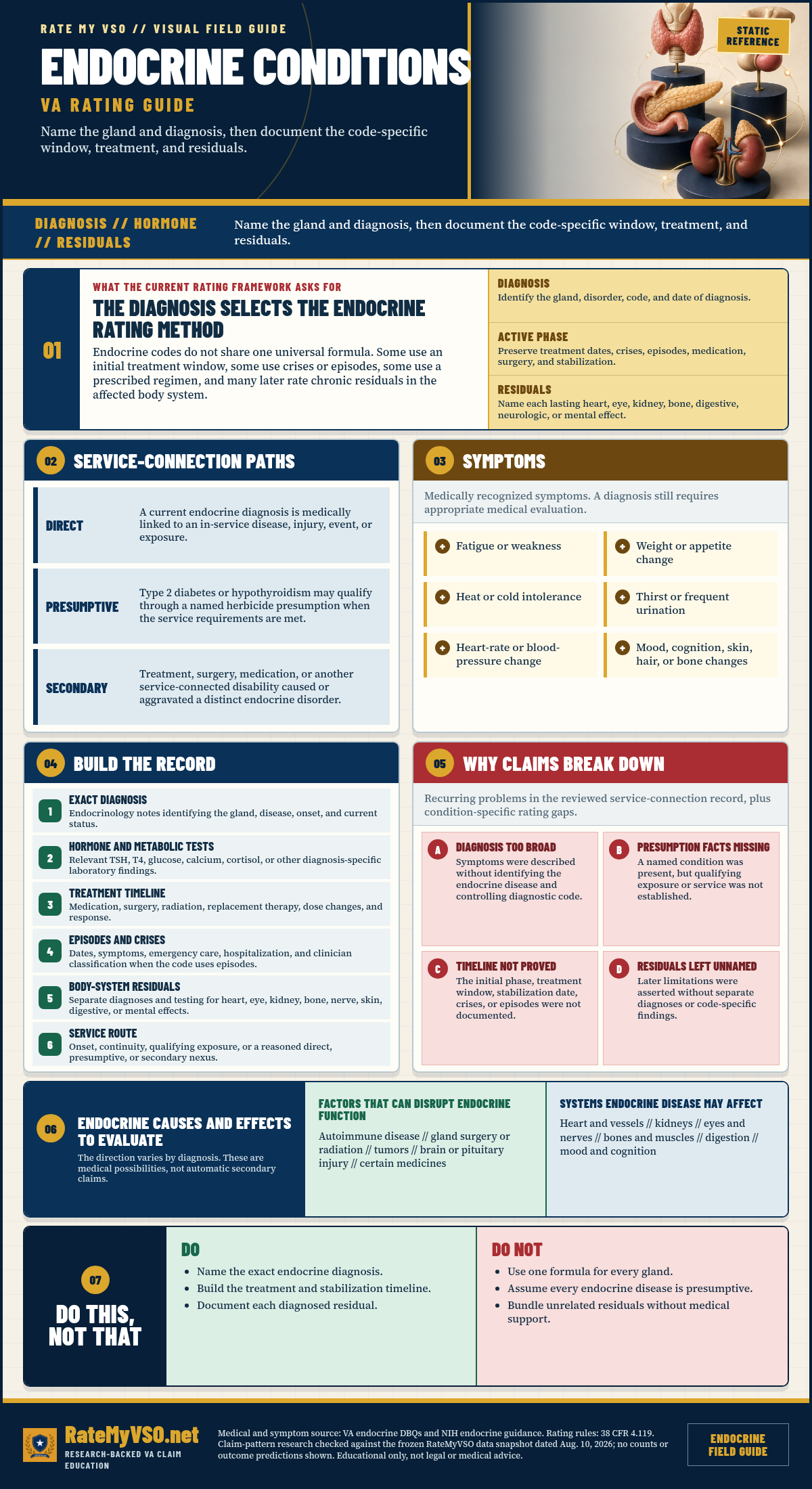 One-page guide: Endocrine Conditions Rating Guide in One Page
Endocrine-system guide covering diagnosis-specific rating methods, hormone testing, active phases, treatment, residuals, service-connection paths, symptoms, evidence, and common claim gaps. Opens the full-size chart, free to save or print.
One-page guide: Endocrine Conditions Rating Guide in One Page
Endocrine-system guide covering diagnosis-specific rating methods, hormone testing, active phases, treatment, residuals, service-connection paths, symptoms, evidence, and common claim gaps. Opens the full-size chart, free to save or print.
The Rules That Decide Every Endocrine Claim
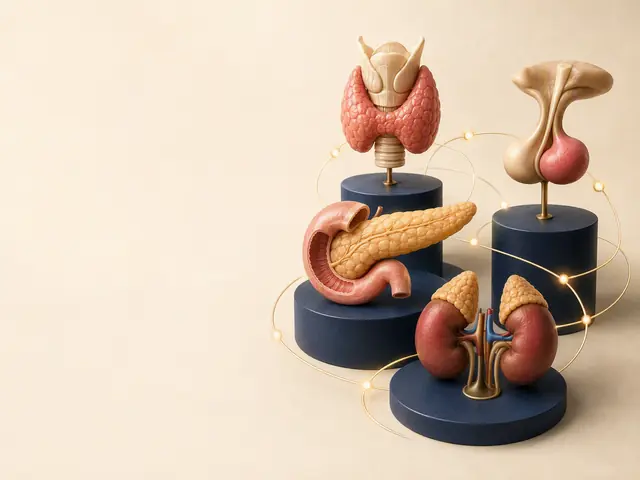
Endocrine conditions are the disorders of the glands that make hormones: the pancreas, the thyroid, the adrenal glands, the pituitary, and the parathyroids. They do not share a single rating measurement the way joints do, but they follow a common logic: the VA rates them on the symptoms you have and how intensively the condition must be treated to control it. A few rules matter more than the rest.
1. Diabetes (DC 7913) is a ladder of treatment intensity
Diabetes is rated by how hard it is to keep under control, not by a single lab number. The ladder climbs through the management the condition requires: a restricted diet at the bottom; oral medication or insulin in the middle; and at the higher levels, "regulation of activities" (avoidance of strenuous occupational and recreational activities, documented by a medical provider; limiting yourself does not meet the criterion) together with episodes of ketoacidosis or hypoglycemia that need hospital care and progressive complications. The more intensive the treatment your doctor documents, the higher the rung.
2. Compensable complications of diabetes are rated separately
This is the most-missed opportunity in the whole system, and it has one precise rule (DC 7913, Note (1)): compensable complications of diabetes, peripheral neuropathy (nerve damage in the hands and feet), diabetic retinopathy (eye disease), nephropathy (kidney disease), erectile dysfunction, or heart disease, are evaluated separately unless they are part of the criteria used to support the 100-percent diabetes level. Noncompensable complications are considered part of the diabetic process under DC 7913 rather than rated on their own. A veteran whose documented compensable complications were never claimed may be leaving those conditions unevaluated.
3. Thyroid conditions are rated on their own scales
Thyroid disease has its own codes and its own criteria. Hypothyroidism (an underactive thyroid, DC 7903) and hyperthyroidism (an overactive thyroid) are each rated on the symptoms you have and the treatment required to manage them, not on the diabetes ladder. The two directions of thyroid trouble are scored differently, so the specific diagnosis matters.
4. The other glands each have their own code
Beyond diabetes and the thyroid, the adrenal glands, the pituitary, and the parathyroids each have a dedicated diagnostic code. They are rated on the specific hormone problem and its effects on the body. Because these are less common, their exact criteria are best read on the individual code page for the condition.
Map the Gland Condition, Its Rating State, and Its Residuals
Endocrine ratings are really two questions: what does the gland condition itself pay while it is active, and where do its residuals get rated afterward. This map answers both:
| Endocrine family | Initial or active rating question | Later or residual question |
|---|---|---|
| Diabetes mellitus | Initial or active rating questionWhich treatment steps in DC 7913 are medically required, including insulin, restricted diet, regulation of activities, and qualifying episodes | Later or residual questionWhich complications are compensable and separate, and which noncompensable complications remain part of diabetes |
| Hyperthyroidism and Graves disease | Initial or active rating questionThe initial six-month period after diagnosis and the active manifestations | Later or residual questionHeart, eye, or other residuals under the appropriate body-system code when the schedule directs |
| Hypothyroidism | Initial or active rating questionMyxedema status and the applicable initial or stabilization period | Later or residual questionResiduals such as heart, eye, cognitive, or other effects under the appropriate system |
| Parathyroid disease | Initial or active rating questionThe diagnosis-specific calcium, bone, kidney, gastrointestinal, neuromuscular, and treatment findings named by the code | Later or residual questionDistinct residuals evaluated in the body system they affect |
| Pituitary disease and diabetes insipidus | Initial or active rating questionDiagnosis, required therapy, polyuria, and the condition-specific initial period | Later or residual questionPersistent manifestations and any distinct residuals after the initial period |
| Adrenal disease, Cushing syndrome, and Addison disease | Initial or active rating questionActive progressive disease, crises or episodes, therapy, and the exact code's initial period | Later or residual questionCardiovascular, musculoskeletal, metabolic, skin, mental, or other residuals when distinctly diagnosed |
| Polyglandular syndrome | Initial or active rating questionThe combined endocrine diagnosis | Later or residual questionEach affected gland and distinct residual, without rating the same manifestation twice |
| Endocrine neoplasm | Initial or active rating questionActive malignancy or treatment, or benign pressure and endocrine effects | Later or residual questionMandatory follow-up and residual evaluation after treatment |
Where the residuals land: neurological (neuropathy), genitourinary (kidneys, erectile dysfunction), and cardiovascular (heart). Condition detail: diabetes and hypothyroidism.
Endocrine Residuals Often Leave the Endocrine Schedule
A gland condition rarely stays in one body system. The residual is usually evaluated where it does the damage, which means the examination and the records have to come from that system too.
| Residual system | Examples the record may need to distinguish | Where to document it |
|---|---|---|
| Neurological | Examples the record may need to distinguishPeripheral neuropathy, weakness, cognitive or autonomic effects | Where to document itNeurologic examination, nerve testing when medically indicated, function and side |
| Eye | Examples the record may need to distinguishRetinopathy, Graves eye disease, visual impairment | Where to document itEye examination and condition-specific testing |
| Kidney and genitourinary | Examples the record may need to distinguishNephropathy, renal dysfunction, erectile dysfunction | Where to document itRenal labs over time, urology findings, the genitourinary examination |
| Cardiovascular | Examples the record may need to distinguishHeart manifestations, hypertension, vascular complications | Where to document itHeart or hypertension examination, METs or other code-specific testing |
| Musculoskeletal | Examples the record may need to distinguishBone loss, fracture residuals, weakness | Where to document itImaging, strength and functional examination |
| Digestive, skin, mental, dental, or reproductive | Examples the record may need to distinguishDistinct diagnosed residuals supported by the endocrine disease or its treatment | Where to document itThe applicable body-system examination and competent relationship evidence |
Endocrine Conditions Do Not Share One Presumptive Rule
Each route below attaches to particular diagnoses and particular service facts. None of them covers the endocrine system as a whole.
- Herbicide: type 2 diabetes and hypothyroidism are on VA's herbicide-presumptive list when the exposure and service requirements are met. That rule does not extend to every type of diabetes or every endocrine condition.
- After traumatic brain injury: certain hormone-deficiency diseases that result from hypothalamo-pituitary changes are held to be proximately due to a service-connected moderate or severe TBI when they appear within the regulation's time limit (see 38 CFR § 3.310(d)). Other endocrine conditions after TBI use the ordinary evidence rules.
- Direct: a current endocrine disability, an in-service disease, injury, exposure, or symptoms, and competent evidence connecting them.
- Secondary or aggravated: a current endocrine disability caused or aggravated by a service-connected disability or its treatment, with a reasoned medical link and, for aggravation, the applicable baseline analysis.
- Cancer or exposure-specific: use only the exact disease and service requirements in the applicable rule.
Find the Guide for Your Condition
The rules above apply across the board. For the exact rating table, the C&P exam, and the Board data for your specific condition, open the dedicated guide:
| Area | Guide | DC codes |
|---|---|---|
| Diabetes mellitus | Diabetes Claims Guide | 7913 |
| Hypothyroidism | Hypothyroidism Guide | 7903 |
For other endocrine conditions (adrenal, pituitary, parathyroid, hyperthyroidism) that do not yet have a dedicated guide, open the condition lookup page for the rating levels and Board data.
Every Endocrine Diagnostic Code, With Board Outcomes
Every diagnostic code in this body system, ordered by how often it reaches the Board of Veterans' Appeals. Percentages are the share of each code's Board issues granted, denied, or remanded (sent back for more development); dismissed and other outcomes are not shown, so rows do not sum to 100%. Each code links to its full page: rating criteria, evidence notes, and secondary-condition data.
| DC | Condition | Board appeals | Granted | Denied | Remanded |
|---|---|---|---|---|---|
| 7913 | Diabetes mellitus | 93,599 | 17.6% | 36.5% | 40% |
| 7903 | Hypothyroidism | 7,545 | 19.2% | 28.8% | 45.9% |
| 7914 | Neoplasm, malignant, any specified part of the endocrine system | 1,960 | 18.7% | 29.1% | 47.3% |
| 7901 | Thyroid enlargement, toxic | 1,682 | 13.1% | 45.7% | 34.1% |
| 7900 | Hyperthyroidism, including, but not limited to, Graves' disease | 962 | 14.7% | 42.8% | 36% |
| 7902 | Thyroid enlargement, nontoxic | 455 | 9.2% | 30.8% | 54.7% |
| 7904 | Hyperparathyroidism | 285 | 10.9% | 30.9% | 54% |
| 7906 | Thyroiditis | 257 | 21.8% | 26.1% | 47.1% |
| 7915 | Neoplasm, benign, any specified part of the endocrine system | 244 | 18.9% | 41% | 34.4% |
| 7911 | Addison's disease (adrenocortical insufficiency) | 193 | 15% | 39.9% | 42% |
| 7909 | Diabetes insipidus | 111 | 18% | 30.6% | 45.9% |
| 7912 | Polyglandular syndrome (multiple endocrine neoplasia, autoimmune polyglandular syndrome) | 47 | 14.9% | 27.7% | 53.2% |
Show 7 more codes with too few Board appeals to report (expand)
| DC | Condition | Board appeals | Granted | Denied | Remanded |
|---|---|---|---|---|---|
| 7905 | Hypoparathyroidism | Too few Board appeals to report | |||
| 7907 | Cushing's syndrome | Too few Board appeals to report | |||
| 7908 | Acromegaly | Too few Board appeals to report | |||
| 7916 | Hyperpituitarism (prolactin secreting pituitary dysfunction) | Too few Board appeals to report | |||
| 7917 | Hyperaldosteronism (benign or malignant) | Too few Board appeals to report | |||
| 7918 | Pheochromocytoma (benign or malignant) | Too few Board appeals to report | |||
| 7919 | C-cell hyperplasia of the thyroid | Too few Board appeals to report | |||
Counts from RateMyVSO's index of published BVA decisions, refreshed weekly. A remand is not a loss; it means the Board needed more evidence before deciding. Descriptive of the published record, not a prediction for any claim.
Common Secondary Conditions
For endocrine claims, the secondary conditions are not a side note, they are the center of the claim. Diabetes in particular drives a cascade of complications, and each COMPENSABLE one is evaluated separately unless it is part of the criteria supporting the 100-percent diabetes level (DC 7913, Note (1)); noncompensable complications stay part of the diabetes rating. The common ones to document:
- Peripheral neuropathy. Diabetes damages the nerves in the hands and feet, producing numbness, tingling, and pain. When compensable, it is evaluated under the nerve codes. See the neurological guide.
- Diabetic retinopathy. High blood sugar damages the blood vessels in the eyes over time, an eye condition evaluated under its own criteria when compensable.
- Kidney disease (nephropathy). Diabetes is a leading cause of kidney damage, evaluated under the genitourinary schedule when compensable. See the genitourinary guide.
- Erectile dysfunction. A very common vascular and nerve complication of diabetes; often noncompensable at 0 percent schedular (where it stays part of the diabetic process), but the SMC-K question is separate. See the genitourinary guide.
- Heart disease. Diabetes raises the risk of coronary artery disease and other heart conditions, evaluated under the cardiovascular schedule when compensable. See the cardiovascular guide.
Each documented, compensable complication can carry its own evaluation alongside the diabetes rating (DC 7913, Note (1)). For the full picture of how one condition opens the door to others, see secondary conditions. Note that type 2 diabetes and hypothyroidism are on VA's herbicide-presumptive list for veterans who meet the service and exposure requirements; the presumption covers those listed conditions, not all diabetes or thyroid disease. See the Agent Orange presumptive list and the PACT Act guide.
Records That Show What the Schedule Measures
An endocrine file has to cover the gland itself, the treatment it requires, and every system its residuals reach:
- Exact gland diagnosis: the specific endocrine condition, since each family uses its own criteria and its own initial period.
- Longitudinal laboratory and imaging record: A1c and glucose for diabetes, thyroid panels for thyroid disease, other hormone levels and imaging as the diagnosis requires, documented over time rather than once.
- Treatment actually required: restricted diet, oral medication, insulin, hormone replacement, or other therapy, plus any prescribed restriction such as regulation of activities.
- Crises, episodes, and dates: hospital care for ketoacidosis, hypoglycemia, or an adrenal crisis, along with treatment start and end dates where a code uses them.
- Functional impact: what the condition and its treatment change about daily activity, work, and self-care.
- A body-system inventory of residuals: a separately diagnosed record for neuropathy, retinopathy, kidney disease, erectile dysfunction, heart disease, or bone loss, documented in the system that evaluates it.
The matching DBQ prompts an examiner to capture the treatment regimen, any activity restriction, and the complications in the schedule's own terms.
Common Mistakes
- Leaving documented complications out of the record. This is the single biggest missed opportunity in endocrine claims. Compensable neuropathy, retinopathy, kidney disease, erectile dysfunction, or heart disease is evaluated separately unless it supports the 100-percent diabetes level, but only when the record documents it and it is claimed.
- Not documenting "regulation of activities." The higher diabetes levels require a doctor's direction to avoid strenuous activity. If your doctor has ordered it, make sure it is in the record; if it is not documented, it cannot be rated.
- Confusing diet-controlled with insulin-dependent. These sit on very different rungs of the diabetes ladder. Be precise about what your treatment actually requires.
- Overlooking that type 2 diabetes is an Agent Orange presumptive. Veterans with qualifying exposure may have a much simpler path to service connection than they realize.
Frequently Asked Questions
Does A1c determine the diabetes percentage?
Why can a thyroid or adrenal rating change after the first months?
How does the VA rate diabetes?
What is "regulation of activities"?
Are the complications of diabetes rated separately?
How are thyroid conditions rated?
Is diabetes an Agent Orange presumptive?
Related Tools and Guides
Sources: 38 CFR 4.119, the endocrine system. Educational only, not legal advice, and not a prediction of any individual claim. Rating criteria and case law change; confirm current details in 38 CFR Part 4. For help with your claim, find a VA-accredited representative.